
Askli is a no-code platform for building custom AI support chatbots from files, Notion, Google Drive, Zendesk and websites, then deploying them to a site widget, WhatsApp, Slack or Telegram with human handoff and a shared inbox.
Used this tool? Rate it
Used this tool? Rate it


AI assistant for writing, analysis and tasks


Build random generators, share them free


Real-time answers, images, and code in one chat


One workspace for every AI model


AI chat for dark fiction and research


AI assistant for structured work


Ad-free Chinese AI search with cited answers


The agentic customer platform for go-to-market teams
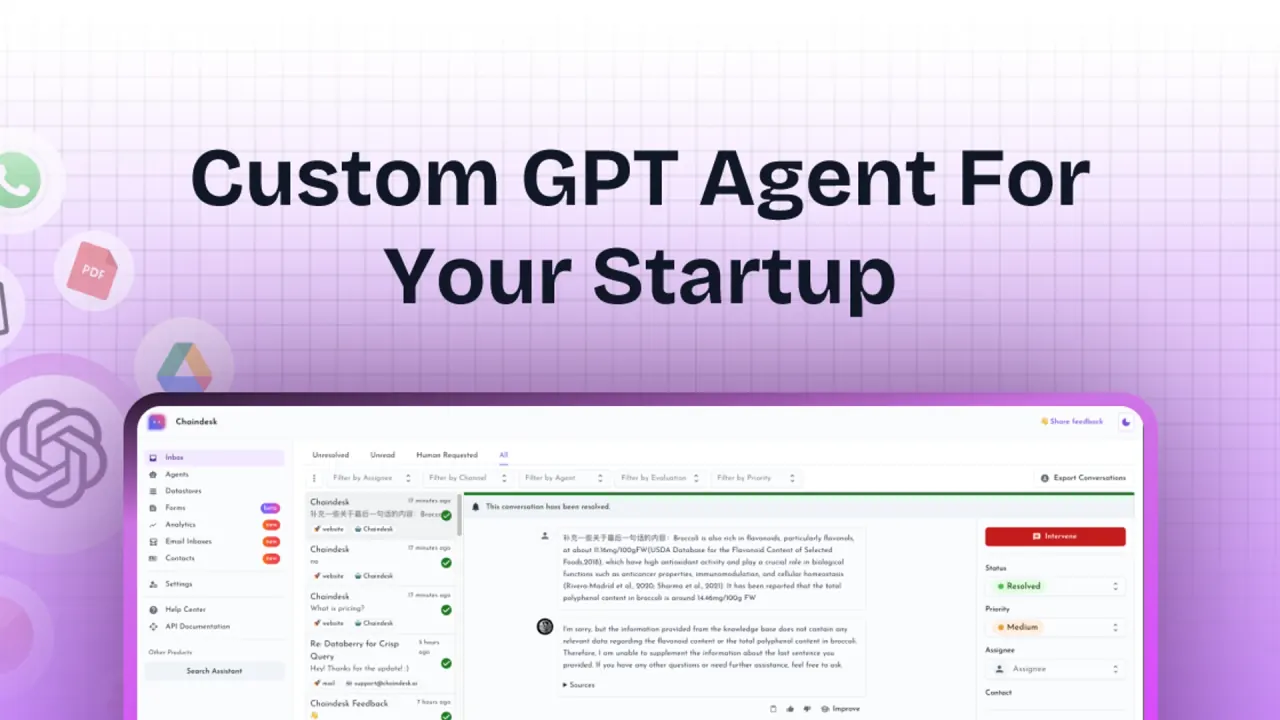
Askli is a no-code platform for building a custom AI chatbot on company data and deploying it for customer support and lead generation. The product was previously listed as Chaindesk; the chatbot, forms, shared inbox and email inbox now sit under the Askli brand.
The build flow has four stages. A team imports data, customises the agent persona and goals, deploys the bot to a website or messaging channel, and monitors conversations afterwards. Askli describes the result as an AI-native support ecosystem rather than a single widget, because the same agent can answer on a site, in WhatsApp, Slack or Telegram, and be taken over by a person when the conversation needs one.
The knowledge layer is organised as datastores. A datastore is a container for multiple datasources, and those sources can be files, Notion pages, Google Drive documents, a Zendesk help centre or any public URL. The platform says it retrains the bot automatically when the underlying data changes, which is the difference between a launch-day demo and a support tool that stays correct.
Askli says more than 14,000 businesses use the platform, a vendor figure that speaks to adoption rather than answer quality. The company is based in France and states that chatbot data is encrypted in transit and at rest on servers in the European Union. That placement matters for teams who need a European processor, but it does not make the product a substitute for a negotiated data processing agreement: Askli offers a standard DPA and says it cannot modify or sign additional ones.
Askli's feature set is shaped by support work: ingest the knowledge, answer within it, hand off when it cannot, and keep the conversation record in one place.
An agent is the configured assistant: persona, goals, model and connected knowledge. A datastore is the knowledge container, and a datastore tool connects it to an agent. Separating the two lets one team keep a product help centre, a returns policy and an internal FAQ in different stores, then decide which agent sees which.
The documented path is deliberately short: create an agent, create a datastore, connect the datastore to the agent, install the widget. No code is required for that path, and the platform also exposes low-code and API routes for teams that want to embed the same agent elsewhere.
Askli imports from files, Notion, Google Drive, a Zendesk help centre and public URLs. The integrations page adds YouTube, PowerPoint, Word, Excel and PDF as chat surfaces, so a team can put an existing document set behind the bot rather than rewriting it as FAQ entries.
Auto-sync is the feature that changes the maintenance burden. Starting with the first paid plan, Askli retrains the chatbot automatically, currently every week, and a team can also trigger a retraining manually or through a webhook. On the free plan, agents and datastores are deleted after 14 days of inactivity, which is a trial constraint rather than a production option.
The primary deployment is an embeddable widget on a website, installed with a script snippet and an agent ID. Askli also documents a standard widget and a bubble variant, plus native integrations for WhatsApp, Slack, Telegram, Crisp, Zendesk, WordPress, Shopify and Zapier.
The channel list matters because support does not start and end on a website. A Shopify store can put the same agent in front of pre-sale questions, a Slack workspace can use it for internal answers, and WhatsApp can carry post-purchase support. The knowledge base stays shared while the surface changes.
A shared inbox collects customer conversations in one place, lets a team assign them to members, and allows a person to take over from the bot at any point. When an agent writes instead of the bot, Askli's AI can still draft a suggested reply, which keeps the assistant useful after the handoff rather than switching it off entirely.
Askli also monitors conversations across all channels, so a supervisor can see where the bot failed rather than only where it answered. This is the part that separates a support product from a chat widget. A bot that cannot hand off creates a dead end; a queue that cannot see the bot's conversation creates duplicate work. Askli puts both in the same interface, and the platform also claims automatic ticket resolution when the user is satisfied with the answer.
Askli Forms builds conversational forms for ticketing and support intake. Fields can be typed as email, phone number, text, select or file upload, and each can be required or optional. The form can be hosted by Askli or embedded as a widget, so a team can collect structured information before a conversation starts.
The email inbox receives and sends mail from the same workspace. Emails work as redirections: a company address is forwarded to the Askli inbox, and replies go out from an alias. A custom sender address is a paid feature; on the free plan messages are sent from an on.askli.co address. Lead generation runs through the same conversation, collecting an email or phone number in a natural exchange rather than a separate form.
Function calling lets an agent call custom API endpoints when a question needs live data rather than a document. A team can connect an order lookup, a booking check or an internal service, and the model decides when to call it. The API uses a bearer key from the account settings, and private agents or datastores require that key in the Authorization header.
The API is the escape hatch for teams that do not want the hosted widget. It exposes the same agents and datastores to another application, which is useful when support lives inside a product rather than on a marketing site.
Askli says its agents stick to the knowledge base, with built-in safeguards against off-topic conversations and misleading answers. A knowledge restriction toggle goes further: the bot answers only questions that fall inside the supplied knowledge, and declines the rest instead of improvising.
The platform supports more than 120 languages, and a site can be in any language rather than English only. A visitor can ask in one language and receive an answer in another, which is the practical requirement for a small support team covering several markets.
The fastest path to a useful Askli bot is not to import everything. It is to pick one support queue, give the bot the documents that queue actually uses, and measure whether the handoff rate falls.
Start with a single datastore built from the help centre and the handful of policy documents that generate repeat questions. Create an agent, connect the datastore, set the persona and the scope, then install the widget on a staging page. Test with real questions from the last month before the bot faces customers; the failures usually point to a missing document rather than a model problem.
Decide early what the bot must not handle: refunds above a threshold, account security, legal complaints, or anything that needs an order system the bot cannot read. Write those into the agent instructions and route them to the shared inbox. A clear handoff rule is more valuable than a longer knowledge base, because it prevents the worst support outcome: a confident wrong answer.
Auto-sync covers sources that expose changes, but it does not fix a document that was wrong when it was imported. Assign an owner for each datastore, review the source pages on the same cadence as the product release notes, and use the manual retrain when a policy changes between scheduled syncs. On the free plan, remember that inactivity deletes the agent and datastore after 14 days.
Askli's own marketing claims the bot resolves 80% of support queries, which is a vendor figure rather than an independent benchmark. Treat it as a target to test, not a guarantee. A better internal measure is the share of conversations that end without a handoff, split by topic, plus the number of handoffs that were caused by a missing document.
Askli fits small and mid-sized support teams that have a body of written knowledge and want to answer common questions without adding headcount.
It is a weaker fit for:
Askli is a hosted web application with embeddable widgets and native chat integrations.
| Surface | What is available |
|---|---|
| Web app | Agent builder, datastores, forms, shared inbox and email inbox |
| Website widget | Bubble and standard embeds installed with an agent ID |
| Messaging | WhatsApp, Slack, Telegram and Crisp |
| Commerce and helpdesk | Shopify, WordPress, Zendesk and Zapier |
| Data sources | Files, Notion, Google Drive, Zendesk help centre, public URLs, YouTube, Office documents and PDFs |
| API | Bearer-key API for private agents and datastores |
| Languages | More than 120 languages for questions and answers |
| Hosting | Data encrypted in transit and at rest, stored in France |
The web app is the control plane; the widget and integrations are delivery surfaces. A team can run the same agent on a site and in WhatsApp without rebuilding the knowledge, and the shared inbox sees both conversations.
Askli prices by message credits and caps the number of agents, datastores, stored words, crawled pages and team seats on each tier. All prices below are monthly, and yearly billing saves 20%.
Askli's own comparison with Chatbase argues on shared inbox, human handoff, knowledge restriction and multilingual support rather than on model quality. Those are product-surface differences a buyer can verify in a trial; the comparison itself is vendor-authored.
| Plan | Price | Credits / month | Agents | Datastores | Team seats |
|---|---|---|---|---|---|
| Free | $0 | 200 | 1 | 1 | 0 |
| Growth | $49 | 20,000 | 2 | 2 | 10 |
| Pro | $99 | 40,000 | 5 | 5 | 25 |
| Enterprise | $499 | 400,000 | 100 | 100 | 200 |
Credits are measured with gpt-4o-mini, so a heavier model or a longer answer consumes the allowance faster. The free tier includes 20,000 words of storage and a website loader limited to 25 pages; Growth raises that to 30 million words and 250 pages, Pro to 60 million words and 1,000 pages, and Enterprise to 300 million words and 10,000 pages.
Every tier lists auto-sync, GPT-4 access and branding removal, while dedicated support starts at Growth. A plan can be changed at any time from account settings, and the yearly switch applies the 20% saving to the same tiers. Enterprise is the only tier that approaches high-volume support, and a team that needs more than 400,000 credits or a custom integration is directed to sales for a custom plan.
The constraints that matter are about volume, maintenance and the boundary of a hosted product.
Yes. The site still uses the chaindesk.ai domain, but the product, pricing and documentation are branded Askli.
No. The documented path is create an agent, create a datastore, connect the two and install a widget. Low-code and API routes exist for teams that want them.
Files, Notion, Google Drive, a Zendesk help centre and public URLs, plus YouTube, PowerPoint, Word, Excel and PDF through the integrations.
Yes. A shared inbox collects conversations, members can be assigned, and a person can take over at any point while the AI continues to draft replies.
Four monthly tiers from $0 to $499, metered in message credits and capped by agents, datastores, storage, pages and seats. Yearly billing saves 20%.
Askli stores chatbot data in France and encrypts it in transit and at rest. Foundation model providers are a separate choice, with zero-data-retention providers available to opt in or out.
Yes. Askli supports more than 120 languages, and a visitor can ask in one language and receive an answer in another.