Three Toolso.AI directory snapshots explain free pricing labels, trial definitions and overlapping categories, with dates and limits.
Q4 2026 interim report · Directory observations through November 11; selected vendor fields checked again November 12 (UTC)
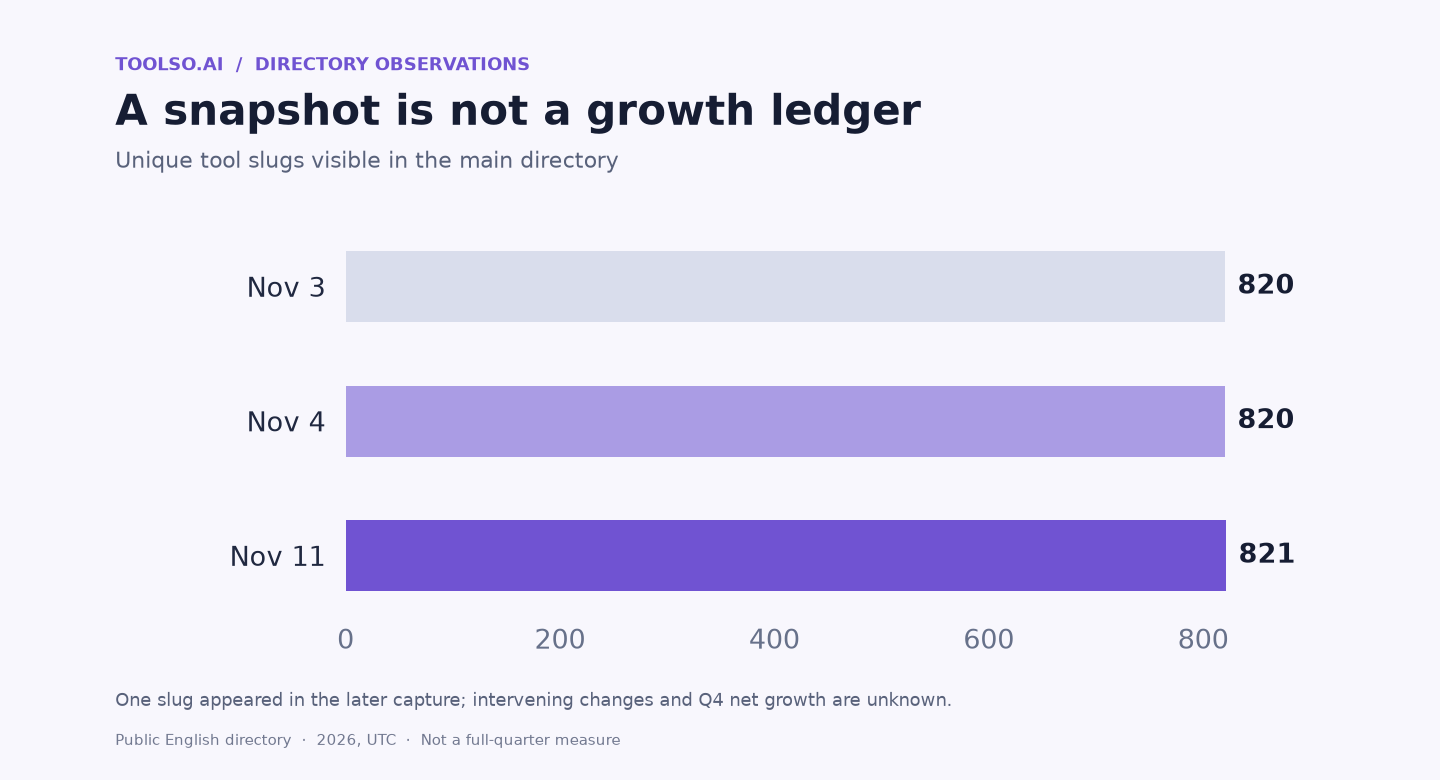
This AI tool pricing report compares three observations of Toolso.AI’s public English directory. On November 11, it showed 821 unique tool slugs, compared with 820 on both November 3 and 4. The later capture included roiva; all November 4 slugs remained visible. This describes observed sets, not a verified product launch date, the full quarter’s growth, or everything that happened between captures.
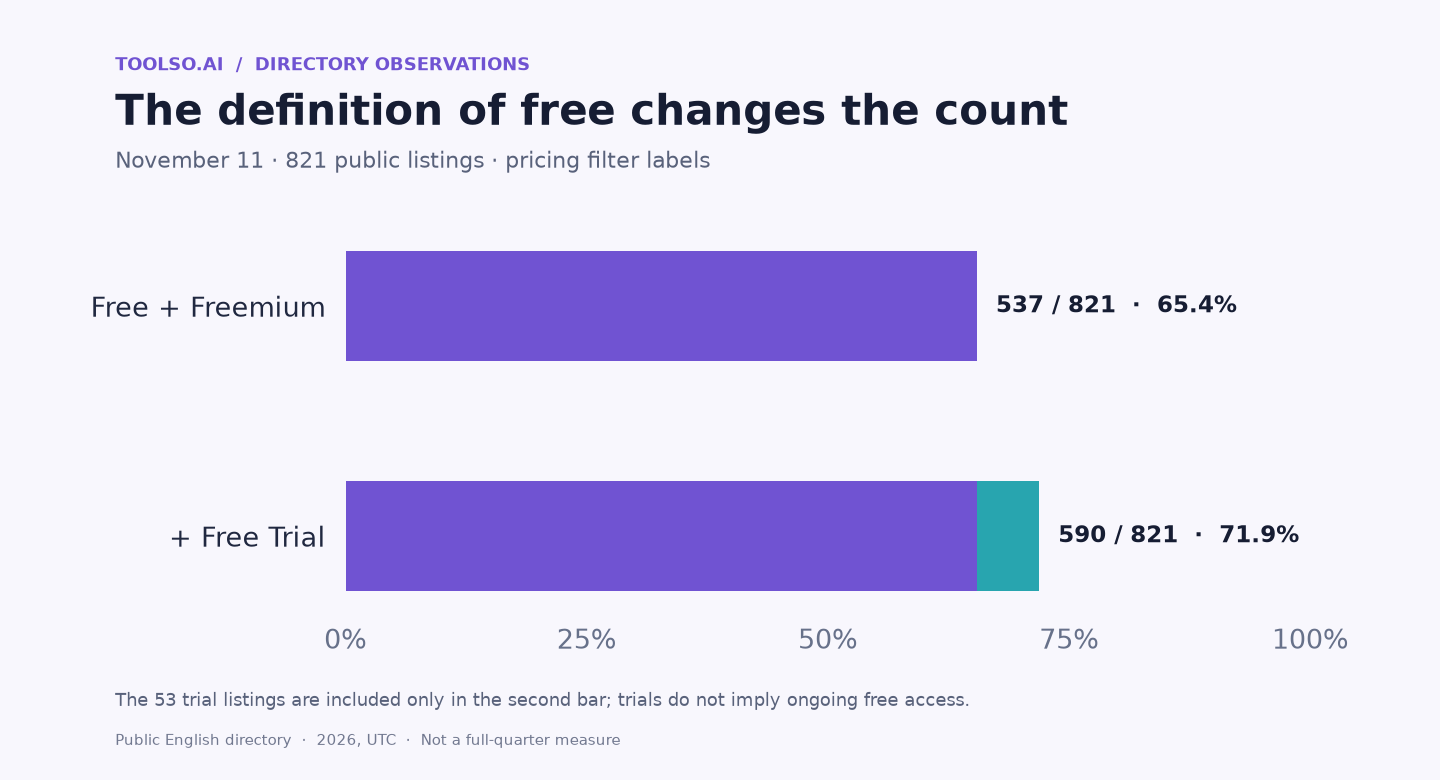
The November 11 pricing filters contained 100 Free, 437 Freemium, 231 Paid, and 53 Free Trial listings. Their non-overlapping union matched the 821 visible slugs; card labels on the filter-result pages agreed with their filters. Free plus Freemium accounted for 537/821 (65.4%); including Free Trial increased the figure to 590/821 (71.9%). A trial does not establish ongoing free access. These are directory labels, not independently verified current vendor prices.
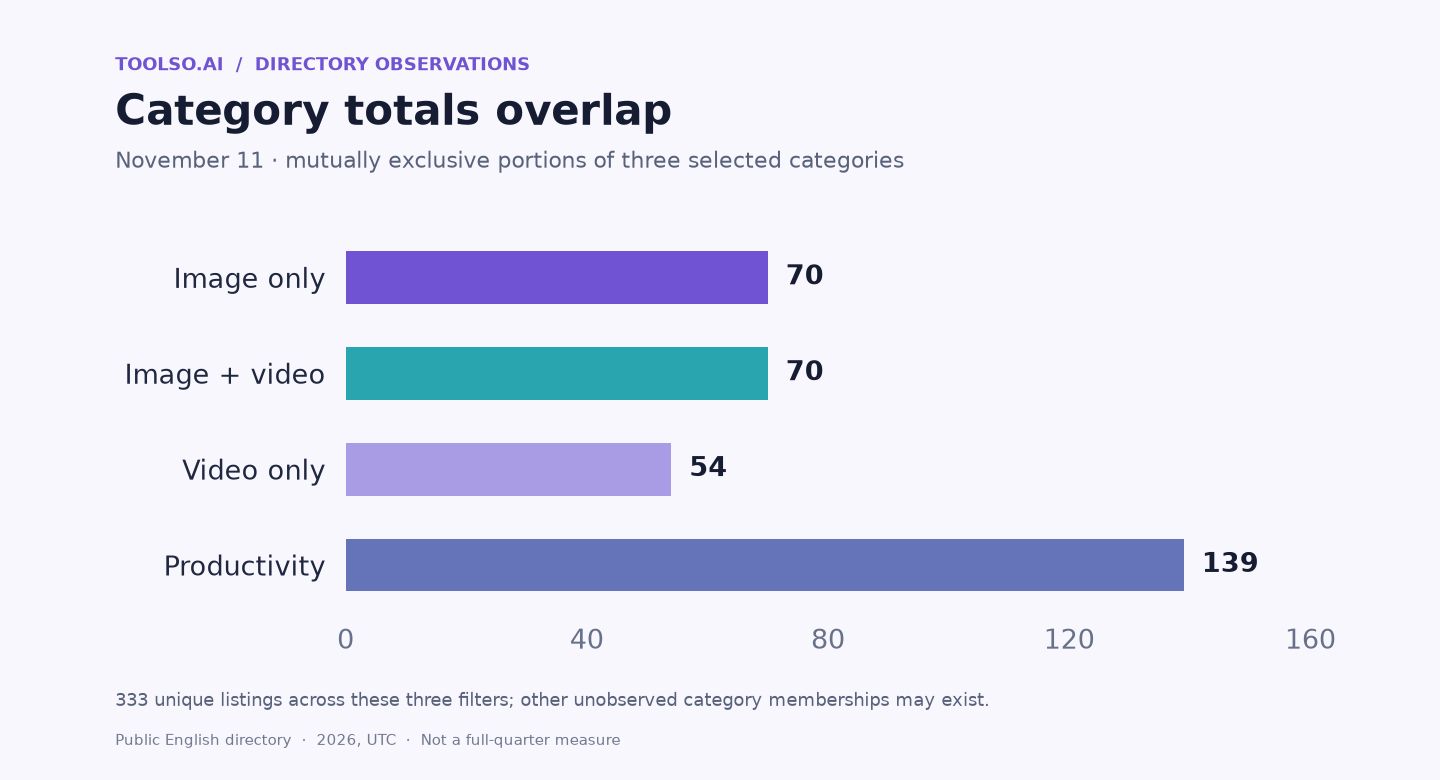
The three selected category filters showed 140 Image Generation, 139 Productivity, and 124 Video Generation listings. Seventy appeared in both generation filters; the three-filter union was 333. Their observed slug memberships matched November 4. These are supply categories, not measures of demand.
The directory sidebar displayed 99 Free and 229 Paid, two fewer Paid and one fewer Free than the respective filter results; Image Generation and Productivity sidebar figures were also lower by two and one. The cause is Unknown. Pages were collected sequentially over several minutes, not atomically. The analysis below preserves the November 3–4 baseline and its original numbers; the later capture does not retroactively update them.
Toolso.AI showed the same 820 tool listings in two consecutive snapshots. The catalog looked steady by headcount, yet a closer look changed what we could say about access. Two listings displayed “Free” on their cards while appearing in the Freemium filter on November 3. By November 4, both cards showed “Freemium” and the filter memberships were unchanged.
That small discrepancy points to a practical question for anyone comparing or launching AI tools. Which part of the listing supports the claim you want to make? A catalog count, a pricing badge, and a vendor's billing terms each answer a different question. We run Toolso.AI and used the public directory to make those boundaries visible. This report compares three Q4 snapshots and separates directory labels from provider terms.
| Question | What the November 3–4 snapshots support |
|---|---|
| How much did the matched catalog change? | All 820 listing slugs appeared in both observations. |
| Did the pricing displays agree? | Two card labels conflicted with their filters on November 3. The November 4 snapshot showed zero conflicts. |
| How much does including trials change the count? | On November 4, 536 listings qualified under Free or Freemium. Adding Free Trial brought the total to 589. |
| How much overlap was there between image and video? | 70 listings appeared in both selected generation filters. |
| What was the net change for the quarter? | Unknown. A comparable quarter-opening baseline is still needed. |
We compared the public English Toolso.AI directory behind our November 3 pricing report with a November 4 repeat collection. The November 3 main directory was captured from 15:10:47 to 15:12:56 UTC; the November 4 collection covered 90 pages from 11:59:39 to 12:02:31 UTC. On November 11, we separately collected 35 directory pages, 37 pricing-filter pages and 18 category-filter pages. Pages were read sequentially, not as an atomic snapshot; the live directory can change after collection.
We identified each listing by the slug in its tool detail URL. A listing that appeared in multiple filters counted once in the inventory. We used the main directory to establish the set of listings, compared visible pricing badges against the separately collected pricing filters, and checked that each slug belonged to exactly one of those filters. We compared category memberships independently because a tool can belong to more than one category. Different localized URLs for the same slug did not add to the listing count.
The historical sampling records are retained in Toolso's internal research files. The live directory can change, so its current pages alone cannot reconstruct those earlier observations.
For the access comparison, a listing counted toward Free or Freemium when its card and pricing-filter membership agreed on that label. The trial-inclusive calculation added listings in the Free Trial group separately. The report's data version was fixed on November 23 for editorial review; that date does not extend the historical observation window. Any full-quarter counts or changes in vendor terms remain Unknown under this method.
| UTC observation date | Unique slugs | Consistent Free + Freemium | Including Free Trial |
|---|---|---|---|
| 2026-11-03 | 820 | 534/820 (65.1%) | 587/820 (71.6%) |
| 2026-11-04 | 820 | 536/820 (65.4%) | 589/820 (71.8%) |
| 2026-11-11 | 821 | 537/821 (65.4%) | 590/821 (71.9%) |
The November 3 and 4 main directory captures each contained 820 unique slugs. Comparing the actual keys showed zero entries appearing only in the second capture and zero appearing only in the first. Comparing totals alone would miss a scenario in which an addition and a removal happened to offset each other. Matching the keys rules out that particular explanation for the difference between these observed states.
A slug can remain visible while its content changes. A rename could also appear as one departure and one arrival, so verified redirects and merges need separate records.
For a growth update, record whether a listing exists and what it shows at a specific time. Catalog growth also needs comparable starting and ending sets and a way to handle renamed records.
The Toolso.AI records shared 820 slugs between the November 4 and November 11 collections. Every one of those matched slugs remained in the same pricing filter. The later capture added roiva in Freemium, taking that group from 436 to 437. Free, Paid and Free Trial counts were unchanged at 100, 231 and 53 respectively.
This separates a change in the observed set from a change in the categories assigned to the matched listings. Looking only at the higher Freemium total would leave both explanations open. Comparing the actual slug memberships identifies which explanation the saved directory observations support.
The result describes the two captured states. We did not continuously monitor vendor terms or directory edits between them, so the comparison cannot establish that offers stayed unchanged throughout the period. Quarter-wide additions and vendor price changes remain Unknown.
On November 3, the cards for Free AI Image Upscaler and Free AI Face Swap Online showed Free. Both slugs were in the Freemium filter. In the November 4 capture, both cards showed Freemium and both slugs were still in the same filter. Those were the only mismatches in the baseline, so the number of disagreements went from two to zero.
The filters collected separately from the cards contained the same members on both dates. They showed 100 Free, 436 Freemium, 231 Paid, and 53 Free Trial listings. As the cards came into agreement with the filters, the number qualifying under our conservative Free or Freemium rule moved from 534 of 820 (65.1%) to 536 of 820 (65.4%). The difference arose at the directory display and classification layer. The reason the labels changed and any corresponding changes in vendor terms are Unknown.
A reproducible report should keep a record of the two signals when they disagree. Readers can see how a conflict affects a count and how much of the sample it touches. Makers can apply the same check to their own listings by comparing what a visitor sees in a card, on the detail page, and on the official pricing page.
Using the November 4 Toolso.AI snapshot, Free and Freemium together covered 536 of 820 listings (65.4%). Adding the 53 listings labeled Free Trial gives 589 of 820 (71.8%). The gap is 6.5 percentage points when calculated as 53 divided by 820 before rounding the two headline percentages.
The comparison matters because a trial and an ongoing free plan can support different decisions. A person checking whether a workflow is worth exploring may want to know whether they can try it. A team planning repeated use needs to know what happens when the trial ends or the introductory credits run out. Both people can start from a directory filter. The next step is checking the vendor terms that apply to the specific workflow and account.
A targeted, non-random check of eight providers on November 3 and 11 illustrates the distinction. Songcove offered a free 60-second preview before a one-time purchase. Typist listed 60 free transcription minutes; a later November 11 FAQ check specified 15 minutes without an account and 60 in total on sign-up, without clearly establishing recurring renewal. Selected fields for these and three other providers matched at the two initial observations; that does not establish what happened in between or verify the rest of the catalog. Missing terms remain Unknown.
In a separate November 12 UTC check, the same Songcove preview and Typist account conditions were visible again. This was a new observation, not a replacement for the missing full-page captures from November 11. The comparison is limited to the specified visible fields; access and charges were not tested.
Toolso.AI's three selected filters contained 140 Image Generation listings, 139 Productivity listings, and 124 Video Generation listings. Membership in each group was unchanged between the November 3 and November 4 snapshots. The Image and Video groups shared 70 slugs. Productivity had no overlap with either of those two groups in the selected comparison. Counting each group separately gives 403 memberships, which correspond to 333 unique listings.
About 56.5% of the Video Generation group also appeared in Image Generation. A maker can describe a workflow that starts with an image and ends with a video. A reader comparing both filters can deduplicate by slug.
Category membership describes where listings appeared in this directory. Judging audience demand would require separate evidence, such as visits to category pages or search queries, with a documented window and clear denominators. A directory can offer many options in a category without telling us how often readers use those options.
Write your listing around a task someone can recognize, then describe access in terms of what they can do. For a tool with free credits, specify whether the credits recur and what outputs they buy. For a time-limited trial, give the duration and the step that starts paid billing if your official terms describe one. For a product that serves two categories, describe a real workflow that justifies each category. A pricing page link and a “checked on” date give readers a path to verify the details.
Keep a dated launch record for every channel. Save the listing URL, the version of the description, the badge displayed to visitors, and the last day you checked the official terms. When you see a difference, record the old and new values and where they appeared. This gives the team enough information to distinguish a directory correction from a change in the product offer. The AI Tool Launch Checklist gives makers a place to fit those checks into a wider launch schedule.
Channel outcomes deserve their own record. A live listing, a referred visit, and a completed action have different evidence requirements. Record the public listing when you can open it, then use your own measurement to establish what happened after a visitor arrived. Where attribution is missing, keep the outcome Unknown so that later comparisons use the same standard.
This is a first-party comparison of the Toolso.AI directory. The main matched comparison describes November 3 and 4; the update adds November 11. A tool could have appeared and disappeared between observations. The sample covers public English-directory listings, with no separate count for translations. Broader market estimates need a sampling frame across directories or providers.
Quarter-to-date additions, removals, and net growth remain Unknown. We do not have a complete comparable quarter-opening set. Likewise, a full comparison of vendor pricing would require dated official terms for the same providers at both points. Traffic, user preferences, submissions, and revenue were outside the public snapshot.
When a later edition uses more evidence, the cutoff, slug count, and definitions should appear beside the figures. If a label changes definition, show the original calculation and document how the comparison was rebuilt. Readers can then tell which differences come from the catalog and which come from changes to the measurement.
We operate Toolso.AI. This first-party report and its language versions were prepared with AI assistance and checked against the retained observations. The draft does not establish independent industry coverage or hands-on testing of the listed products.
The public English directory contained 820 unique listing slugs on both November 3 and 4, and 821 on November 11. Each listing counts once per slug.
The 65.4% figure uses 536 Free or Freemium listings with matching card and filter labels on November 4. Including Free Trial brings the count to 589, or 71.8% of the same 820 listings.
Yes. In the selected filters, 70 listings appeared in both Image Generation and Video Generation. The category totals therefore count more memberships than unique listings.
Selected fields for five providers matched on November 3 and 11. The check does not establish what happened between observations, cover every plan, or represent the rest of the catalog. Broader vendor price changes remain Unknown.
ProductLed describes a free trial as time-limited access to part or all of a product, while freemium provides ongoing access to part of it. A label alone does not establish renewal, export rights or the terms of a particular task; check the vendor's current conditions.
A trial may be free during its stated period, but some offers involve fees or convert to paid subscriptions unless canceled. The FTC recommends checking the trial length, any fees, and how and when to cancel before signing up.
ProductLed describes freemium as continued access to part of a product without payment, with paid upgrades available for additional functionality or usage. Check the provider's own limits and terms; a directory label alone does not establish them.
Sources:

Dated Toolso directory snapshots separate pricing labels, free trials and verified billing facts across the same 820 listings.


OpenAI's Agents API makes durable cloud agents easier to build. Here is what changed, what remains unproven, and how to deploy it with control.

How AI reshaped creative work: 86% adoption, design jobs down 17%, the music settlements that set the template, and what courts still haven't settled.

The 2026 data: 88% of students use generative AI, teachers save 5.9 hours weekly — yet only 13% of schools have a formal AI policy. What to do.

The 2026 landscape: the Digital Omnibus deferring high-risk deadlines to 2027, two new EU prohibitions, GPAI supervision, and the US patchwork.
AI in financial services: 90% running AI fraud defenses, 70–80% of US trades executed algorithmically, 52% piloting agentic AI, and the deepfake race.

Expert forecasts for AI by 2030 — AGI timelines, labour-market impact, technological breakthroughs, and the scenarios researchers actually disagree on.

AI in medicine by the numbers: 1,451 FDA-cleared devices, 75% health-system adoption — and the finding that 43% lack clinical validation data.
