A dated Toolso directory snapshot separates pricing labels, free trials and verified billing facts, with three charts and clear Unknowns.
An AI tool pricing label is a starting point for comparison. It does not, by itself, establish a vendor's billing terms. In Toolso's directory observations dated 2026-11-03 UTC, 434 of 820 listings had a consistent Freemium label. Only 5 listings had a vendor primary classification supported by our scoped official-page checks; the other 815 remain Unknown.
This report explains what that gap means, shows the calculations and offers a practical way to describe pricing more clearly. We operate Toolso.AI, the directory being examined. This is a study of our own directory observations, not an independent industry survey, a price ranking or a test of the listed products.
| Question | Answer within this snapshot |
|---|---|
| What was collected? | 820 unique listing slugs across 35 public directory pages |
| Largest provisional directory group? | Freemium: 434/820, or 52.9% |
| Provisional directory Unknown? | 286/820, or 34.9% |
| Free/Freemium labels, excluding trials? | 534/820, or 65.1% |
| Same measure with Free Trial added? | 587/820, or 71.6%; a 6.5 percentage-point difference |
| Vendor primary classification still Unknown? | 815/820, or 99.4% |
The two Unknown counts refer to separate fields. They overlap and must not be added. None of these percentages measures market share, willingness to pay, profitability or conversion.
We collected the public directory sequentially on 2026-11-03 UTC and deduplicated records by detail-page slug. We then checked membership in the Free, Freemium, Paid and Free Trial filters and collected the complete visible membership of the image-generation, productivity and video-generation categories. The filters covered the same 820 listing slugs; this is not a raw production database export or an atomic snapshot.
We retained the main-card label and the independent filter value separately. Where those observations conflicted, we recorded both and assigned provisional Unknown. We did not change the live listing to make the analysis agree.
The official-page check covered 8 deliberately selected vendors. It was not random sampling. We recorded the product scope and missing evidence rather than treating a homepage, an API and an enterprise sales form as interchangeable. We did not register, purchase or test delivery for this pricing study.
All percentages use the full denominator of the relevant group, including Unknown, and are rounded to one decimal place after calculation. Percentage-point differences use unrounded values. The report's tables and charts share this dated input; they are not independent confirmations of one another.
Provisional directory classification is a conservative interpretation of directory labels. Consistent Free and Freemium observations retain those names. Paid does not establish a billing cycle; Free Trial does not establish ongoing free access. Both therefore remain Unknown for this provisional classification, as do conflicting observations. Unknown is not a negative quality rating or evidence that a product has no pricing page.
Verified vendor primary classification is a separate field supported by the scoped official-page check. Our vocabulary includes Free, Freemium, Subscription, Usage-based, One-time, Contact sales and Unknown. A field stays Unknown when the evidence or product scope is insufficient. We do not populate the vendor field from the directory label.
For this version, an explicit ongoing Free plan alongside paid tiers takes the Freemium primary label. A target offer with clear recurring charges but an unresolved free-access duration can take Subscription, with the unresolved point retained. A single song purchase takes One-time. These are documented selection rules for the checked scope, not a universal taxonomy of all offers.
Free access and billing mechanism should also be described separately. A product can offer a free tier and sell subscriptions. A usage allowance can belong to a subscription; the presence of credits alone does not prove usage-based purchasing. Likewise, a sales contact route does not establish the actual quote or billing structure.
Toolso's fixed directory sample contains Free 100/820 (12.2%), Freemium 434/820 (52.9%) and Unknown 286/820 (34.9%). Freemium is the largest of these provisional groups. It would be misleading to rewrite this as a finding that most AI vendors have a verified Freemium business model.
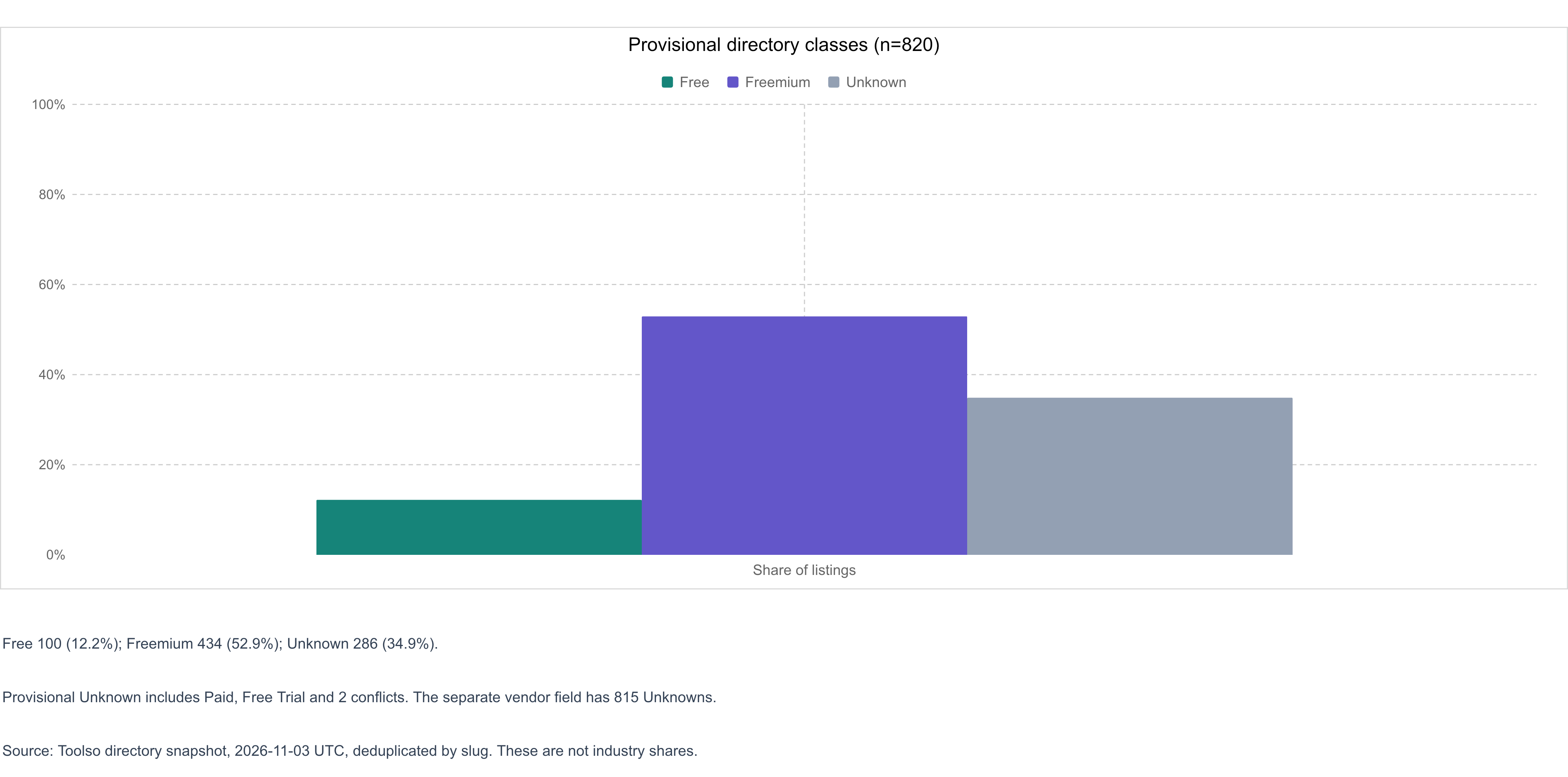
Figure: Toolso directory observations, 2026-11-03 UTC. The Unknown bar remains in the denominator; vendor verification is a different measure.
The 286 provisional Unknowns consist of 231 Paid labels, 53 Free Trial labels and 2 label conflicts. The conflicted slugs are image-upscaling and aifaceswap: their main cards showed Free while independent filter membership showed freemium.
Those two conflicts explain why the raw freemium filter contains 436 listings while the consistent provisional Freemium group contains 434.
| Category | Listings | Free | Freemium | Unknown | Free/Freemium share |
|---|---|---|---|---|---|
| Image generation | 140 | 14 | 80 | 46 | 94/140 = 67.1% |
| Productivity | 139 | 15 | 77 | 47 | 92/139 = 66.2% |
| Video generation | 124 | 14 | 70 | 40 | 84/124 = 67.7% |
In Toolso's three collected category sets, the free-entry label share ranges from 66.2% to 67.7%, a maximum gap of about 1.6 percentage points. This is a descriptive comparison; we did not establish statistical significance or a reason for the difference.
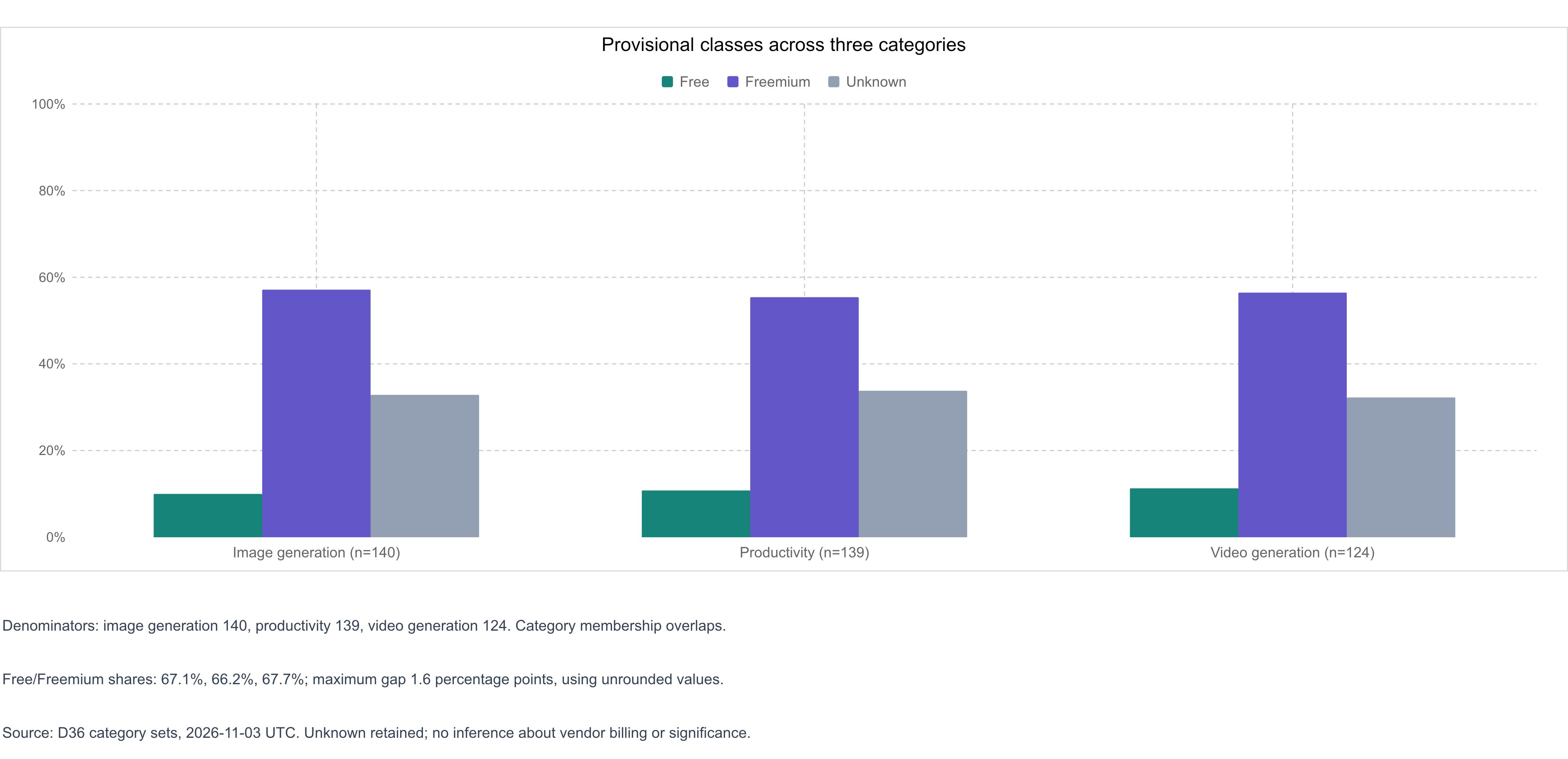
The categories overlap: their 403 memberships represent 333 distinct listings. Do not sum their counts as separate vendors or assume the comparison covers every directory category.
According to the same Toolso snapshot, 534/820 listings (65.1%) have consistent Free/Freemium labels. Adding the 53 Free Trial labels changes the result to 587/820 (71.6%), an increase of 6.5 percentage points. The 2 label conflicts are excluded from both numerators, while all 820 listings remain in the denominator.
| Group | Excluding trials | Including trials, for comparison |
|---|---|---|
| All listings | 534/820 = 65.1% | 587/820 = 71.6% |
| Image generation | 94/140 = 67.1% | 102/140 = 72.9% |
| Productivity | 92/139 = 66.2% | 100/139 = 71.9% |
| Video generation | 84/124 = 67.7% | 92/124 = 74.2% |
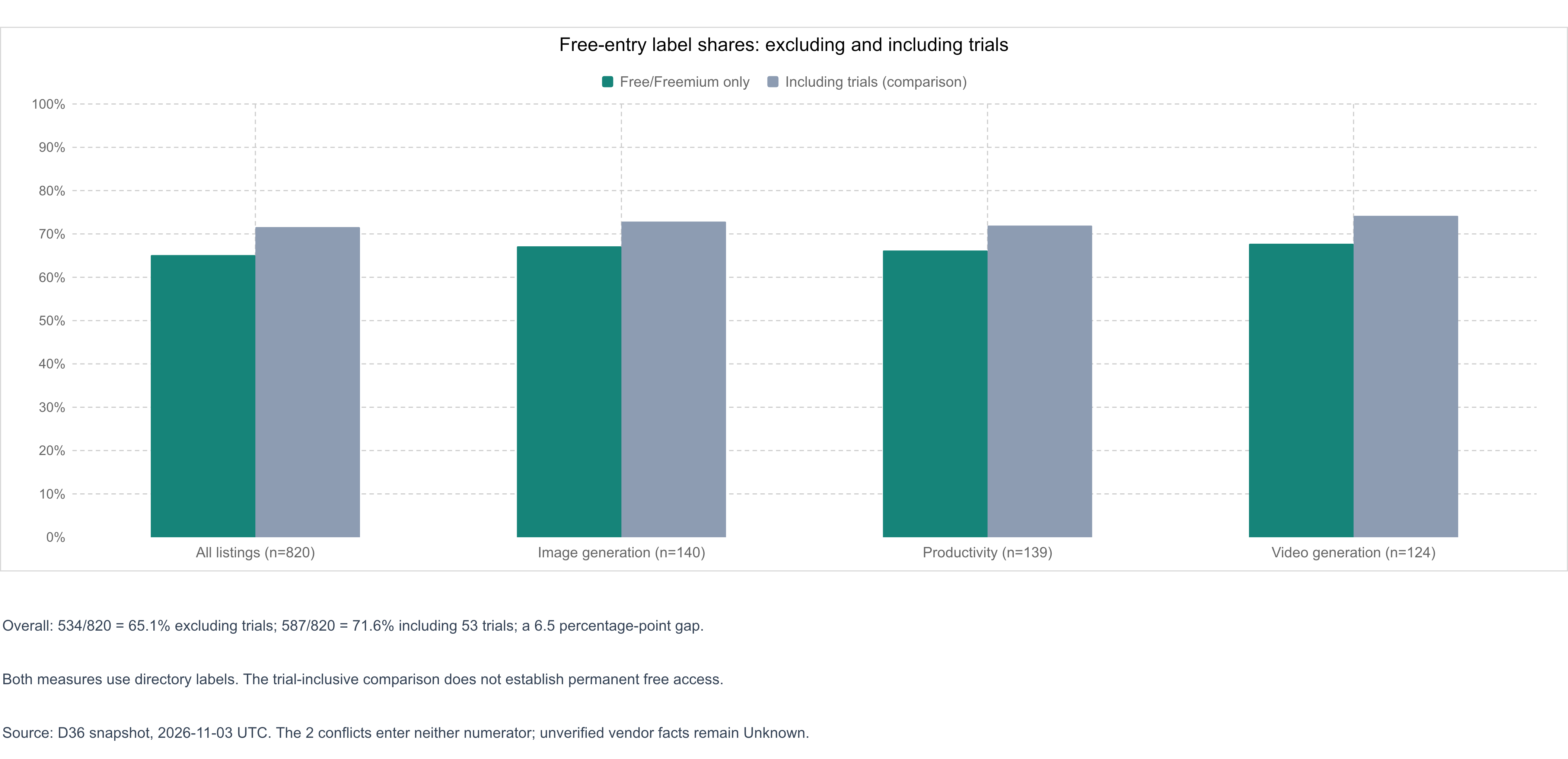
This is a definition check, not a reclassification. It does not mean 587 products are permanently free, nor that their free features were tested. A claim such as “free AI tools” needs to explain whether trials, previews and limited recurring tiers are included.
Of the 8 scoped official-page checks, 5 support a primary classification: Freemium 3, Subscription 1 and One-time 1. The vendor field remains Unknown for 815/820 records (99.4%), including unexamined listings and cases with insufficient or mismatched scope. This coverage cannot support a population-wide billing distribution.
Typist is the Subscription example: recurring paid terms were explicit, while replenishment of its free allowance was unresolved. Its classification retains that limitation rather than guessing that the allowance recurs.
The recorded Gamma, ElevenLabs and Synthesia pages show free access alongside subscription offerings within the checked product scope. These are examples of coexistence, not a random sample from which to estimate prevalence. No current price amount or promotion is compared here.
The scope matters elsewhere too. DeepSeek's API pricing supports a usage-based API observation, not a verified primary classification for the whole directory entry. Harvey's sales page confirms a contact route, not a billing mechanism. Songcove distinguishes a free preview from a paid complete song. These statements refer to the official material archived for the snapshot date, not a purchase or entitlement test.
For a maker preparing a listing, the useful response is to make the offer easy to verify. Link to the specific product's official pricing page. Explain whether free access recurs, expires or only previews the result. State the billing interval separately from any usage allowance, and distinguish an annual average from an offer payable monthly.
If the website and API have different plans, name each scope. If access requires a sales conversation, say what is actually public rather than implying a known price. An Unknown field is preferable to a confident label that joins unrelated offers.
These are editorial recommendations from the ambiguities in this sample. We have not measured whether adopting them improves traffic, trust, conversion or revenue. Our tool evaluation guide explains the wider evidence-review process, while the launch checklist helps organize launch materials.
Before sending pricing information to a directory or partner, check the following:
The checklist does not score or rank the vendors in this report. It is a practical template for documenting a verifiable offer.
The sample is selected by inclusion in Toolso, not by random selection from the AI industry. Pages were collected sequentially, and directory labels may lag a vendor's offer. The three category sets overlap, other categories were not collected for comparison, and the official-page check was deliberately limited.
We did not normalize currency, taxes, promotions, billing periods or units of consumption into comparable prices. We did not verify account-level eligibility, renewal behavior or paid delivery. We have no evidence here about market growth, retention, revenue, profitability or which pricing model performs best.
Unknown is therefore part of the result. Removing it, replacing it with a likely subscription label or treating an untested free claim as confirmed would answer a different question with unsupported data.
When referring to a result, identify Toolso, the 2026-11-03 UTC observation date, the relevant denominator and the field being measured. For example: “In Toolso's 820-listing directory snapshot, 434 listings had consistent Freemium labels.” Keep the category overlap and trial definition attached when quoting those charts.
The aggregate tables expose the arithmetic; they do not provide full vendor verification. To suggest a correction, identify the listing or product scope, the official source and the date of the evidence. A future update should retain its own sampling date and definitions rather than silently changing this snapshot.
The strongest result from these observations is the importance of separating a discovery label from a billing fact. Freemium leads the provisional directory grouping, but vendor Unknowns dominate the verification field. Definitions also determine whether a trial appears in a free-entry count.
If you are preparing a Toolso listing, use the tool submission page with the relevant official pricing source and scope. Clear documentation gives editors something concrete to review; this report offers no guarantee of acceptance, visibility or commercial results.
No. They describe the dated Toolso directory sample and its stated classifications. The sample was not randomly drawn from the AI industry, and most vendor billing classifications remain Unknown.
No. The provisional field records consistent directory observations, while official product verification is separate. Check the relevant vendor page and the exact free entitlement before relying on a label.
A trial does not establish ongoing free access. We show a separate trial-inclusive comparison so readers can see how the definition changes the percentage without relabeling unverified products.
Yes. The scoped Gamma, ElevenLabs and Synthesia examples show that the access route and paid billing mechanism answer different questions. They do not establish how common that combination is across the industry.
Sources:
Data observed: 2026-11-03 UTC. Editorial preparation: 2026-11-03.

OpenAI's Agents API makes durable cloud agents easier to build. Here is what changed, what remains unproven, and how to deploy it with control.


How AI reshaped creative work: 86% adoption, design jobs down 17%, the music settlements that set the template, and what courts still haven't settled.

The 2026 data: 88% of students use generative AI, teachers save 5.9 hours weekly — yet only 13% of schools have a formal AI policy. What to do.

The 2026 landscape: the Digital Omnibus deferring high-risk deadlines to 2027, two new EU prohibitions, GPAI supervision, and the US patchwork.
AI in financial services: 90% running AI fraud defenses, 70–80% of US trades executed algorithmically, 52% piloting agentic AI, and the deepfake race.

Expert forecasts for AI by 2030 — AGI timelines, labour-market impact, technological breakthroughs, and the scenarios researchers actually disagree on.

AI in medicine by the numbers: 1,451 FDA-cleared devices, 75% health-system adoption — and the finding that 43% lack clinical validation data.

What 2026 labor data shows: 87,714 AI-attributed cuts in five months, 28,000 monthly declines in tech and finance, and the automation split that matters.
