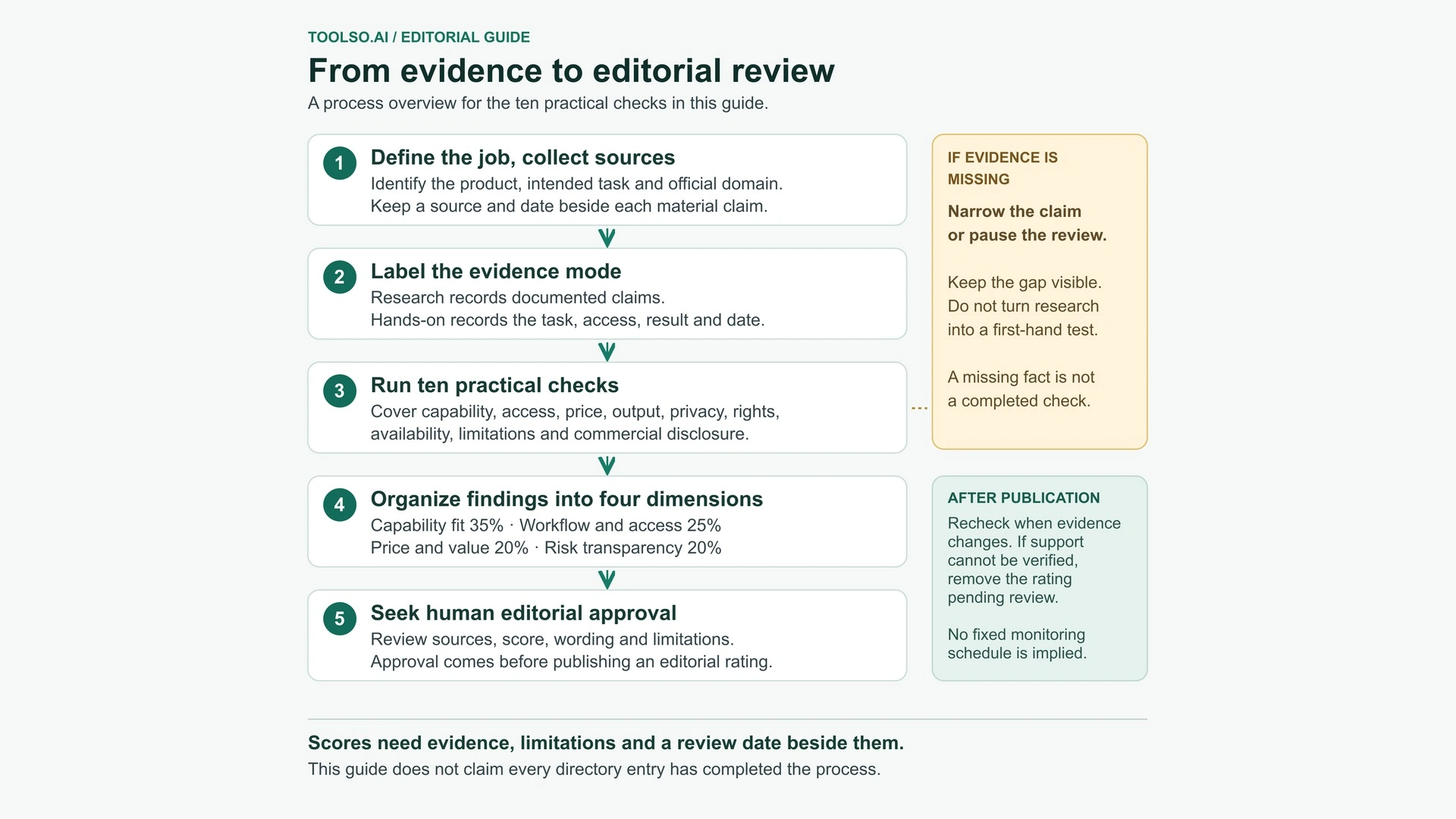
A practical guide to evidence, ten checks, editorial scoring, commercial disclosure, and the limits of an AI tool assessment.
Choosing an AI tool means choosing a workflow, a price, and a set of trade-offs. A polished demo may show a useful feature while leaving important questions unanswered: Can you export the result? Does the advertised price require annual billing? What happens to uploaded files?
This guide explains Toolso's published editorial-rating framework and offers ten practical checks for reading a listing or preparing a submission. The checks are questions to investigate, rather than a claim that every listed product has passed a full hands-on test. A directory entry can help you narrow a shortlist; your own requirements still determine whether a tool fits.
Toolso's published methodology distinguishes research-based assessment from hands-on assessment. Research can establish what a provider documents, publishes, or makes visible. It cannot establish how a feature performs in an account, plan, region, or production workload that the reviewer has not tested.
For a hands-on claim, useful evidence includes the task attempted, access conditions, inputs, observable result, and date. A successful demonstration of one feature does not establish reliability across every use case. When something cannot be checked, the useful answer is to describe that gap and explain why it matters.
Editorial scores also serve a different purpose from community ratings. One expresses an evidence-based editorial judgment; the other reflects contributions from users. Neither should be substituted for the other or presented as proof of universal suitability.
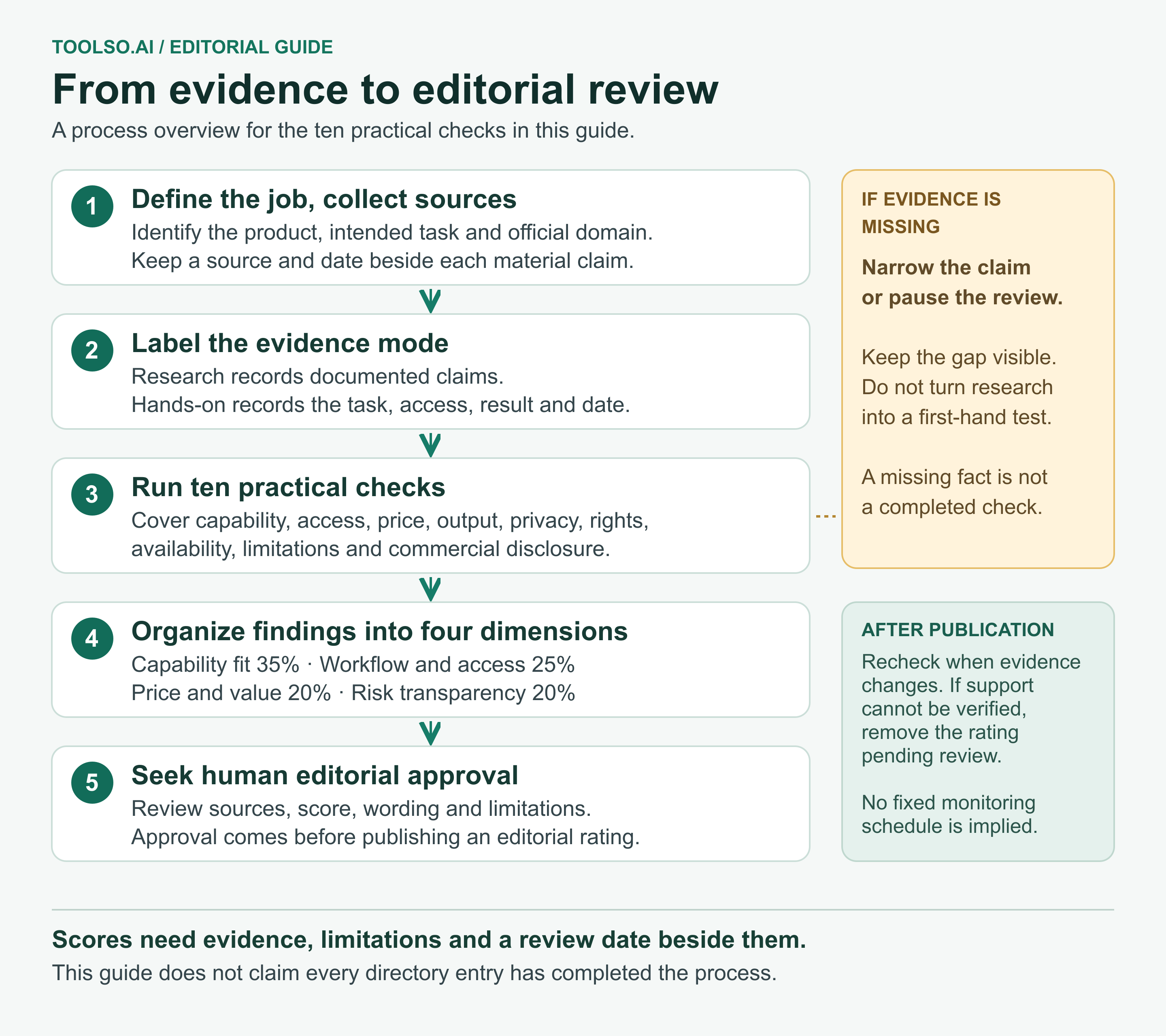
An overview for evaluating evidence. Missing support calls for narrower claims or a hold; it does not become a completed test.
In text: define the task and collect dated sources; label the evidence as researched or hands-on; work through the ten checks; organize the findings into the four dimensions; then seek editorial approval before publishing a rating. If evidence is missing, narrow the claim or pause. Recheck the assessment when its supporting evidence changes. This is a guide to the process, not a statement that every directory entry has completed it.
Start with the exact product name, official domain, and task someone wants to complete. Similar names can belong to unrelated services. A useful description connects a user, an input, and an output: for example, turning a recorded interview into an editable transcript. Avoid treating a long feature list as evidence that the tool solves the reader's particular problem.
Find the official feature description, documentation, pricing page, or policy that supports each material statement. Keep the source and review date with the claim. A provider's promise should remain attributed to the provider unless it has been independently checked. If sources disagree, retain the qualification instead of choosing the more attractive version. Missing evidence is a reason to narrow the wording.
Ask what was actually verified. Reading an export guide supports a statement about documented export options. Completing an export supports a narrower statement about that particular attempt. For a practical trial, define an expected result before starting and use non-sensitive sample data. Record failures and partial results as carefully as successes. Do not turn a marketing example into a first-hand testing claim.
Record whether the relevant feature requires an account, payment card, waitlist, particular device, or supported region. Check whether the free tier includes the capability being discussed. Trial limits, queues, watermarks, and seat restrictions can change the experience substantially. If access is unavailable, say which part could not be checked rather than filling the gap with an assumption about ease of use.
Capture currency, billing period, included usage, and the plan needed for the intended task. A monthly equivalent billed annually is different from a monthly subscription. Credits may have different costs for different models or output settings. Highlight meaningful export limits, renewal conditions, or additional charges when documented. Preserve the observation date, and avoid promising a price will remain unchanged.
A result is useful only if the reader can take it into the next step. Check documented download formats, resolution, editing options, integrations, and API availability where relevant. Treat a provider's mobile-browser claim separately from a verified native app. Identify manual handoffs and feature gates. For team workflows, clarify whether collaboration is available on the plan being described rather than assuming every tier includes it.
Look for the provider's statements about storage, retention, sharing, deletion, and model training. Note the policy date and whether controls depend on a plan or setting. If the relevant information is absent or ambiguous, record that uncertainty. A visible privacy page does not itself establish that a service is appropriate for confidential files. This check documents available information; it is not a security audit or legal certification.
Find the terms that apply to the intended output and account tier. Personal use, commercial use, attribution, redistribution, and prohibited-content restrictions may differ. Record what the provider states without expanding it into a broader guarantee of ownership or clearance. If the planned use depends on an unclear permission, the next step is clarification from the provider before relying on the output.
Check whether the official product, documentation, and access route still match the description. Record a dated availability observation and any documented updates that affect the assessment. One failed visit does not establish that a service has permanently closed. Likewise, a page loading successfully does not establish that a paid workflow works. A review date helps readers judge how much verification they need to repeat.
Finish with who the tool fits, its most important limitation, and any material commercial relationship. Readers should be able to distinguish an assessment from a promotion. Give them a route to flag incorrect claims or changed conditions. Keep an unresolved issue visible in the working record instead of presenting the entry as fully verified. A useful conclusion explains what remains uncertain and what to check next.
Toolso's published framework groups editorial judgment into four dimensions: capability fit at 35%, workflow and access at 25%, price and value at 20%, and risk transparency at 20%. The ten checks above help gather evidence for those dimensions. They are not ten equally weighted points or an additional certification system.
On the five-point scale, the weighted result is rounded to one decimal place. As an arithmetic illustration only, dimension scores of 4.0, 3.5, 3.0, and 2.5 produce 3.4 overall. Those figures do not describe a real product. The explanation, evidence mode, primary limitation, and intended audience remain essential context for any displayed number.
Automation can help organize evidence and prepare a candidate assessment. Toolso's published methodology requires editorial approval before an editorial rating is published. A successful automated validation is not a substitute for that approval, and the existence of a rating feature does not mean every directory entry has a published score.
Toolso offers a Featured Listing service for promotional visibility. Paying does not guarantee approval of a submitted tool. Submission handling and placement should be understood separately from the evidence supporting an editorial assessment. Payment status is not one of the four inputs in the scoring formula. That fact alone cannot prove every editorial decision is independent; clear disclosure and reviewable reasoning still matter.
Readers should look at the promotion label, the assessment's limitations, and its evidence basis together. A listed product may be useful for one audience and unsuitable for another, regardless of whether its maker purchases promotion.
Evidence can change after publication. Toolso's published methodology says a rating is removed when its support changes or cannot be verified, pending review. Removing a rating and archiving a tool listing are separate actions; a missing score does not by itself explain the product's availability.
If a detail appears wrong, use the contact page to identify the listing, the statement, and a source showing the change. Do not include passwords, private account records, or confidential files. This guide does not promise a fixed response time or a universal monitoring schedule.
For makers, a clear submission starts with the official URL, intended users, practical limitations, pricing sources, and relevant policy links. You can review the current submission options and provide your tool for consideration. Check the terms shown there before proceeding; this guide does not promise a free submission route or recommend purchasing a score. Complete information helps an editor assess a product; it does not guarantee acceptance, a particular score, traffic, or search rankings.
About this guide: Toolso.AI explains its own editorial framework and submission service here. No individual product is evaluated or scored in this article.
How Toolso structures multilingual URLs, canonical tags, hreflang, sitemaps, and translation fallbacks, with checks for directory builders.

How to produce AI video in 2026: picking a model per shot, prompting for motion, keyframe workflows, real cost math, artifact fixes and Sora migration.

The 2026 automation guide: how Zapier, Make and n8n differ on pricing model, AI agents and self-hosting — plus when a workspace agent beats all three.

Prompt engineering for 2026: why leaner prompts score 10–15% higher, what reasoning modes made obsolete, the five patterns that survived, and agent specs.

The 2026 playbook for coding with Claude: lean CLAUDE.md, plan-first workflows, subagents, parallel worktrees, hooks, and verification loops that work.

A working guide to Copilot in 2026: Agent Mode setup, auto-approve policy, agentic review, cost discipline, and the habits that make agents net-positive.

The current Midjourney guide: prompt structure, every parameter that matters, personalization training, the 4× GPU trap, video mode, and a working loop.

The complete V7 tutorial — parameters, prompting patterns and workflows from Midjourney's 2025 generation — with a full migration map to today's V8.2.
