
The 2026 automation guide: how Zapier, Make and n8n differ on pricing model, AI agents and self-hosting — plus when a workspace agent beats all three.
Three platforms, three shapes: Zapier (8,000+ apps, easiest, priciest at volume), Make (3,000+ apps, best value-per-dollar for SMBs, visual power), n8n (developer-grade, the only self-hosting option, 2.0 shipped January 2026 with native LangChain and ~70 AI nodes). All three now connect natively to OpenAI, Anthropic and Google models.
The decision that actually matters is the pricing model, not the sticker price: Zapier bills per task (each action), n8n bills per execution (a whole workflow = one unit). For a 10-step workflow running 10,000×/month, that difference is 80–90%.
The largest app ecosystem and the most polished experience; Agents brings autonomous multi-step actions. Choose it when time-to-first-automation matters more than unit cost, or when the app you need only integrates here.
Watch: per-task billing punishes long workflows at volume — exactly the workflows that get valuable.
More powerful than Zapier's linear model (visual branching, iterators, error handlers), far cheaper at equivalent volume, with a conversational builder (Maia) and an agent builder in beta. For most SMBs in 2026, this is the highest value per dollar.
Watch: the visual canvas gets genuinely complex past ~20 modules; that's the moment to consider n8n.
Grew from niche developer tool to serious enterprise alternative; 2.0 (January 2026) added native LangChain integration and roughly 70 AI nodes, making it the most capable platform for building actual AI pipelines rather than AI-flavored triggers. Self-hosting is unique to n8n — if data residency or privacy compliance is a requirement, the shortlist has one entry.
Watch: real learning curve; you're closer to code, which is the point and the cost.
The 2026 twist: much of what needed a workflow tool now lives inside the apps.
Rule of thumb: use an automation platform when the work crosses systems; use a native agent when it lives inside one.
All three are one-hour builds and hit the same criterion: repetitive, rules-describable, and currently costing someone attention weekly.
Automation platforms grew AI nodes, and separately a wave of autonomous agents arrived: Zapier Agents, ClickUp Autopilot, Notion Custom Agents running on schedules and triggers. These are different things. A workflow executes a graph you drew; an agent decides what to do.
A workflow fails predictably — a step errors, you see it in the log, you fix it. An agent fails plausibly: it reports success on something it didn't finish. That's why the enterprise data shows 88% of agent pilots never reaching production while ordinary automation runs fine.
If you can draw the graph, build the workflow. Reach for an agent only when the branching is genuinely unbounded — and when it is, give it a checkable terminal condition and a narrow blast radius.
80% of enterprises embed an agent in at least one production application; only 23% are scaling one. Median payback is 5.1 months, but 22% of deployments are ROI-negative at twelve months. Deterministic automation has none of that variance — which is an argument for using it wherever it fits. Enterprise data →
Sources: HatchWorks n8n vs Zapier analysis · Digital Applied three-way comparison · n8n blog — AI workflow tools · Automation Labs on where agents fit
Last updated: July 29, 2026

A practical six-stage launch guide for AI tool founders, with 30 copyable actions and clear records for owners, dependencies, evidence, and results.

A practical guide to evidence, ten checks, editorial scoring, commercial disclosure, and the limits of an AI tool assessment.
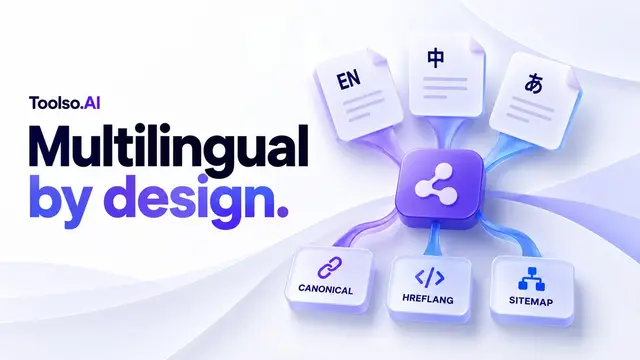
How Toolso structures multilingual URLs, canonical tags, hreflang, sitemaps, and translation fallbacks, with checks for directory builders.
How to produce AI video in 2026: picking a model per shot, prompting for motion, keyframe workflows, real cost math, artifact fixes and Sora migration.

Prompt engineering for 2026: why leaner prompts score 10–15% higher, what reasoning modes made obsolete, the five patterns that survived, and agent specs.
The 2026 playbook for coding with Claude: lean CLAUDE.md, plan-first workflows, subagents, parallel worktrees, hooks, and verification loops that work.
A working guide to Copilot in 2026: Agent Mode setup, auto-approve policy, agentic review, cost discipline, and the habits that make agents net-positive.

The current Midjourney guide: prompt structure, every parameter that matters, personalization training, the 4× GPU trap, video mode, and a working loop.
