
A practical six-stage launch guide for AI tool founders, with 30 copyable actions and clear records for owners, dependencies, evidence, and results.
A launch needs a usable product, clear information, a way to measure useful activity, and someone ready to help. A directory submission or announcement is one step in that work. Plan the month before launch and the month after it as a sequence of decisions, with evidence showing when each step is ready.
This guide was prepared with AI writing assistance for Toolso.AI. It is a working template for founders launching an AI tool, not a report of measured launch results. Use launch day as T0, assign an owner to each action, and move a date when a real dependency remains unresolved. The six milestones below are a planning framework, not mandatory platform deadlines.
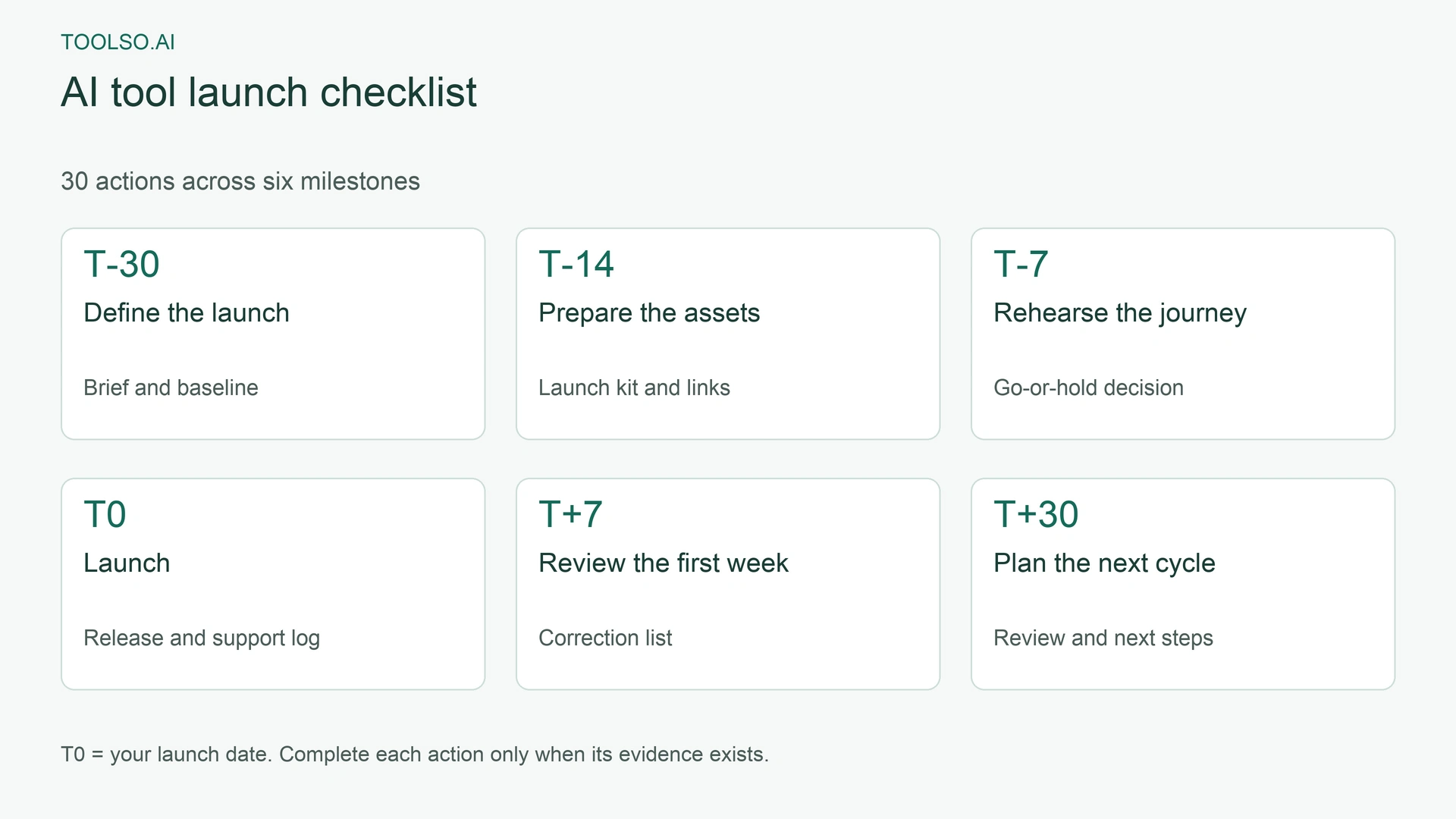
Thirty checklist items across six milestones. T0 is the launch date you choose.
Describe one audience, one problem, and one workflow the first release can support. Specify the input, expected output, and limits. If the tool creates transcripts, identify supported languages, export formats, and the account tier required. Keep documented capability separate from what you have personally tested.
Choose a primary launch outcome and define its measurement window. For a transcription tool, it could be a new user exporting a usable transcript after onboarding. Define the event and denominator, exclude internal tests, and record the data source. This is an example definition, not a measured result. Record a baseline where available. Missing access to analytics is an open dependency, not a zero.
Shortlist channels by audience and product eligibility. Keep a source for each platform's current requirements. An AI directory, a maker launch platform, and a discussion community serve different purposes. Check existing accounts and ownership before registering again. Keep credentials in a password manager and public assets in the working folder.
Deliverable: a one-page brief containing the promise, success definition, baseline, channel shortlist, owners, and unresolved dependencies.
Prepare a landing page explaining the task, intended user, practical limits, pricing basis, and next step. Make support easy to find. Keep a single reference version of the product name, homepage, descriptions, feature claims, and pricing sources so different submissions do not contradict one another.
Capture readable screenshots of the actual workflow. Include enough context to explain the result, remove private information, and confirm permission to reuse every asset. Prepare shorter descriptions and any demo a chosen channel requires. Product Hunt's launch guide, for example, describes page copy, visuals, a demo, and a maker introduction. Check its current requirements when preparing that submission.
Check mobile layout, titles, descriptions, working links, canonical URLs, crawl access, and sitemap coverage. Verify that visitors reach the intended page. Use a documented UTM convention for external distribution, including source, medium, campaign, and an identifier for the placement where useful. Keep tracking parameters separate from the canonical URL.
Deliverable: an approved asset folder, consistent submission copy, a checked landing page, and a channel-to-link register.
Walk through the journey from an external link to the product's first useful result. Use a fresh session and non-sensitive sample data. Check account creation, plan limits, error messages, exports, cancellation information, and support contact routes where relevant. Use an appropriate test environment for payment checks rather than placing an unintended live order.
Test measurement separately. Confirm which event represents the useful result, check for duplicate events, and document how test activity will be excluded. Source labels, visits, signups, and completed actions answer different questions. A tagged URL alone does not establish that a conversion was measured correctly.
Prepare responses to likely setup, billing, privacy, and output questions. Assign support coverage and a way to escalate faults. Verify account access without copying passwords into the launch sheet. For each channel, confirm eligibility, review lead time, disclosure requirements, permitted links, and publication approval. Reddit's own guidance directs uncertain participants to community-specific rules; participation history does not provide blanket promotional permission.
Deliverable: a rehearsal record, a support sheet, and a go-or-hold decision for each channel.
Make the release decision against the unresolved items from rehearsal. Hold a channel when its account, approval, or required asset is unavailable. If a broken workflow prevents users from obtaining the promised result, fix or narrow the promise before drawing more attention to it.
Publish approved material through the selected channel's permitted process. Recheck the live destination, screenshots, disclosures, and tracking link. Record the actual URL, account, date, timezone, and visible status. A submitted listing, an approved profile, and a searchable page are separate observations. A directory submission does not prove a new indexed backlink.
If you control the site, request search discovery or indexing through the applicable tools once the original page is ready. Google's guidance says a crawl request does not guarantee inclusion in search results. Keep the response and inspect the actual status later.
Respond to substantive questions with accurate information. Avoid coordinated votes, repetitive comments, or unsolicited message blasts. Record faults and assign a next action. If a material claim is wrong, correct the source and the affected approved copy.
Deliverable: a release log with live URLs, pending reviews, support issues, and measured results or clearly labeled gaps.
Compare channels using the same observation window and definitions. For an activation rate, use people completing the defined action divided by the eligible people in that same cohort; name both groups. Trace visits through signup and the first useful action where data is available. Keep unknowns visible and separate test traffic. Small samples may suggest questions to investigate without supporting a confident claim about which channel performs best.
Group feedback into product understanding, activation, output quality, pricing, and trust. Keep a source for each issue and avoid publishing private customer material without permission. Choose a small set of fixes with owners and completion evidence. Repeated confusion about a limit may require clearer copy as well as a product change.
Review pending submissions according to each platform's stated process. Follow up only when appropriate and authorized; do not duplicate a submission because approval is taking time. Recheck changed pricing or features before reusing the launch kit. Continue useful conversations where community rules allow it, with your relationship to the product disclosed.
Deliverable: a first-week review, a prioritized correction list, and a deliberate decision about the next channels to use.
Review acquisition alongside continued use, support effort, and commercial outcomes where they can be measured. Compare cohorts over equivalent periods and state the denominator for each rate. Keep invoiced revenue, collected payments, refunds, and promotional claims distinct. Keep any revenue attribution separate from invoices and collected payments. Do not attribute all observed growth to the launch without supporting evidence.
Account for time as well as money. Decide which channel to continue, change, or stop, and explain why. A useful conversation with a relevant audience can justify another experiment even when the sample is too small for a reliable conversion comparison.
Refresh the landing page, directory records you can maintain, documentation, and support answers when facts change. Check actual link and indexing status. Turn verified lessons into a dated resource with a change log, so future founders can understand its limits and reuse the practical steps.
Deliverable: a thirty-day review and a next-cycle plan with owners, evidence, and explicit stop conditions.
Copy the block below into your working document. It contains five actions for each milestone. Add an owner, due date, dependency, status, evidence, and next action for every item. Leave an item unchecked when its evidence is missing. The template starts blank; it does not describe a launch Toolso has already executed.
# AI Tool Launch Checklist

Product:
Launch date and timezone:
Launch owner:
Primary outcome and observation window:
Baseline and source (or not measured):

For each item, add: owner | due date | dependency | status | evidence | next action.
Check an item only when its evidence exists. Keep passwords and private customer records elsewhere.

## T-30: Define the launch
- [ ] T30-01: Document the audience, input, useful output, access conditions, and practical limits.
- [ ] T30-02: Define the primary outcome, measurement window, baseline, and test exclusions.
- [ ] T30-03: Shortlist channels and record each channel's audience, eligibility, rules, and review requirements.
- [ ] T30-04: Confirm existing accounts and owners; keep credentials in a password manager.
- [ ] T30-05: Assign delivery, approval, support, and incident owners; list launch-blocking dependencies.

## T-14: Prepare the launch kit
- [ ] T14-01: Check the landing page's workflow, limits, pricing basis, support route, and main link.
- [ ] T14-02: Check mobile layout, metadata, canonical, crawl access, sitemap coverage, and destination URLs.
- [ ] T14-03: Capture readable workflow screenshots and any required demo; confirm privacy and reuse rights.
- [ ] T14-04: Approve consistent product descriptions, categories, pricing sources, and relationship disclosures.
- [ ] T14-05: Register channel links with consistent UTM values; keep campaign parameters out of canonical URLs.

## T-7: Rehearse
- [ ] T07-01: Test the external-link-to-useful-output journey in a fresh session with safe sample data.
- [ ] T07-02: Verify attribution and the outcome event; remove duplicates and document test exclusions.
- [ ] T07-03: Recheck account access, product ownership, channel eligibility, links, disclosures, and approvals.
- [ ] T07-04: Rehearse support, escalation, cancellation information, and payment checks in a suitable test environment.
- [ ] T07-05: Record a go-or-hold decision for each channel and its unresolved dependencies.

## T0: Launch day
- [ ] T00-01: Recheck the promised workflow and material faults; obtain the required release and content approvals.
- [ ] T00-02: Publish permitted, approved content; record the actual URL, account, time, timezone, and visible status.
- [ ] T00-03: Check live copy, destination, disclosures, and UTM; separate submission, approval, link visibility, and indexing.
- [ ] T00-04: Where applicable, request search discovery or indexing and retain the response; verify indexing later.
- [ ] T00-05: Handle substantive questions and faults; avoid coordinated votes, repetitive promotion, and unsolicited message blasts.

## T+7: Review the first week
- [ ] T07P-01: Compare visits and useful actions over the same window; separate tests, missing data, and observed zeroes.
- [ ] T07P-02: Group feedback by understanding, activation, output quality, pricing, and trust; retain non-sensitive evidence.
- [ ] T07P-03: Assign a short correction list with owners, priorities, and verification criteria; recheck changed claims.
- [ ] T07P-04: Review pending submissions through each platform's process; avoid duplicates or reposting removed content.
- [ ] T07P-05: Choose what to continue, change, or hold; recheck community rules before further participation.

## T+30: Plan the next cycle
- [ ] T30P-01: Compare acquisition, continued use, support effort, and commercial outcomes with explicit periods and denominators.
- [ ] T30P-02: Separate invoices, collected payments, refunds, and unverified attribution when reconciling commercial figures.
- [ ] T30P-03: Allocate time and budget to the next experiments with reasons and stop conditions.
- [ ] T30P-04: Refresh documentation, directory records, support answers, and actual link or indexing status where authorized.
- [ ] T30P-05: Record decisions, owners, evidence, and changes; obtain permission before sharing customer material or public resources.
If a relevant directory is part of your plan, review Toolso.AI's current submission options. Check the requirements and terms shown there. Inclusion, approval, traffic, and search rankings are not guaranteed.
Sources reviewed on October 28, 2026: Google Analytics URL builders, Google Search recrawl guidance, Product Hunt launch guide, and Reddit spam guidance.
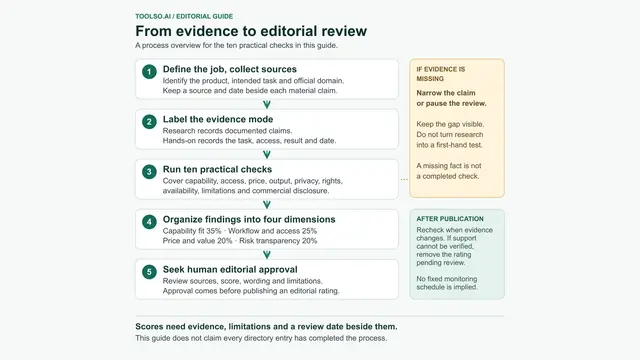
A practical guide to evidence, ten checks, editorial scoring, commercial disclosure, and the limits of an AI tool assessment.

How Toolso structures multilingual URLs, canonical tags, hreflang, sitemaps, and translation fallbacks, with checks for directory builders.
How to produce AI video in 2026: picking a model per shot, prompting for motion, keyframe workflows, real cost math, artifact fixes and Sora migration.

The 2026 automation guide: how Zapier, Make and n8n differ on pricing model, AI agents and self-hosting — plus when a workspace agent beats all three.

Prompt engineering for 2026: why leaner prompts score 10–15% higher, what reasoning modes made obsolete, the five patterns that survived, and agent specs.

The 2026 playbook for coding with Claude: lean CLAUDE.md, plan-first workflows, subagents, parallel worktrees, hooks, and verification loops that work.

A working guide to Copilot in 2026: Agent Mode setup, auto-approve policy, agentic review, cost discipline, and the habits that make agents net-positive.

The current Midjourney guide: prompt structure, every parameter that matters, personalization training, the 4× GPU trap, video mode, and a working loop.
