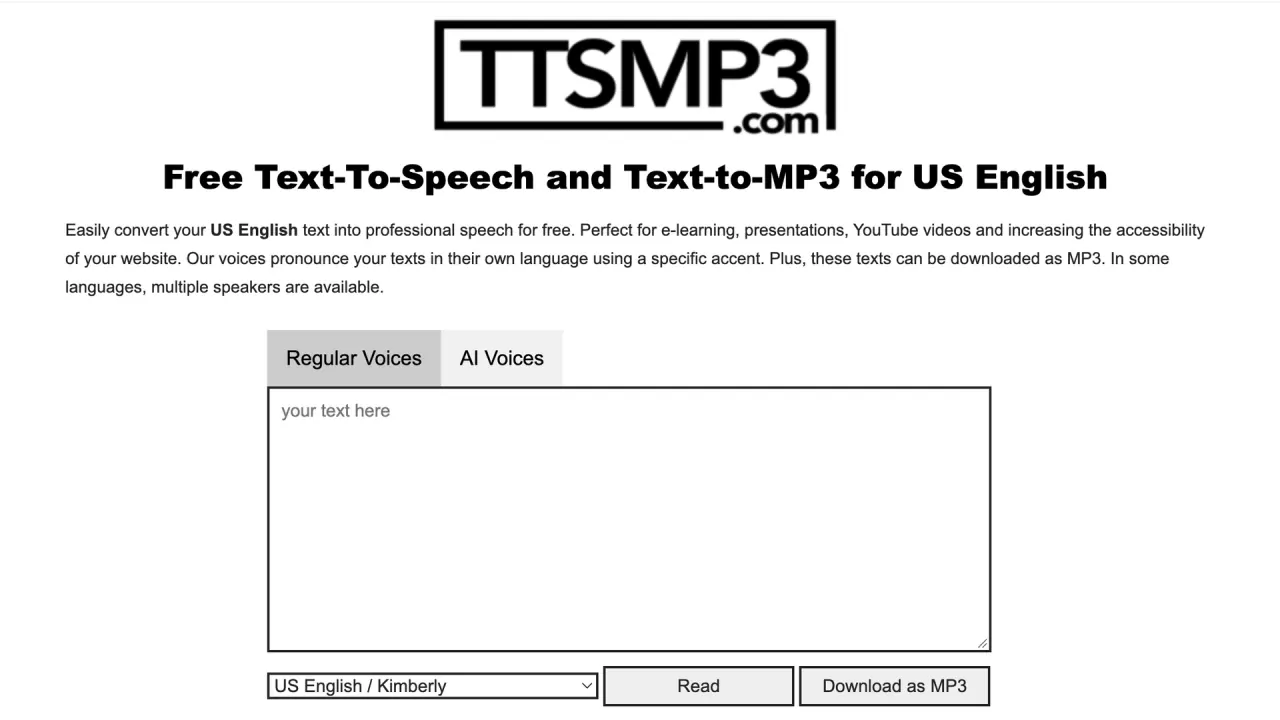
ttsMP3 converts text into speech online and returns an MP3 file. A regular converter built on Amazon Polly voices and an AI converter from OpenAI and Gemini models sit behind the same page, with 3,000 free characters a day for the regular voices.
Used this tool? Rate it
Used this tool? Rate it


Personal stories, made into song gifts


AI image editing from a reference photo


Multi-model image studio, free to start


Natural AI photo editing for portraits and projects


AI assistant for writing, analysis and tasks


From a prompt to a deck, site or doc


Build random generators, share them free


Anime art, powered by a million community models
ttsMP3 is an online text to speech tool that converts written text to MP3 and returns the audio as a downloadable file. Everything runs in a browser, so a phone, a tablet and a desktop reach the same converter without an app or plug-in.
The site carries two voice systems. The regular converter draws on Amazon Polly and accepts SSML markup for pauses, emphasis, speed, pitch and whispering. The AI converter generates speech with OpenAI and Google Gemini models, detects the language automatically and takes a written instruction for tone, emotion or accent.
Free use needs no account: the regular voices convert up to 3,000 characters a day and the AI voices up to 1,000, both resetting daily. A pass or plan raises the character count, removes advertising and lifts the ceiling on a single conversion.
The name travels in several spellings: ttsMP3 stands for text to speech MP3, and the site records that people also type it as ttmp3, tts mp3 or mp3tt.
| Dimension | Regular voices | AI voices |
|---|---|---|
| Speech engine | Amazon Polly | OpenAI and Google Gemini |
| Catalogue | 74 voices in 41 languages and accents | 39 voices, 57 languages detected automatically |
| Free allowance | 3,000 characters per day | 1,000 characters per day |
| Speech control | SSML for pauses, emphasis, speed, pitch, volume and whisper | Pauses and a written voice instruction |
| Language choice | A named speaker per language and accent | Detected from the submitted text |
SSML tags go straight into the text field, with no setup and no separate editor; the converter adds the surrounding <speak> element itself.
<break time="1s"/> stops the voice, and the regular voices accept up to 10 seconds, so longer silence comes from stacked breaks.<emphasis level="strong"> takes strong, moderate and reduced, while <prosody rate="slow"> and <prosody pitch="high"> accept steps from x-slow to x-fast and x-low to x-high, or a percentage such as 80%.<say-as interpret-as="characters"> spells a code out, <sub alias="Doctor">Dr.</sub> replaces an abbreviation, <phoneme alphabet="ipa"> fixes a pronunciation and <lang xml:lang="fr-FR"> reads one phrase in another language.<amazon:effect name="whispered"> is a Polly-specific effect for close, quiet delivery.A conversation in one file uses a small syntax of its own: each line begins with [speaker:Brian] or another regular voice name, and the speaker changes at that point. Accents are dropped from the names, so Léa is written Lea. A two-voice exchange therefore needs no editing software.
The AI converter adds a field beside the script. An instruction covers identity, affect, tone, emotion and pronunciation, so a prompt such as "speak in a cheerful tone" or "use a thick French accent" is applied to the reading. While instructions are active the speed slider is pinned at 1.0, and the site names Ash, Coral and Sage as the voices that follow instructions best.
Every conversion returns a mono MP3 in speech quality: 22 to 24 kHz and 48 kbit/s on the regular voices, 24 kHz and 128 kbit/s on the AI voices. The file is generated on the server and opens in video editors, presentation software and learning platforms.
The regular catalogue holds 74 Amazon Polly voices across 41 languages and accents, each language with its own page and sample. It spans English variants from US to Welsh, alongside Spanish, Portuguese, French, German, Dutch, Arabic, Mandarin, Cantonese, Japanese, Korean and the Nordic and Slavic languages. The AI converter instead holds 39 voices and detects the language from the text automatically, which helps when a script quotes foreign phrases.
A yearly plan on the regular voices includes API access. The endpoint https://api.ttsmp3.com/v1/ takes POST or GET with three parameters: apikey, speaker and text. A successful call returns the speaker used, the character count, the remaining quota and a URL to the generated MP3, plus flags for cache hits and engine errors. The speaker name determines the language, so no language parameter is sent.
Leave a space after a full stop before the next sentence. SSML is parsed as XML, so a literal ampersand is written & and an angle bracket <. Attribute values need straight quotes, because typographic quotes from a word processor are rejected, and every opening tag needs its closing tag.
<break time="2s"/> on the regular voices, or a whole number from 1 to 60 on the AI voices.<prosody rate="slow">Please read the safety instructions.</prosody>.<phoneme alphabet="ipa" ph="pɪˈkɑːn">pecan</phoneme>.<say-as interpret-as="characters">X7K2</say-as>.[speaker:Brian] Hello Emma followed by [speaker:Emma] Hey Brian, how are you?.A script is pasted scene by scene, converted to MP3 and dropped under the footage in any editor. The licence covers monetised videos without a credit line, so a channel can voice a series without a per-video fee. The AI voices suit explainers and tutorials; the regular voices take over when a video needs a specific language or exact SSML timing.
E-learning producers use the regular voices for slide narration and for scripts that need fixed pauses between sections, which is easier to control than a re-record. The paid ceiling of 100,000 characters per conversion covers a long module, and the same route serves a podcast insert, an audio guide or a chapter draft: listen first, download only when the read sounds right.
The API returns a URL to a generated MP3, which suits short fixed messages such as app notifications, game prompts or telephone announcements. Audio made under the commercial licence can ship inside an app, a website or a product video.
Playback needs no download, so the converter doubles as a pronunciation reference: paste a word, choose a native speaker of that language and listen. An AI instruction such as "slow, for language learners" slows a passage without editing it, and instruction sheets can be turned into audio for listeners who prefer speech.
ttsMP3 fits people who need a finished audio file rather than a voice platform to run.
Four situations fit badly. The voice models cannot be downloaded or used offline, so an offline workstation is not an option. The export is MP3 only, with no WAV or lossless format listed, which rules out broadcast post-production. Everything runs through a hosted converter with a daily cap, so bulk processing needs a paid plan. Confidential text does not belong in the box at all, because converted text is stored for a period and generated files are reachable by link.
https://api.ttsmp3.com/v1/ answers POST or GET with an API key, a speaker and the text, and returns a link to the MP3.Free use is the default state of the site: 3,000 characters a day on the regular voices and 1,000 on the AI voices, both without an account. Beyond that the site sells a 24-hour pass, a monthly plan and a yearly plan, and the ladder is identical for both voice families.
| Plan | Price | Characters | Validity |
|---|---|---|---|
| 24-hour pass | $5.00 | 1,000,000 | 24 hours, one-time, no renewal |
| Monthly | $10.00 / month | 1,000,000 per month | Renews monthly, cancel in the account |
| Yearly | $99.00 / year | 10,000,000 per year | Renews yearly, includes API access |
The AI plans hold a quarter of those characters: 250,000 AI characters for the 24-hour pass and the monthly plan, and 2,500,000 for the yearly plan.
Every plan includes the full catalogue of its voice family, SSML on the regular voices, commercial and non-commercial use, no advertising and conversions of up to 100,000 characters at a time. Unused characters expire at the end of the paid period, and monthly and yearly plans renew automatically until cancelled; cancelling keeps access until that period ends. A refund is given for an unused 24-hour pass and for an accidental double purchase of the same plan, while used plans are not refunded. Extra characters can be bought inside the account at any time. An account can be switched once between the regular and the AI catalogue, converting 1,000,000 regular characters into 250,000 AI characters while validity and subscription stay unchanged.
Payment runs through a third-party reseller acting as merchant of record, which issues the invoice; cards, PayPal, Google Pay and further local methods are offered by country. The free tier is financed by advertising, which disappears on a paid plan. The API key included with the yearly plan allows 150 requests per minute, and 300 per minute apply per IP address across all keys.
Amazon Polly directly. The regular voices are Polly voices, so a team that wants the same engine without an intermediary can call Polly itself. Its free tier includes 5 million characters per month for Standard voices, and Standard voices cost $4.00 per 1 million characters beyond that, with Neural, Long-Form and Generative voices priced higher. The trade-off is an AWS account, IAM and billing setup instead of a web form.
A dedicated AI voice platform. Services built around expressive synthetic voices add voice cloning and studio controls that ttsMP3 does not offer. The free entry tier on one such platform is listed at $0 with 10,000 credits per month, with paid tiers from a few dollars; credits are charged per generation rather than per download, so a long script drains the allowance quickly. That route makes sense when voice identity matters more than price per character.
The free allowance is small and guarded. 3,000 characters is roughly 375 words, or two to three minutes of speech, and the terms forbid circumventing the daily limit with scripts, automated requests, rotating IP addresses, deliberate cookie deletion or multiple identities. Automated access is allowed only through the API with a valid key.
Converted text and audio leave the machine. The text is transmitted to the voice provider to generate the audio, and the resulting MP3 sits on the site's servers, where anyone holding the link can open it. Files unused for three months are usually deleted, text after 12 months and the IP address after 90 days, long enough that confidential material should not be converted.
The voices cannot be taken offline. Generated MP3 files are yours to use, but the voice models are not downloadable and cannot be used offline, and the terms forbid extracting them, training a competing voice on the output or reselling access.
The catalogue is not fixed. Voices and languages come from the model providers and change when those providers add or retire them: on the AI side a set of older voices is scheduled to be withdrawn at the end of 2026.
The AI voices accept far less markup. Pauses work, but emphasis, pitch, volume and whisper are regular-voice features; on the AI side the speed slider and the written instruction replace them.
Only MP3 comes out. There is no WAV, no stems and no lossless export, and the files are mono speech quality rather than music-grade audio.
Impersonation is prohibited. The terms forbid using the audio to impersonate real people or to mislead listeners about who is speaking, and they require compliance with the usage policies of the underlying voice providers.
Labelling guidance is inconsistent. One page states that no label is required and that some platforms or countries set their own rules for AI-generated content, while the video-voiceover page asks creators to make clear to viewers that the voice is AI-generated.
API access carries its own conditions. It is tied to the yearly plan on the regular voices, covers those voices only, and the key is personal. The pages also differ on how it is obtained: the API documentation says access must be requested by e-mail, while the FAQ describes creating the key in the account area.
Liability is capped. Total liability is limited to the amount paid in the previous twelve months, or USD 50 for free use, and the service is provided as is, with no warranty that pronunciation or timing will meet a particular requirement.
Yes. Free use is capped per day, resets daily and needs no account, while paid plans raise the volume, remove advertising and lift the ceiling on a single conversion.
Yes. The licence covers commercial and non-commercial projects, including monetised YouTube videos, podcasts, presentations, e-learning, websites and apps, for free and paid use alike, with no credit line required.
The regular voices are Amazon Polly voices with full SSML control across 41 languages and accents. The AI voices come from OpenAI and Google Gemini models, sound more natural, detect the language themselves and accept a written instruction for tone or emotion, but support pauses only.
Only on the regular voices, where each speaker belongs to one language and accent. The AI voices detect the language from the text across 57 supported languages.