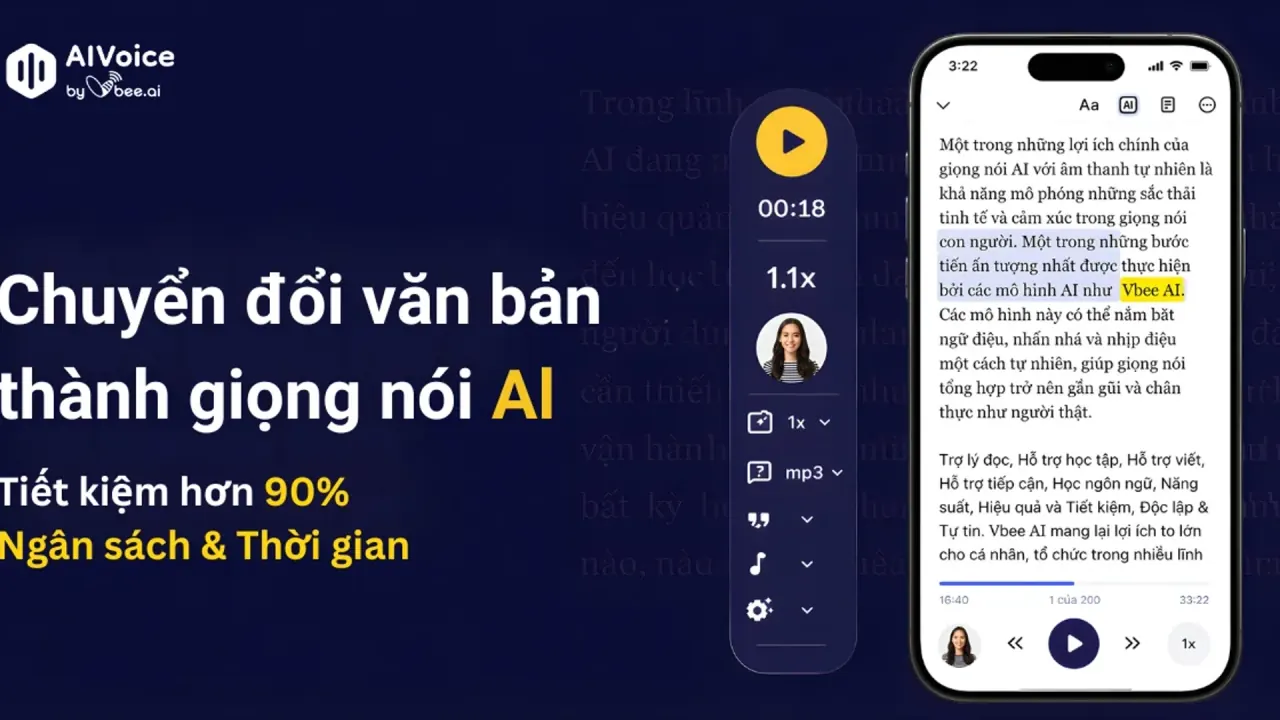

Vbee AIVoice converts Vietnamese and international scripts into downloadable speech, clones a voice from a short recording, dubs subtitles, and exposes the same engine through an API — with a free daily allowance and paid credit plans.
Used this tool? Rate it
Used this tool? Rate it


Personal stories, made into song gifts


AI image editing from a reference photo


Multi-model image studio, free to start


Natural AI photo editing for portraits and projects


AI assistant for writing, analysis and tasks


From a prompt to a deck, site or doc


Build random generators, share them free


Anime art, powered by a million community models
Vbee AIVoice is a Vietnamese text-to-speech platform that turns a written script into downloadable audio, and it bundles voice cloning, AI dubbing and a developer API into the same account. It is built and operated by Vbee AITalk, a joint-stock technology company registered in Hanoi, Vietnam.
The studio sits inside a wider product suite. The same company sells AICall for automated phone conversations and the SmartDialog Platform for virtual assistants, and Vbee AIVoice is the content-creation product in that set.
Much of the design assumes Vietnamese as the working language. The company says it carries features specific to Vietnamese — phonetics, tones and intonation — into its own research, and it traces the product back to research carried out at the Hanoi University of Science and Technology's school of information and communication technology. The voice library is not Vietnamese-only: the Special plan adds basic global AI voices and advanced AI voices, with premium voices on the tier above.
Numbers on the site are large but loosely defined. The voice-cloning page displays a customer count of 2,000,000+ as captured on November 23, 2026, without saying what counts as a customer.
The account exposes four surfaces — text to speech, voice cloning, AI dubbing and the AIVoice API — over one shared library of voices.
Vbee documents the text-to-speech flow as three steps. A script is pasted or typed into the conversion box, a voice is previewed and chosen from the AI and community library, and one click converts the text into speech that can then be previewed or downloaded as MP3 or WAV.
The company's own examples cluster around content that has to be produced in volume and in Vietnamese.
A marketing specialist quoted on the site describes producing content for Facebook and TikTok with the voice library. A gaming YouTuber describes cloning his own voice so that a script can be typed instead of recorded line by line. A video editor says the tool replaced paid voice-over work on smaller projects, where hiring a narrator used to dominate the budget.
Online training is the first example on the cloning page: lectures and electronic learning material can be produced in the author's own voice, which the page frames as saving time and cost while keeping learners engaged. The same page points at audiobooks, where a classic title can be read by a synthetic version of the author's voice or by a seasoned actor's voice. A university lecturer quoted on the site says students told him the narration sounded like a real lecturer.
Podcasts are listed as a use case on the grounds that a good voice holds listeners. Dubbing is listed separately for automatic voice-over with cloned voices taken from the shared library. Media teams dubbing foreign footage into Vietnamese are the clearest fit, because the dubbing page starts from an existing subtitle file.
Users can publish a cloned voice to the community library, where other accounts discover and use it. The library page states that a publisher receives a bonus each time a user selects and uses that voice. It adds that a published AI voice can be discovered and used by thousands of users.
Vbee AIVoice is aimed at people producing Vietnamese audio at volume: content creators, marketing teams, e-learning producers, video editors and local businesses. An independent Vietnamese technology publication's round-up of ten text-to-speech tools places Vbee AIVoice in the category of Vietnamese creators and businesses, next to global and local alternatives.
It also suits developers who need speech inside another product, because the same account can call the API rather than exporting files. Teams that mostly need English narration are a weaker fit: a comparison published by another voice-generation vendor argues that Vbee's pricing competes for Vietnamese content but not against general-purpose text-to-speech for English content.
Two boundaries narrow the audience further. The terms require a user to be at least 16 years old, and a user under 16 needs a parent's or guardian's consent. Advanced voices and cloning capacity are also plan-dependent: a third-party round-up notes that some advanced features depend on the service plan, and that voice cloning may have specific restrictions based on voice type and account level.
Vbee AIVoice sells credits, and the pricing page switches between monthly and yearly billing with a "Save 79%" badge on the yearly view. Three plans carry names on the page.
| Plan | Monthly billing | Yearly billing | Credits included |
|---|---|---|---|
| Free | $0 | — | 3,000 credits per day, and extra credits cannot be bought |
| Standard | $6.50/month | $17.65/year | 125K credits per month |
| Special | $9.19/month | $23.04/year | 250K credits per month |
Two further cards sit above Special without a plan name in the rendered table. One is listed at $15.35/month or $38.42/year with 450K credits per month, premium AI voices and the pronunciation checker; the other is an annual tier at $42/year with 3 million credits per year, no monthly credits cap, real-time and streaming API access, and customization.
The plan ladder is mostly about voices and cloning. Free covers basic Vietnamese voices, unlimited downloads, subtitle-to-speech, custom pause duration and instant voice cloning, but it cannot buy extra credits beyond the daily allowance. Standard adds API text-to-speech and speech-to-text integration, audio preview and no watermark. The Vietnamese version of the same page describes that difference as no ad audio inserted, while the English version calls it no watermark. Special adds basic and advanced international AI voices plus professional voice cloning, and the top cards add premium voices and concurrency.
Top-ups are priced per unit rather than per plan. Extra credits start at $0.6 per 50K on Standard. On the higher paid tiers the same 50K block costs $0.5. An extra simultaneous device is $3.87. An extra professional voice clone is $39.01. An extra concurrency slot for the batch text-to-speech API is $2. Special carries a social-proof line saying 88% of users choose this plan.
Above the self-serve cards, the company sells a custom quote for enterprises that need API integration and unlimited characters, collected through a contact form on the pricing page.
The alternatives that come up in independent coverage are mostly Vietnamese-first engines or global clouds rather than content studios.
Account and service data supplied at registration and during use is collected and stored. Behavioural data is gathered through cookies. Support calls may be recorded. The privacy commitment states that personal data is not sold to any third party. It also states that data is used to support customers and to improve and develop products and services.
Customers keep ownership of the input and output data they create. At the same time they grant the company a licence to use that input and output to provide the service and to improve and develop products. Individual rights are spelled out as access, correction and deletion of personal data, deletion of the service account, and withdrawal of consent to collection, storage and use. For voice cloning, the recording page promises that a submitted voice is used only for training and is kept confidential.
Yes. The free plan allows 3,000 credits per day, which the comparison page equates to roughly 3,000 characters a day, and it cannot be topped up; a paid plan is the only way past the daily allowance.
The terms put the customer in ownership of input and output data, and the company warrants that output made with voices from its library does not infringe third-party voice rights. The licence for those library voices is non-exclusive, non-transferable and revocable, and cloned voices a customer creates are the exception the terms carve out of library ownership.
The terms grant the company a licence to use input and output data to run the service and to improve and develop products, and the privacy commitment names the same purpose. Neither document states separately whether customer text trains speech models, so the answer is not spelled out on the pages reviewed.
Vietnamese is the core language, with regional voices, and the paid tiers unlock basic, advanced and premium international voices. A third-party count, attributed to the company's help centre, puts the library at 20 Vietnamese voices alongside hundreds of international voices.
The studio runs on the vbee.vn website and in the Vbee AIVoice app with a login account, so nothing has to be installed. Cloning asks for a phone recording, and dubbing starts from an SRT file rather than a video upload.
The terms state that a paid plan is not refunded by default, with exceptions only where the payment policy provides for them, so the payment policy is the document that defines the exceptions.