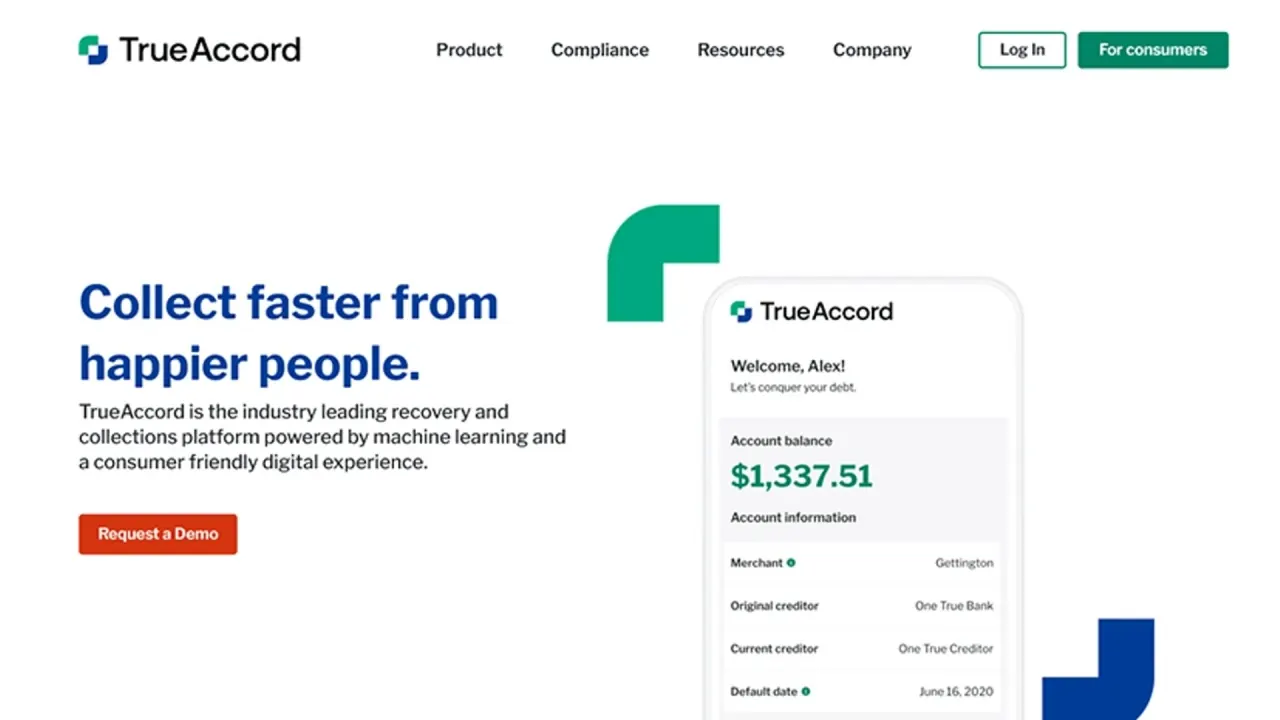

TrueAccord is a licensed US debt collection agency that recovers delinquent accounts through machine-learning decisioning, email, SMS and a self-service payment portal, sold as first-party white-label servicing or third-party contingency collections.
Used this tool? Rate it
Used this tool? Rate it

Track AI budgets, cash returns and portfolio decisions


Build forms around real submission workflows


AI image editing from a reference photo


Multi-model image studio, free to start


Natural AI photo editing for portraits and projects


AI assistant for writing, analysis and tasks


From a prompt to a deck, site or doc


Build random generators, share them free
TrueAccord is not a self-serve software product. It is a licensed debt collection agency that runs recovery on behalf of creditors, and its homepage describes it as "the premier omnichannel debt collection agency, leveraging data science and AI technology to deliver superior results with a consumer-friendly experience." A creditor places delinquent accounts with TrueAccord; TrueAccord then contacts those consumers, offers payment plans, takes payments and reports outcomes back to the client.
The service is split into two lines that map onto different stages of delinquency. "Recovering As You (First Party)" is white-label servicing, and the homepage footnote states it is "Offered by TrueAccord’s subsidiary, Sentry Credit, Inc." "Recovering For You (Third Party)" is contingency collections aimed at liquidation and resolution of charged-off debt. Together the company markets them as full-lifecycle recovery, "from early-stage re-engagement to late-stage recoveries."
The numbers TrueAccord publishes are account volumes rather than user counts. The homepage claims "25+ million accounts daily" under Scale and "95+ Clients, including leading debt issuers and buyers" under Expertise. Its about page says the company has worked with more than 20 million consumers of major banks, issuers, eCommerce companies and direct lenders. These are vendor-reported figures without published methodology, and they describe debt placed for collection, not software adoption.
Evaluation is therefore a vendor-selection exercise, not a sign-up. Public pages route commercial conversations through "Schedule a Consultation" or "Request a Demo", and the terms state that obligations "are governed solely by the agreements pursuant to which they are provided."
The homepage says TrueAccord's "collection strategy utilizes HeartBeat™ to eliminate the guesswork of collections, allowing our agents to spend 100% of their time on what matters." The late-stage page describes the same system as "a patented machine learning platform" used "to dynamically optimize the next best touchpoint for every consumer in real-time."
The stated scope goes beyond choosing a channel. HeartBeat "leverages engagement signals to identify consumers at risk of breaking plans – and automatically adapts to keep them successful until resolution", so the model is positioned as managing an ongoing plan, not only the first contact.
The third-party page promises a "mobile-optimized payment portal where they can set up flexible payment plans and autonomously resolve their debt 24/7 without the 'shame factor' of a phone call." Consumers reach the same functions from consumers.trueaccord.com, which offers "Make a Payment" and "Account Access", and the privacy policy notes that a consumer "can view your account information through any of the links in a TrueAccord email."
Discounts are framed as an optimisation problem rather than a fixed policy: "Data-driven settlement logic to offer the right discount at the right time, creating a 'moment of receptivity' that maximizes recovery on accounts that would otherwise remain stagnant." No discount bands, settlement ranges or approval rules are published.
Outreach is "built digital-first and smartly augmented with optimized voice and mail servicing". The late-stage page names the digital set as "email, SMS, voicemail drops, and Facebook", and the SMS terms confirm that messages can carry a link to an individualised self-service page.
TrueAccord sells speed of implementation: a "flexible account ingestion engine and battle-tested client teams ensure your portfolio is live and generating revenue without the typical implementation lag." No file format or integration specification is published, and the developer documentation site returned no usable content when captured.
White-label work can be staffed rather than only automated. The first-party page offers "highly trained first-party specialists to scale immediately without hiring", and says the team "can work directly within your internal systems (CRM/SOR) or utilize our proprietary tech stack". Client-specific compliance programmes are also run by TrueAccord staff: "TrueAccord team members work with clients to execute their client-specific compliance program(s)."
The operating model reads from the outside in. A creditor places an account file; TrueAccord builds a treatment per account; outreach runs across digital channels and voice or mail; the consumer resolves through a plan in the portal; the model watches the plan and escalates to human agents or legal action when needed.
TechCrunch described the mechanism in 2017 with a useful analogy: "You can think of TrueAccord like a marketing and sales campaign, just for debt collection." The same article explained the loop: the first message is chosen from several possible emails based on debt parameters, and behaviour — emails opened, replies, browsing, call-centre conversations — then changes "channel, frequency, tone, and payment arrangement until it finds something that works for you." It also reported a reduction to "an average of three per-week" contacts, against several calls a week in the older model.
Two parts of that loop matter when comparing vendors. The first is contact strategy: which channel, when, how often and with what tone. The second is resolution design: what plan or settlement is offered, and what happens when a consumer misses an instalment. TrueAccord's public material is far more specific about the first, which is why a pilot should test plan completion and cure rates, not only contact rates.
The human layer is explicit rather than residual. Agents spend their time "helping pre- and post-delinquency consumers find a way forward", and late-stage work adds "optimized voice and mail servicing" alongside digital channels.
First-party servicing is aimed at "the critical initial months of delinquency", where the goal is recovery without damaging the customer relationship. TrueAccord's pitch is that the service "seamlessly extends your brand", runs inside the client's CRM or source of record, and can be staffed by specialists who follow the client's compliance programme. This is the option for a lender that wants collection capacity without building a call floor.
Third-party contingency work targets "late-stage and charged-off portfolios" and older balances the client may have written off. The company claims customised treatment "for every account", with "leading net-back results within reach even for your oldest 'uncollectable' accounts." Net-back is the relevant metric because contingency work is judged on cash recovered after fees.
TrueAccord describes engaging "more than 24 million consumers annually" and scaling "across any debt volume". The clearest published example is Klarna, which the late-stage page says moved "from 100% in-house to 100% outsourced collections" and improved results, consumer experience and retention. That is a vendor-published case study, so treat the outcome claims as directional.
The model depends on consumers being reachable by email, text or web. A portfolio dominated by consumers with no stable digital contact point, or by debts needing immediate legal action, is a different operational problem.
TrueAccord is built for creditors, not consumers or teams that run collections in their own software. The buyer is a bank, issuer, fintech or eCommerce lender, or a debt buyer with a delinquent or charged-off book and a decision to make about outsourcing.
Three situations fit well. A lender that wants early-stage recovery under its own brand, with its own compliance rules, can use white-label first-party servicing. A creditor with aged, charged-off balances can place them on contingency and pay for results. A portfolio owner with high digital reach can use automation to avoid proportional headcount.
TrueAccord runs as an operated service with three surfaces: the creditor relationship, the consumer portal, and the communication channels. Creditors work through account placement and client teams rather than an API; teams can work inside a client's CRM or source of record, but no public integration documentation could be verified at capture.
Consumers interact through consumers.trueaccord.com for payments and account access, through links in email and SMS, and through voice and mail. SMS support runs on short code 58469, with "STOP" to opt out and "HELP" for help, and the terms warn that "Message and data rates may apply."
Geographic scope is narrow by design. The terms state that "TrueAccord does not provide services outside of the United States", and that the site is "intended for individuals over the age of 18 years that are located in the United States." Licensing is handled state by state; the compliance page offers a lookup, and the site footer lists "California License: 10526-99" and Nevada licence CAD11758 under NMLS ID 1374720.
Consumer data handling is spelled out in the privacy policy. TrueAccord says it does not sell personal information or share it for cross-context behavioural advertising, and encrypts data "in transit using encryption such as Transport Layer Security (TLS) and at rest using encryption such as AES 256". The policy also says consumer emails carry pixel tags and that Web Applications "do not recognize or act on 'do not track' requests from a browser."
TrueAccord does not publish prices. There is no rate card, per-account fee or software tier on the public site; the path to a number is a consultation or demo request. The two service lines imply two commercial shapes rather than two price points: first-party work is white-label servicing, and third-party work is described as "contingency collections", a term that ties compensation to amounts recovered. Commission, minimums and any servicing fees sit in the agreements the terms refer to.
Performance claims are vendor claims. The homepage states "25% Higher liquidation than many competitors", and a customer quotation on the same page says TrueAccord is "~40-60% better than traditional agencies." Neither figure comes with a portfolio definition, measurement window or audited comparison, so they frame a pilot rather than forecast returns.
The comparison a buyer needs is net-back after fees against the current agency or in-house operation, on the same accounts over the same period.
InDebted is the closest like-for-like alternative for a digital-first agency model. Its site presents "COLLECT" as the third-party product and "RECEIVE" as first-party "cloud-based collections decisioning, at scale", and says its solutions are available in "ANZ, the UK, North America, Latin America, the UAE and Europe" — a wider geographic footprint than TrueAccord's US-only service.
IC System represents the traditional agency comparison. It describes itself as offering "Ethical and Efficient Debt Recovery Services", which is the incumbent model TrueAccord positions against: relationship-led and long-established rather than software-led.
A third path is software rather than service, where the creditor keeps the operation and licenses decisioning. That is a different purchase, because the creditor retains the licences, agents and compliance accountability.
The service is US-only. The terms state that TrueAccord "does not provide services outside of the United States" and that the site is intended for individuals over 18 located in the United States, which rules out multi-country programmes.
The website and portal come with broad disclaimers. TrueAccord "DOES NOT PROMISE THAT THE WEBSITE OR ANY CONTENT, SERVICE OR FEATURE OF THE WEBSITE WILL BE ERROR-FREE OR UNINTERRUPTED", content is delivered "ON AN 'AS-IS' AND 'AS-AVAILABLE' BASIS", and the company reserves the right "at any time, without notice" to "modify, suspend, or terminate operation of or access to the Website".
Contractual recourse is limited for site-related claims. Any claim under the terms "must be brought within one (1) year after the cause of action arises", governing law is Kansas and venue sits in Johnson County, although claims under separate agreements or federal and state consumer financial protection laws are carved out of that limit. The terms also prohibit scraping and automated access outside the responsible disclosure policy.
The public complaint record is a real signal to weigh. PlainCredit's extract of the CFPB Consumer Complaint Database, dated August 14, 2026, reports 4,082 complaints naming TrueAccord Corp., of which 1,531 concern "Attempts to collect debt not owed" and 1,733 sit in the "Debt collection - I do not know" bucket. The same page reports a 99.2% timely response rate and cautions that "a complaint is a consumer-filed record, not a proven finding of wrongdoing" and that raw volume is not a rate.
Two information gaps affect evaluation: no pricing is published, and no developer or integration documentation could be verified.
It operates as an agency. The homepage calls it "the premier omnichannel debt collection agency", first-party work is offered through its subsidiary Sentry Credit, Inc., and third-party work is contingency collections. Software is the delivery mechanism.
Creditors with US consumer debt: banks, issuers, fintech and eCommerce lenders, telecoms and debt buyers. The service is limited to the United States and to users over 18, and there is no self-serve sign-up.
Primarily by email, SMS, voicemail drops and web, with voice and mail as augmentation. The late-stage page also lists Facebook, and SMS messages can link to an individualised page for payment and resolution.
There is no published price list. Third-party collections are contingency-based, so compensation depends on amounts recovered, while first-party servicing is a white-label engagement. Rates and fees are set in a separate agreement.
Yes. The payment portal is mobile-optimised and supports flexible plans and self-resolution at any hour. Consumers can also view account information through links in TrueAccord emails.
By replying "STOP" to any SMS, by emailing support@trueaccord.com with the phone number and account number, or by calling 1-866-611-2731. "HELP" returns help, and message and data rates may apply.
Licensing is listed state by state on the compliance page, with licence numbers in the site footer, including California 10526-99 and Nevada CAD11758 under NMLS ID 1374720.