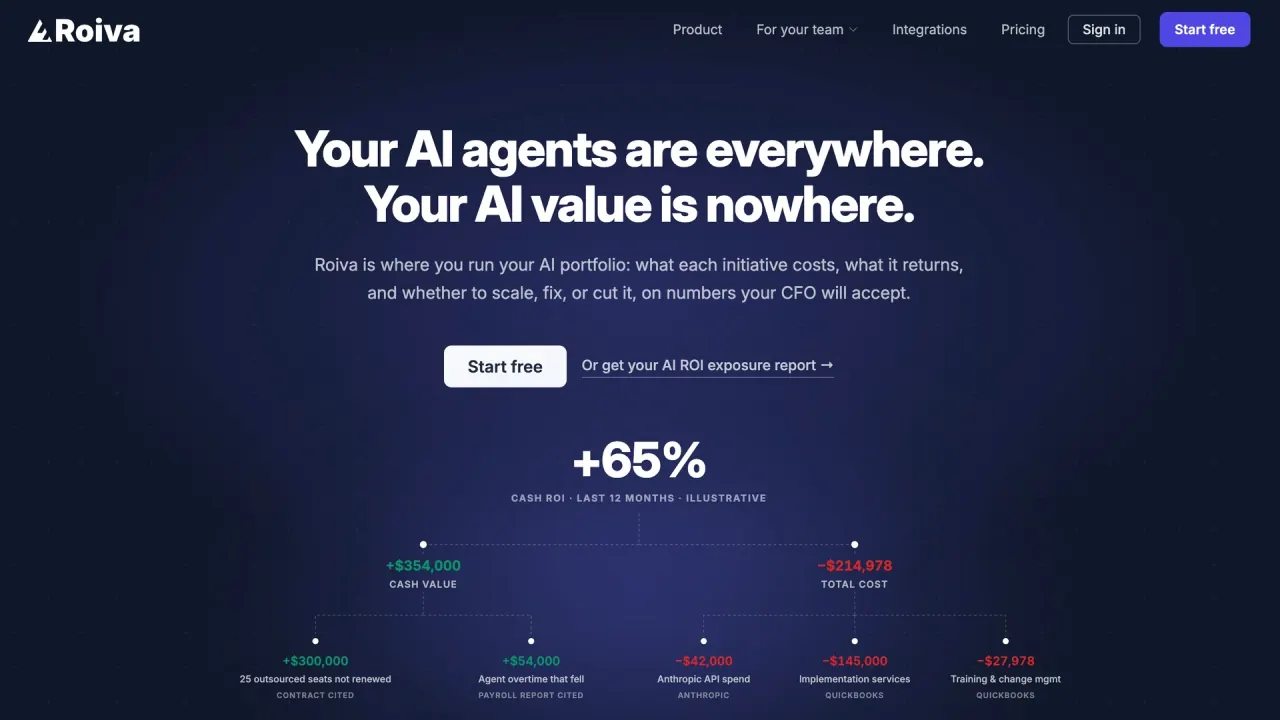

Roiva connects AI initiative costs to approved cash value and separately reported freed capacity. Teams manage budgets, calculation evidence and portfolio decisions in one record.
Used this tool? Rate it
Used this tool? Rate it
Roiva is AI portfolio management software for tracking initiative costs, returns and decisions to continue, scale, fix or retire them. Operated by Roiva LLC, it combines budgets, cost records, value calculations and approvals across business functions.
Roiva positions this financial record alongside an AI governance inventory for risk review. Uploading an exported register produces proposed initiatives for people to review.
Reported AI ROI is cash value minus cost, divided by cost. Only approved value counts; costs count in full without approval. Freed capacity—hours or output priced at labor or largely staff-based unit cost—is reported separately and excluded from ROI.
Capacity becomes cash through a documented monthly entry, capped at that month's approved freed capacity and removed from capacity. Evidence includes a canceled requisition, reduced overtime or a contract not renewed. Payroll falling beyond fully realized capacity is recorded separately, with closed-position evidence and approval by someone who never recorded or edited the entry. Severance belongs in costs.
The signed-off budget—a CapEx total and OpEx rate—is separate from the editable business case. Implementation approval creates it only when cost figures exist; otherwise an Owner/Admin can set it later. Business-case edits leave it unchanged. Revisions retain who changed what and why, affecting current or future months.
Increases above the senior threshold wait for an Owner or delegate, unless proposed by that person; a blank threshold makes every increase wait. QuickBooks/Xero budget comparisons flag differences without changing Roiva's approved budget or gating approval. NetSuite budgets are not read yet.
Portfolio decisions retain the reason and contemporaneous cost, cash, capacity and ROI. Continue, scale and fix keep work running; pause suspends it; retire moves it to Completed. Dismiss stops recurring costs after this month and new allocation/vendor bill bookings; historical ROI remains. Back to Implementing takes a live initiative out for rework. Saved decisions cannot be edited; a changed judgment needs a new one. Next-review dates schedule further review.
The Assistant can create/edit initiatives, record costs and readings, draft value and move eligible stages with the user's permissions. Costs, readings, stage changes and syncs require confirmation; value starts as a draft.
Financial answers use Roiva's reported figures; the Assistant is instructed not to calculate new totals or differences. It cannot approve value, delete anything, change settings or invite people.
The vendor describes a named owner spending roughly two hours weekly in month one. Existing initiatives can use connected history after agreement on formulas and before-values; a new rollout needs weeks of post-go-live readings for comparison.
Owners/Admins connect systems from Integrations through provider sign-in, credentials, a GitHub App or service-account permissions. Ordinary syncs run nightly at 2:00 AM UTC or through Sync Now. Exceptions include incoming Zapier runs, uploaded American Express statements and Slack's notification-only connection.
Brex and Ramp cannot yet connect: their apps await platform approval. Gemini API is also marked Coming Soon.
Metric CSVs must follow Roiva's template and be uploaded manually; arbitrary columns are not mapped and files are not fetched on a schedule. Supported warehouse queries offer a separate nightly route.
MCP is on every plan. Customer-selected assistants read initiative costs, cash, capacity and ROI and, where allowed, draft monthly readings, vendor-bill costs or business-case figures. Nothing changes until a person accepts the draft in Roiva.
Owners/Admins can export a full-account ZIP of CSVs and documents on every plan, including formula versions, budgets, decisions, approvals, synced records and audit log. Credentials and access tokens are excluded.
Prices captured on November 6, 2026 are based on the annual AI spend tracked in Roiva. They are not per-seat prices.
| Access or tracked AI spend | Yearly price | Monthly option |
|---|---|---|
| Free | $0 | No expiry |
| Under $250K | $7,500 | $750 |
| $250K to $500K | $12,500 | $1,250 |
| $500K to $1M | $25,000 | Yearly only |
| $1M to $2M | $45,000 | Yearly only |
| More than $2M | Quoted | Not published |
Free measures five initiatives at once, with unlimited ideas, three integrations and ten seats, without a card.
Paid plans add unlimited measured initiatives, connections and seats, reporting tables and API access. Free includes SSO, MCP, approvals, budgets and function templates; SSO setup is self-service without setup help. The in-app Assistant has a shared monthly allowance and daily cap; the reviewed pricing and Assistant pages give no numerical allowances. At the monthly limit, answers stop until reset or a vendor-authorized increase.
Pricing spend includes AI-provider bills, AI cloud/data lines, AI vendors on connected books/cards and typed AI costs. Salaries, staff time, unrelated cloud spend and unpriced AI features are excluded; AI inside the customer's own product counts only if measured in Roiva. Bands change only at yearly renewal, up or down with tracked spend. Founding customers get 20% off while spots last and renewals remain uninterrupted; references and founder calls can be declined.
Subscriptions are prepaid and auto-renew unless canceled before renewal. Fees are non-refundable except under law, Roiva's Terms or a signed order form.
The $5,000 service measures one initiative live for at least a quarter. Roiva handles setup/data entry; the customer supplies about two hours of interviews and one approval session. Terms include PDF/PowerPoint readouts and unrestricted plan access during the period. Customer admins authorize connections; customers retain value approval and investment decisions. Fees exclude applicable sales/use taxes. Without a subscription afterward, the account and data remain under Free limits.
The fee credits year-one subscription fees only when ordered within thirty days after the Readout ends. Otherwise it is non-refundable, except for vendor-attributable non-delivery: Roiva continues free for up to thirty more days, then the customer may terminate for a refund if still undelivered.
Neither description establishes superior returns or full equivalence.
Roiva says syncs exclude ticket messages, contact details and calendar titles from retained fields. Retained deal/opportunity names, invoice/Stripe customer names, free text and platform IDs can still identify people. Customer-authored warehouse queries keep a month, value, optional breakdown and sample size.
Roiva states that it and its AI service providers do not train/fine-tune models on initiative, metric or integration data. The in-app Claude Assistant sends questions, conversation history and retrieved context to Anthropic, potentially including owner/approver names or emails. Customer-connected MCP assistants are different: their provider's retention and training follow the customer's own agreement, not Roiva's sub-processor terms.
Aggregate Figures Only disables Roiva's account-data AI features and connections except Owner-authorized cloud/AI cost connectors. Files are not retained. Member names, emails, roles, sign-in/IP records, optional SMS numbers, document-link titles/addresses and audit logs remain.
Roiva describes US AWS hosting, TLS 1.2+ transport and AES-256 for sensitive credentials, with RDS records and S3 files separate from the application host. Its SOC 2 Type 2 program began September 25, 2026; observation began October 21. Roiva says no SOC 2 report exists yet; an independent CPA report follows the three-month observation period.
Customers own uploaded/connected data, licensing it to Roiva only to provide the service. Account data stays while active. Workspace deletion removes records, but encrypted backups retain them until thirty-day expiry; a minimal deletion record remains, including a deleted user's hashed email.
User deletion leaves generated workspace reports and accounting-period PBC packets unchanged, including printed names/emails, until report or workspace deletion. Other exports/reporting tables may retain details until expiry; colleague-authored text stays. Roiva's own billing records have separate tax-retention requirements.
Browser analytics require banner acceptance. Separately, fixed signed-in server product events send email and account details to PostHog regardless of that browser choice.
Implementing or Live initiatives, ones paused from those stages and ideas with recorded value count. Drafts, ideas without value and sample data do not; closing an initiative releases a place.
Cancel through support before renewal. Paid access continues to term end, then the account moves to Free without deleting data. Reporting tables and read API switch off; SSO and MCP continue. Above Free's limit, approved value stays, but only the oldest initiatives up to that limit keep booking new value.
No. Attribution is the share your team chooses to credit to AI, not a causal experiment. Legacy pre-v4 formulas that value an entire business-wide change keep calculating until their arithmetic changes.
