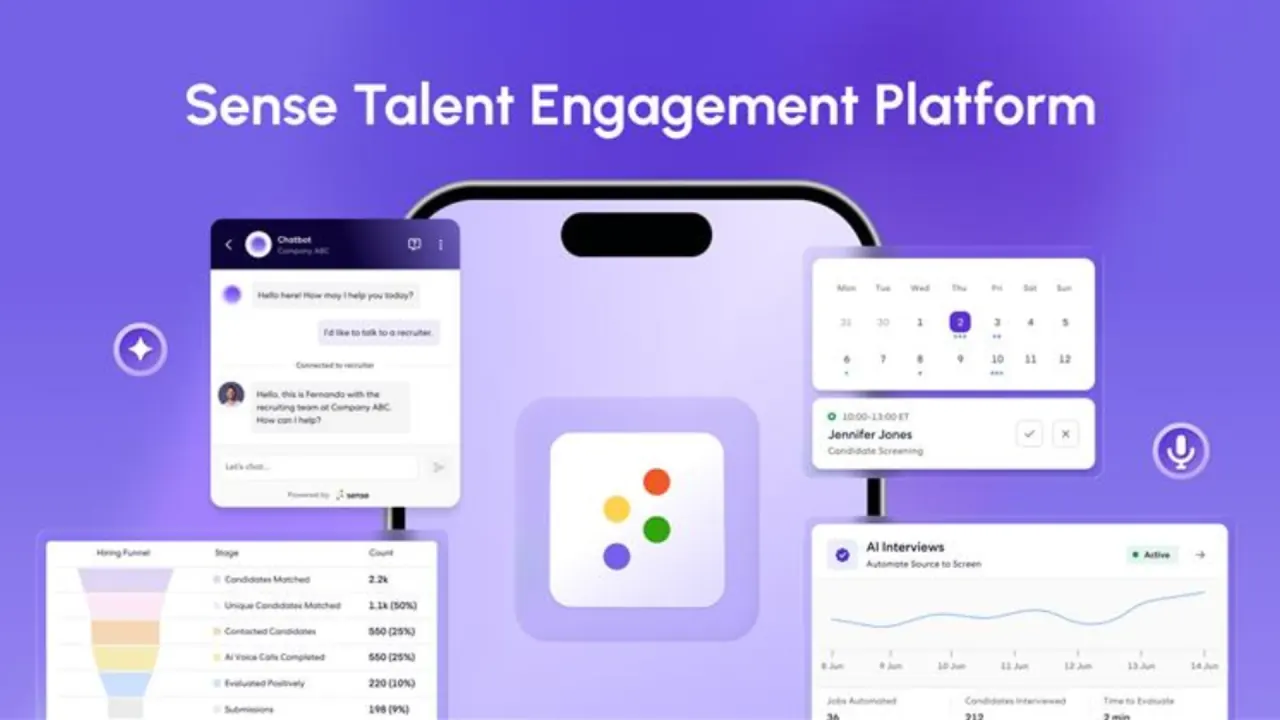

Sense is an AI-powered recruiting platform that automates candidate screening, matching, outreach and interview scheduling on top of an existing ATS. It is sold as quote-based packages for talent acquisition and staffing teams.
Used this tool? Rate it
Used this tool? Rate it


Build forms around real submission workflows


AI image editing from a reference photo


Multi-model image studio, free to start


Natural AI photo editing for portraits and projects


AI assistant for writing, analysis and tasks


From a prompt to a deck, site or doc


Build random generators, share them free


Anime art, powered by a million community models
Sense is an AI-powered recruiting platform that turns an existing ATS into what the vendor calls an active talent engine. Its homepage invites teams to automate their recruiting process exactly how they want it. AI recruiting automation is the precise short description: it automates engagement, screening, matching, messaging and scheduling around the system of record rather than replacing it. Modules share one candidate database and one ATS connection, not a single chat window.
The homepage says teams can automate early outreach or run roles end to end. Its hero states that Sense automatically screens, matches, and engages candidates across their favourite channels, with AI handling repetitive work so recruiters can focus on closing candidates. Six capability areas are named: Voice AI, Automation, CRM, AI Chatbot, Messaging and Scheduling.
The company says AI should enhance human decision-making rather than replace it, with every employment-impacting decision made by people. Its AI policy calls the product decision support, not a decision maker, and says all outputs are subject to human review, editability, and override; this is a vendor commitment rather than an independently audited outcome. The homepage states that Sense accelerates hiring for 1,000+ market leaders, as captured on November 22, 2026, a vendor-reported reach figure rather than a verified customer count. A demo request, sign-in and quote form are visible; no self-serve free account is described.
Six capability areas are named on the homepage — Voice AI, Automation, CRM, AI Chatbot, Messaging and Scheduling — and each is sold as a module that can be automated independently. The same candidate record moves between them, so a workflow is not rebuilt at each step.
The shared feature set includes Talent CRM, workflows, chatbot/SMS/WhatsApp/Voice AI screening, candidate matching, an AI chatbot, campaigns, events, landing pages, analytics, onboarding communication and being integrated with your ATS. Candidate screening is tied to human oversight: match scoring includes explainable reasons, and AI content is editable by humans. A candidate can be sourced, matched, screened and scheduled without re-keying the record. No built-in job board, assessment library or background-check service of Sense's own is described.
Getting started is quote-led: the pricing page asks for a quote and company employee count. No free trial is documented; onboarding is part of a purchased package. The product pages imply four steps:
No public API reference, self-serve sandbox or named setup wizard is described. Human review is part of the product design: the AI policy assigns employment-impacting decisions to a person.
High-volume recruiting is the main setting. The site lists industry solutions for financial services and insurance, healthcare, retail, restaurant and hospitality, logistics and transportation, manufacturing and warehousing, staffing, and technology and IT. These verticals share many open roles, many candidates and a need to re-contact people already in a database rather than source every role from scratch.
A customer story on the homepage describes using text messaging, chatbots and creative re-engagement campaigns to connect and engage with talent. One customer story reports a 30% reduction in time-to-match and a 40% increase in candidate conversion. Another reports a 4x increase in completed interviews, 50% faster time-to-screen and 18 hours saved per recruiter per week. Both are vendor-published testimonials, not independently verified measurements.
Three patterns recur. Re-engaging an existing talent pool is one, with vendor and independent editorial comparisons placing Sense in a staffing-agency and talent-pool-reactivation context. High-volume screening and scheduling is the second, where voice AI, chatbot screening and automated interview scheduling replace manual phone and calendar work. Onboarding and post-offer communication is the third, supported by the feature list and a customer quote extending to a candidate's first day. No small-team single-role use case is shown; pricing, verticals and messaging all point at volume.
It fits talent acquisition teams, staffing agencies and employers hiring at high volume with an existing ATS, because the platform is built on top of that system rather than replacing it. If the bottleneck is weekly candidate contact, screening and scheduling volume, the automation modules address it directly; poor ATS data quality is not fixed by the platform itself.
A vendor-authored comparison distinguishes direct employers from staffing agencies and frames a single-ATS automation product as tied to one ATS while Sense works with many ATSs; this is positioning rather than an independent test. The pricing page reinforces the split with Talent Acquisition, Staffing Teams and Enterprise Staffing editions. It fits less well for a small team wanting a published per-seat price and self-serve signup, since the lowest package starts at $500 per month and pricing is quote-led. Anyone seeking autonomous AI hiring decisions is also a poor fit, because the vendor reserves employment-impacting decisions for people.
The platform is a web service with sign-in and demo-request entry points, not a downloadable desktop app. Browser access is described; no native client, minimum operating-system version or offline mode is listed. Chrome Extension and Mobile App belong to messaging; scheduling adds calendar connection, round robin and panel scheduling, ATS integration and automated reminders.
A vendor comparison page names Bullhorn, Avionte Bold, Job Diva, Erecruit, LaborEdge, Tempworks, and ABD as ATS partners and says a single-ATS automation product works only within its own ecosystem while Sense works with many ATSs. The list is vendor-published, not a verified catalogue; pricing confirms ATS integration with platform packages.
Messaging covers 1:1 and bulk SMS and WhatsApp; screening can run by chatbot, SMS/WhatsApp or Voice AI, and Voice AI adds phone calls for reference checks. Candidate channels are broad, but customers need a supported applicant tracking system, or an ATS the vendor agrees to connect during implementation.
Six packages list a monthly starting price in USD and are labelled 'Starting at', not fixed fees. The page combines platform editions with standalone modules, so a buyer can take the whole platform or only messaging or scheduling.
| Package | Starting price | What the page lists |
|---|---|---|
| Sense Platform for Talent Acquisition | $7,000 per month | Talent CRM, workflows, messaging, scheduling, screening, matching, referrals, campaigns, events, landing pages, analytics, onboarding, ATS integration |
| Sense Platform for Staffing Teams | $2,000 per month | The same shared feature list for staffing organisations |
| Sense Platform for Enterprise Staffing | $2,000 per month | The same shared feature list, sold via a quote request |
| Sense AI Recruiter | $3,000 per month | Orchestration, messaging, scheduling, screening, matching, evaluation and onboarding agents |
| Sense SMS/WhatsApp Messaging | $500 per month | 1:1 and broadcast bulk messaging, conversation search, templates, shared inboxes, Chrome Extension, Mobile App |
| Sense Interview Scheduling | $500 per month | Calendar connection, round robin/panel scheduling, ATS integration, automated reminders, Chrome Extension |
The Talent Acquisition platform starts at $7,000 per month, Staffing Teams and Enterprise Staffing at $2,000, AI Recruiter at $3,000, and the standalone messaging and scheduling packages at $500 each. The subscriber agreement states all dollar amounts in United States Dollars.
Each package includes a dedicated customer success manager, an implementation manager, first three months of hypercare and 24/7 support. Employee-count bands are 1-200, 200-1,000, 1,000-5,000 and 5,000+. No annual-versus-monthly toggle, published per-seat rate or free tier is described; the quote form leads to a final price.
One 2026 editorial comparison of AI recruitment chatbots places Sense as the pick for staffing agencies that want to reactivate an existing database, alongside Paradox, Humanly, XOR and Noota. A separate 2026 comparison of enterprise AI recruiting chatbots lists Paradox, Fountain and Sense among the tools teams run upstream. The same comparison notes that Workday completed its acquisition of Paradox in October 2025. Neither is a hands-on test; they show only that buyers compare these products, not rank their quality.
It also says pricing across this category is custom-quoted rather than published. A team whose ATS is already Bullhorn and whose problem is re-engaging a large candidate database sits closest to the use case Sense is written for; a team standardising on a different core HR stack, or one needing a front-of-funnel assistant inside a specific enterprise suite, is pointed toward the other named products.
Fees paid under the subscriber agreement are non-refundable, and Sense requires auto-payment for recurring installments of less than $10,000. These contractual terms change what a buyer commits to before implementation begins.
The company says it does not use or infer protected attributes such as race, gender or age, that models are audited regularly, and that candidates are told when AI is involved; these are vendor-authored commitments with no published third-party audit report.
The privacy policy lists improving services, including training artificial intelligence models, as a use of personal information. The AI policy says clients may opt out of training contributions. It also says customers may opt out of data training; both vendor statements are reported rather than reconciled. Google Workspace APIs are not used to develop, improve or train generalized AI and ML models. Candidates are notified and may opt out, and sensitive information is anonymized or excluded where feasible. The policy includes international transfers, retention and rights for residents of California, Virginia, Connecticut, Utah, Colorado, Nevada and other states.
No. The Conversational CRM lives in the ATS, and the feature lists include being integrated with your ATS; Sense automates work around an existing system of record.
Six packages have starting prices: Talent Acquisition at $7,000 per month, Staffing Teams and Enterprise Staffing at $2,000, AI Recruiter at $3,000, and SMS/WhatsApp Messaging and Interview Scheduling at $500 each. All are 'Starting at' figures in USD obtained through a quote or RFP request.
No, according to the vendor's AI policy. Employment-impacting decisions are made by people, AI is decision support, and outputs remain subject to human review, editability, and override.
The vendor comparison page lists Bullhorn, Avionte Bold, Job Diva, Erecruit, LaborEdge, Tempworks and ABD as ATS partners; the pricing page lists ATS integration among shared features. The partner list is vendor-published, not a verified catalogue.
The privacy policy lists training artificial intelligence models among its uses of personal information, while the AI policy offers opt-outs from training contributions and data training. Google Workspace APIs are not used to train generalized AI or ML models.
No free tier or self-serve checkout is described. The pricing page asks for a quote or RFP request and an employee-count band; each package includes onboarding support and 24/7 support.