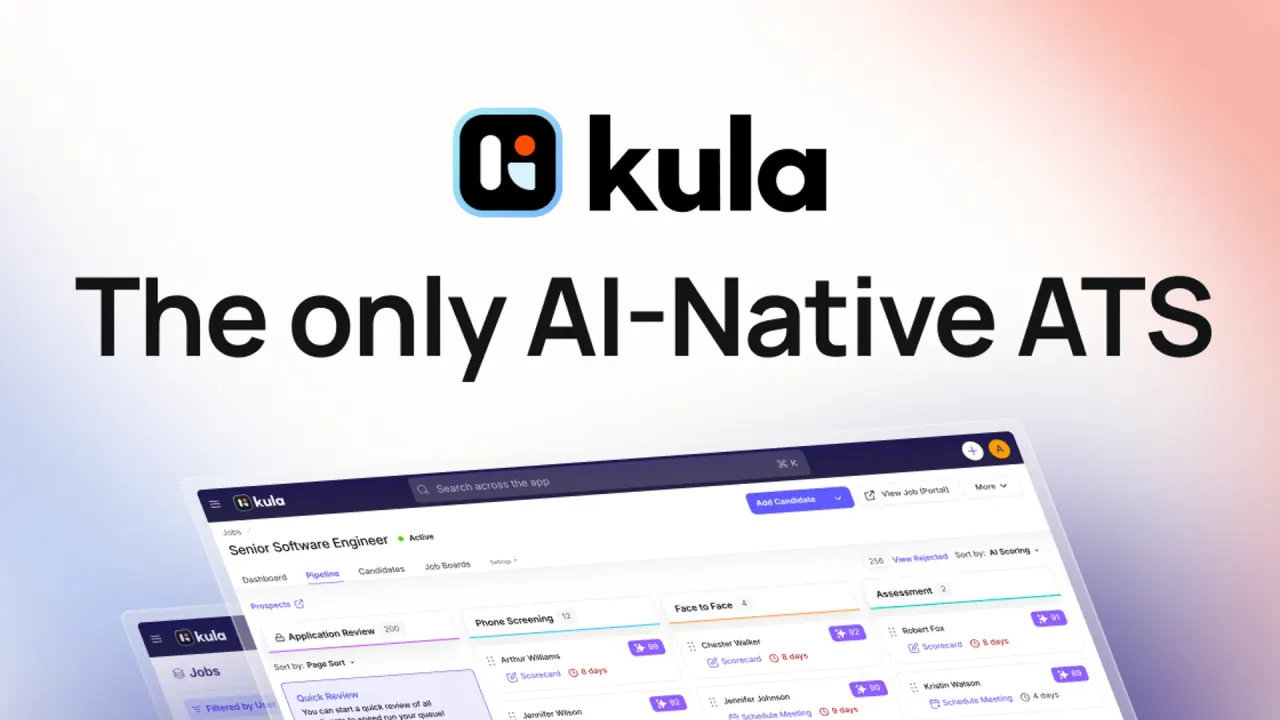

Kula is an applicant tracking system that combines candidate sourcing, AI scoring, interview scheduling, an AI notetaker and conversational analytics, sold on annual plans priced by company headcount.
Used this tool? Rate it
Used this tool? Rate it
Kula is a web-based applicant tracking system for in-house recruiting teams that keeps sourcing, screening, interview scheduling, interview notes and hiring analytics in one workspace. The company markets the Kula ATS as "the only AI-Native ATS, built by recruiters, for modern hiring", which is a vendor tagline rather than an independently verified ranking.
The operator named in the legal terms is Kula Technologies Inc., registered in Delaware, with a place of business in Walnut, California, and a further business address in Singapore. Co-founder and CEO Achuthanand Ravi (Achu) writes that he built an internal hiring system during recruiting roles at Stripe, Uber and Freshworks before starting the company with two engineer friends.
The product began narrower than it is today. In August 2022, independent tech press described Kula as a tool that integrated with LinkedIn, GitHub, Gmail and an existing applicant tracking system to automate recruiter outreach. The same report covered a $12 million seed round co-led by Sequoia Capital India and Square Peg Capital, which brought total funding to $15 million before public launch. Kula now positions itself as a full ATS replacement rather than an add-on to another system.
The name is shared with unrelated products, including an AI mobile app builder; this page covers only the recruiting platform.
Kula's main argument as an AI-native ATS is consolidation. The company says it "connects sourcing, screening, interviews, analytics, and scheduling into a single AI-native workflow", so a candidate found through the browser extension, scored by AI, interviewed and reported on stays in one record instead of moving between separate sourcing, scheduling and note-taking tools.
Kula's Fraud Detector, presented as the first of its "AI teammates", checks each application for signs of fake candidates. The Fraud Detector cross-checks signals across identity, network and behavior, including device and IP fingerprints, disposable or breached contact details, location spoofing and bot activity. Every applicant is returned as flagged, inconclusive or cleared, with the reasoning listed signal by signal. The company states that the detector is native to Kula and switched on for existing customers, with no separate login or integration.
Kula is sold through a sales-led process. The calls to action on the pages checked are booking a demo and taking a free product tour; no self-serve sign-up or free trial was found on them.
Kula says teams can switch in 4–6 weeks with an implementation manager assigned to the project. The published migration process has three stages:
A customer success manager and ongoing support continue after go-live, and the company says support runs through Slack, in-app chat and email.
Kula offers a hosted MCP connector, so recruiters can query and update Kula from an AI assistant chat. Setup follows the developer documentation:
Every action runs with the user's own Kula role and permissions, so it can't see or do anything the user can't. Lookups run automatically, while tools that change data ask for confirmation first. The connector exposes 48 tools across applications, candidates, jobs, interviews, requisitions, users, templates and reference lists.
Kula targets in-house talent acquisition teams rather than individual job seekers. The company says it fits companies whether they are hiring their first 20 employees or scaling across regions, and tailors its pitch by company stage:
Among AI recruiting software, Kula is a weaker fit for buyers who want self-serve sign-up without a sales conversation, since plans start with a demo and annual billing is the standard. Teams whose main need is deep interviewer coaching may also prefer a dedicated interview-intelligence tool, as noted under the alternatives below.
Kula runs as a web application on a company workspace subdomain, with sourcing handled through its Chrome extension. The remaining access points are integrations, an API and an MCP server:
Kula pricing is based on company headcount rather than seats, and the company says every customer gets the full platform. It also says it never charges for AI or usage, and integrations and support are included in all plans. The pricing page uses a headcount selector:
| Company headcount | Price shown on the pricing page | Billing |
|---|---|---|
| 1–50 employees | $4,800/year in the rendered default view; $5,120/year in the page's static text | Annual |
| 51–75 employees | Not shown in the default view | Annual |
| 76–100 employees | Not shown in the default view | Annual |
| 101–1k+ employees | Custom pricing | Book a call |
The two figures for the smallest band come from the same page as captured on October 6, 2026, and a browser rendering shows $4,800 per year with the 1–50 band selected. The text served before scripts run shows $5,120 per year beside the four headcount bands. Kula offers annual billing as the standard, with flexible payment terms available on request.
Other price-related terms on the official pages:
Kula frames its main competitors through a set of comparison pages, published against Workable, Lever, Greenhouse, JazzHR, Ashby and Gem. These pages are vendor-written: for example, Kula's Greenhouse page argues that Greenhouse lacks built-in sourcing, analytics, note-taking and scheduling.
The trade-off is breadth against depth: Kula replaces several tools with one bundle under a single headcount price, while specialists may go deeper in one area.
Kula states that it meets NYC Local Law 144 compliance and is "on track with the EU AI Act", with regular audits and real-time bias reports. The pricing page lists ongoing fairness and bias audits by Warden AI. The homepage, by contrast, lists the EU AI Act alongside California FEHA, Colorado SB205 and NYC Local Law 144 under "AI Compliance" without the "on track" qualifier. These are the vendor's own statements, and the pages use different wording.
Fraud screening keeps a human in the loop: Kula states that nothing is auto-rejected and that applicants are told fraud detection is part of the process. A flag is a prompt for a recruiter decision rather than an automatic rejection.
Public user-review samples are thin: the one accessible launch-platform listing had only three reviews as captured on October 6, 2026, too few for a quality conclusion. Most speed, savings and accuracy figures on Kula's pages are vendor numbers.
No free plan or free trial appeared on the pages checked. Access starts with a demo or a free product tour, and paid plans are billed annually by company headcount.
For 1–50 employees, the rendered pricing page showed $4,800 per year while its static text showed $5,120 per year as captured on October 6, 2026. Prices for 51–100 employees were not shown in the default view, and companies above 100 employees get custom pricing.
The company says it never charges for AI or usage. AI scoring, the notetaker, writing assistance and conversational analytics are listed as included in all plans.
Kula states that its Fraud Detector does not auto-reject applicants; flagged candidates go to a human decision. AI scores rank applicants against the team's criteria, and recruiters choose who moves forward.
The hiring company is the data controller, and Kula processes candidate data on its instructions.
Yes. Kula's hosted MCP connector works with paid Claude plans and with other MCP clients that support remote servers with OAuth, and changes to data require user confirmation.
