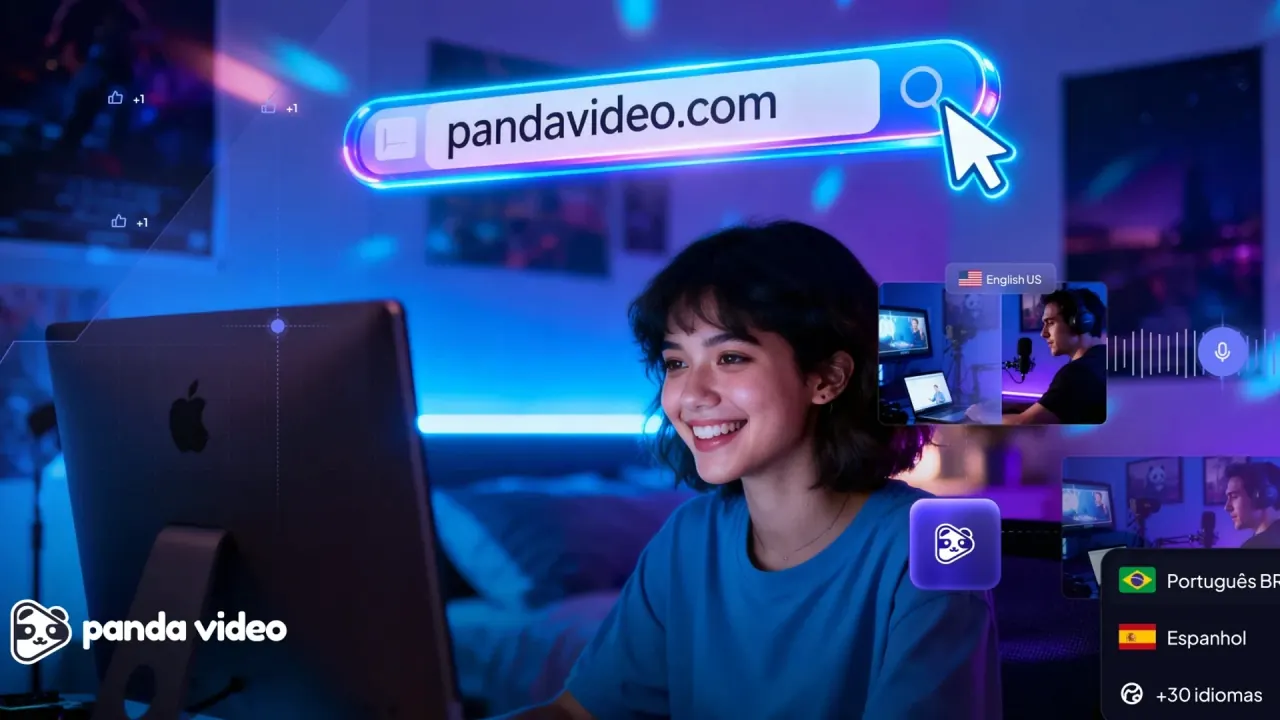

Panda Video is a business video hosting platform that protects course and sales videos with watermarking, DRM, and AI features such as dubbing in up to 34 languages.
Used this tool? Rate it
Used this tool? Rate it

Track AI budgets, cash returns and portfolio decisions


Edit, caption, and generate video in one place


Track public AI usage-limit reset signals


AI image editing from a reference photo


Multi-model image studio, free to start


Natural AI photo editing for portraits and projects


AI assistant for writing, analysis and tasks


From a prompt to a deck, site or doc
Panda Video is a hosted video platform for businesses, course creators, and infoproducers. The Terms of Use glossary defines it plainly: "PANDA VIDEO: Platform that offers video hosting and streaming services." The operator is PANDA VIDEOS LTDA., registered under CNPJ 40.486.278/0001-35 and headquartered at Avenida Ana Costa 59, Gonzaga, Santos/SP, Brazil. A launch-tracking directory entry, as captured on November 27, 2026, records the product as launched on March 13, 2026.
The vendor's own home page headlines it as "the most complete video hosting solution" and promises to "host, protect, and supercharge your videos with artificial intelligence" — that is the company describing itself, not an independent finding. Marketing pages and the help centre both position the product around protected video: watermarking, anti-download tooling, and AI features such as dubbing and subtitles wrapped around a customizable, ad-free player.
Three editorial scores were captured on November 27, 2026, and all three publishers disclose commercial relationships on the same pages. One review directory gives Panda Video 3.8/10 and ranks it #58 of 114 paid video hosting platforms. A second editorial review, updated November 8, 2026, gives 6.9/10, described as "Good, with trade-offs". A third gives 4.1 out of 5. None of this round's checks surfaced an independent review sample of 20 or more reviews, so these scores are directional context only and not a quality conclusion. The paid listing at #58 sits beside the directory's own statement that vendors can pay for top positions in its rankings, so the rank position is not treated as an independent verdict here.
Security is sold in two levels. The Regular level includes a visible watermark in the player and encryption against manipulation at no additional cost. The Advanced level, priced at US$ 0.60 per GB of bandwidth, embeds a permanent watermark into the video itself. Beyond watermarking, the allowed-domains feature lets you define exactly which domains and subdomains your videos can be embedded on — websites, blogs, or membership areas you explicitly allow. DRM video protection at the Advanced level is therefore a per-GB cost decision, not a one-time add-on.
The company is explicit that protection has limits: "Although Anti-Download significantly increases protection, no technology guarantees 100% blocking against piracy, and no serious platform promises that." That statement is the vendor's own, and it matches how the feature is sold — as layered deterrence rather than prevention.
The AI suite covers four areas. AI-generated subtitles are built for multi-speaker audio, with SRT or VTT files uploadable if you are migrating from another platform. AI video dubbing adds lip synchronization across markets. Panda AI generates ebooks, quizzes, and mind maps directly in the player. A Tutor feature rounds out the set. Subtitles and dubbing are bundled free on the Gold plan, which is the plan tier where the AI entitlements are spelled out on the pricing page.
A built-in Video Editor cuts sections, adds text, images, and subtitles, switches between horizontal and vertical formats, chooses a background color, and uses files from your computer; it sits in the dashboard's Studio menu. For audience engagement, the platform lists A/B testing to discover which video version converts best, chapter markers to organize a video into topics, and a screen recorder for quick lessons and team messages. Live streaming for online courses and webinars is marketed as lag-free, and paid entitlements cap how many simultaneous lives a plan can run. The Tutor feature stands out: it creates AI assistants trained on your own videos, so viewers get answers sourced from the material itself.
The analytics dashboard summarizes the last 30 days of plays, average retention, and bandwidth usage, breaks metrics down by device, browser, viewer location, and traffic source, and exports charts and tables in PNG, PDF, or CSV. The same dashboard shows account usage in real time with a daily chart and an estimated forecast for the month, which matters because both storage and bandwidth are metered on every self-service plan.
Moving an existing library in is the first workflow most teams need. The vendor promotes a Chrome extension for this: "Use our Chrome extension to import your videos to Panda in minutes." Migration from Vimeo is the named example on the home page.
Subtitle workflows are equally direct. You can generate subtitles automatically or upload existing SRT or VTT files, then fine-tune wording and timing in the built-in subtitle editor. Once videos are live, the dashboard's real-time usage view and daily forecast chart let you track bandwidth consumption against plan limits before overage rates apply. Metering is not intuitive: the help centre notes that if a video is 1GB in size it does not necessarily consume 1GB of bandwidth, so plan the month from the dashboard's measured numbers rather than file sizes.
Course creators and infoproducers selling video products are the clearest fit — this is video hosting for courses in the literal sense: an ad-free, customizable player plus domain locking that keeps embeds restricted to your own membership or landing pages. For creators serving multiple markets, the dubbing feature translates videos into up to 34 languages with lip synchronization on the feature page. The home page hero says 33, so the two official pages disagree on the ceiling and neither figure is treated as authoritative here.
E-learning teams run the same stack: lessons stay downloadable in the mobile app through expiring, app-scoped downloads with QR codes in the player. Instructors control how long each video remains available offline. Course material extends past the video itself — Panda AI generates ebooks, quizzes, and mind maps in the player, turning one recorded lesson into study assets.
Brazilian info businesses are the primary audience. The Portuguese home page states that all plans are billed in reais and that payment runs by credit card and boleto bancário — a local payment path the English page does not mention. For VSL hosting specifically, a low-confidence verdict from a community comparison service, analyzed September 19, 2026, reads: Plausibly fine for course creators and VSL marketers wanting flat-priced, ad-free hosting, but verify plans and terms with the vendor.
Creators who cut short-form clips from long recordings get a dedicated Clipper add-on, listed at $3,90 per month (50% OFF) for the first two months with 12 renewable monthly credits, enough to cut videos up to 2 hours long. Teams above ten users, or anyone needing custom storage and bandwidth, are pointed at the Enterprise tier negotiated with sales rather than a published plan.
The English pricing page runs a Black Friday banner — 20% OFF for 3 months on every plan — and the plan cards below carry both figures.
| Plan | List price | First 3 months | Storage | Bandwidth | Team members |
|---|---|---|---|---|---|
| Bronze | $17.90/mo | $14.32 | 200 GB | 500 GB | 1 |
| Silver | $37.90/mo | $30.32 | 512 GB | 1 TB | 2 |
| Gold | $97.90/mo | $78.32 | 1 TB | 4 TB | 10 |
| Enterprise | Upon request | — | Custom cost per GB | Custom | — |
Overage is prepaid-and-postpaid mixed: additional storage costs $0.06 per GB, additional bandwidth $0.03 per GB, and watermark protection is metered at $0.60 per GB. When the contracted bandwidth limit is exceeded, videos keep playing and postpaid bandwidth is charged automatically, but the account holder can suspend postpaid usage and switch to prepaid bandwidth at any time. Gold adds free AI subtitle, Tutor, and Mind Map/Quiz/eBook generation, 2 simultaneous lives, up to 10 users per account, and Anti-download.
The Brazilian lane prices the same ladder in reais — Bronze at R$ 97,90 per month, R$ 78,32 for the first 3 months, with overage of R$ 0,18 per GB of storage and R$ 0,15 per GB of bandwidth — and the Portuguese FAQ adds boleto bancário as a payment method while stating that all plans are billed in reais.
Access terms shape the real cost. The trial period lasts 14 days, bandwidth is limited during it, and the terms say videos should not be used in production in that window. Plans can be upgraded, downgraded, or canceled at any time from the dashboard. Three official figures disagree on the postpaid bandwidth rate: the pricing page shows $0.03 per additional GB, the English Terms of Use state $0.06/GB, and the Portuguese terms state R$ 0,30/GB. All three are recorded side by side; this page does not pick one. A vendor blog post also describes Bronze as 200 GB of storage and 300 GB of bandwidth, which conflicts with the live pricing page's 500 GB — the blog figure appears to be an older published ladder, and the conflict is reported rather than reconciled.
Independent editorial roundups place Panda Video in a crowded field. One roundup names Vimeo, Brightcove, and Dacast as the top alternatives among 15 compared video hosting platforms. A second editorial ranking checked September 23, 2026 places Muvi Flex, Spotlightr (formerly VooPlayer), MediaCMS, and Streamable beside Panda Video — Muvi Flex from $8.25/mo with a free trial, Spotlightr from $13/mo with a free trial, MediaCMS as open-source and self-hosted with a free plan (from $2,000/mo), and Streamable with a free plan from $9.99/mo. Both sources disclose affiliate relationships, and neither ranking is treated as a quality verdict; they establish which products buyers actually compare, and competitor sites themselves can confirm the features named here.
A Brazilian consumer-protection register, as quoted in a dated secondary reading from an affiliate-disclosed review, recorded 6 complaints in the six months to August 31, 2026, 100% answered, with an average response time of 12 hours. That figure is a third party's dated reading of the register, not a primary record, and the register itself could not be read directly in this round.
The privacy policy states that PANDA does not store user payment data and that Stripe processes transactions client-side without sensitive data reaching its server. Collected data is hosted on servers in the United States, and the policy says using the services constitutes consent to processing and transfer of data to Brazil and the United States. The policy excludes anyone under 13: such data is not collected, and discovered accounts are canceled and deleted. Data not required by law to retain is deleted, destroyed, or anonymized. The policy also affirms that personal data belongs to the user, with rights granted under international laws. On training or secondary use of customer content, the policy pages checked in this round make no statement.
Panda Video is operated by PANDA VIDEOS LTDA., a Brazilian company registered under CNPJ 40.486.278/0001-35 and headquartered in Santos/SP, per its own privacy policy and terms.
The dubbing feature page says up to 34 languages with lip synchronization; the home page hero says up to 33. The two official pages disagree, so treat either figure as the vendor's range rather than a verified ceiling.
The English FAQ says credit card. The Portuguese page adds boleto bancário and states that all plans are billed in reais. The two pages describe different lanes, and the payment path you get depends on which locale you buy through.
Yes — 14 days, with bandwidth limited during the trial, and the terms state videos should not be used in production during that period. A credit card is the payment method on the English lane.
No. The company's own help centre says anti-download significantly increases protection but that no technology guarantees 100% blocking against piracy, and that no serious platform promises otherwise.
This round's checks captured only affiliate-disclosed editorial scores (3.8/10, 6.9/10, and 4.1/5) and no independent review sample of 20 or more reviews, so no rating in this round can be read as a quality conclusion.