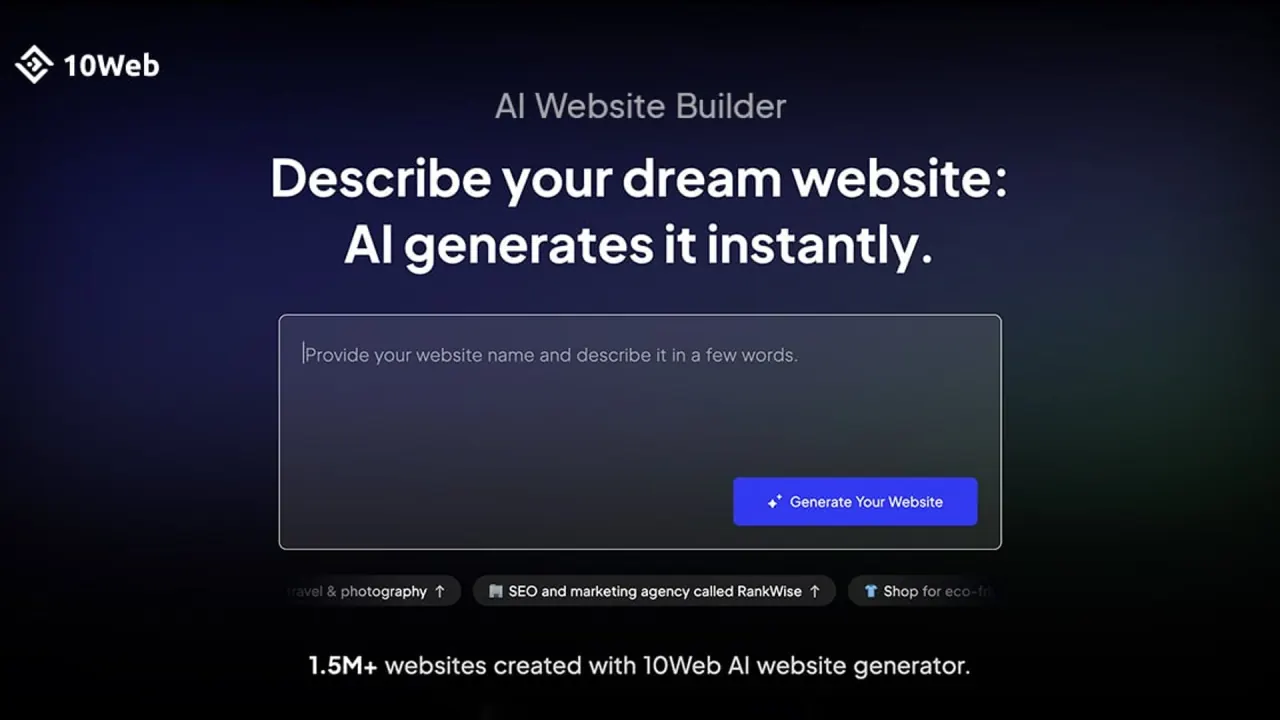

10Web turns a prompt, a link or a file into a hosted WordPress website, online store or web app, with hosting, payments and logins set up during the build. Editing continues through AI agents, a visual editor or the code.
Used this tool? Rate it
Used this tool? Rate it


From a prompt to a deck, site or doc


Product photo editing for online stores


Plan, build, and refine work with an AI agent


One-click AI background removal at scale


AI image editing from a reference photo


Multi-model image studio, free to start


Natural AI photo editing for portraits and projects


AI assistant for writing, analysis and tasks
10Web is an AI website builder that turns a prompt, a link, a file or an existing social profile into a working website, online store or web app, then hosts it. What a launch usually assembles in separate pieces — hosting, SSL, database, logins, payments and a security check before publishing — is configured during generation.
The difference from most tools that generate a page from a prompt sits underneath. Every project is a standard WordPress installation, the visible front end is a generated React app, and features the builder does not cover are generated as WordPress plugins. The admin panel, file and database access and a catalogue of more than 60,000 plugins remain, and the company says content and data can always be exported.
Websites, stores and apps are three outputs of one engine rather than three products. A website gets pages, bookings and SEO; a store gets products, checkout, orders and shipping; an app gets tables, logins, roles and plans. Holding two of them means two projects inside one account.
The company reports more than 2 million projects built since 2017, hosting and support on every plan, and a 30-day money-back guarantee on paid plans. Independent technology press coverage in February 2024 recorded 1.5 million sites generated and $5 million in annual recurring revenue at the time; those are 2024 snapshots, not live readings.
The builder accepts more than a prompt, and the kind of input decides how much is written for you.
Each output pulls a different part of the same feature set.
Custom records carry the app side: tables and relations defined per project, each exposed through an API from day one. A feature that fits no module is built as a plugin with its own admin screen.
There are three, and they are not exclusive.
Payments run through 10Web Payments, which takes a 7% transaction fee on the free plan on top of Stripe processing fees; the table below lists the paid-plan rates.
A build has four steps, and only the first asks for input.
Credits are the unit of AI work, and one balance covers building a project, regenerating a page, redesigning, cloning and importing from a link. Large tasks consume more, and paid plans refill every month. A broad redesign can therefore cost several times the first build.
The use-case index reads as a catalogue of small businesses, and three patterns account for most of it.
Replace an outdated site without losing what it earned. The old-site route is described as keeping the same URLs, applying a new design, loading faster and keeping the rankings already earned. For a business whose site works but looks dated, that is a different job from starting over: the pages and the inbound links stay where they are.
Turn a social presence into a store. Instagram posts become products, captions become the basis for prices, and an Etsy shop can be moved with its listings and reviews rather than rebuilt item by item.
Build the internal tool nobody wants to commission. A written brief becomes a client portal with a login per client, two-way files, approvals and invoices; a spreadsheet becomes an inventory tracker staff log into; contacts become a CRM.
The product fits teams that want the output to be an ordinary website they can hand to someone else, and that accept a WordPress admin in exchange.
Three situations fit less well. Anyone who wants one closed dashboard will find the admin and the plugin catalogue an extra surface. Anyone who needs a predictable invoice should read the credit rules first, because regenerating and redesigning draw on the same balance as the first build. And anyone who needs a custom domain, backups or support from day one is on a paid plan immediately.
Prices are from the pricing page on 26 November 2026, with yearly billing selected.
| Plan | Price | Projects | AI credits | Storage | Monthly visitors | Fee |
|---|---|---|---|---|---|---|
| Free | $0 | 1 | 15 | 200 MB | 1K | 7% |
| AI Starter | $10/mo | 1 | 100/mo | 10 GB | 10K | 2% |
| AI Premium | $15/mo | 2 | 200/mo | 15 GB | 20K | 0% |
| AI Ultimate | $22.50/mo | 4 | 300/mo | 25 GB | 50K | 0% |
| Agency Starter | $42.50/mo | 10 | 400/mo | 50 GB | 80K | 0% |
| Agency Core | $80/mo | 20 | 600/mo | 120 GB | 120K | 0% |
| Agency Pro | Custom | 50+ | 800/mo+ | Custom | Custom | As low as 0% |
The credit column alone does not decide it. Paid plans show a yearly rate, and the page states the monthly basis: AI Starter is $120 for 12 months against a regular price of $240, and the same halving applies down the line. Free is card-free and open-ended, on a 10web.site subdomain.
Three rules change the arithmetic after signup.
Every paid plan includes a domain credit of up to $30, covering a first custom domain for a year or applied as a discount on a more expensive one.
10Web publishes its own comparison against Lovable, Wix and a self-hosted WordPress install, and the three differ in ways that decide the choice before price enters.
Independent coverage offers the same reference. Technology press reporting in February 2024 described 10Web as entering a race that already included Wix and Squarespace among established players, and noted that WordPress, unlike those closed platforms, requires the owner to manage hosting and backend tasks. That supports the portability argument without vouching for the company's claims about competitor features.
Two options sit outside the comparison. A hosted builder in the Wix or Squarespace mould removes the hosting decision but keeps the site inside its platform. A full WordPress host gives the most control and the most maintenance, with the AI layer left to separate plugins.
The free plan carries the strictest conditions, and they are documented rather than hidden.
To build and publish, yes. The free plan allows one project on a 10web.site subdomain with hosting and SSL, 15 AI credits and a 10Web badge, but no custom domain and no backups. Paid plans add both, monthly credits and a higher hosting tier.
No. The site is generated from a description or a link, and changes are requested from the AI or made in the visual editor. Code access, custom code, FTP and a full export exist for anyone who wants them, but they are optional.
Yes. Each build is a standard WordPress installation with admin, database and plugin catalogue, and the visible front end is a generated React app. Because the output is ordinary WordPress, the site can be moved to another host.
The project and everything built in it stay online. Continuing with the AI means topping up at $0.40 per credit in packs of 50, or moving to a plan with a monthly allowance.
On any paid plan. A domain credit of up to $30 is included, covering the first year or discounting a more expensive domain. The 10web.site subdomain keeps working until the new domain is connected.