
Toolso.AI
Toolso.AI
All ToolsCategoriesTrendingLatest ToolsPricingBlog
Toolso.AI
Toolso.AI
Toolso.AI
Toolso.AI

Discover the best AI tools to boost your productivity

GitHubGitHubTwitterX (Twitter)YouTubeYouTubeTikTokEmail

Popular Categories

  • AI Writing
  • AI Image
  • AI Video
  • AI Coding
  • More Categories

Explore

  • Latest Tools
  • Popular Tools
  • More Tools
  • Submit Tool
  • Pricing

About

  • About Us
  • Contact
  • Blog
  • Changelog

Legal

  • Cookie Policy
  • Privacy Policy
  • Terms of Service
  • Refund Policy
© 2026 Toolso.AI All Rights Reserved
Limited timeLimited-time offerFeatured Listing24h priority review · No backlink · 30 days featured$29.90then $59.90Price rises to $59.90 after Oct 31Ends in--:--:--Submit now
  1. Home
  2. All Tools
  3. Website Generator
  4. Studio.Design
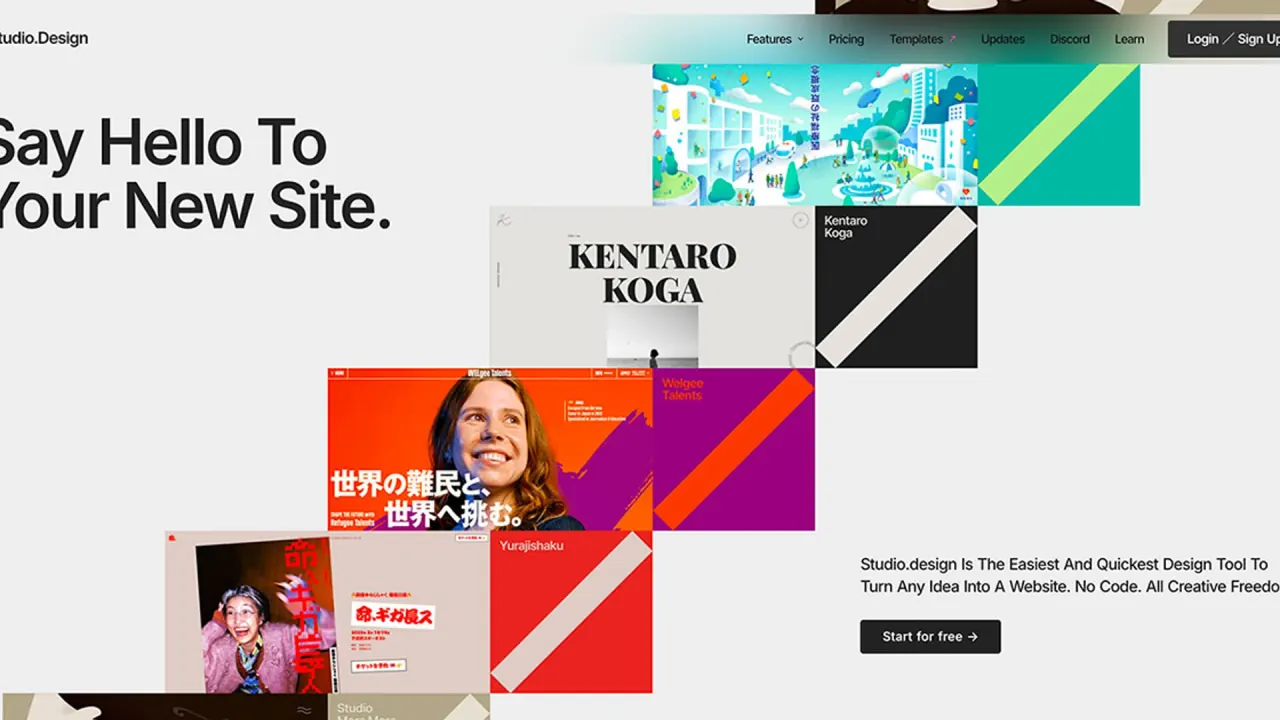
Studio.Design interface preview
Studio.Design logo

Studio.Design

Studio.Design is a browser-based no-code website builder from Tokyo's STUDIO Inc. that combines a visual design editor, CMS, forms, SEO settings and managed hosting, with AI editing tools and a separately billed AI site generator.

Website GeneratorDesign Tool#No Code#Seo#Design
Try for Free
Saves
Visits
Views
Pricing
Freemium
Published
Oct 6, 2026
Domain
studio.design
Community rating

Used this tool? Rate it

Rate this tool

Studio.Design Product Information

Try for Free
Tool Information
Saves
Visits
Views
Pricing
Freemium
Published
Oct 6, 2026
Domain
studio.design
Community rating

Used this tool? Rate it

Rate this tool

Featured Tools

Related Tools

Try for Free

What is Studio.Design?

Studio.Design (written as Studio or STUDIO on its official pages) is a no-code website builder that runs in the browser: you lay out pages visually, manage content in a built-in CMS and publish to hosting the company operates. Its homepage pitches it as the easiest and quickest design tool for turning an idea into a website, with no code and full creative freedom.

The product comes from STUDIO Inc., whose terms list a mailing address in Ebisu, Shibuya-ku, Tokyo. A Japanese tech news outlet reported the official launch on April 2, 2018, roughly a year after a beta opened in April 2017, and named Yutaka Ishii and Keima Kai among the founders.

The Japanese-language site reports more than 900,000 users, more than 220,000 published sites and more than 30,000 adopting companies, as captured on October 6, 2026; these are the company's own figures, not independent counts. The English and Japanese sites also differ in scope: the English pages cover the core builder with prices in US dollars, while the Japanese pages add yen pricing, an Enterprise plan and a long list of corporate case studies.

Core features

Design Editor

  • Box layout and symbols: Layouts are built by stacking boxes, spacing is adjusted with on-canvas drag controls, repeated elements become reusable symbols, and each responsive breakpoint is customized visually instead of in CSS.
  • Team editing: Several people can edit at once, a Content Edit Mode lets editors change text and images without disturbing the design, and comment threads sit inside the editor.
  • Fonts: The English editor page advertises more than 900 fonts at no extra cost. The Japanese editor page gives a much larger figure of more than 9,200 free fonts, spanning Morisawa (TypeSquare), Google Fonts, custom fonts and system fonts; the two official pages do not agree.
  • Real data and embeds: Designs can pull data from Notion and Airtable, and iframes bring in services such as Google Maps or YouTube.
  • Templates: A template store offers free and paid designs from outside designers that can be customized without code.

CMS, hosting, forms and SEO

  • CMS: Content supports real-time collaborative editing down to property settings, scheduled publishing that runs even when the app is closed, and a one-click import of WordPress content.
  • Publishing: One click turns a design into a live site with no server setup; every site gets SSL automatically and the hosting page advertises 99.9% uptime.
  • Forms: Forms are placed by drag and drop with custom fields, submissions can sync to Google Sheets, and Google reCAPTCHA is available against spam.
  • SEO settings: Redirects, generated XML sitemaps and per-page titles, descriptions, favicons and OGP tags sit next to connections for Google Search Console, Google Tag Manager, Google Analytics and HubSpot.

Motion and Figma import

  • Lottie: A Lottie box takes a dotLottie or Lottie JSON URL, and playback can autoplay, start when visible, run on hover or click, or sync to scroll or cursor position.
  • Figma to website import: The Figma to STUDIO plugin copies frames from Figma into the editor; Studio says imported designs become responsive automatically and that images, icons, fonts and colors come across with them.

AI tools in the editor

The help center documents five AI functions. Image AI edits pictures from natural-language instructions, optionally guided by a reference image; Text AI drafts or rewrites copy from a prompt and can translate it; Auto Responsive applies breakpoint settings to a finished desktop layout; Layer Rename replaces generic layer names; and SEO Writing Assist drafts page titles and meta descriptions from the text on the page.

Studio.Assistant

Studio.Assistant is an AI site generator on its own paid plan, separate from the Design Editor. From the details you enter, it produces a site's information structure through to a design draft, which you then export into the Design Editor to refine and publish. The Japanese product page frames it as a tool that assumes a person adjusts the output in the interface, and states that it does not complete a workflow autonomously the way an AI agent would.

Guide

Importing a Figma design

  1. Install the Figma to STUDIO plugin in Figma.
  2. Prepare the file: the import tips favor Auto Layout and adding <img> to the start of layer names used for illustrations and images.
  3. Select the frames and copy them; pages with many layers can be imported section by section.
  4. Paste the design into the Studio editor to complete the import.

Drafting a site with Studio.Assistant

  1. Create a new project (or open an existing one) and select Assistant.
  2. Fill in the website overview: name, purpose, category, description, current URL and photo search keywords.
  3. Use the Content type sliders to set the balance of text and photos, how persuasive the copy should be and how many pages to generate.
  4. Upload logo and image assets as PNG, JPG or SVG; the site's key color can be taken from the logo.
  5. Select Generate design. Pages appear one after another, and the existing site stays read-only while generation runs.
  6. Add, delete or reorder pages in the sitemap view, then export to the Design Editor for detailed editing and publishing.

Use cases and examples

  • One-page sites and portfolios: The paid tiers are positioned by site type, with Mini for one-page sites, Personal for portfolios, Business for startups and Business Plus for scale-ups. A single campaign page built with Studio as a landing page builder fits the Mini limit of 2 pages plus a 404 page.
  • Landing pages inside a large company: In a vendor case study, East Japan Railway Company builds multiple landing-page sites under its jreast.co.jp domain and uses workspaces to control permissions across many stakeholders.
  • Consolidating several corporate sites: Another vendor case study is headlined as ITOCHU bringing the management of 14 sites onto Studio and cutting costs by 40%.
  • Agency and sales pitches: Studio.Assistant is pitched to sales staff and directors for producing several draft designs quickly and sharing them as working websites while a proposal is still being discussed.
  • Leaving WordPress: WordPress posts, pages, categories and tags can be imported from an XML export, but the design and site settings do not carry over, so page structure, design, CMS setup, URLs and redirects need checking after the move.

Case-study results are the customers' own accounts as published by Studio, not independent measurements.

Who is it for

Likely fits

  • Designers who want to publish without writing code. At its 2018 launch, the co-founder described the target as businesses that specialize in design but lack coding skills, rather than individuals or small firms that simply want any website.
  • Graphic designers, agencies and UX designers: the homepage's customer stories feature a graphic designer, an agency, a UX designer and a UX design student.
  • Companies and teams, particularly in Japan. The Japanese FAQ points team use toward Business or Business Plus for permission management and post-launch operation, and toward Enterprise for larger operations, audit and security requirements, or individual support.

Weaker fits

  • Shops and membership sites, which need features Studio lists as unsupported.
  • Anyone who must take the site's code elsewhere or edit from a tablet or phone; both are ruled out in the help center (see Platforms and Limitations).

Platforms

  • Where you edit: The Design Editor and project dashboard are supported in Google Chrome on desktop only. Other browsers are not supported, and editing is not available on tablets or phones.
  • Where sites live: The Free plan publishes to a studio.site address and shows a Studio badge; paid project plans add a custom domain.
  • Integrations: The Japanese FAQ lists Google Analytics, Google Tag Manager, Search Console, reCAPTCHA, Meta Pixel and chat tools, adding that tools without direct support can sometimes be connected through Google Tag Manager or embed code.
  • Custom code: The Embed box accepts HTML, CSS and JavaScript, and paid plans can inject code into the head or body section across the site or on single pages.
  • Languages: Studio.Assistant's interface, chat and generated text support Japanese and English.

Pricing

Studio bills per project, not per account: each project has its own subscription, and only one website can be created and published per project. Prices below come from the English pricing page as captured on October 6, 2026.

PlanAnnual billing (per month)Monthly billingPagesForm responsesVersion history
Free$0$050Not listed on plan card1 day
Mini$5$102 + 404 page1005 days
Personal$10$121501,00030 days
Business$25$3530010,000120 days
Business Plus$80$110300Everything in Business360 days

The page states that all amounts include applicable taxes and advertises savings of 20% or more for annual billing. Beyond the table, Personal adds password protection; Business adds basic permissions, unlimited analytics and redirects; Business Plus adds 15,000 CMS items, advanced permissions, custom headers and activity logs. The July 2026 product update announced no monthly visitor limits.

Other charges and plans

  • Custom Proxy add-on: Business Plus projects can add it for $290 per month to serve Studio pages under subdirectories of an existing domain, with custom certificates and 301 redirects.
  • Workspaces: Billed separately from project plans. The free workspace holds up to 3 projects; Team costs $14 per member per month on annual billing (from $42 for the 3-member minimum) or $18 per member on monthly billing (from $54).
  • Yen pricing: The Japanese pricing page lists Mini at ¥590, Personal at ¥1,190, Business at ¥3,980 and Business Plus at ¥9,980 per month on annual billing, or ¥1,290, ¥1,720, ¥5,460 and ¥12,900 on monthly billing, with Custom Proxy at ¥39,800 per month.
  • Enterprise: Shown on the Japanese pricing page but not on the English one checked here, by inquiry, with unlimited pages and CMS items, a 99.9% SLA, 360-day activity logs, IP address restrictions and bank-transfer payment.
  • Studio.Assistant: Starter costs ¥24,800 and Pro ¥99,800 per month on monthly billing, or ¥19,800 and ¥74,800 per month on yearly billing, tax included, and both start with a 14-day free trial. The trial applies only to a first subscription, and billing begins automatically 14 days after sign-up.
  • Domains: The Japanese FAQ notes that the monthly fee covers building and publishing only; custom domain registration and internet connection costs are separate.

Billing rules

  • Payment is by credit or debit card.
  • Switching from annual to monthly billing is not supported; the project has to drop to Free and then take a monthly plan.

Studio.Design alternatives

  • WordPress: Studio's own FAQ frames the difference as maintenance. WordPress extends flexibly through themes and plugins but leaves servers, updates and security for you to manage, while Studio keeps site building, CMS, forms, SEO and hosting in one environment. This is the vendor's comparison, not an independent one.
  • Wix, Squarespace and Peraichi: At launch, the co-founder said these builders could partly compete with Studio, and the same report named Webflow as the competitor STUDIO watched most closely.
  • Framer, Webflow, WebWave and Dorik: A product launch platform lists these as products similar to Studio.Design.

Limitations

  • No code export: You cannot directly edit a page's HTML, and Studio.Design offers no way to export the site's HTML code.
  • No online store or members-only pages: The Japanese FAQ lists members-only pages and e-commerce among functions Studio does not support.
  • One password per site: Studio cannot assign different passwords to different viewers; only a single site-wide password can be set.
  • Hidden form responses: Responses beyond a plan's limit do not appear in the dashboard or in email notifications until the plan is upgraded.
  • Downgrades unpublish content: A downgrade can be scheduled even when content exceeds the lower plan's limits, but CMS items or features beyond those limits are unpublished.
  • No refunds: Plans are not refunded once a contract is established, accidental upgrades included, and an automatically renewed plan cannot be canceled or refunded.
  • AI usage caps: AI functions have an execution limit; after it is exceeded they cannot be used for a certain period.
  • Figma import caveats: Figma designs made at tablet or mobile size are recognized as desktop size, and the multi-page Page mode is in beta and may behave unexpectedly.
  • Single-user AI generation: Work in Studio.Assistant is designed for one person at a time; normal collaboration resumes after export to the Design Editor.
  • Support scope: Chat support covers Studio-related issues but not third-party services or design advice.

Privacy and content rights

  • Data location: Studio runs on Google Cloud Platform servers in Japan and the United States, and personal information may be stored in either country.
  • AI training: The help center states that sites and content created in Studio.Assistant are never used to train AI. In the pages checked for this review, no equivalent statement was found for the editor's Image AI and Text AI functions.
  • Content license: Your content stays yours, but the terms grant STUDIO an irrevocable, perpetual, worldwide license to use it for providing, improving and promoting the service.
  • Showcasing: STUDIO may feature your website on its own site and in marketing materials.
  • Age and jurisdiction: Users must be at least the age of majority where they live or have parental consent, with a minimum of 16 in the EU. For users outside the US, the terms are governed by the laws of Japan.

FAQ

Q1. Can I export my Studio.Design site's code?

No. Studio.Design does not offer HTML export or direct HTML editing. Custom code can be added through the Embed box, but the site stays on Studio's hosting.

Q2. Can I edit a Studio.Design site on an iPad or phone?

No. Editing requires Google Chrome on a desktop computer; tablets and phones cannot be used for editing.

Q3. Is Studio.Design free?

There is a Free plan with the design tools and up to 50 pages, but it shows a Studio badge and publishes only to a studio.site address. A custom domain starts with the Mini plan.

Q4. Does Studio.Design use my content to train AI?

For Studio.Assistant, the help center says created sites and content are never used to train AI. A comparable statement for the editor's other AI functions was not found in the pages checked.

Q5. Can I get a refund?

Generally no. Studio does not refund plans after purchase, including accidental upgrades, so a plan has to be downgraded before its renewal date to avoid the next charge.

Know a Similar Tool?
If you know other great AI tools, feel free to submit them to us