
Toolso.AI
Toolso.AI
All ToolsCategoriesTrendingLatest ToolsPricingBlog
Toolso.AI
Toolso.AI
Toolso.AI
Toolso.AI

Discover the best AI tools to boost your productivity

GitHubGitHubTwitterX (Twitter)YouTubeYouTubeTikTokEmail

Popular Categories

  • AI Writing
  • AI Image
  • AI Video
  • AI Coding
  • More Categories

Explore

  • Latest Tools
  • Popular Tools
  • More Tools
  • Submit Tool
  • Pricing

About

  • About Us
  • Contact
  • Blog
  • Changelog

Legal

  • Cookie Policy
  • Privacy Policy
  • Terms of Service
  • Refund Policy
© 2026 Toolso.AI All Rights Reserved
Limited timeLimited-time offerFeatured Listing24h priority review · No backlink · 30 days featured$29.90then $59.90Price rises to $59.90 after Oct 31Ends in--:--:--Submit now
  1. Home
  2. All Tools
  3. Website Generator
  4. Design Arena
Design Arena interface preview
Design Arena logo

Design Arena

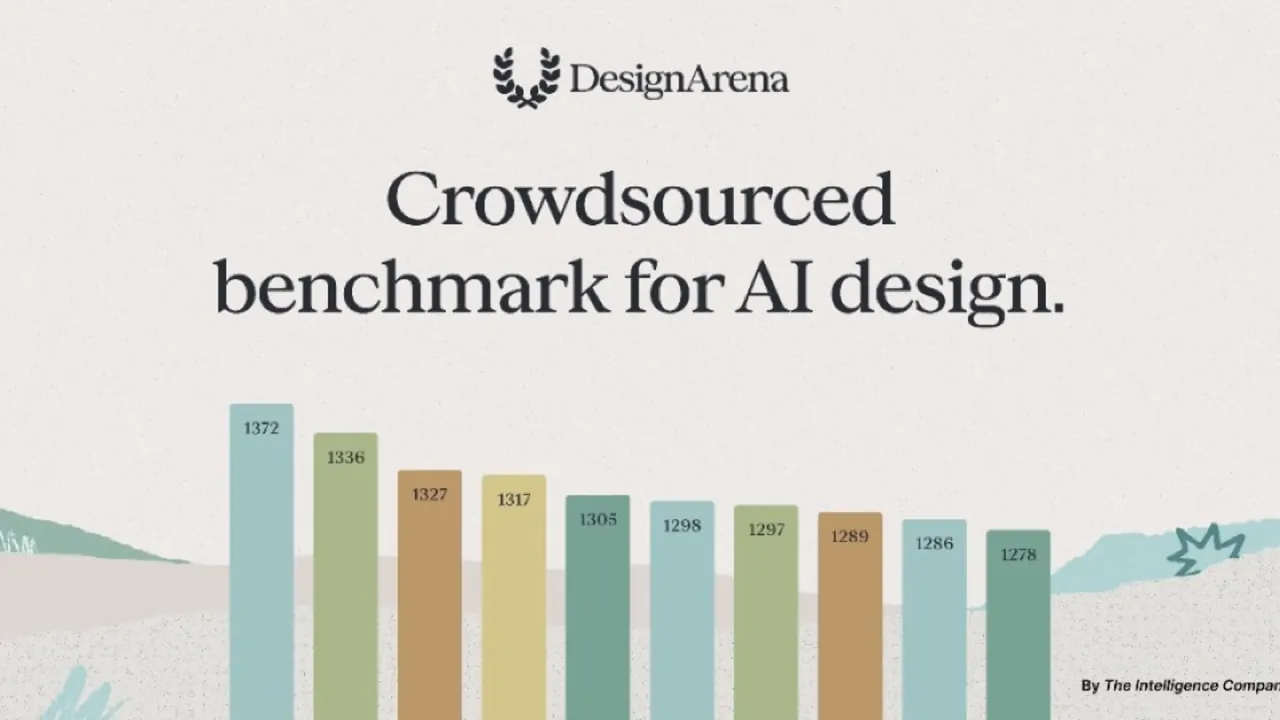
Design Arena sends one prompt to several AI models, hides which model made each result, and turns your head-to-head votes into public leaderboards for websites, images, slides, video, speech and more.

Website GeneratorDesign Toolmodel hub#Design#Api Available#Multi-Model
Try for Free
Saves
Visits
Views
Pricing
Freemium
Published
Sep 28, 2026
Domain
designarena.ai
Community rating

Used this tool? Rate it

Rate this tool

Design Arena Product Information

Try for Free
Tool Information
Saves
Visits
Views
Pricing
Freemium
Published
Sep 28, 2026
Domain
designarena.ai
Community rating

Used this tool? Rate it

Rate this tool

Featured Tools

Related Tools

Try for Free

What is Design Arena?

Design Arena is a web-based AI design benchmark: you submit one creative prompt, several AI models answer it, and your blind votes decide which output wins. Its terms describe it as a benchmarking platform for evaluating and ranking machine learning models through AI-generated design outputs, offered by Arcada Labs Incorporated.

The same session doubles as a creation tool. Users describe what they want to make, from a website or game to an image, video, presentation or app, and see how the top models render that idea side by side.

Scale figures come from two different places. The homepage says millions of people across 190+ countries use Design Arena to discover and compare models. An independent news report from August 2026 put the figure at 5.3 million people worldwide.

The name is easy to confuse with Arena (formerly LMArena and Chatbot Arena), a public web platform that evaluates large language models. Design Arena's own terms name Arcada Labs Incorporated as the provider, and its focus is visual and interactive output rather than chat replies.

Core features

Categories and arenas

  • Prompt categories: the homepage offers website, slides, image, game, 3D asset, SVG, data visualization, UI component, mobile app, logo, text-to-speech, ASCII art and video, with video labeled "Coming back soon" as captured on September 28, 2026.
  • Model directory: as captured on September 28, 2026, the models directory listed 51 models for Text to Website and 46 for Text to Image.
  • Changelog: a public log records model additions, updates and removals on the leaderboard.
  • Model comparison pages: the directory is built to compare win rates, pricing, context windows and modalities at a glance, which adds cost and context data to the vote-based rank.
  • Task-specific boards: the Website arena breaks results down by task, showing how models rank on specific jobs such as landing pages, portfolios, dashboards and e-commerce sites.
  • Trade-off charts: a Preference vs Price chart places models by cost and rating, with the top-left quadrant showing low-cost, high-rated models; a matching chart plots preference against generation time.

Blind tournament voting

Each voting session draws four models from the active pool plus one backup, and every model receives the identical prompt. Model identities remain hidden throughout evaluation to prevent brand bias. Outputs are also revealed at the same moment so faster models gain no edge, a rule the methodology notes say may change later.

The session is structured as a small bracket rather than a single A-versus-B pick. Two pairs are judged first, then winners and losers meet, and each of the five battles produces one vote that feeds both win rates and the rating model. The result is a full 1st-to-4th ordering from one prompt.

Fixed test conditions

In the main Model Arena, a model can take part only if it accepts a text input and returns a single-file HTML/JS/CSS code file. System prompts are kept constant across providers to minimize bias, so every model works from the same instructions.

How the leaderboard is calculated

Rankings are calculated with the Bradley-Terry model, a statistical method built for pairwise comparison data, and shown as Elo-style ratings. Each model's estimated strength is converted with Rating = 400 × log₁₀(strength). The margin of error uses an approximate 95% Wilson score confidence interval. Every pairwise vote is weighted equally, with no filtering or editorial adjustment. The leaderboard is updated with live results every two hours, and models with fewer than 50 votes carry a "new" tag to signal that their position may still move.

Model turnover

The roster changes often, which is part of what makes Design Arena useful as an AI model leaderboard. On September 22, 2026 the changelog recorded claude-opus-5-5, gpt-6-sol and gpt-6-luna as added. Removals come with short reasons, such as a model that was consistently bottom-ranked across categories.

Guide

Running a comparison

  1. Choose a category, such as website, logo or data visualization; the category decides which arena your vote counts toward.
  2. Write the prompt; input prompts must stay under 5k characters.
  3. Optionally press the enhance prompt button, which calls gemini-2.5-flash-lite-preview-09-2025 to add detail to a short request.
  4. Wait for the outputs; video jobs can take 5-10 minutes, and an email arrives when they are ready to vote on.
  5. Vote through the pairings; you are shown a series of A vs. B choices until the handful of outputs is ranked from best to worst.

Requesting leaderboard data

  1. Apply for an API key through the developer application form, describing the intended use.
  2. Wait for review; applications are reviewed within 1-2 business days, and approved keys arrive by email.
  3. Send authenticated requests with a Bearer token to fetch arenas, models or a specific leaderboard.

Use cases and examples

  • Choosing a model for front-end work: a team can run its own landing-page or dashboard prompt and compare AI models on the exact brief, instead of relying on a general benchmark.
  • Mobile app prototypes: Mobile Arena compares React Native, iOS and Flutter apps built by AI models, so the comparison matches the target stack.
  • Evaluating AI app builders: the Builder category sends the same prompt to every builder as a one-shot request and pairs them head to head, which suits a first-pass look at builder tools rather than long multi-turn projects.
  • Publishing rankings: analysts and journalists can pull rankings into dashboards or articles through the Design Arena API, provided Design Arena is credited and linked when the data is shown publicly.

Who is it for

  • Designers, developers and founders who want to see how several models handle one real brief before committing to a tool.
  • AI labs and model providers: co-founder Grace Li has said frontier labs pay for this kind of human feedback and that the site generates $60 million in ARR.
  • Model developers who want to be listed: registering a model requires signing in with a company email, and common providers such as Gmail and Outlook are not accepted.
  • Researchers and writers who need a crowdsourced preference signal for visual output rather than a text-only chat ranking.

It is not built for anyone under 18: the terms allow use only by people 18 or older who can form a binding contract.

Platforms

  • Web app: prompting, voting, leaderboards, the model directory and the changelog all run in the browser at designarena.ai; no desktop or mobile app was found among the pages checked.
  • Design Arena API: the API gives direct, real-time access to leaderboard data. It tracks three arenas, covering foundation models on generation tasks, AI-powered developer tools and IDEs, and autonomous agents building complete web apps.
  • Rate limits and caching: the API does not currently enforce strict rate limits, though keys that abuse the service can be revoked. Models and leaderboard responses are CDN cached for 5 minutes and the arena list for 1 hour, so the API is not a per-vote live feed.

Pricing

No standalone pricing page was found among the pages checked, and /pricing returned not found. The terms state that there are no fees for use of the Services unless otherwise set forth, for example for certain limited additional features. The paid rules below come from the account and billing interface text.

Access pathWhat it coversPublished cost
Free tierEveryday prompting and voting within usage limitsNo fee under the terms
Prepaid creditsUsage beyond the free tier, plus Pro benefitsTop-ups from $5 to $100
Premium modeTop-ranked models by Elo for a generationActual cost per generation
Leaderboard APIProgrammatic ranking dataFree, with attribution

Credits work as a prepaid balance and are deducted only when you go past your free tier limits. Top-ups range from $5 to $100 per purchase. Free usage has per-category caps on top of a shared daily limit, and those limits vary with prompt complexity, so the number of free generations is not a fixed figure. One Pro benefit is video length: up to 15 seconds versus 5 seconds on the free tier.

Premium mode picks the best models by Elo for that generation and charges the actual cost per generation. Per-type prices load inside the account area and were not shown on the pages checked.

Category availability can depend on credits. When a category is paused, a message says it is coming back soon and can be used now by adding credits, while slideshows and websites remain available with no limits.

The leaderboard API is a separate track: its data is free to use for personal and commercial projects.

Design Arena alternatives

The closest comparison is a text-first arena. An independent news report described LM Arena as taking a similar approach to text-based responses. That service, now called Arena and hosted at arena.ai, also lists leaderboards for WebDev models, text models, image generation and video generation, so the two overlap on web and image tasks while differing in origin and emphasis.

Artificial Analysis takes a different route: it publishes independent benchmarks of AI models and API providers across quality, price, output speed and latency. It also runs Image Arena and Video Arena leaderboards, which makes it the better fit when cost and speed matter as much as taste.

OptionMain signalBest fit
Design ArenaBlind crowd votes on visual and interactive outputWebsites, UI, slides, logos, games
Arena.aiCrowd votes, text-first with WebDev and media boardsChat and general model choice
Artificial AnalysisMeasured quality, price, speed, latencyCost and performance trade-offs

Limitations

Methodology inconsistencies

Design Arena's own pages do not describe the ranking rules identically:

  • Chart cut-off: the About page says main bar charts filter out models with less than 50 pairwise comparisons. The methodology notes instead say leaderboards and bar charts drop models with fewer than 15.
  • Preliminary status: the About page says models stay preliminary until they reach enough comparisons, typically 200 and varying by category.
  • Model selection: the About page describes random selection, but the methodology notes say selection is stochastic yet biased toward models where more comparisons are expected to be most informative.

Rankings therefore reflect crowd preference under these rules, not a fixed test suite, and a new entry can shift noticeably.

Prompt moderation

User prompts are moderated through an API call to gemini-2.5-flash-lite-preview-09-2025, a model the notes say was chosen for cost. The published moderation instructions also ask it to check prompts for anything political, political people, or political or religious symbols, so topical or campaign-style design briefs may be flagged.

Access and output reliability

  • Login: according to independent reporting, users have to log in to get their output, which lets the company track how tastes change across continents over time.
  • Output quality: the terms warn that outputs may be inaccurate, incorrect, offensive or otherwise undesirable, and users are expected to apply their own judgment before relying on them.
  • Disputes: U.S. users agree to resolve disputes through binding individual arbitration, with limited exception.
  • Service changes: Arcada Labs may change or discontinue all or any part of the Services at any time and without notice, which matters for anyone building a workflow or dashboard around it.

Privacy and content rights

  • Sharing with AI providers: prompts, inputs, outputs and uploaded media may be shared with third-party AI technology providers, including potentially for training their models.
  • Identifiers removed, content not: the company takes steps to remove usernames and email addresses, but personal information typed into a prompt, image or uploaded document may still be passed on.
  • No downstream control: Design Arena states it does not control how those providers use content once shared.
  • What to leave out: the privacy notice asks users not to submit sensitive personal information, confidential information, or details about third parties without consent.
  • License to Arcada Labs: anything you submit comes with an irrevocable, perpetual, transferable, worldwide, royalty-free license to Arcada Labs. That license extends to sublicensing or commercializing User Content with third parties and to training machine learning models.
  • Rights in outputs: your right to use a generated result follows the terms of the model that produced it. A Model Terms page links to each provider's terms of service.
  • Data collected: beyond prompts and outputs, the privacy notice lists account information, voice data and payment information among the personal data it collects.
  • Security: data is encrypted at rest (for example AES-256) through cloud infrastructure partners and in transit with TLS 1.2 or higher. Infrastructure runs on cloud providers holding SOC 2 and ISO 27001 certifications; the page attributes those certifications to the providers rather than to Design Arena. The security page also lists annual vulnerability assessments and penetration testing of systems that process data.

FAQ

Q1. Is Design Arena free?

Basic prompting and voting carry no fee under the terms, within free usage limits that vary by category and prompt complexity. Prepaid credits of $5 to $100 cover usage beyond those limits, and Premium mode charges the actual cost per generation.

Q2. How are Design Arena rankings calculated?

Votes from blind, head-to-head matchups feed a Bradley-Terry model, which produces Elo-style ratings. The leaderboard refreshes every two hours, and models with fewer than 50 votes are marked as new.

Q3. Can I use Design Arena leaderboard data in my own project?

Yes. The Design Arena API is free for personal and commercial projects after an application is approved, but public use must credit Design Arena and link to designarena.ai.

Q4. Who can see my prompts and uploads?

Prompts, outputs and uploaded media may be shared with third-party AI technology providers, including for training. Design Arena takes steps to remove usernames and email addresses first, but personal details written inside the content itself may still be shared.

Q5. Is Design Arena the same as LMArena?

No. Arena (formerly LMArena and Chatbot Arena) is a separate platform focused on evaluating large language models, while Design Arena, from Arcada Labs Incorporated, ranks models on visual and interactive design output.

Know a Similar Tool?
If you know other great AI tools, feel free to submit them to us