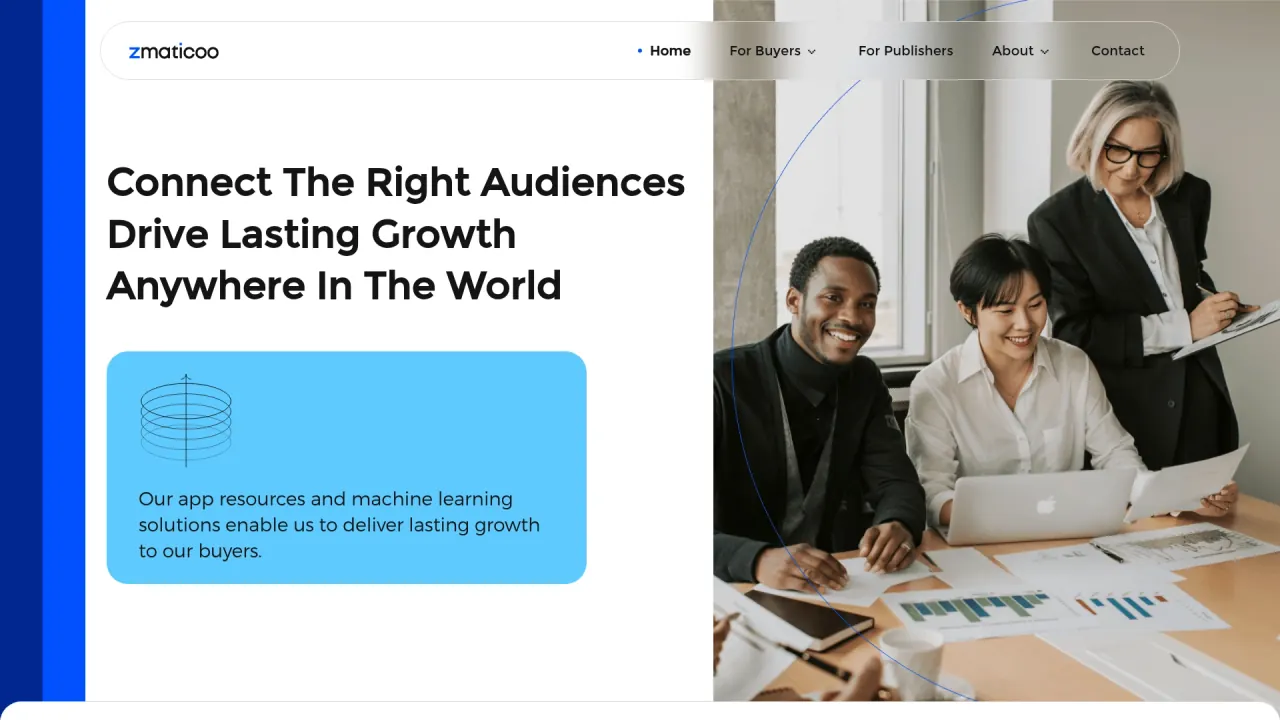

zMaticoo is an AI-driven programmatic advertising platform with an SSP for app developers to monetize in-app inventory and a DSP for advertisers and agencies to buy and retarget audiences, with its supply rooted in APAC's top mobile app developers.
Used this tool? Rate it
Used this tool? Rate it

Track AI budgets, cash returns and portfolio decisions


The agentic customer platform for go-to-market teams


AI image editing from a reference photo


Multi-model image studio, free to start


Natural AI photo editing for portraits and projects


AI assistant for writing, analysis and tasks


From a prompt to a deck, site or doc


Build random generators, share them free
zMaticoo describes itself as APAC's leading mobile monetization platform, with deep in-market relationships with APAC's top mobile app developers whose apps serve a global audience. The product is two-sided: a supply-side platform, branded zMaticoo SSP, serves publishers and app developers, while a demand-side platform, zMaticoo DSP, serves advertisers and agencies.
The parent company describes zMaticoo as its programmatic advertising platform, built on advanced algorithms and AI capabilities that connect multi-source data and media resources. That operating relationship is stated by the parent company, eclicktech (易点天下), in its own corporate communications, so it should be read as a vendor-stated affiliation rather than an independently confirmed corporate structure.
Scale figures on the site are vendor-reported but concrete. The site states 8,000+ directly integrated apps and 1,500+ advertisers on its homepage. The same page lists 1.33Bn+ unique users, 2Bn+ unique devices and 170B daily ad requests. The company says 50% of its monetization opportunities come from audiences in the US market, with the balance coming from APAC, EMEA and LATAM. Taken together, these numbers describe a supply base of APAC-built apps whose audiences are heavily used by US-facing campaigns.
For external context, a third-party directory estimates monthly visits to zmaticoo.com at more than 100,000, as captured on November 28, 2026. The same estimate attributes 83% of those visits to direct traffic. Those numbers estimate traffic to the marketing site itself, not the volume of ads flowing through the platform, and the two should not be conflated.
zMaticoo covers both sides of the programmatic trade, and each side has its own product page, pitch and toolset.
On the buyer side, zMaticoo offers advertisers and agencies a suite that runs from AI-driven creative design to multi-channel and multi-market budget execution, with various ad formats plus targeting and remarketing options aimed at ROAS goals. The activation pitch lists three levers: access to global supply at scale, higher reach into daily active users within cap requirements, and re-engagement of inactive users.
The company says its DSP is powered by DNN and machine learning models designed to optimize ad performance. Its stated design goal for bidding technology is to maximize ROAS for the advertiser's spend. Buyers get what the company calls an intuitive UI and a customizable reporting API that it says ensures marketplace transparency.
The homepage states that the SDK is certified by Google Play Index, that impressions are scanned by Human and Pixalate, and that ad safety is handled by GeoEdge and TMT. Inventory is described as coming from direct relationships with high-scale global publishers and OEM handset partners, with vetting by third-party vendors to mitigate fraud and spam traffic.
Both the buyer and publisher pages list support for interstitial, video, icon, banner, rewarded video and native ad formats. Buyers can also draw on an in-house creative team and a suite of creative tools that includes KreadoAI, covering static and dynamic images and videos.
Two 2026 announcements extend the picture, and both come through press-release channels:
These performance figures are company-reported outcomes distributed as press releases, not results verified by an independent party, so they should be treated as the vendor's own benchmarks. The announcement also details the engineering behind the upgrade: low-latency loading cuts initialization time to under 100 ms with intelligent caching and progressive asset loading, and load-show decoupling boosts ad show success rate by over 30%.
The two sides of the platform differ in who they serve and what they optimize:
| Aspect | zMaticoo SSP | zMaticoo DSP |
|---|---|---|
| Serves | App developers and publishers | Advertisers and agencies |
| Core job | Monetize in-app inventory | Buy and re-engage audiences at scale |
| Stated scale | 8,000+ direct apps, 60B+ daily auctions | Multi-channel, multi-market budget execution |
| Tools | SDK, mediation support, PMP packages | Bidding, targeting, remarketing, reporting UI and API |
Getting started differs by side, and the site describes the paths at a high level rather than as self-serve checklists.
The SSP page states that the zMaticoo SDK is Google Index compliant and works alongside leading mediation platforms — Max, Google AdMob and IronSource — plus the company's own mediation solution, TradPlus. In practice this means an app developer's integration surface is the SDK itself, and developers already running one of those mediation platforms have a documented interop path named by the vendor. The publisher page adds that the company offers full technical support and active account management to ensure fast go-live.
On the data side, the company states its DMP holds 1.3Bn+ MAU and 1k+ active segments, with support for PMP packages and audience curation by geography, seasonal events and audience traits. Segment curation is grouped by geo markets such as US/CAN/MX/BR, UK/DE/FR/ES/IT and JP/KR/IN/ID/VN/PH, by seasonal events such as holidays and elections, and by audience traits such as travelers, shoppers and entertainment audiences.
The company's case-study pages describe five deployments that show how these tools are combined in practice, spanning coffee retail, cross-border e-commerce, an e-commerce marketplace, streaming video and casual gaming. All five accounts are vendor case studies, so the metrics are company-reported outcomes rather than independently audited results.
Read together, the cases cluster around two repeatable motions: demand-side re-engagement driven by data integrations such as RTA, and supply-side monetization uplift driven by format expansion and algorithmic optimization.
zMaticoo is built for two professional audiences that rarely overlap: mobile app developers who want to sell their in-app inventory, and advertisers or agencies that want to buy that inventory programmatically.
The publisher page invites app developers to join more than 8,000 direct apps that have already integrated the SDK and to leverage a monetization platform integrated with leading mediation and demand partners. On the supply side this fits studios with meaningful traffic and the engineering capacity to integrate and operate an SDK, especially those with APAC audiences.
Buyer-side messaging is aimed at marketers running app-install, re-engagement and branding campaigns across multiple markets, with success framed in ROAS terms rather than in small self-serve budgets. Advertisers seeking US-facing reach through APAC-developed apps are the audience the positioning speaks to most directly.
On the supply side, monetization is delivered by integrating the zMaticoo SDK into mobile apps, which the company positions as a lightweight, powerful monetization engine. If your product is a web-only property, a desktop service or a single-market local business, nothing on the checked pages addresses those setups, and the platform's mobile-first, SDK-based design makes it a poor shape match.
Access to the platform runs through these integrations rather than a public web console; the SSP page also names SKOverlay, Deep Link and Viewability Monitor among its supported capabilities.
zMaticoo does not sell subscriptions through the website. No checked page lists prices or offers self-serve signup; both the buyer and publisher journeys end in a contact prompt, with support reachable at support@zmaticoo.com. The MCP announcement follows the same pattern, telling clients to connect with their dedicated business contact to obtain a token for AI-driven data access.
For a buyer or publisher, this means the commercial terms — spend minimums, revenue shares, eCPM expectations — are set during a sales conversation and cannot be compared against a public rate card. What the site does commit to publicly is the toolset around the deal: reporting through the UI and API on the buyer side, and mediation interoperability on the supply side.
Publishers and advertisers evaluating zMaticoo therefore have credible alternatives across the same category, and independent 2026 roundups name several of them explicitly.
One 2026 roundup of top mobile SSPs lists Google AdX (via GAM), AppLovin MAX, Unity LevelPlay, Meta Audience Network, InMobi and Pangle, noting InMobi's strong APAC presence. Another 2026 roundup ranks Magnite #1 of 19 SSPs with a 9.2/10 score and PubMatic #2 with 9.1/10, both listed with pricing on request.
These rankings come from third-party editorial roundups, so they reflect the publishers' own evaluation criteria rather than a user-voted marketplace, and none of the listed vendors was evaluated against zMaticoo directly in those roundups. The practical takeaway from zMaticoo's own pages is complementary rather than competitive: developers already standardized on Max, Google AdMob or IronSource mediation can keep those stacks and evaluate zMaticoo demand alongside them, while buyers already working with large Western SSPs may see zMaticoo's APAC-rooted supply as a diversification source rather than a like-for-like swap.
Three boundaries matter before committing, and all three are visible on the vendor's own materials.
The supply story is APAC-first by design: the site cites 85% APAC mobile app coverage and roots its strength in relationships with APAC's top mobile app developers. Buyers whose campaigns target a single non-APAC market get only the indirect route — APAC-developed apps with global audiences — rather than locally concentrated inventory.
Monetization on the supply side arrives through SDK integration inside mobile apps rather than any web or desktop embedding, so the SDK relationship is a technical commitment: certification, mediation choices and release validation all bind to it. The SDK 2.0 announcement also says the SDK ships with built-in GDPR, CCPA and COPPA compliance and goes through a mandatory two-week gray-release validation before release. That is a company-stated release discipline developers should expect to plan around.
Across the checked pages there is no published price list and no self-serve signup: both the buyer and publisher journeys end in a "Let's Talk" contact prompt, with support reachable at support@zmaticoo.com. Evaluating the platform therefore starts with a sales cycle, not a free trial.
Finally, the evidence base skews vendor-side. The performance metrics, the case-study outcomes and the compliance statements in this profile come from the company's pages and its press-release announcements, and no independent user-rating listing for zMaticoo was found in the review platforms and community channels checked on November 28, 2026.
zMaticoo is an AI-driven programmatic advertising platform operating on both sides of the market: an SSP that helps app developers monetize in-app inventory and a DSP that helps advertisers and agencies buy and re-engage audiences, with its supply rooted in APAC's top mobile app developers.
The parent company, eclicktech (易点天下), describes zMaticoo as its programmatic advertising platform in its own corporate communications. That affiliation is vendor-stated.
No. None of the checked pages lists prices; both buyer and publisher journeys route to a "Let's Talk" contact prompt, with support reachable at support@zmaticoo.com.
The buyer and publisher pages list interstitial, video, icon, banner, rewarded video and native formats.
The site cites 85% APAC mobile app coverage, with 50% of monetization opportunities coming from US audiences and the balance from APAC, EMEA and LATAM. A 2026 announcement adds micro series inventory across the United States, LATAM, Japan, Korea and Southeast Asia.
The homepage states the SDK is certified by Google Play Index, with impressions scanned by Human and Pixalate and ad safety handled by GeoEdge and TMT; the SSP page states the platform is fully GDPR compliant, and the SDK 2.0 announcement adds built-in GDPR, CCPA and COPPA compliance.