Explore ad examples, follow brands, and turn selected creative into scripts or image variations. Published pages give different details about platform coverage and credit costs.
Used this tool? Rate it
Used this tool? Rate it
GetHookd combines ad research with tools for organizing examples and developing new advertising creative. Its homepage describes a library of Meta ads that can be explored in the app or queried through AI assistants, with links back to source ads. The product is aimed at people researching brands and preparing new ad concepts, including individual marketers, growing brands and teams.
The distinction between research and creative production matters. Explore and Brand Spy concern ads the service has collected or tracked; AI ad creative features use inputs or existing examples to produce new material. The company's performance claims and examples are marketing descriptions, not independently verified results for a particular campaign. In particular, its marketing page advertises AI-generated UGC-style video and customizable voice and model choices, but this public-material review did not test video generation.
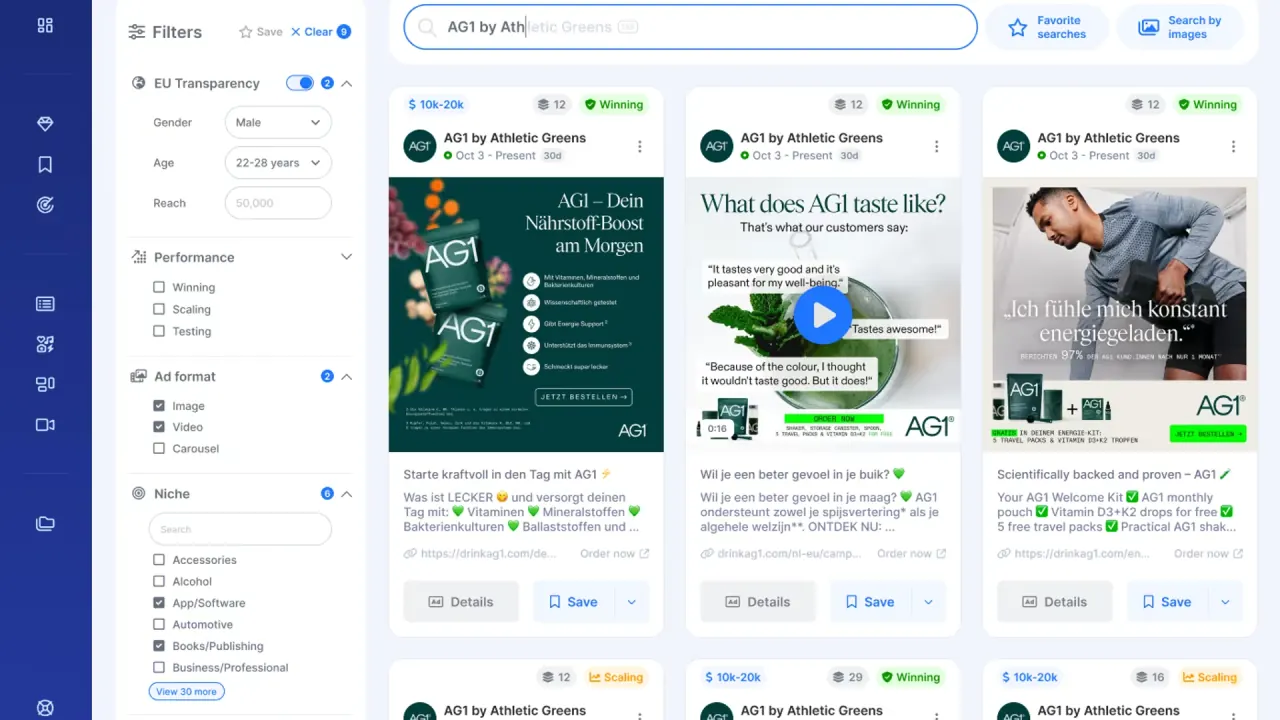
Explore searches the words entered in ad copy, headlines and brand names. The vendor describes filters for formats and other ad attributes, as well as saved searches and a way to save useful ads. Ad cards can show an image, video or carousel preview and estimated impression data when available. These are ways to narrow a collection of ads; they do not establish that every advertiser or creative in the underlying public library is present.
The status labels carry different meanings. A green “Present” label means the ad is shown as running, while “Last seen” means the service has not reconfirmed it for several days and it may have stopped. A result can therefore still be useful as a saved example even when its present status is uncertain. The detail view described in the help material includes ad copy and a landing-page link alongside the creative.
Brand Spy presents a brand's recorded ads and advertising activity over time. Its active-ad trend chart has 7/30/90-day views and can be broken down by format or page type. The format totals cover recorded ads including ones that are no longer running, whereas the active-ad chart concerns ads reported as live. Those measures answer different questions: a total of recorded ads is not the same thing as a current live-ad count. The help article says daily snapshots begin once tracking starts; earlier chart points are marked as backfill and are best-effort estimates. Its launch chart covers ads available in GetHookd, so a month with no recorded launches means the count is unknown, not that the advertiser launched nothing.
The service also describes alerts and a digest for tracked brands. The digest frequency can be set to daily, weekly, biweekly, monthly or off. Removing a brand stops tracking it, and the help article says the credits used to add it are not restored. The article also describes a charge if the same brand is added again later.
Clone Ads is described as an AI image-variation workflow. It analyzes the style of an inspiration ad and combines that with product research to build a prompt. The help article offers one to six image variations per generation and names Nano Banana 2, Nano Banana Pro and GPT Image 2 as model choices. The product may use a product page as part of the input; generated variations are based on the selected inspiration and product information rather than being a measurement of the original ad's results.
The documented format choices include square, several portrait and landscape ratios, and a “Match Ad” option that follows the inspiration's shape. The text language defaults to the language detected in the inspiration and can be changed using the language selector. Individual images can be downloaded separately, or a set can be downloaded as a ZIP; generated sets are also saved in the account's Clone Ads history.
A video ad can be transcribed and used as the starting point for a script brief. The help article says transcripts include timestamps that can be shown or hidden, and the interface reports when it cannot find spoken words. From a video ad's detail view, the documented AI Script action creates a brief from its transcription; the help page says that action is available on video ads, not image-only ads. The script workspace can hold a folder, status, due date and concept description, plus a selected brand profile and inspiration ads. It also describes fields for details such as target duration, placement and uploaded assets.
A script is a written creative asset. The separate UGC video claim concerns generated video, and the available public pages do not establish that every script is automatically converted into a video or that a particular voice or likeness can be cloned. The marketing page's voice, model, script and format options are vendor claims; the available material does not verify output quality, rights clearance or campaign performance.
The help material describes opening Clone Ads from the creation menu or from an image ad. A product and an inspiration provide context for the generated prompt, after which the model, aspect ratio, text language and number of variations can be selected. The displayed generation cost depends on model and quantity according to the help article. Finished variations can be reviewed individually, downloaded or revisited in generation history.
This workflow is specifically documented for image ad inspiration: the Clone Ad option is not shown on video ads in the help article. A selected visual reference can guide layout and style, but the terms still place responsibility for submitted content on the user. The company does not establish in these materials that an example ad's creative elements are licensed for reuse merely because they appear in a research library.
GetHookd's plan descriptions address solo marketers, growing brands, collaborative teams and agencies, with different included credit and seat amounts. Its combination of a searchable ad collection, brand tracking and saved examples is relevant when a team needs to compare ads and organize creative references in the same workspace. Script briefs and static variations extend that process into creative preparation.
The breadth of the collection is a practical selection constraint. The homepage says coverage is thinnest in smaller countries and service or information niches. The help material also explains that the Explore collection is built from brands tracked through Brand Spy and ads saved from Meta through the extension, rather than being a complete copy of the Meta Ad Library. A missing result is therefore not proof that a brand is not advertising.
For teams focused on video, the advertised UGC video feature and the separately documented script and transcription tools should be considered distinct capabilities. The public materials used here do not establish actual video output quality or the rights attached to a specific generated voice or likeness.
The vendor's pages disagree about the ad library's platform coverage. The homepage says the library is limited to Facebook and Instagram ads and that TikTok is not included. A separate marketing page describes the library as covering Facebook, TikTok and Google. Those claims do not resolve which scope a subscriber will see in the product at a given time.
The Chrome extension has a separate documented scope. Its help page says it can save from the Meta Ad Library and from TikTok's ad library, organic videos, Creative Center and Spotlight pages. It requires Google Chrome and an active GetHookd login. Being able to save material through an extension is a different claim from the coverage of the app's searchable ad library; the two descriptions should not be treated as interchangeable.
The homepage also advertises access through AI assistants including Claude, ChatGPT, Gemini, Cursor and Perplexity. It says API and MCP access are included on every annual plan and on the Team and Agency monthly plans. This is an access condition for those interfaces, separate from the number of users or creative credits in the subscription.
The marketing page displayed the following monthly subscription prices and allowances when captured on November 2, 2026. The annual prices are monthly equivalents billed yearly, and the yearly credit column reflects the numbers displayed with those plans. Additional credit packs are separate purchases.
| Plan | Monthly price | Monthly credits | Monthly equivalent billed yearly | Yearly credits shown |
|---|---|---|---|---|
| Starter | $29 | 50 | $19 | 600 |
| Pro | $49 | 150 | $32 | 1,800 |
| Team | $79 | 400 | $52 | 4,800 |
| Agency | $129 | 800 | $83 | 9,600 |
The page also says plan credits reset each billing cycle, while displaying annual credit totals for annual plans; it does not make the schedule of credit release unambiguous in that table. The vendor advertises a seven-day trial at $0. Its homepage says cancellation before the trial ends avoids a charge; after that, cancellation stops the next renewal while access continues through the paid period. The terms state subscriptions renew automatically. These are the vendor's stated conditions, not an independently observed cancellation or billing test.
The refund policy, effective March 2026, distinguishes cancellation from a refund of an existing charge. For the first monthly charge after the trial, it states that a request within 24 hours with no platform usage qualifies for a full refund; at 24–48 hours with no usage, the stated refund is 50%. It says significant usage within 24 hours and requests beyond 48 hours receive no refund. The policy counts activity such as searching ads or tracking brands as usage.
Annual plans are described as non-refundable, although in exceptional cases a prorated refund for remaining full months may be considered. Subsequent subscription charges are non-refundable under the policy. Credit packs are generally non-refundable, but a request for review can be made within 24 hours of purchase if no credits have been used. The policy says each account is eligible for one refund. These are the stated terms; no refund was requested or tested in this review.
The marketing FAQ lists Brand Spy at 8 credits per brand, video scripts at 5, Clone Ads at 5 per cloning and transcription at 1. The Brand Spy help article lists 2 credits when a brand is first added, while the transcription article describes transcription as free. For Clone Ads, the help article lists 1 credit per image with Nano Banana 2 and 2 credits per image with Nano Banana Pro or GPT Image 2; the total equals the model's per-image cost multiplied by the number of variations. The marketing FAQ does not specify how many images its 5-credit cloning action includes, so its figure cannot be directly compared with the per-image rates. None of these costs was verified through a paid account.
The help article says the two-credit Brand Spy charge is not restored when a brand is removed and that re-adding it incurs the charge again. The marketing FAQ says additional credit packs are one-time purchases and unused pack and plan credits do not roll over. These rules describe separate issues from the price of each action: a monthly allowance alone does not resolve how many generations or tracked brands it buys when the cost descriptions conflict.
The homepage lists Clone Ads among Starter features. The Clone Ads help article instead says the feature is available on Pro, Team and Agency and is not included in Starter. That disagreement affects whether the entry plan supports the described image workflow. The documentation does not resolve it, and no paid account was used to test plan access.
Foreplay describes a swipe-file workflow for saving, organizing and sharing ad inspiration. Its Chrome extension is advertised as saving from the Facebook Ad Library, TikTok Creative Center, TikTok Top Ads and LinkedIn. BigSpy advertises a TikTok ad library for searching, analyzing and downloading ads, alongside its ad-research tools. These are the respective vendors' descriptions, not independent tests of either product or evidence that every plan includes every source. GetHookd's own pages give conflicting descriptions of its library coverage, while its extension has separately documented TikTok saving support.
GetHookd does not describe Explore as a complete copy of the Meta Ad Library. Its help material says the collection grows from brands added to Brand Spy and ads saved through the extension. The homepage's narrower-coverage warning for small countries and service or information niches makes this a meaningful limitation for searches in those areas.
Brand Spy's recorded format totals include ads that are no longer running. Its help article also says creatives that Meta hides from visitors who are not logged in to Facebook are not listed or included in the active-ad count. A figure shown in this interface therefore has a defined collection and visibility boundary; it is not necessarily a complete count of every ad a brand has run.
The terms say users are responsible for their content and must ensure their submissions are lawful and do not infringe rights. They also give GetHookd the right to use submitted content in connection with providing the services. That applies to the user's submitted material; the excerpt does not itself grant rights to a third party's ad, voice or likeness. The pages reviewed did not establish a special consent process for using a person's voice or likeness, or a general guarantee of ownership of every output.
The privacy policy identifies text, prompts, advertising copy and other information entered into the platform as information users may provide. It says information may be used to improve the platform, including training or improving AI models that serve the company and its other customers. It also allows third-party providers to analyze use of the site or inputs into the platform. The retention section uses a purpose-based period tied to the relationship and legal obligations, rather than a fixed number of days in that section. The policy says information may be transferred to and processed in the United States or another country where the company or its vendors have facilities. It also describes possible requests to know, delete or correct information, where applicable to the user’s jurisdiction and subject to stated exceptions.
These disclosures apply alongside the product's input workflows: a script brief may contain uploaded assets and product details, while Clone Ads can use a product page and a visual reference. The policy's wording does not give a separate retention duration for every input type in the passages reviewed. It should not be read as a promise that prompts or uploaded material are excluded from model improvement.
