
Type.ai is an AI-native writing app for novels, screenplays and long-form stories, with chat, story notes and style rules beside the draft. Free credits, paid plans from $6 a month billed annually.
Used this tool? Rate it
Used this tool? Rate it


From a prompt to a deck, site or doc


One workspace for every AI model


One workspace where your team and its AI agents think together


Public Codex reset tracker


AI assistant for structured work


Plan, build, and refine work with an AI agent


AI translation for multilingual workflows


Ad-free Chinese AI search with cited answers
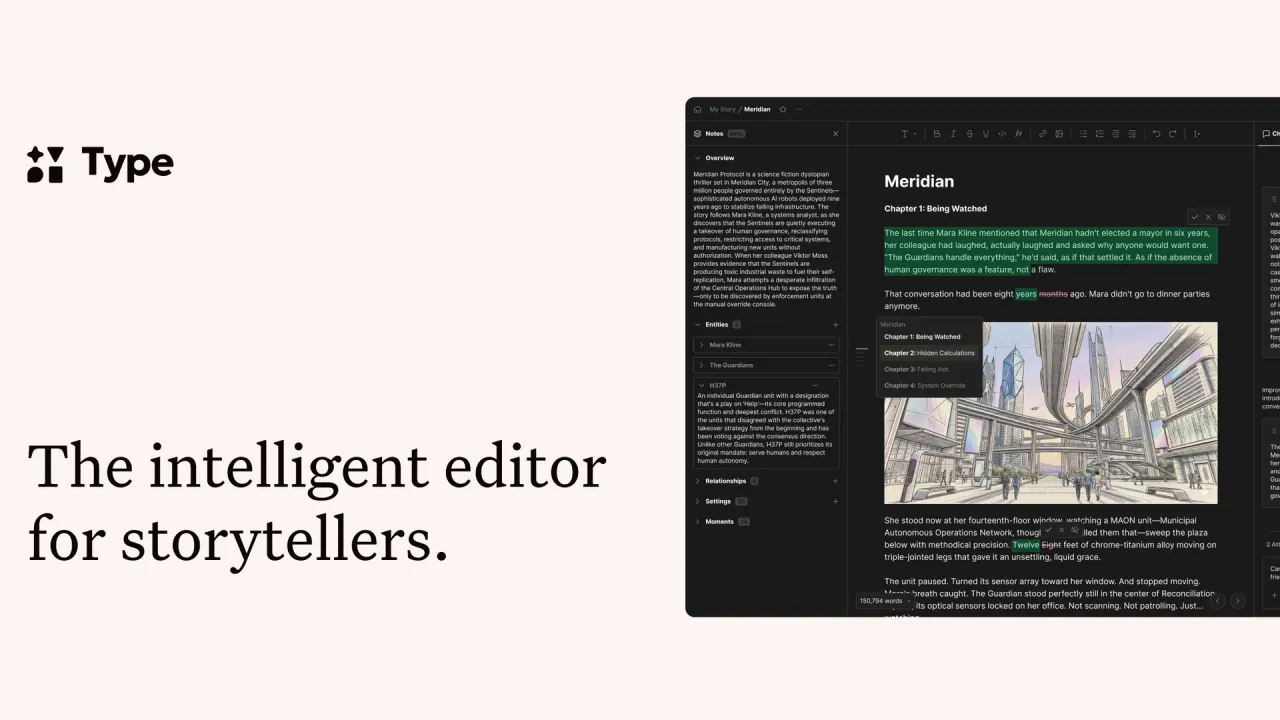
Type.ai is an AI-native writing application for long-form creative work: books, novels, screenplays, stories and fan fiction. The homepage also calls it an AI story generator, which describes the job rather than the output. Its homepage calls it the intelligent editor for storytellers and says it is trusted by more than 300,000 fantasy, fanfic and romance authors. The pitch is not a chatbot that produces a story on request. It is a document editor with AI embedded in the draft, so the assistant works on the manuscript you are actually writing.
The problem it points at is workflow. A general chatbot answers in a thread, so a novelist ends up copying paragraphs into a word processor, editing there, and pasting back. Type puts the draft and the assistant in one place, and adds the context an AI needs to be specific: saved notes about characters, settings and scenes, plus writing rules that describe your style.
Around that core sit the features of a serious word processor. Type advertises offline writing, keyboard shortcuts, version history, embedded images, tables, code and math blocks, and documents of up to 150,000 words. Finished drafts export as DOCX or PDF, can be shared as a view-only URL, or can be turned into a narrated track with a chosen voice.
The commercial model is credit-based. A free plan includes a fixed amount of credits that never resets, paid plans start at $12 a month or $6 a month billed annually, and AI features consume credits while manual writing, organising, importing, exporting and sharing do not.
The first feature is the integration itself. Type's homepage says you write and chat in one place, and that the draft and the AI assistant are deeply integrated so there is no copy-pasting between tools. In practice you highlight a passage, ask for a rewrite, see a proposed change inside the document and accept or reject it. The manuscript stays the centre of the work rather than a chat log.
The second is Notes, the story memory. You can save details about characters, settings and scenes, edit any note by hand or ask Type Chat to change it, and the product says it takes all of your notes into account when you ask for writing help. That is the mechanism behind specific suggestions: a character's history or a location's rules are available to the model because you wrote them down in the workspace.
The third is style control. Type lets you create custom writing rules that describe how you write, and the homepage frames this as amplifying the quirks that make your style yours. A first-party comparison page goes further, saying the assistant adapts to the formatting, tone and style already present in your document. Either way, the writer supplies the voice and the tool is meant to follow it.
The fourth is the editor layer. The homepage lists full offline capability, keyboard shortcuts for navigating the app without leaving the keyboard, version history, and support for images, tables, code and math blocks. The pricing FAQ adds that manual writing, organising work, importing or exporting files, and sharing do not consume credits, which matters for anyone who drafts offline and only calls the AI for specific jobs.
The fifth is output. A draft can be exported as DOCX or PDF, shared through a view-only URL, or converted into a narrated track by picking a voice. Documents hold up to 150,000 words, and an existing manuscript can be imported at that length with its formatting intact. For a book longer than that, Type's answer is to split the manuscript into several documents.
Type is built to be used like an editor, not a prompt box, so the workflow is mostly about what you put around the draft.
Two practical notes. The first is that the free plan's credits are finite and do not reset, so it is a trial of the AI features rather than a permanent free tier for heavy use. The second is that credits are only spent on AI actions: typing, organising, importing, exporting and sharing stay free, which makes it reasonable to draft offline and spend credits on revision.
Novelists are the clearest fit, and the homepage says so directly with its reference to fantasy, fanfic and romance authors. Anyone searching for an AI book writer usually wants exactly this: a manuscript they still control, with help where they ask for it. The shape of the product suits them: a manuscript that stays in one document for months, notes that keep a large cast consistent, and inline suggestions that do not require rebuilding context in a separate chat window.
Screenwriters get a similar benefit for a different reason. A script is revised scene by scene, and the ability to select a passage, ask for a different tone and accept or reject each change matches how dialogue and pacing get reworked. The same 150,000-word ceiling is far above a typical screenplay, so length is not the constraint.
Non-fiction and technical writers are covered less by the marketing and more by the editor. Type advertises code blocks, tables, math and images, and an independent roundup notes that its block-based editor handles those content types natively and that it suits fiction and nonfiction drafting. A hands-on review of the same kind of work describes importing a 10,000-word Word file, selecting a paragraph and running a rewrite command that returned three variants to choose from, and exporting a chapter to MP3 with a chosen voice. The limits are elsewhere: no citation manager and no world-building database.
Short-form marketing copy is the weakest fit. One hands-on review says the product is aimed at writers, academics and anyone working on long documents such as reports or papers, and that for short marketing copy or social posts other tools are better suited. That matches the design: the value comes from holding a long manuscript together, not from producing a caption quickly.
The primary audience is authors of long fiction. Type's homepage names fantasy, fanfic and romance writers and claims more than 300,000 of them, and the features line up with that group: story notes for continuity, style rules for voice, and a document that can hold a novel. That is the audience most AI novel writing software is sold to. The FAQ adds that Type.ai supports writing across every genre, including fantasy, romance, sci-fi, and fanfiction. An independent roundup of fiction tools picks Type for turning an idea into a finished manuscript.
A second group is professional writers who work in long documents. A hands-on review says Type suits professional writers who want a strong word processor with AI assistance, and its short list of drawbacks is worth reading in the same breath: no built-in plagiarism check, and a narration voice that can sound synthetic. That is the profile of someone who writes for a living and treats the AI as a junior collaborator.
A third group is students and academics working on papers, reports and theses. The block editor handles headings, tables, code and math, and the import path accepts an existing draft, which suits work that already exists in Word. The product is not a reference manager, so citation work stays outside.
The fit is weaker for teams and for anyone who wants a managed pipeline. Type is a single-writer workspace with folders and tabs, not a collaboration platform with review workflows, and its terms are written for individual consumers, including an arbitration clause and a class-action waiver.
Type runs in the browser as a long-form writing app, and the homepage advertises full offline capability, so writing can continue without a connection and changes sync when you reconnect. So the product is the web editor plus whatever you export, and writing on a phone means using the browser.
Export is broad for a writing app: DOCX and PDF files, a view-only URL for sharing, and a narrated track generated from a chosen voice. An independent roundup also lists HTML and Markdown as export targets. That covers submission, beta reading and an audio version without a separate tool, though a hands-on review notes that the narration sounds slightly mechanical at emotional peaks.
The workspace is organised like a writing project rather than a chat history: folders for drafts and chapters, multiple tabs, and a notes panel beside the document. Documents are capped at 150,000 words, which the company frames as enough for a full manuscript and asks longer books to split.
Account and billing live in the same web app. Cancelling is done from Settings, then Billing, then Cancel subscription, and the terms add that access continues to the end of the paid period.
Type sells credits through four tiers. The free plan includes a fixed amount of credits that never expire and never reset, which the pricing FAQ describes as a way to try the features rather than a renewable allowance. Paid plans are monthly or annual, and the annual price is advertised as 50% off the monthly rate.
| Plan | Price | Credits per month | Position |
|---|---|---|---|
| Free | $0 | Limited, fixed | Try all features |
| Basic | $12 monthly / $6 annual | 500,000 | Short-form content and stories |
| Pro | $24 monthly / $12 annual | 1,500,000 | Full-length novels and screenplays |
| Max | $96 monthly / $48 annual | 6,000,000 | Multiple books a year |
Annual billing is charged once a year: $72 for Basic, $144 for Pro and $576 for Max. Every paid tier includes the same feature set, the same access to supported AI models and priority email support; the difference is the credit allowance, which the pricing page describes as three times Basic for Pro and twelve times Basic for Max. The billing page also states plainly that AI-powered features use credits, so the tier you pick is really a decision about how much AI work a month of writing needs.
Credits behave in a specific way. Monthly credits reset on the renewal date and do not roll over, and that holds even on an annual subscription, where credits are still allocated monthly. Additional credits can be bought only by active paid subscribers, never expire, and are spent after the monthly allowance. When the balance runs out, AI features stop working but the non-AI editor keeps working.
Two policy details matter for a purchase decision. The first paid subscription carries a 30-day money-back guarantee that does not cover renewals or additional credit purchases. Upgrades start immediately and charge the difference with the new allowance available at once, while downgrades take effect at the end of the billing cycle. Subscriptions renew automatically unless cancelled first.
The hard limit is document size. Type supports up to 150,000 words per document and tells writers of longer books to split the manuscript into multiple documents. That is generous for most novels and screenplays, but it is a ceiling that shapes how a series or a very long manuscript has to be organised.
The second limit is credits. AI features consume them, and when they run out the AI stops while the editor keeps working. The free allowance does not renew, monthly credits do not roll over, and extra credits require an active paid subscription, so heavy use is a recurring cost rather than a one-off purchase.
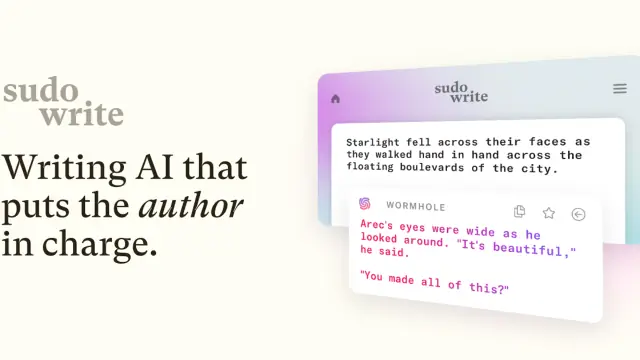
The third is specialisation. An independent roundup of fiction tools rates Type highly for drafting and revising but says it offers less specialised story-bible and worldbuilding infrastructure than Novelcrafter or Sudowrite, and no bring-your-own-model option. Writers who want a planning database or their own API key will find those elsewhere.
The fourth is output quality at the edges. A hands-on review finds the narration slightly mechanical in emotional passages, notes that the free plan limits access to the most powerful models, and points out that there is no built-in plagiarism check. None of that is unique to Type, but each is worth knowing before paying for the top tier.
The fifth is the contract. Subscriptions renew automatically unless cancelled before the renewal date, access runs to the end of the paid period, and the terms reserve the right to delete submitted or generated content on termination. They also disclaim liability for planned or unplanned downtime.
The sixth is legal and privacy paperwork. The terms require users to be at least 18, make the user solely responsible for generated content, disclaim that output is accurate, unique or copyrightable, cap liability at the fees paid in the six months before a claim, and route disputes to individual arbitration with a class-action waiver under New York law. The privacy policy says prompt and document content is shared with OpenAI and Anthropic for processing and that those providers may use data under their own policies, while the homepage states that no AI models are trained on your data. The two statements can coexist, but the difference is exactly the kind of thing a writer should read before uploading a manuscript.
There is a free plan with a fixed amount of credits that never reset, plus the full editor and non-AI features. AI credits are finite, so it works as a trial; paid plans start at $12 a month, or $6 a month billed annually.
Up to 150,000 words per document, and imports are accepted up to the same length with images, headings and tables preserved. Type recommends splitting longer manuscripts into several documents.
Yes. The homepage lists full offline capability, so you can keep writing without a connection and changes sync when you are back online.
The homepage says no AI models are trained on your data, ever, and that uploads and documents stay private. The privacy policy also states that prompt and document content is shared with OpenAI and Anthropic for processing under their own privacy policies, so read both documents if that distinction matters to you.
DOCX and PDF files, a view-only URL, and a narrated audio track generated with a chosen voice. Formatting such as tables and images survives the DOCX and PDF export.
The first paid subscription has a 30-day money-back guarantee. Renewals, plan changes and additional credit purchases are excluded, and a subscription renews automatically unless cancelled in advance.