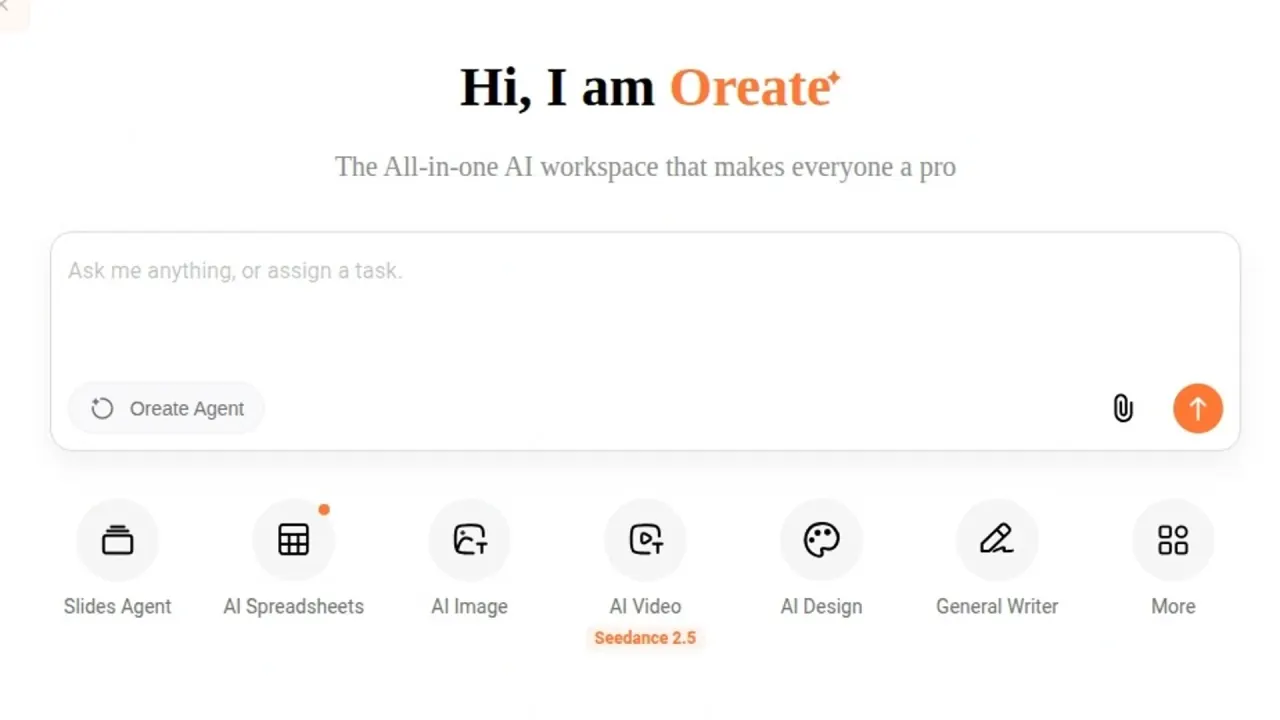

An all-in-one AI workspace where an outline-first essay writer, a register-controlled paraphraser and a slide generator share a single credit balance — built for students and writers who move from brief to draft to presentation without switching tools.
Oreate AI is a browser-based AI workspace that puts essay drafting, paraphrasing, slide generation, image editing and video generation behind one login and one shared credit balance. The vendor calls it an all-in-one AI workspace. It is not an essay generator that grew extra features; it is a bundle whose selling point is that one tool's output becomes the next tool's input without an export step. Almost every capability exists elsewhere in a more specialised form. What does not is the convenience of turning a prompt into a cited draft and then a deck without leaving the tab — worth something only if your work moves through those stages in order.
The operator is a Japanese company, Flextech Inc., listed at Roppongi Hills Mori Tower in Tokyo — which decides the legal regime governing your subscription, and explains why the clearest pricing document on the site is a statutory sales disclosure rather than a marketing page.
One thing to carry below: on several points the vendor's legal documents state the opposite of what its landing pages imply. The essay page advertises confidential academic writing; the privacy policy advises against entering sensitive information. The presentation page markets client decks; the terms prohibit unauthorised commercial use. Both are stated here.
The AI essay writer does not hand you a finished draft on the first click. It builds an editable outline first, lets you regenerate that outline until the shape is right, and only then expands it into prose, returning you to an editor for review, citation checking and format selection.
A single writing run is advertised at up to 20,000 words, which puts a dissertation chapter rather than a short answer inside one pass — a ceiling on what the interface accepts, not a promise about coherence at that length. Citation sourcing is the line the vendor draws against a general chat assistant, claiming references from an academic library rather than invented ones.
Up to 10,000 words pass through the AI paraphraser in one run, with a regenerate control for a second option, and the rewrite is steered by a register you name rather than one the tool guesses.
The humanize feature is narrower than the paraphraser sitting beside it. Its own input box accepts English only for now, so the multilingual reach advertised for essays does not carry across.
The vendor's own pages also disagree about detector evasion. The essay landing page markets guaranteed detection success, while the paraphrasing page only claims detection is made difficult. A third-party bypass test through three detectors found one still returning a machine-written verdict; its publisher sells a competing detector, so it is not settled proof, but it lands where the softer wording pointed.
The deck builder is where the bundle argument is strongest: the document you drafted is already in the workspace. Slides leave as editable .pptx that the vendor says opens in PowerPoint or Google Slides, with PDF and a share link alongside. Editable export matters more than generation quality: flat images cannot be fixed before a meeting.
Video generation routes to outside models, with Seedance, Kling and Pixverse offered as switchable options in the same editor. The thirty-second length and fifty-reference ceiling advertised there belong to the upstream model, so it moves when the model does.
Two habits follow from how the product is built. Spend your effort on the outline rather than the draft, and treat the free evaluation budget as exactly that. A signed-in account receives free daily credits without a card on file, so the first pass costs nothing but an email address.
The first follows from the pipeline: the outline arrives before the prose, so the cheap correction point is the one the interface already puts in front of you.
The second follows from the contract. The vendor declines to warrant the legality, authenticity, accuracy or completeness of anything produced and puts the burden of judging output on the user, so verify every citation against its named source.
The workspace earns its keep in the seams between tasks, not inside any one of them, and three sequences show where that pays.
The first is coursework to presentation: start from a prompt carrying the source count and word target, verify each citation, then push the document into the slide generator. A single writing run is advertised at up to 20,000 words, which puts a dissertation chapter rather than a short answer inside one pass, so an entire assignment moves through in one sequence.
The second uses only half the product. As an AI presentation maker, decks can start from a typed topic, an uploaded PDF, Word or TXT file, pasted text or existing HTML, so an existing report skips drafting — a cheap way to test the bundle first.
The third is register conversion. In the AI paraphraser, rewriting is steered by a named register, with Academic, Business, Technical, Marketing, Creative, Artistic, Plain, Basic and Extended offered as separate choices, so a passage written for reviewers can move toward plain prose.
Fit turns on one question: whether the work you bring is something you may safely hand over on these terms.
It fits a student or early-career writer in a supported language who moves from brief to draft to deck and verifies sources whatever any tool claims. Essay generation covers English, Spanish and Arabic, and anything beyond those three is described as planned rather than shipped, so anyone outside those languages is evaluating a smaller product than the one advertised. It also suits a non-native English writer who needs register control more than raw generation.
It fits badly for confidential or client-owned material. Using the service grants the operator and its affiliates a royalty-free, worldwide, perpetual and sublicensable licence over everything you type in or generate — not a licence you can grant over work that is not yours to give away.
It fits badly for commercial production work. The same terms prohibit reselling the service or using it for commercial purposes without authorisation, which runs into the business proposals and marketing decks the product advertises.
It also fits badly for under-18 school users. Account holders must warrant they are over 18, which sits awkwardly beside marketing built almost entirely around school and university assignments — and the privacy policy sets its child threshold at 14, so the documents disagree on who counts as a minor.
Everything runs in a browser tab on desktop, tablet and mobile with nothing to install, and a desktop download is offered separately. For a tool whose input is typed text and uploaded files, that removes the friction of moving between a personal laptop and an institutional machine you cannot install software on. The image tools accept JPG, JPEG, PNG and WEBP, exporting without a visible watermark.
The sitemap lists the essay-writer page in three locales — English, Spanish and Arabic — so readers outside those three meet it in a second language. The essay feature states those same three languages, and the humanizer's input field states English only.
File handling is where reach is broadest. On the way in, the deck builder accepts documents and markup as well as prompts; on the way out, the .pptx it produces stays editable in the desktop tools most institutions already require, with PDF and a share link as fallbacks.
Access is metered in credits that are only drawn down when a feature actually runs, and the balance is split three ways. Each class expires differently. Daily credits expire weekly on a timezone-dependent reset, subscription credits expire 31 days after they are granted, and bonus credits never expire. The soonest-to-expire balance goes first, which works in your favour — but a healthy-looking total can be mostly about to vanish.
The monthly plan grants 1,500 credits a month, the annual plan grants 2,000 a month across twelve months, and the introductory plan grants 300 up front before renewing at the monthly rate. Annual therefore buys a third more credits every month as well as a lower rate. Bonus credits need no payment — sign-up, first use of each feature, and 500 credits when a referred friend first pays.
| Plan | Published price | Credit grant | Renewal |
|---|---|---|---|
| Three-day introductory | $3.59 | 300 up front | Renews monthly at the monthly allowance |
| Monthly | $19.99 | 1,500 per month | Auto-renews each cycle unless cancelled |
| Annual | $94.88 | 2,000 per month for 12 months | Auto-renews unless cancelled |
Those figures come from the statutory sales disclosure: a three-day introductory plan at 3.59 US dollars, a monthly plan at 19.99 US dollars and an annual plan at 94.88 US dollars. Two things the table cannot show matter more. Subscriptions renew automatically unless cancelled, so the introductory plan is an entry into a recurring charge; and the terms let fees change at any time without notice. On refunds, the request has to be made within three days of the original purchase, and no charges beyond the plan price apply — which for an annual plan makes the decision final after the first weekend.
The public pricing and help routes drop an anonymous visitor into the workspace shell instead of a plan table. You learn what a plan costs and how many credits it grants, but not what any action consumes — so the allowance cannot become a number of essays, decks or videos.
A dated editorial audit found that the published allowances do not disclose enough per-task charging detail to forecast what one real assignment costs; it also states what it did not test — citation precision, export fidelity, cancellation and refund success. The free daily allowance is the only way to price it: record your balance before and after one representative task.
On alternatives the useful question is not which tool is better overall, but which bundled job you would miss if you unbundled them. An independent tool directory files the product under education and studies and names a research assistant, a notes workspace and a paraphrasing tool as its nearest substitutes — three categories rather than one competitor, because the bundle's parts map onto three markets, each with deeper specialists.
A dated comparison roundup reached the same split. It judged the workspace worth keeping when an outline, a cited essay and a deck follow one another, and worth leaving when any one of those jobs needs specialist depth. Its publisher sells a competing product, so the recommendation is self-interested, but the observation matches the neutral listing.
Figures elsewhere may be stale: an older snapshot shows a promotional rate and a seven-day trial where the disclosure now names three days. Confirm both at checkout.
The vendor declines to warrant the legality, authenticity, accuracy or completeness of anything produced and puts the burden of judging output on the user. Beside the promise of genuine citations from credible sources, that is the most important sentence on the site: reliability is the marketing position, verification the contractual one. The terms separately warn that output may not be unique between users, so two people on a similar brief can receive similar text.
Publishing on the service carries a disclosure duty: output published there must be conspicuously identified as produced by the service, and the AI-generated marker may not be removed or tampered with without the vendor's consent or a legitimate and proper basis. Work submitted elsewhere follows that venue's rules. The same terms prohibit reselling the service or using it for commercial purposes without authorisation.
The terms reserve the right to change how many words an output or input is charged for and to impose hourly usage caps regardless of what was promised at purchase. With no published per-action cost, the relationship between what you pay and what you get is not fixed when you buy. If the operator restricts or terminates an account under its own enforcement, the terms state it may keep the fees already paid.
On a rated review platform the claimed profile carries a TrustScore of 2.0 across 29 total reviews, 83 percent of them at one star. That 29 is the profile's total review count, not a verified sample of any one complaint theme. Individually quoted entries there report automatic renewal without warning, no cancellation control in settings, and support not replying after five days — the area where a three-day refund window leaves least room to recover. Disputes run under the laws of Japan, raising the cost of escalating one above the subscription price itself.
Uploaded documents, typed text, voice and images are recorded and used to improve the system's recognition and response — source material you did not write as much as your own. A memory system carries content across conversations, and switching it off hides existing entries rather than deleting them; removal is manual. The operator's own advice is not to enter personal or sensitive data at all, which is hard to square with the confidential academic writing promised on the essay page.
There is a free tier rather than only a trial: a signed-in account receives free daily credits with no card on file. Those credits expire weekly, so the allowance does not accumulate while you are away.
The statutory sales disclosure lists a three-day introductory plan at 3.59 US dollars, a monthly plan at 19.99 US dollars and an annual plan at 94.88 US dollars. A refund request has to arrive within three days of purchase, and subscriptions auto-renew unless cancelled.
The published material does not say, and a dated editorial audit found that the published allowances do not disclose enough per-task charging detail to forecast what one real assignment costs. Measure it inside your own account.
No, and the terms say so: the vendor disclaims any warranty over the accuracy or completeness of what it produces, leaving verification to you.
Not reliably. The essay landing page markets guaranteed detection success, while the paraphrasing page only claims detection is made difficult, and a third-party test through three detectors found one still flagging the humanized version.
Essay generation covers English, Spanish and Arabic, and anything beyond those three is described as planned rather than shipped. The humanizer is narrower still, accepting English only.
You keep your own rights but grant a broad one: a royalty-free, worldwide, perpetual and sublicensable licence to the operator and its affiliates over everything you type in or generate. Output published on the service must be identified there as machine-produced; the clause does not reach other venues.
Not without asking first: the terms bar unauthorised commercial use, which the product's own business-proposal marketing cuts against.
