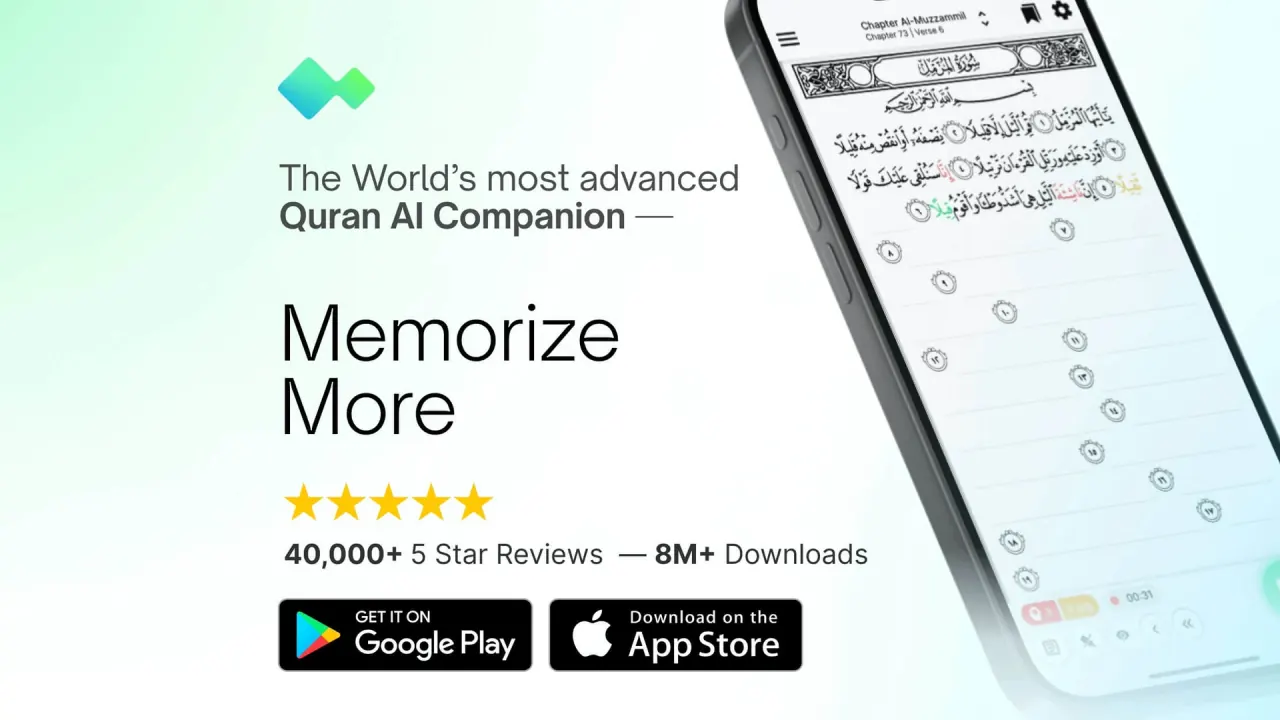

Tarteel AI is a Quran memorization app that listens while you recite, flags missed or incorrect words in real time, and tracks goals, mistakes and streaks across a memorization plan.
Used this tool? Rate it
Used this tool? Rate it


Astrology readings from real astrologers


AI image editing from a reference photo


Multi-model image studio, free to start


Natural AI photo editing for portraits and projects


AI assistant for writing, analysis and tasks


From a prompt to a deck, site or doc


Build random generators, share them free


Anime art, powered by a million community models
Tarteel AI is a Quran memorization app that listens to a recitation, follows the reader's place in the text and flags words that were missed, skipped or recited incorrectly. The company calls it the leading app for Quran memorization and says artificial intelligence helps millions of Muslims connect with the Quran; that framing is the vendor's own positioning rather than an independent measurement.
The product is narrower than a Quran library with a recording button attached. Its speech features exist to support practice: reciting from memory, being corrected in the moment, and reviewing what went wrong afterwards. Everything else in the app — the mushaf, translations, tafsir, reciters — feeds that loop rather than standing alone.
Two figures on the pricing page describe its reach. The vendor reports over 20 million downloads worldwide. The same page advertises more than 100,000 five-star reviews, and both numbers are reported by the company rather than audited. This review did not reach a store listing to verify either of them, so no store rating or review count is quoted here.
Tarteel AI is often compared with Quran readers, but the two do different jobs. A reader helps someone follow the text; Tarteel AI asks the reader to produce the text from memory and then judges the attempt.
Quran mistake detection is the capability the vendor leads with, and the rest of the feature set supports it. The work divides into four jobs: catching mistakes, planning what to memorize, getting through a recitation, and seeing progress over time, each with its own limits on the free tier.
The flagship capability is real-time mistake detection: the vendor says the AI detects missed, incorrect and skipped words in a recitation and alerts the reader while they recite. Correction therefore arrives during the attempt, not in a summary afterwards, which is the part that separates the app from an audio player with a repeat button.
The comparison table lists separate rows for mistake detection, mistake history, mistake frequency and mistake playback, so a flagged word can be revisited rather than only counted. It also lists "verse peeking" and "hide verses", the two halves of a common hifz drill: cover the page, recite, and look only when stuck.
Planning tools are presented as a way to fit memorization to a reader's own learning style and preferences. Goals are recorded per reader and tracked as the work progresses. The plan comparison sets "1 goal" against "Unlimited goals", so the lower tier covers a single target while a wider plan allows several at once.
Streaks and badges sit alongside the goals. They are habit mechanics rather than study methods, and the vendor lists them among the free features, which makes them the cheapest part of the product to try.
AI recitation follow-along is included in the free plan: the app tracks where the reader is in the text as they recite. Voice search works in the other direction — a verse is located by reciting part of it, which is useful when the words are remembered but the surah and ayah number are not.
Search history has a cap on one column and none on the other: the comparison lists "3 searches" against "Unlimited". The same table distinguishes basic from advanced analytics, and one goal from unlimited goals, so the free tier is a trial of the mechanics rather than of the analysis.
Reading support covers two script styles, Indopak and Madani, plus translations, transliteration, tafsir and bookmarks. The comparison groups these under a mushaf heading, which matters for readers trained on one page layout: an Indopak reader and a Madani reader are looking at different line breaks for the same verse.
Reciter audio, repeat and a custom range of verses belong to the same reading surface, which is what makes a revision session possible without a printed copy.
Session history, streaks, completion tracking and a mistakes overview are listed as progress features, with analytics split into a basic and an advanced version. Cross-device syncing is listed too, so a session started on one phone is not stranded there.
Session audio can be kept for the last session or without a cap depending on the plan, and it can be shared. That is the feature a teacher or a study partner actually uses: not a score, but the recording of the passage as it was recited.
A Family Plan covers one subscription and five family accounts in total, with an invite link sent to each member. The family page describes the setup in three steps: subscribe, send the invite, start memorizing together.
A practice session in Tarteel AI follows the shape of a hifz lesson rather than a media player.
The last step is the one that changes behaviour. A single session tells a reader that something went wrong; a mistake history tells them which word, which position in the verse and which surah keep coming back, which is the information a teacher would otherwise have to remember for them.
The vendor defines the service's scope as recitation, memorization, review and related educational use, which maps onto a narrow set of practice routines rather than general audio work.
What the app does not cover is equally specific. It is not built to transcribe lectures, produce subtitles or convert arbitrary speech into text, and treating it as a dictation tool would fall outside the use the vendor permits.
Tarteel suits learners who practise alone on a phone and want immediate feedback, and it is a weaker fit for anyone who needs a desktop workflow or a general-purpose transcription tool.
The vendor also reports that Premium users spend 74% more time in the app than non-Premium users. That is an engagement statistic about people who already pay, not evidence that the paid tier teaches better, and it should be read as a signal of how the paid features are used rather than as a learning outcome.
The service is delivered as mobile apps for iOS and Android plus the websites where accounts and plans are managed, and an independent review describes the product as mobile-only.
A free tier is listed at $0 and described as free forever with no ads. Premium is $7.50 per month billed annually, shown as 42% off, and adds mistake detection, memorization planning and advanced analytics. A Family Plan is $13 per month billed annually, or $156 a year, for five accounts.
| Plan | Price as listed | Billing | What the plan adds |
|---|---|---|---|
| Free | $0 | No payment | AI recitation follow-along, custom goal setting, streaks, no ads |
| Premium | $7.50 per month | Billed annually, shown as 42% off | Mistake detection, memorization planning, advanced analytics |
| Family | $13 per month | Billed annually, $156 per year | All Premium features, 1 subscription, 5 family accounts |
A monthly and annual toggle sits above the cards, and the annual position is advertised as up to 65% off. The Family page compares the plan with five separate Premium subscriptions at $37.50 per month each, or $449.95 a year, which is where the 65% claim comes from.
One further path sits outside the three cards. The Alim Program offers a discounted subscription to applicants who demonstrate financial need: the form asks about commitment to memorization, the application is reviewed within 48 hours, and an approved participant can use the discounted subscription for 12 months.
Billing is automatic: unless cancelled before the end of a promotional period, the subscription renews for further terms of the same length at the then-current price. Cancelling during a promotional period ends access with no refund or exchange.
The comparison is less about features than about what each app is built to do: Quran.com for reading and tafsir, Muslim Pro for prayer times, and Tarteel for recitation feedback.
Quran.com. An independent comparison describes the Quran.com app as open source and built for readers who want to reach the mushaf quickly, without unrelated menus or promotional screens. It is the choice when translation depth and tafsir matter more than recitation correction, and its reading tools are the ones most often paired with Tarteel rather than replaced by it.
Muslim Pro. The same roundup describes Muslim Pro as handling prayer times, adhan notifications, Qibla, the Hijri calendar and a Quran reader in one place. It is the all-in-one option; the review also notes that the interface is dense and the free tier shows ads, so it trades a clean reading surface for breadth.
Ayah. Ayah is described as free, with no ads and no in-app purchases on the core reader, and as having one of the highest ratings among Quran apps. It is the reading-first choice for someone who does not need AI feedback at all.
What none of the three does is judge a recitation word by word. The trade is straightforward: a reader gives depth and breadth, Tarteel gives correction, and a serious hifz student often keeps one of each.
There is a free plan listed at $0 and described as free forever with no ads. It includes AI recitation follow-along, custom goal setting and streaks, but mistake detection, memorization planning and advanced analytics are listed as Premium features.
Premium is listed at $7.50 per month billed annually, shown as 42% off the monthly position, and the Family Plan is $13 per month billed annually, or $156 a year, for five accounts.
Yes, according to the vendor: the AI detects missed, incorrect and skipped words in a recitation and alerts the reader while they recite. The terms disclaim any warranty of accuracy, so the flags are best treated as prompts to re-check.
No. The terms state that the speech recognition and transcription features are intended solely to support recitation, memorization, review and related educational use, and are not a general-purpose transcription service.
Voice recordings are treated as personal information and stored on servers in the United States. The policy says no data is stored in the EU and that US server providers hold a GDPR-compliant data processing addendum.
The Family Plan covers five accounts on one subscription, and the Alim Program offers a discounted 12-month subscription to applicants who demonstrate financial need, with applications reviewed within 48 hours.