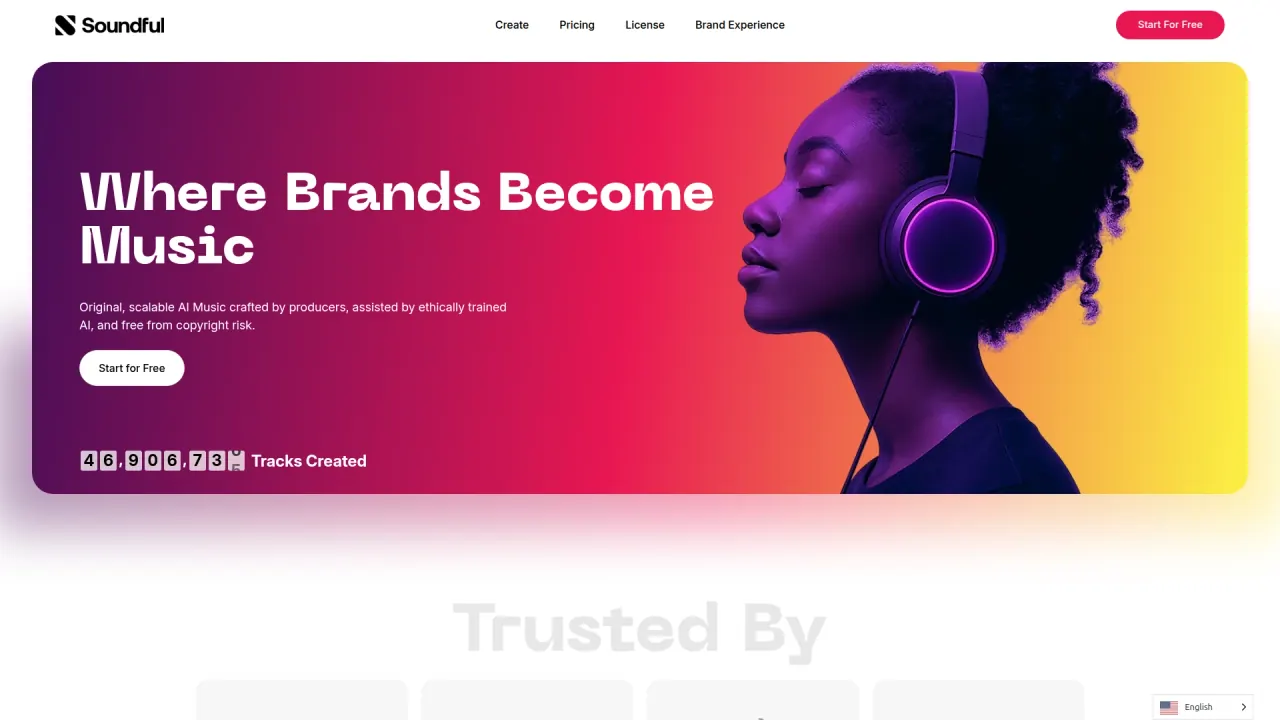

Soundful turned a genre and template choice into royalty-free instrumentals, loops and STEM packs in the browser. Its self-serve Studio is no longer open to the public, and this page records how the plans, licences and downloads were built.
Used this tool? Rate it
Used this tool? Rate it


Personal stories, made into song gifts


AI image editing from a reference photo


Multi-model image studio, free to start


Natural AI photo editing for portraits and projects


AI assistant for writing, analysis and tasks


From a prompt to a deck, site or doc


Build random generators, share them free


Anime art, powered by a million community models
Soundful is a browser-based AI music generator that turned a genre and template choice into a finished instrumental, a loop or a multi-track STEM pack for video, podcast and brand projects. Its status is the first thing to know: the company's homepage now says that Soundful Studio "will no longer be available to the public" as the business takes a new direction. The self-serve studio that tutorials and comparison lists describe is therefore closed, and every product URL left in the sitemap now serves the same notice.
Before it closed, the company said more than 2 million creators had used Soundful to bring their ideas to life through music. Independent music-industry trade coverage in April 2022 described the company as Los Angeles-based with a $3.8m seed round already closed, and pitched the system to musicians as a source of "ideas or hooks and beats" and to social media influencers as royalty-free music for their videos.
A user picked a genre, a template (the company called a template a sub-genre), a key and a tempo, and the platform composed from scratch. Loops were short repeating parts, tracks were complete songs, and STEM packs unpacked a track into editable parts. Each generation was unique, which is why the platform asked users to save anything they might want later.
The starting point was a style library rather than a text prompt. Standard included 25+ free styles and paid plans unlocked 150+ styles, so the free and paid difference was the size of the template library as much as the download allowance. A template narrowed a broad genre toward a use case rather than asking users to describe music in words.
Three modes sat on one create control. Similar generated a track from the same template as the selected one, Track opened the full track menu regardless of the selection, and Loop opened the loop menu for looping material instead of a full arrangement.
Loops and tracks differed in structure and licence. The company described its loops as typically 30 seconds long and published them under a non-exclusive licence, meaning no individual user could own the copyright in them; they were meant for building up existing projects or for mixing into a Soundful track. Tracks did not necessarily repeat seamlessly, and the licence attached to them depended on the plan.
A STEM download arrived as a zipped folder containing a MIDI file, a mix and master file, and a stems file. That package is what made the output usable inside a DAW rather than only as a finished stereo file.
The licence page grouped usage into a Personal License, a Music Creator License and a Business License. Personal covered personal and non-commercial projects; Music Creator covered commercial projects and music releases by an individual; Business was described as the licence for growing or established businesses, allowing use across creative works and distribution. The plan set the licence, and users did not choose one separately.
Copyright in created tracks was owned by Soundful, but active Music Creator Plus subscribers could buy it per track. The help centre said copyright started at $50.00/track and included full ownership of the track licences plus a STEM pack. Purchases ran by email, followed by a contract for signature, and the buyer had to be an individual rather than a group or business. Bundles (5 or 15) were also sold from the plan details page.
The AI song generator workflow ran in six steps.
The documented route to a full song treated the platform as an instrumental source, not a vocal generator: lyrics and vocals were prepared outside the platform and combined with the downloaded instrumental in an audio workstation. The company also suggested online mastering.
The Standard plan allowed unlimited personal use of tracks on TikTok, YouTube, Twitch, podcasts, Instagram, Facebook and Vimeo, but not monetisation. That fits a creator publishing regularly who needs cleared background music and does not earn from the channel; once the channel is monetised, the licence question changes rather than the music.
Generating several instrumentals in one key, writing over them and keeping the take that fits is the clearest Soundful use case in its own documentation. The documented route was to write or refine lyrics, record or generate vocals separately, then combine the take with the downloaded instrumental in an audio workstation at the BPM shown in the library. The output stayed editable, which matters to a songwriter who wants a bed rather than a finished song.
Streaming on services such as Spotify or Apple Music required buying the copyright, because the standard licences did not cover distribution of the track as the user's own release. A release plan therefore carried a second cost beyond the subscription, quoted per track rather than bundled into the monthly price.
The plan descriptions named their audiences precisely. Premium was described as being for social media creators, freelancers, businesses and agencies looking for royalty-free background music to use for profit. Pro was aimed at artists and producers wanting a broader set of capabilities. Business tiers were aimed at small production houses and agencies where music is part of the value delivered, with the first tier scoped to organisations under $1M in revenue and Enterprise to larger organisations needing tailored licensing.
That ladder points to three buyers: a creator who needs cleared background music at low cost, a producer who wants stems and MIDI to build on, and a business that needs a licence covering client work and distribution. The first of those is the classic royalty-free music buyer: someone who wants cleared tracks without negotiating licences per project.
It also shows who the product did not fit: anyone who needs a working generator today, teams expecting an API the terms did not allow, mobile-first users on a desktop-first product, and anyone who needed to own a master without a per-track copyright purchase.
Soundful ran in a browser. The help centre said it is best experienced on a desktop, and that it could also be used through a phone's browser with functionality and support potentially limited. It stated plainly that there was no app for download, so the product was web-only.
Pro and higher plans also listed direct distribution to SoundCloud, which moved a finished track to a streaming profile without a manual upload. Downloads were MP3, WAV and STEM formats, with MIDI inside the STEM package.
The API question is unresolved across the site's own pages. One help-centre answer said API use was not allowed under the Terms and Conditions and invited users to request a feature instead. Elsewhere in the same help centre an API integration was described with 1,000 pulls per month, no rollover and $1 per pull beyond that, and the pricing page's licence comparison listed API access. The pages contradict each other and neither is marked as superseded.
Prices below are from the archived pricing page as it stood on June 10, 2025. They describe a product now closed to new users, recorded because price is the most-searched fact about a discontinued tool.
| Plan | Price as archived | Downloads per month | STEM packs per month | Styles | Licence |
|---|---|---|---|---|---|
| Standard | Free, forever | 1 MP3 | 0 | 25+ free styles | Personal |
| Premium | $5.00 per month | 100 MP3 and WAV | 0 | 150+ | Music Creator |
| Pro | $9.99 per month with annual commitment, $119.99 today | 400 MP3 and WAV | 20 | 150+ | Music Creator |
| Business Tier 1 | $49.99 per month with annual commitment, $599.99 today | 750 MP3 and WAV | 35 | 150+ | Business |
| Business Tier 2 | $120.83 per month with annual commitment, $1,449.99 today | 1,500 MP3 and WAV | 100 | 150+ | Business |
| Business Tier 3 | $249.99 per month with annual commitment, $2,999.99 today | 3,000 MP3 and WAV | 300 | 150+ | Business |
| Enterprise | Contact sales | Tailored | Tailored | Customised styles | Business |
The annual figures are the amounts the page said would be charged today, not discounted monthly rates. Premium showed a monthly price with no annual amount. Standard was free forever with a Personal License, which is why it carried no premium content and no STEM packs.
A second set of help-centre articles describes the same paid plans with different numbers: 10 downloads and 1 STEM pack per month on Standard, a Content Creator plan with 100 downloads and 1 STEM pack available yearly only, and Music Creator Plus with 300 downloads and 10 STEM packs. Those figures do not match the Standard row or the Pro row on the pricing page. The site never reconciled them, so plan allowances should be treated as inconsistent between pages rather than averaged.
At $50.00 per track, buying rights to one track cost roughly ten months of Pro, and only active subscribers could buy. Enterprise pricing was not published; the page offered customised styles, monetisation of styles on Soundful, a dedicated team and white-glove production instead of a number.
Soundful published its own comparisons before it closed, the only place it described competitors in its own words. Those pages are marketing material, so the descriptions read as the company's characterisation, not an independent ranking.
Soundraw was positioned for content creators, video editors and individuals who want quick royalty-free background music tailored to a mood or scene without deep customisation. Soundful's page said Soundraw assembles songs from a curated set of instrument loops and templates, with each track checked through content ID systems, and that ownership remains with Soundraw. That last point is the sharpest difference for anyone who needed to own a master: Soundful sold copyright per track, while its comparison said Soundraw keeps ownership.
For readers looking for Soundful alternatives, licence scope is the more useful comparison than a feature list. Loudly and Boomy appear on the same pages, but most differences are reduced to feature tables with sparse text, and since those pages predate the closure, licence terms should be checked with each supplier rather than read from a comparison the vendor wrote.
The decisive limitation is availability. The homepage states that Soundful Studio will no longer be available to the public, and the same notice is served on every product URL in the sitemap. A third-party directory independently records the same status. Nothing on the public site says whether existing subscribers keep access, whether tracks can still be downloaded, or what happens to purchased copyrights; those questions are unanswered in the pages reviewed.
The help centre states that API use is not allowed under the Terms and Conditions, while another article and the pricing page both describe API access. With no resolution date or replacement statement, the term that applies cannot be determined from the public pages.
Copyright of created tracks was owned by Soundful, and the terms state that content on the service is owned by Soundful and its affiliates. Downloading a track did not transfer ownership; the master licence stayed with the vendor and copyright was a separate contract. The terms also prohibit data mining and reserve the right to suspend or terminate access at the company's sole discretion without notice.
The published policy allowed a refund only where the customer had not used any premium feature of the plan; using premium features was treated as a waiver of the withdrawal right. It also said no refund would be made because a customer forgot to cancel, and that downgrading or disabling auto-renewal was the customer's responsibility. The free plan was offered as the way to evaluate paid features.
Monthly downloads and STEM credits reset on the sign-up or upgrade date and did not carry over. A fair-use policy also allowed the company to prompt members who exceeded a daily limit for generation or downloads, so unlimited generation did not mean unlimited throughput.
There was no app, and the mobile browser experience was described as limited. A workflow that depended on a phone had to be built around the platform.
The privacy policy reviewed sets out California residents' rights to know what personal information is collected and to request its deletion, exercised by emailing the support address. It does not state whether generated tracks or prompts are used to train models.
No. The homepage states that Soundful Studio will no longer be available to the public, and the pricing and product pages now resolve to that notice. There is no working sign-up path on the public site.
The public pages reviewed do not say. The help centre, as archived, said tracks remain in a user's library while the account is active and that downloaded tracks stay available, but it was written before the shutdown notice and does not cover what happens now.
As archived on June 10, 2025: Standard was free, Premium $5.00 per month, Pro $9.99 per month on an annual commitment of $119.99, and Business tiers from $49.99 to $249.99 per month. Copyright for one track started at $50.00.
Not by default. Copyright of created tracks was owned by Soundful, and active Music Creator Plus subscribers could buy it per track, which included full ownership of the track licences and a STEM pack.
Under Standard, tracks could be used for unlimited personal use on social platforms but not for commercial use or monetisation. Premium plans added monetisation across social platforms, and the duration of that monetisation depended on the plan being active. Client and business use sat under the Business License.
The site contradicts itself. One help-centre answer says API use is not allowed under the Terms and Conditions; another describes an API integration with 1,000 pulls per month and $1 per pull beyond that, and the licence comparison lists API access.
Soundful's own comparison pages described Soundraw as a faster, mood-and-scene-based option that keeps ownership of the tracks it generates. Loudly and Boomy appear on the same pages with thinner descriptions, and all three should be checked directly for current licence terms.