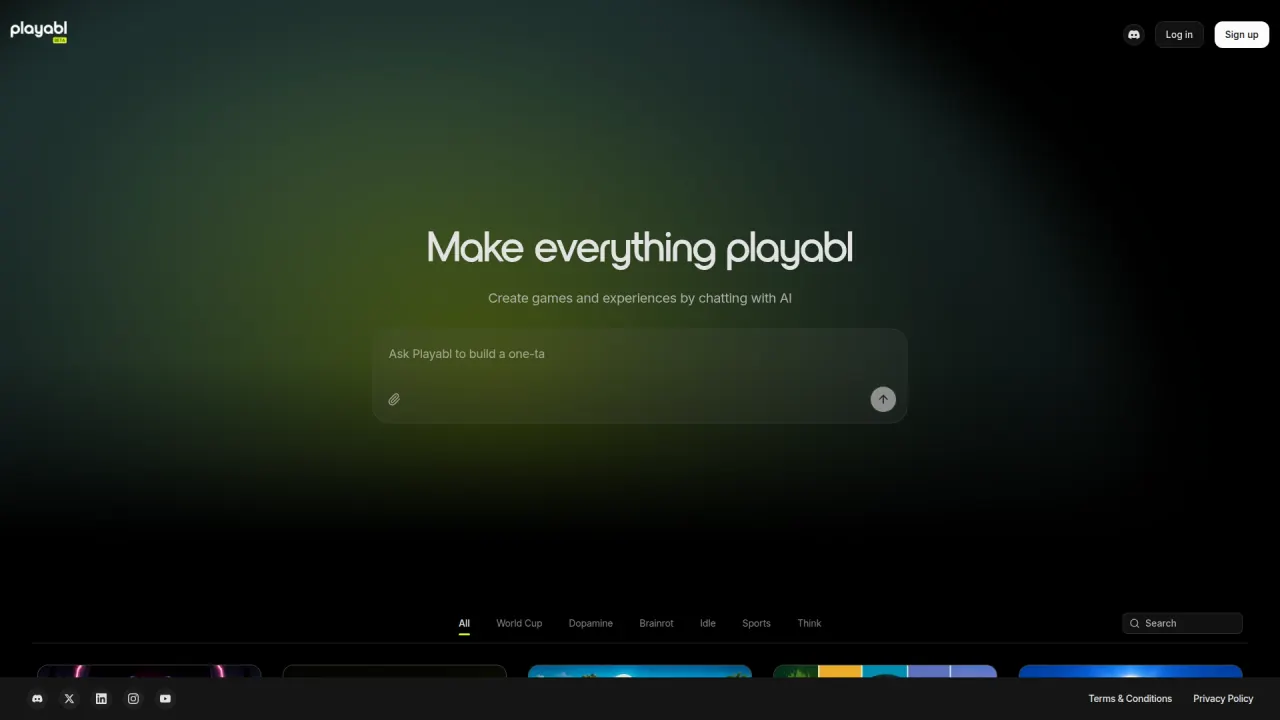

Playabl is a browser-based AI game builder: describe a game in chat, get a playable draft with generated 3D characters, props and sound, refine it by conversation, then publish it to a public Discover feed where other people can play and remix it.
Used this tool? Rate it
Used this tool? Rate it


Anime art, powered by a million community models


From prompt to production with Gemini


Generate new shots and rework existing footage


AI image editing from a reference photo


Multi-model image studio, free to start


Natural AI photo editing for portraits and projects


AI assistant for writing, analysis and tasks


From a prompt to a deck, site or doc
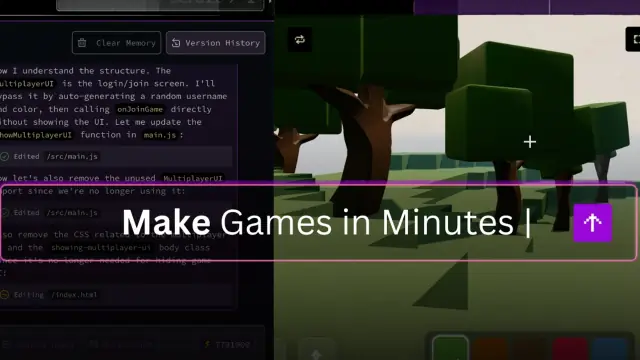
Playabl is an AI game builder that runs in a browser tab. The company's own site description puts the promise in one line: "Turn any idea into a playable game by chatting with AI. No coding needed. Build web games and interactive experiences in minutes with Playabl." No engine is installed and no editor has to be learned: you type what you want, and the system answers with something you can already play.
The loop is narrow by design. A description comes back as a playable draft carrying the main loop, controls, interface and enough starter content to be judged, and later changes to difficulty, pacing, rules or layout are requested in chat. Art, sound and animation come from the same workspace, so a creator with no modelling or audio tool can still finish a small game.
Distribution is the other half. Finished games go to a Discover feed that the homepage sorts into categories such as World Cup, Dopamine, Brainrot, Idle, Sports and Think. The feed is built for play and remixing: a published game can be forked, changed and republished, and a link is enough for someone else to play in a browser.
Playabl Inc. is the contracting party in the current terms, and the company traded as Replkt, Inc. until early September 2026. Hokai describes a Spring 2026 Y Combinator company of ten people in San Francisco. It cites Y Combinator figures of 15,000 games, 4 million unique plays, 40,000 daily and 300,000 weekly active users as of 19 June 2026.
Two cautions belong up front. The product is aimed at consumers, but the terms are written for businesses: they state that the services are for business or commercial use, not personal or consumer use, and describe the service as creating 3D content rather than games. The pricing link inside those terms also returned a not-found error when checked on 26 November 2026.
The first prompt is the whole interface. Hokai describes a typed idea coming back as a playable draft with a main loop, controls, interface and starter content, with later messages treated as instructions about difficulty, pacing, rules or layout. Unlike a prompt-to-code tool, the first output here is already a game you can lose at.
Iteration is conversational, and nothing in the public material suggests a timeline editor or a node graph.
Playabl generates the assets as well as the game. Images, 3D characters, props and sound effects are produced inside the platform from text or an uploaded reference, and covers get their own AI thumbnail generator, according to Hokai. The privacy policy names the same scope: game development, 3D modelling, audio and video generation, texturing, animation and style customisation.
That removes the usual pipeline problem, where an idea stalls because nobody can model a character or find a sound, though the style stays within what the generator can produce.
Publishing puts a game into a public feed rather than behind a download. The homepage's category strip is the visible part, and Hokai adds the mechanics: games can be searched, filtered to remixable titles only, and sorted by newest, most played or most remixed. Remixing and republishing under your own name is a first-class action.
Generation is metered. Hokai reports that every plan carries a monthly credit allowance that resets on a fixed date, that generation stops when it runs out, and that the ways forward are an upgrade, a top-up or pay-as-you-go billing with a spending limit the account holder sets. A workspace view also exposes the code behind a project as a diff.
Creators are paid from the feed. Hokai reports that a creator with at least five published games earns a share of advertising revenue on plays, at a CPM between $0.50 and $10.00 depending on where the plays come from, capped at 1,000,000 paid plays, with a $10 minimum before a payout. A separate affiliate programme pays 20% of a referred customer's payments for the first six months, tracked on a 30-day cookie.
A finished game is played in a browser, on a phone or a laptop, with nothing to install. Hokai describes the hosting as a discover.playabl.ai subdomain and says custom domains and self-hosting were not confirmed. The export path is a link, not a build: no package for Steam, no project file for Unity.
That suits a game jam or a lesson and stops a team whose plan is a storefront: Unity, Unreal Engine, Steam, Itch.io and GitHub are all listed by Hokai as expected but unsupported.
Keep one project and push it, because the model already knows the rules of that game. Change one variable at a time and note the prompt that produced the best version: the chat history is the design document. When a mechanic refuses to behave, simplify it rather than adding another instruction.
Start a second project when the genre changes: Hokai's list of supported styles runs to short-session arcade games, and a runner and a puzzle share little beyond the interface that builds them.
The common thread is a small game with a short session and a link: Playabl is at its best when a stranger can play thirty seconds after clicking.
Playabl fits people who have a game idea and no production team. Hokai lists marketing and brand teams building promotional minigames, indie designers, educators, streamers and non-developers among them. Hokai judges the product good for prototypes and short-session social games rather than a production commercial title.
It fits less well in four situations. A studio planning a commercial title for Steam needs an engine and an export path, and neither is on offer. A team with confidentiality requirements should read the terms first. A developer who wants to own and steer the code belongs in Replit or Cursor. And anyone who needs the monthly cost before signing up will not find it on a public page.
Playabl runs in a browser. There is no desktop client, no mobile app and no plugin, and the games run in the browser too, so a phone can play what a laptop built. Hokai lists the platform simply as "Web" and records no offline mode.
The input side is the chat box, and assets can come from text or an uploaded reference image, according to Hokai. Publishing produces a hosted page on the playabl.ai domain; custom domains, self-hosting and storefront builds were not confirmed when Hokai checked.
Unity, Unreal Engine, Steam, Itch.io and GitHub are all listed as expected but unsupported, so the platform is a destination rather than a step in an existing pipeline, with no public developer API or SDK to build around.
| Plan | Published price | Billing | What is confirmed |
|---|---|---|---|
| Free | No price | Not applicable | A daily creation cap and a monthly credit allowance, per Hokai |
| Pro | Not published | Monthly or yearly, via Stripe | Monthly credits and a three-day credit trial, per Hokai |
| Enterprise | Not published | Contact sales | Custom terms for larger organisations, per Hokai |
Playabl no longer presents itself as free-only: a free tier remains, with Pro above it and Enterprise above that, and Hokai reports the paid tiers are billed monthly or yearly through Stripe, with Pro able to start as a free trial carrying three days' worth of credits. Hokai states that no price is published for either paid tier and that the pricing screen loads only for signed-in accounts. An earlier directory FAQ still calls the product a public beta that is completely free, with paid pricing unannounced.
The free tier is the part with a number attached. Hokai's review, last checked against the vendor's site on 27 September 2026, reports that free accounts can create two games a day, drawing on a credit balance that refills on a fixed date each month. Hokai flags that figure as unconfirmed since, and the pricing page was unreachable in late November 2026.
The terms fill in the mechanics a price page would normally carry. Fees are in US dollars. The price is exclusive of taxes, which the customer pays. Late amounts can attract interest at 1.5% per month, access can be suspended until arrears are cleared, and an account more than 30 days overdue can be terminated. There is no refund on termination.
Money can also flow the other way. A creator with at least five published games earns advertising revenue on plays, at a CPM of $0.50 to $10.00, capped at 1,000,000 paid plays with a $10 payout minimum, according to Hokai.
The alternatives divide into game builders that host what you make and application builders that hand you a codebase.
| Tool | Entry paid price | Free option | Where it differs |
|---|---|---|---|
| Rosebud AI | Not published | Not stated | A quick game-prototyping tool rather than a feed, per a directory comparison |
| YouWare | Not published | Not stated | Prompt-to-playable-product building with backend features, per the same comparison |
| Lovable | $25/month | Yes | Produces a web app you deploy and own |
| Replit | $20/month | Yes | A real development environment for any app type |
A Chinese AI-tools directory compares Playabl with Rosebud AI and YouWare and draws the line at scope. Rosebud AI is described as a fast game-prototyping tool. YouWare is described as a zero-code platform that takes a prompt to a playable product, adding backend features such as logins, leaderboards and saves.
Hokai's framing is blunter. Pick Lovable if the output is a web app you deploy and own, and Playabl if the output is a game that lands in a feed other people can play and remix. Hokai lists Lovable at $25 a month and Replit at $20 a month, both with a free plan, and notes that neither is built around game loops, sprites or 3D assets.
Nothing on the public site tells a prospective customer what Pro costs. The pricing link in the terms returns a not-found error, the pricing screen loads only for signed-in accounts, and Hokai's round-up names Playabl as one of the builders that does not show a price before sign-up. A creator can start for free but cannot model the cost of finishing anything.
Generation is metered, so an open-ended session turns into a budgeting exercise. Hokai's account is that generation stops when the allowance runs out and resumes only on reset, upgrade, top-up or pay-as-you-go billing. For a project that needs dozens of iterations, the constraint is the meter rather than the model.
Publishing produces a hosted page on a playabl.ai subdomain, and Hokai found that custom domains and self-hosting were not confirmed. The integrations most teams expect are all listed as unsupported. There is no export to an engine and no repository to migrate, which makes the platform a destination rather than a stage in a pipeline.
The terms are an AI services agreement for business use, with a liability cap at the fees paid in the previous 12 months, a warranty disclaimer, a Delaware governing law clause and a 30-day notice period for termination on either side. They also describe the service as creating 3D content, including 3D modelling, texturing and style customisation, which does not match a homepage that promises games. A consumer signing up for fun is accepting a contract drafted for procurement, and should read the clauses on data use and refunds. Access can also be suspended when the provider sees an attack, a security risk, fraud or illegality.
Hokai records that Playabl publishes no SOC 2 or ISO 27001 certification and does not name the model behind the product. The privacy policy adds that Playabl is the data controller. Retention lasts as long as the company judges necessary. Personal information is not sold. Hokai also notes that the terms license customer data to improve the AI technology and that no data residency is stated. After termination the terms allow deletion of customer data within 30 days, with no refund. The age floor is 13, or 16 in Europe.
There is a free tier, and Hokai reports that it allows two games a day with a monthly credit allowance and no card to sign up. Pro adds credits, and its price is not published anywhere a signed-out visitor can see.
No. The homepage promises games built by chatting, with no coding needed, and the interface is a prompt box rather than an editor. A code view exists for anyone who wants to inspect the output, but reading it is not a requirement.
Not as a packaged build. Games are published to Playabl's own feed and played through a link, and Hokai lists Unity, Unreal Engine, Steam, Itch.io and GitHub as unsupported. Money can come from the creator revenue share, which starts at five published games and pays a CPM of $0.50 to $10.00, capped at 1,000,000 paid plays.
The terms say the customer owns its data, while granting Playabl a licence to use it to provide the service and improve its AI technology. Output can be used and displayed under a non-exclusive, royalty-free licence for internal business operations, and feedback becomes the company's property. That is workable for a game jam and poor for confidential client material.
The terms allow Playabl to delete customer data within 30 days of termination, and they do not entitle the customer to a refund when the agreement ends. Anything worth keeping should be copied out while the account is active.