
Pi AI is Inflection AI's conversational assistant for venting, thinking out loud, preparing for a hard conversation or keeping everyday reminders. It runs in a browser and as an iOS and Android app, and it starts with a free sign-up.
Used this tool? Rate it
Used this tool? Rate it


AI assistant for writing, analysis and tasks


Build random generators, share them free


Real-time answers, images, and code in one chat


One workspace for every AI model


One workspace where your team and its AI agents think together


AI chat for dark fiction and research


AI assistant for structured work


Astrology readings from real astrologers
Pi AI is a conversational AI assistant and AI companion built around talking rather than around tasks: you type or speak, and Pi answers in a warm, unhurried register. Inflection AI presents the product as "your personal intelligence partner" and calls it, on its own onboarding page, "the world's first personal intelligence".
The promise there is emotional rather than functional. The headline is "Conversations with emotional intelligence", and the situations listed are personal: "Vent, think out loud, prep for a hard conversation, or just chat. Pi meets you wherever you are." The sign-in screen introduces the assistant as "your personal AI, designed to be supportive, smart, and there for you anytime".
Pi is made by Inflection AI, which describes itself as a Public Benefit Corporation "empowering people and brands with human-centered, emotionally intelligent AI". The same name appears as the developer on the Google Play listing, and the terms of service are published under it.
That positioning sets what the product claims. Across the pages reviewed here, Pi is described through conversation, reminders, curiosity prompts and voice; document analysis, coding help and image generation are not presented as capabilities. The start screen is explicit about accuracy: "Pi may make mistakes, so double-check important info."
Pi's pages group the product into a small set of capabilities that all feed the same conversation.
The onboarding page presents reminders, topic prompts and voice as parts of one product rather than separate add-ons: a reminder is set in the same window that answers a question, and voice is a way into that conversation rather than a separate calling app. Its sample exchanges follow the same pattern: asked to help with a weekly meal plan, Pi asks about cuisines and dietary restrictions before producing anything, and every reply ends with a question that keeps the exchange going.
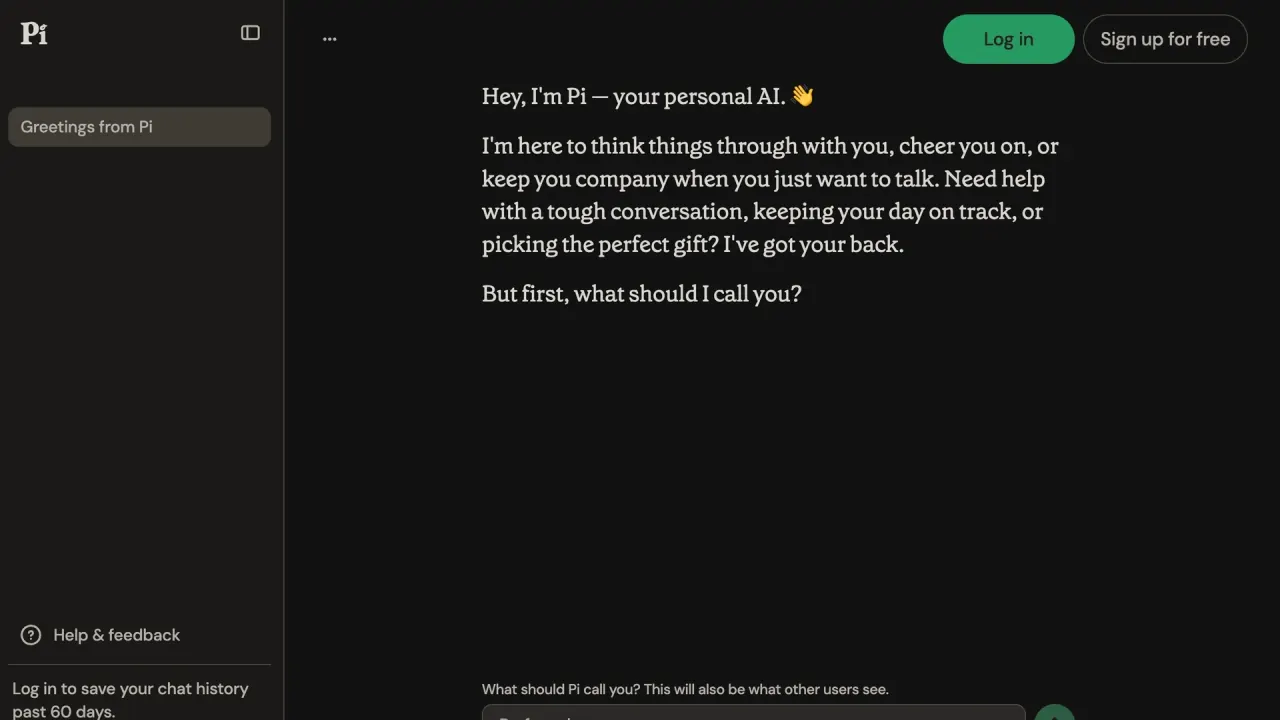
The landing page greets a visitor with an introduction rather than a feature list: "Hey, I'm Pi — your personal AI. I'm here to think things through with you, cheer you on, or keep you company when you just want to talk." It then names three openings: "Need help with a tough conversation, keeping your day on track, or picking the perfect gift? I've got your back."
That framing is a fair expectation to carry in: Pi is most useful when there is something to talk through, and a reader expecting a search engine or a coding partner will find the conversation pleasant but beside the point. Reminders are the one place where it produces an artefact rather than a reply, and the practical habit is to state the reminder in the same sentence as the task.
Pi's pages describe personal, everyday situations rather than workplace deliverables. The sign-in greeting names three of them at once: a tough conversation, a day that needs keeping on track, and a gift to choose.
None of these use cases requires an output file. What the product produces is a reply, a follow-up question and sometimes a reminder; the pages reviewed here describe no template library, export format or work-tool integration.
The sample exchanges also show the limits of the format: the meal-planning example ends with Pi asking about preferences rather than producing a plan.
Pi is a personal AI assistant aimed at adults who want a conversational partner for personal matters, and its terms say so more bluntly than the marketing does.
One detail is worth recording rather than resolving. The Google Play listing carries a "Teen" content rating, while the terms restrict use to adults 18 and over. The two statements sit on different pages, and this profile reports both rather than picking one.
Pi is available in a browser and as a mobile app, and the terms describe a text-message channel as well.
| Channel | What the vendor pages state |
|---|---|
| Web browser | The product runs at pi.ai, where the sign-in screen offers "Log in" and "Sign up for free". |
| iOS | The onboarding page points to the App Store, where the listing is published under Inflection AI. |
| Android | The same page points to Google Play, where the listing is published under Inflection AI. |
| Text messages | The terms describe text, SMS and MMS messages and say "There is no additional charge from Inflection AI for Text Messages, but your carrier's standard message and data rates apply". |
The Google Play listing, as captured on November 26, 2026, showed "1M+ Downloads" and a Teen content rating. Its data safety section stated "No data shared with third parties", "Data is encrypted in transit" and "You can request that data be deleted", and listed personal info and photos or videos among the data the app may collect.
Access is tied to an account on every channel. Registration is the step the terms describe, and the phone number collected then is what the text-message channel depends on. No guest mode is described on the pages reviewed here.
Pi is presented as free. The sign-in screen offers "Sign up for free", and across the sign-in screen, the onboarding page, the terms of service and the privacy policy reviewed here there is no subscription price, paid tier or in-app purchase described.
Outside observation agrees. An independent comparison of companion apps published in November 2026 states that "Pi's paid price is not stated" and that neither the site nor its help centre gives a price, while recording that the site says "Sign up for free".
What the free account covers, on the vendor's own pages, is the conversation and the capabilities those pages advertise: reminders and to-dos, topic prompts, prepared shortcuts and voice mode. The costs that do appear sit outside the product: the terms note that text messages carry no additional charge from Inflection AI but that carrier message and data rates apply, and data use on a phone is the reader's own.
The terms reserve the right to suspend or terminate access at the company's discretion, covered under limitations below.
An independent comparison published in November 2026 lines Pi up with three apps that do the same job, "chatting with an AI character or companion": Replika, Talkie and Tolan. It treats Pi as one option within that group rather than as a general assistant.
The distinction the comparison draws for Pi is the choice a reader actually faces: "Pi also remembers you and takes voice calls, but you talk to Pi itself, not to a character you design." Readers who want to shape a persona, switch between characters or role-play are choosing a different kind of product; readers who want one consistent conversational partner are in Pi's territory.
Age is a second axis. Two of the four apps in that comparison, Replika and Pi, are adults-only on their own terms, while Talkie and Tolan set lower age floors. The comparison also treats data settings as a differentiator, noting that Pi's pages say you can opt out of model training in account settings, which the other three do not offer on the pages it read. That claim covers model training only; Pi's retention rules are set out under limitations below.
The most useful boundaries are the ones the vendor states on its own pages.
The terms grant Inflection AI a broad licence over what you write and say: the licence allows the company "to use the Content to improve our Services and develop new products and services, including by using Content to train and improve models used by our Services and other generative or other AI models". The same clause adds analysis of content to find opportunities for new features and to evaluate existing services.
The privacy policy adds an account-level control: "You may opt out of model training in your Account settings page". A second control covers voice: "You may opt out of using voice to infer emotions in your Account settings page". It sits next to another disclosure: "We may use your inputs to make inferences about your emotional state, tone, sentiments, or other characteristics." For a product sold on emotional intelligence, that inference is part of the mechanism.
Retention is split between inputs and outputs. For Pi, the privacy policy says it "generally retain inputs for at most 15 days after user deletion", longer "if needed to address fraud and abuse, for security reasons, if we are legally required to, or for financial record-keeping purposes". Outputs are different: "We retain outputs indefinitely for the limited purposes described in Section 4 of our Terms of Service."
Deletion is self-service, with two routes described in the privacy policy: "navigating to their profile page within the Service, selecting Account, and clicking on the 'Delete my account' button; or (2) typing '!delete' within the chat."
Read together, the policy describes a product that keeps outputs indefinitely, keeps inputs briefly after deletion, trains on content unless the account setting is changed, and can infer emotional state from voice unless that setting is changed.
Yes according to its own pages. The sign-in screen offers "Sign up for free", and no subscription price, paid tier or in-app purchase appears on the pages reviewed here. Text messages carry no additional charge from Inflection AI, though carrier message and data rates apply.
Yes. The terms say registration requires "your name, phone number, and other requested information", and the sign-in screen offers only "Log in" and "Sign up for free" as entry points.
Yes. The onboarding page promotes voice with "Skip the typing. Say what's on your mind and Pi listens" and labels the spoken mode "Talk it out live".
The terms license Inflection AI to use your content "to train and improve models used by our Services and other generative or other AI models". The privacy policy says you can opt out of model training in your account settings.
Two ways, both in the privacy policy: open your profile, go to Account and click "Delete my account", or type "!delete" inside the chat. Inputs are then generally retained for at most 15 days, while outputs are retained indefinitely for the purposes set out in the terms.
The terms restrict the service to adults: "our Services are not intended for minors under the age of 18." The Google Play listing separately shows a Teen content rating, which is a store classification rather than a statement of eligibility.