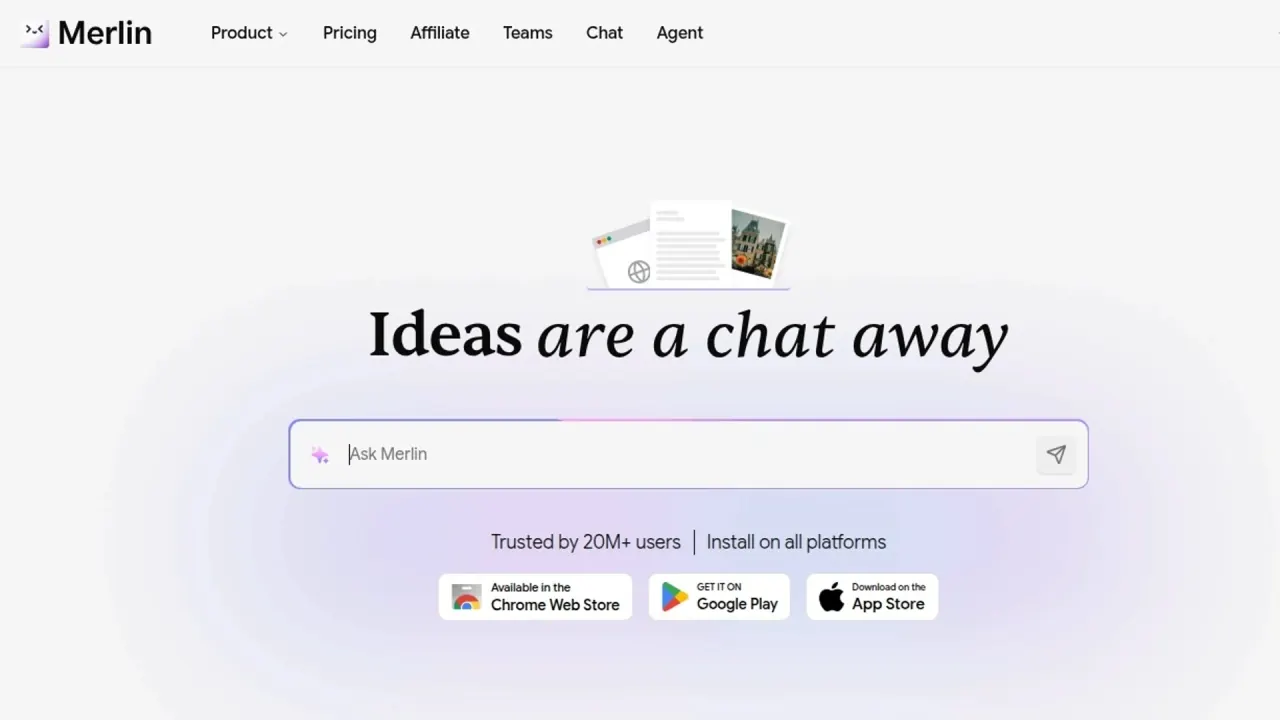

Merlin brings GPT, Claude, Gemini and other third-party models into a Chrome extension, web chat and mobile apps for page summaries, writing, Projects and Deep Research. The free plan has daily caps, and paid plans run under a shared fair-use limit.
Used this tool? Rate it
Used this tool? Rate it
Merlin (often written Merlin AI) is an AI assistant that runs as a Chrome extension, a web app and mobile apps, and lets one account send prompts to many third-party language and image models. The legal notice says the website is operated by Foyer Tech Inc. and describes Merlin as an all-in-one AI assistant that offers access to multiple advanced AI models, like ChatGPT, Claude and Gemini, through a unified interface.
Two legal documents name related entities: the terms of use say the product is developed and provided by Foyer Tech Incorporated, a company registered in Delaware, while the privacy policy names Foyer Technologies Private Limited and covers the websites, Chrome, Edge, Firefox and Safari extensions, iOS and Android apps and an AI Note Taker app.
Model names on this page are simply the models Merlin can call, and one free Merlin account replaces separate ChatGPT, Claude, Mistral or Llama accounts. The pricing FAQ says Merlin buys model APIs in bulk and keeps margins minimal; the pages reviewed make no statement about any partnership with or endorsement by the companies that build those models.
The homepage claims 20M+ users, a vendor figure. As captured on 2026-09-21, the Chrome Web Store shows 900,000 users for the extension alone. A different company also called Merlin, on another domain, appears alongside it on review platforms; this profile covers the AI assistant at getmerlin.in.
Once the Merlin Chrome extension is installed, it opens the Merlin chatbot on any website with Ctrl/⌘+M, and on X, LinkedIn, YouTube and Gmail it adds its own buttons to the page. On search result pages it answers alongside the results, and Merlin currently supports Google, Baidu, Bing, DuckDuckGo, Yahoo and Yandex for this. The pricing table groups the extension's page-level tools as follows:
The web chat is a multi-model AI chat where the model is picked per conversation or left to an automatic choice:
Crafts was rebuilt in March 2026 after code output kept stopping part-way; the new version builds files in stages and was tested up to 7,000 lines. Expert Mode, added in December 2025 and switched on from the globe icon, lets a model search and run tools for up to 100 steps, and more steps mean more cost.
Live Search has Focus modes for YouTube, for academic papers via Semantic Scholar, and for community discussions.
Image generation runs on several named models: FLUX 1.1 Pro and Pro Ultra, Recraft V3, Ideogram V3 Turbo, GPT Image 1 and HiDream L1, plus a native model powered by FLUX [schnell]. Paid plans add upscaling, editing, object erase, background replacement and image-to-image. Beyond chat, the plan table lists an AI detection tool, an AI humanizer and an essay writer with custom writing style and academic citation support, part of what Merlin calls 70+ AI tools.
Merlin Agent is a separate desktop app available only on macOS. It routes each task to the most cost-effective model, keeping premium models for harder work, and can connect to Gmail, Google Calendar, Google Docs, Google Sheets, Notion, LinkedIn and Slack to read and act on those apps.
The homepage describes workflows for several user groups:
The free plan gives limited access to the extension's page tools, while Pro lists unlimited fair access, so daily use is where the plans diverge.
Merlin suits people who want to try many models from inside the browser for one subscription and can accept shared, capped usage.
Merlin runs as a web app, Chrome extension, iOS app and Android app, with synced history, custom prompts and chatbots. The Chrome Web Store description adds that one account works across Chrome, Edge, iOS, Android, Windows and Mac. Store figures below are as captured on 2026-09-21.
The vendor also says Merlin can be used anywhere in the world, including countries where ChatGPT is banned.
Merlin AI pricing has three listed plans, and the page opens on yearly billing, where Pro is "Billed $228 for a year" and Teams "Billed $180 for a year" per seat, with the yearly toggle labelled Save 35%. The plan data behind the monthly toggle lists Pro at $29 and Teams at $19 per seat.
| Plan | Yearly billing | Monthly billing | Main limits |
|---|---|---|---|
| Free | $0 | $0 | Up to 102 basic-model messages per day; up to 10 per day on most listed advanced models |
| Pro | $19 per month, billed $228 per year | $29 per month | Monthly per-model caps, all under one combined fair-use limit |
| Teams | $15 per seat per month, billed $180 per year | $19 per seat per month | Everything in Pro, minimum team size of 2, usage dashboard |
Other prices appear elsewhere. A banner across the site reads "Get Merlin Pro for $2/mo today" and is labelled a special offer, and the comparison table sets Pro at $19/month next to ChatGPT Plus at $20/month. The macOS agent page advertises Merlin for $10 renewed monthly. These discounted offers matter beyond price: the terms say promotional accounts get proportionally lower usage limits.
| Model | Free | Pro |
|---|---|---|
| Claude Opus 4.6 | No access | Up to 500 messages per month |
| Claude Sonnet 4.6 | No access | Up to 1,000 messages per month |
| GPT 5.2 | Up to 10 messages per day | Up to 5,000 messages per month |
| Gemini 3.0 Pro | Up to 10 messages per day | Up to 1,000 messages per month |
| GPT OSS 120B | Up to 100 messages a day | Up to 10,000 messages per month |
The same table lists Deep Research at no access on Free and up to 5 queries per month on Pro, file uploads of up to 10 files of 50 MB each on both, vault storage of 100 MB versus 5 GB, and AI detection at 5 versus 3,200 uses per month.
Usage limits are shown for maximum availability per feature, and all features share a combined fair usage limit, so heavy use of one reduces what is left for the others. The pricing FAQ says Pro gives at least 30x the usage of Free but is bound by fair use, and a top-up feature sells extra credits when you hit a limit. The terms add a cost ceiling: on standard paid accounts, usage whose model and cloud cost exceeds $100 in a month ends service for the rest of that month, and usage above $16 in a day ends it for that day.
The homepage FAQ still describes an older query system in which a GPT 4, Gemini 1.5 or Mistral Large message used 30 queries and lighter models 1, and automatic answers on Google search pages were free. It names older model versions and differs from the current per-model table.
For subscriptions bought on or after August 12, 2026, refunds must be requested in writing within 3 days of purchase. Payment processing fees and any residual usage are not refunded, low or no usage after that window does not qualify, and there are no prorated refunds. You can cancel at any time to stop renewal, but cancellation does not refund the current period.
Merlin's closest peers are other multi-model AI sidebars. A 2025 academic audit of generative AI browser extensions, reported by an IT news outlet, studied Sider, Monica, ChatGPT for Google, Merlin, MaxAI, Perplexity, HARPA, Wiseone, TinaMind and Copilot side by side.
| Option | Chrome Web Store scale, captured 2026-09-21 | What stands out |
|---|---|---|
| Merlin | 900,000 users, 4.8 from 8.8K ratings | Web chat, Projects, Crafts, a macOS agent and mobile apps |
| Sider | 5,000,000 users, 4.9 from 114.4K ratings | Several chat models in one sidebar for search, reading and writing |
| HARPA AI | 400,000 users, 4.7 from 3.2K ratings | 100+ commands to automate, monitor prices, summarise and write |
| ChatGPT Plus | Not an extension | Merlin's own table prices it at $20/month against Pro at $19/month |
On privacy the same audit ranked the assistants differently: the researchers observed Perplexity to be the most privacy-friendly, while Harpa, MaxAI and Merlin were amongst the least.
As captured on 2026-09-21, a third-party review platform shows a TrustScore of 2.0 from 32 company-level reviews, 69% of them one-star; it notes that the company has not invited reviews recently, has replied to 57% of negative reviews and typically takes over a month to reply. Among recent reviews, at least three customers on the $2-a-month offer complained of throttling or of hitting daily or monthly limits after only a few requests. App store ratings cover different products (4.8 for the extension, 3.6 on Android, about 4.56 on iOS) and should not be averaged with that score.
While the extension is enabled, the privacy policy says it collects activity data for the pages you visit, including the URL, previous URL, referrer, timestamp, user ID, redirects, browser, operating system and HTTP status code, and sends it to Merlin's servers. Page content is not collected unless you use a feature that needs it, and URL collection can be turned off in Settings. The Chrome Web Store disclosure for the extension lists personally identifiable information and location as the data it handles.
The extension package itself requests the tabs, webNavigation, webRequest and scripting permissions, host access to all https sites, and a content script that runs on all URLs, with extra scripts for Gmail, LinkedIn, X and YouTube.
Independent research tested an earlier build, version 7.3.2, in 2025. It found that Merlin extracted form inputs, including a Social Security number typed into a government tax site and medical records on a university health portal, and that it shared raw user queries and identifiers with Google Analytics. The current privacy policy, last updated on 20-Jan-2026, is the vendor's statement of present practice; no re-test of version 8.2.3 was found in the sources reviewed.
Training and compliance are described unevenly across pages:
No. Merlin accesses the models through APIs it buys in bulk, so a free Merlin account is enough and you do not sign in to the model makers' services.
Yes, with limits: up to 102 basic-model messages a day and about 10 a day on most advanced models. Deep Research, the top Claude models and image editing need Pro.
Yes. While enabled it logs page URLs and related browsing data, and it reads page content when you use a page-aware feature.
Within 3 days of purchase, by written request. After that, purchases are final except for exceptional cases the vendor may review without guarantee.
No. Merlin states that it does not provide direct API access and is designed as an interface for using multiple AI models.
