
Toolso.AI
Toolso.AI
All ToolsCategoriesTrendingLatest Tools
AI Models

Image models

  • Nano Banana 2.1
  • GPT Image 2.6 Sunburst
  • Seedream 5.5
View all

Video models

  • MiniMax H3
  • Kling 4.0
  • Seedance 2.5
View all
All AI models
Blog
Toolso.AI
Toolso.AI
Toolso.AI
Toolso.AI

Discover the best AI tools to boost your productivity

GitHubGitHubTwitterX (Twitter)YouTubeYouTubeTikTokEmail

Popular Categories

  • AI Writing
  • AI Image
  • AI Video
  • AI Coding
  • More Categories

Explore

  • Latest Tools
  • Popular Tools
  • More Tools
  • Submit Tool
  • Pricing

About

  • About Us
  • Contact
  • Blog
  • Changelog

Legal

  • Cookie Policy
  • Privacy Policy
  • Terms of Service
  • Refund Policy
© 2026 Toolso.AI All Rights Reserved
Limited timeLimited-time offerFeatured Listing24h priority review · No backlink · 30 days featured$29.90then $59.90Price rises to $59.90 after Dec 31Ends in--:--:--Submit now
  1. Home
  2. All Tools
  3. Sales
  4. Copy.AI
Copy.AI interface preview
Copy.AI logo

Copy.AI

Copy.AI combines agentic workflows, a queryable data layer and brand-governed content generation so sales, marketing and revenue operations teams can run go-to-market plays from a single platform.

SalesAutomation ToolsAI Marketing#Copywriting#Business#on-brand copy
Try for Free
Saves
Visits
Views
Pricing
Freemium
Published
Nov 26, 2026
Domain
copy.ai
Community rating

Used this tool? Rate it

Rate this tool
Try for Free

Copy.AI Product Information

Try for Free
Tool Information
Saves
Visits
Views
Pricing
Freemium
Published
Nov 26, 2026
Domain
copy.ai
Community rating

Used this tool? Rate it

Rate this tool

Featured Tools

Jotform interface preview
Jotform logo

Jotform

Freemium

Build forms around real submission workflows

HubSpot interface preview
HubSpot logo

HubSpot

Freemium

The agentic customer platform for go-to-market teams

AI Image To Image interface preview
AI Image To Image logo

AI Image To Image

Free

AI image editing from a reference photo

Raphael AI interface preview
Raphael AI logo

Raphael AI

Free

Multi-model image studio, free to start

Airbrush interface preview
Airbrush logo

Airbrush

Free Trial

Natural AI photo editing for portraits and projects

ChatGPT interface preview
ChatGPT logo

ChatGPT

Freemium

AI assistant for writing, analysis and tasks

Gamma interface preview
Gamma logo

Gamma

Paid

From a prompt to a deck, site or doc

Perchance interface preview
Perchance logo

Perchance

Freemium

Build random generators, share them free

PixAI interface preview
PixAI logo

PixAI

Freemium

Anime art, powered by a million community models

DeepSeek interface preview
DeepSeek logo

DeepSeek

Freemium

DeepSeek AI models for chat and API

Grok interface preview
Grok logo

Grok

Freemium

Real-time answers, images, and code in one chat

SeaArt AI interface preview
SeaArt AI logo

SeaArt AI

Freemium

Community-Trained Models for Art, Video and Characters

ZenMux interface preview
ZenMux logo

ZenMux

Free

One Gateway, Every Model, Compensated Failures

PIXLR interface preview
PIXLR logo

PIXLR

Free Trial

Browser-Based AI Photo Editing and Image Generation

i10X interface preview
i10X logo

i10X

Paid

One workspace for every AI model

Photoroom interface preview
Photoroom logo

Photoroom

Free Trial

Product photo editing for online stores

Fotor interface preview
Fotor logo

Fotor

Paid

AI photo editing and design in one browser tab

Notion interface preview
Notion logo

Notion

Paid

One workspace where your team and its AI agents think together

Related Tools

Mailchimp
Mailchimp interface preview
Mailchimp logo

Mailchimp

Freemium

Email and SMS Marketing Without the Learning Curve

Try Now
Omnichat
Omnichat interface preview
Omnichat logo

Omnichat

Freemium

Connect customer chats, AI agents and retail sales

Try Now
PhantomBuster
PhantomBuster interface preview
PhantomBuster logo

PhantomBuster

Freemium

Cloud prospecting from live data to CRM

Try Now
Smartlead
Smartlead interface preview
Smartlead logo

Smartlead

Freemium

Cold email at volume with unlimited mailboxes

Try Now
Outreach
Outreach interface preview
Outreach logo

Outreach

Freemium

Agentic AI platform for B2B sales execution

Try Now
Robly
Robly interface preview
Robly logo

Robly

Free Trial

Email marketing with automatic resends and AI send timing

Try Now
Protaigé
Protaigé interface preview
Protaigé logo

Protaigé

Free

Brief It Once, Ship the Whole Campaign

Try Now
Atria AI
Atria AI interface preview
Atria AI logo

Atria AI

Free

Research, create and launch ad creative

Try Now
HomeTop toolsSimilar

What is Copy.AI?

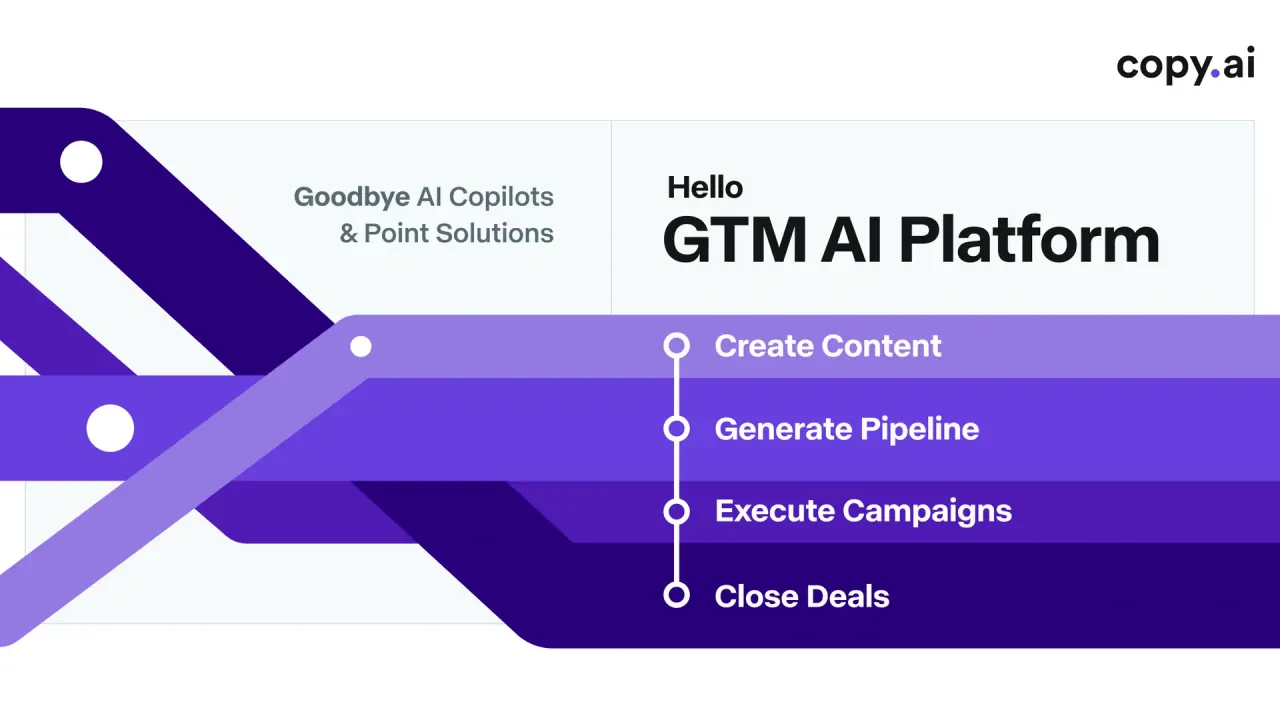
Copy.AI is a web-based go-to-market AI platform that pairs a generative content engine with workflow automation for sales, marketing and revenue operations teams. The company describes it as "the first-ever GTM AI platform" and frames it against "dozens of disconnected AI copilots, narrow point solutions, or unconstrained AI agents": the promise is one governed system that codifies processes, unifies data, connects teams and covers several GTM use cases instead of one.

The ownership changed in October 2025. Copy.AI's own announcement states that "Fullcast has acquired Copy.ai to create the first end-to-end AI-native RevOps platform uniting planning, execution, and intelligence". The product is described there as contributing "agentic workflows" that turn plans into automated processes across prospecting, content creation and deal coaching, while Fullcast contributes planning, forecasting and compensation. Fullcast presents Copy.AI as the execution layer of a suite that also includes data, analytics and incentives products, which is why the platform's centre of gravity is revenue teams rather than standalone copywriting.

The vendor states the platform is "trusted by 17 million users at leading companies" on its homepage as captured on November 26, 2026. That is the company's own count, not an audited figure, and it spans the product's history as a writing tool as well as its current GTM positioning. An independent technology-media report in October 2021 put the company's Series A at $11 million and total funding at $13.9 million, when the product was still sold as an AI copywriting tool.

Copy.AI is organised around six named modules rather than one editor: Workflows, Actions, Agents, Tables, Chat and Infobase, with Brand Voice as a shared layer.

Core features

Workflows and actions

Workflows are the automation layer: they carry a team's process definition and the stated purpose of unifying cross-functional teams, systems and GTM strategies. A workflow is where a repeatable motion, such as outbound research or inbound triage, becomes something the platform runs rather than something a person retypes.

  • Actions are described as "building blocks that allow users to harness the power of AI without being AI experts". They are the individual steps a workflow is assembled from.
  • Workflows chain those steps and carry the process definition, including the parts of a play a team already considers settled.

Agents and guardrails

Agents are described as automating "targeted tasks by combining AI decision-making with proper guardrails". The scope is a defined task rather than an entire function, and the guardrails are part of the description rather than an add-on. The acquisition announcement repeats the framing in its reference to "agentic workflows".

A queryable data layer

Two modules hold the information the rest of the platform works from.

  • Tables are "a queryable data foundation that consolidates disparate sources to power AI automation". The emphasis is on consolidation: the platform expects data from more than one system.
  • Infobase is "a centralized repository for your company's essential information to inform content generation", the knowledge base behind brand-accurate output.

Chat with a choice of model providers

Chat is "a prompting interface that allows users to rapidly complete one-off tasks and to-dos". The Chat plan lists "Access to OpenAI, Anthropic, and Gemini models" alongside unlimited words in chat. The homepage also states the platform is "LLM Model Agnostic", a vendor claim about architectural flexibility rather than a published list of every supported model.

Chat covers work that happens once, Workflows work that recurs, so the platform can serve as a multi-model assistant without any automation.

Brand voice and localisation

Brand Voice is defined as "the definition of your brand's unique personality that ensures consistent, authentic content outputs" and is the control layer for AI content generation across teams. It sits alongside Infobase: one supplies company knowledge, the other supplies tone. Copy.AI also markets a translation and localisation use case, described as producing "native speaker level translations for any language" in real time and "for a fraction of the cost of translation agencies". Both the quality and the cost comparison are vendor claims; neither is backed by a published benchmark on the pages reviewed.

Guide

Copy.AI defines workflows as "AI-powered codifications of your processes, plays, and best practices", which is why knowledge and data come before automation.

Assembling a play from those use cases

Copy.AI documents its modules as separate building blocks rather than a single prescribed sequence, so the order below follows the dependencies between them: knowledge and data first, automation last. It is a way to read the platform, not a vendor-published procedure.

  1. Load company knowledge into Infobase. Product facts and reference material go in first, because later generation steps draw on them.
  2. Define Brand Voice. Tone rules are set once so output stays consistent across workflows and chat.
  3. Consolidate sources in Tables. Account, contact and product data from different systems land in one queryable foundation.
  4. Encode the play as a Workflow. The repeatable process becomes a workflow built from Actions, which is where an existing play becomes re-runnable.
  5. Add Agents where a step needs judgement. Tasks that need the model to decide something use agents with guardrails rather than a fixed branch.
  6. Use Chat for one-off work. Ad-hoc requests run through Chat, with the model provider chosen per task.
  7. Connect the surrounding systems. Outputs are pushed into the tools the team already runs.

The platform does not decide the play for a team: workflows codify processes a company already has, so the input has to exist first.

Copy.AI use cases for go-to-market teams

Copy.AI names six GTM use cases on its homepage. They are the sales workflows and marketing workflows the platform is positioned around, and each is a vendor-described scenario with a stated outcome rather than an independently tested result.

  • Prospecting Cockpit. Research accounts and contacts in depth, then draft sales outreach. The stated aim is to "double your pipegen per rep" while keeping customer relationships personal.
  • Content creation. Power a content engine across SEO, thought leadership, use cases and social, with drafts "delivered in seconds, not weeks".
  • Inbound lead processing. Enrich, research and engage marketing-generated leads, with speed-to-lead as the stated metric.
  • Account-based marketing. Gather insights on accounts, industries and personas to inform ABM plays, then produce context-heavy assets at scale.
  • Translation and localisation. Produce translations the company describes as native-speaker level, in real time, positioned as cheaper than agencies.
  • Deal coaching and forecasting. Turn sales transcripts into customisable insights, score deals and predict close dates.

The six split into two groups. Prospecting, inbound processing and deal coaching are sales-execution plays that depend on CRM and enrichment data in Tables; content creation, ABM assets and localisation depend more on Infobase and Brand Voice. A content-led team and an SDR-led team can buy the same platform for workflows that share almost no configuration. The outcome figures attached to these use cases are the company's own, drawn from vendor copy or customer quotations rather than a controlled comparison: they indicate what the product is designed to move, not what a new account should expect.

Who is it for

  • Sales organisations running outbound at volume. Prospecting research, personalised outreach and transcript-based deal coaching are the three sales plays the company documents.
  • Marketing teams with a content engine to feed. SEO, thought leadership, social and ABM assets use the same modules, with Brand Voice keeping output consistent across writers.
  • Revenue operations teams consolidating tools. The pitch is explicitly against a stack of point solutions, and the shared data layer is what makes consolidation plausible.
  • Enterprises needing implementation support. Enterprise adds "Guided Jumpstart Implementation" and a "Designated Account & Support Team", and a SOC 2 report can be requested.
  • Small teams that only need chat. The 5-seat Chat plan covers conversational drafting with model choice, but lists no workflow credits.

The fit narrows once automation is the goal: workflow plans start at 75 seats, so a five-person team wanting one automated play buys a plan sized for a department. Individual writers who mainly need long-form drafting are the least served group here, because the modules that justify the price are built for team processes rather than personal editing.

Platforms

Copy.AI is reached through a subscription account on the web platform, and the product pages reviewed here promote a demo request before sign-up.

  • Integrations. The homepage lists "2,000+ Integrations"; the pricing page names "20+ Tech Integrations & API Access" in the Enterprise column.
  • API and bulk runs. "API Access & Bulk Workflow Runs" is an Enterprise feature, so programmatic use is outside the self-serve tiers.
  • Model providers. Chat exposes OpenAI, Anthropic and Gemini models; the platform is described as LLM model agnostic.
  • Security posture. The security page states SOC 2 Type II compliance and offers the report on request.

Both figures are vendor claims; the integration count comes with no breakdown by category or depth.

Pricing

Copy.AI's pricing page presents four self-serve tiers plus Enterprise, with a monthly and annual toggle and a stated 20% saving for annual billing.

PlanSeatsIncluded usageMonthly priceAnnual price
Chat5Unlimited words and projects in chat; access to OpenAI, Anthropic and Gemini models$29/mo$24/mo, billed $288/yr
Growth7520K workflow credits per month$1,000/mo$12,000/yr
Expansion15045K workflow credits per month$2,000/mo$24,000/yr
Scale20075K workflow credits per month$3,000/mo$36,000/yr
EnterpriseCustomAPI access and bulk workflow runs, unlimited customisable workflows, designated account and support teamCustomCustom

Two features of this structure are easy to miss. The jump from Chat to Growth is a category change rather than a seat increment: Chat is a small-team plan with no workflow credits, while Growth starts at 75 seats and 20,000 monthly credits. Workflow consumption is metered on every automation tier, so the effective cost depends on how many runs a play needs; the capture shows the allowances but not the credit-to-run conversion.

Billing terms live in the subscription agreement rather than on the pricing page: payments are non-refundable except as expressly provided, a full refund applies only within five calendar days of the initial purchase, annual subscriptions renew automatically, and a cancellation stops the next renewal rather than the current term.

Copy.AI's own framing is that buyers should avoid "a bloated set of AI point solutions", which sets up the real choice: a team that needs drafting buys Chat, a team that needs repeatable automation steps up to Growth, and a team that needs neither is better served by a standalone assistant or a single-purpose writing tool. No intermediate workflow tier sits between the two, and that gap is what most often decides the purchase.

Limitations

  • Five-day refund window. The subscription terms allow a full refund within five calendar days of the initial purchase; after that the purchase "is final" and no refund of the subscription fee is available.
  • Annual commitment by default. Subscriptions renew on the anniversary of purchase until cancelled, and a cancellation takes effect at the end of the current period, so unused months are not refunded.
  • Access can be withdrawn at the vendor's discretion. The terms allow Copy.AI to suspend or terminate access "at our sole discretion, at any time and without notice".
  • Workflow usage is metered. Growth, Expansion and Scale are sold with fixed monthly credit allowances, and the pricing page does not state whether unused credits carry over.
  • No workflow credits on the entry plan. The Chat tier's listed inclusions are chat words and projects, so automation requires a 75-seat plan.
  • Content licensing is broad. The terms state that Copy.AI "does not claim any ownership rights in any User Content", while granting the company a licence to use that content in connection with "providing, operating, securing, and improving their services".
  • Upstream usage rules flow through. The subscription terms require that use of Generated Content stay "consistent with the OpenAI mission and Charter", and ask users to follow the OpenAI API usage guidelines, so a buyer is bound by a model provider's policy as well as Copy.AI's own.
  • Data-use statements sit in two documents. The security page states "We don't train on your data", while the subscription terms grant a licence covering service improvement. The two statements are not reconciled on either page, and the terms do not use the word training in that clause.

The last two points matter most in procurement: a licence to improve a service and a promise not to train models are different commitments, so certainty about training rests on the security page's wording rather than the contract.

FAQ

Q1. What is Copy.AI?

Copy.AI is a go-to-market AI platform for sales, marketing and revenue operations teams. It combines Workflows, Actions, Agents, Tables, Chat and Infobase with a Brand Voice layer, and has been part of Fullcast since October 2025.

Q2. How much does Copy.AI cost?

Chat is $29 per month for 5 seats, or $24 per month billed annually at $288 per year. Growth is $1,000 per month or $12,000 per year with 75 seats and 20K monthly workflow credits; Expansion is $2,000 per month or $24,000 per year; Scale is $3,000 per month or $36,000 per year. Enterprise pricing is quoted.

Q3. Can I get a refund?

A full refund is available within five calendar days of the initial purchase. After that window the purchase is final, and cancelling an annual subscription does not produce a refund for the remaining term.

Q4. Does Copy.AI train on my content?

The security page states "We don't train on your data" and says prompts are not shared with other customers. The subscription terms separately grant Copy.AI a licence to use user content in connection with operating, securing and improving its services; the pages reviewed do not reconcile the two.

Q5. Which AI models does Copy.AI use?

The Chat plan lists access to OpenAI, Anthropic and Gemini models, and the platform is described as LLM model agnostic. Copy.AI does not publish a per-feature model mapping on the pages reviewed.

Q6. Is there a free plan?

The pricing page captured on November 26, 2026 lists four paid self-serve tiers and Enterprise, with no free tier among them. A demo request is the documented way to evaluate the platform first.

Know a Similar Tool?
If you know other great AI tools, feel free to submit them to us