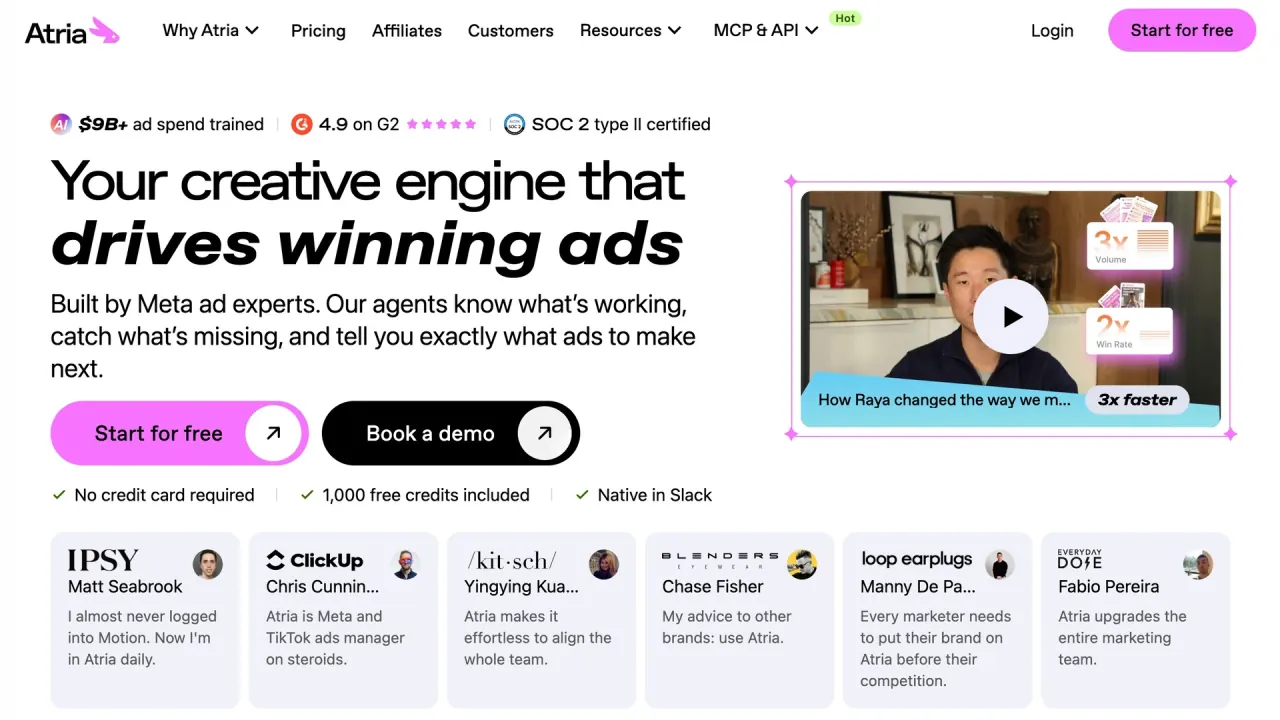

Atria AI combines ad research, connected-account analytics and AI image ads for marketing teams. Raya turns brand context and campaign data into briefs, reports and creative iterations.
Used this tool? Rate it
Used this tool? Rate it
Atria AI is a browser-based advertising workspace for researching creative, analyzing connected ad accounts and generating AI image ads. Its own branding also uses the shorter name Atria.
Atria positions the product as a replacement for separate analytics, swipe-file, ad-launching and digital asset management tools. The operator named in its terms is TESSERACT01, Inc.
Raya is Atria AI's assistant for analyzing ads, researching competitors, writing briefs and building reports. The company describes her as trained on over $11 billion in ad spend. That is a vendor description of the system's background, rather than independent proof that a new ad will achieve a particular return.
Atria advertises a searchable library of more than 25 million ads, with filters for platform, format, language, industry, status and dates. Results can expose hooks, copy, landing pages and asset URLs.
Brand Library adds running-ad counts, niches, regions and creative velocity, with lookup by brand name or followed brands.
Atria explicitly describes how long a video ad has been running as a proxy for what is working.
Atria AI can turn a product URL or reference ad into a creative brief and generate new image ads for Meta. A reference ad supplies direction for a new creative; it does not by itself supply permission to reuse another advertiser's protected material.
Radar grades recent ads on hook, retention, click-through and conversion, with static ads graded only on click-through and conversion. Its description uses ads from the last 30 days, and each ad receives its own grades.
Radar's benchmarks include a timeframe, conversion metric and target goal, and it needs a connected Meta or TikTok account with ads and conversion data. ROAS, CPA and custom conversion metrics are among the documented choices.
Raya connectors include Triple Whale, Shopify and Slack, giving the assistant access to information from those tools.
Launch can publish the same ads to several selected Meta ad sets through a single task. The documented sequence is specific to the Atria interface:
Radar recommendations turn a selected ad into new angles and hooks for the same audience; video recommendations become briefs, while static recommendations lead to new image versions. Reference ads may be drawn from outside the advertiser's industry. This is a use case for extending an existing creative direction, with the original ad and its performance context providing the starting point.
Atria's API recipes include competitor research, daily new-ad digests to Slack or email, long-form video research and keyword searches within a time window.
The long-form recipe finds video ads of at least 60 seconds and ranks them by running duration. The output is a research collection, not the private campaign results of the advertisers in that collection.
Anyone can view a report snapshot without a seat, on any plan. This provides a narrower access route for a client who needs results rather than the ability to work in Analytics, Raya or the asset library.
For agencies, plan selection counts combined client Meta and TikTok spend and all connected client accounts. The guidance says an account is not cut off merely for exceeding the plan's spend limit; Atria notifies the customer.
Atria requires a compatible web browser. Connecting an account also depends on external access: Atria can only see Meta ad accounts visible to the Meta user making the connection. The first sync usually takes 15–20 minutes and can take longer for large accounts.
Disconnecting an ad account removes Atria's connection and its synced account data without changing anything in Meta. Custom reports built on that account do not move to a new account. Account disconnection therefore has a different data consequence from simply switching which account is visible.
TikTok accounts can be analyzed in Atria, but TikTok ads cannot be launched from Atria. Meta publishing is documented separately through Launch.
The brand landing-page headline names Meta, TikTok and YouTube. The account-connection guidance specifically describes Meta and TikTok. The broader marketing headline and the narrower documented connection flow should not be read as identical scopes.
Atria MCP connects the product to Claude, ChatGPT and Cursor as a native tool without integration code. It lets a user ask about brands, boards and ads through an assistant already in use.
The REST API is intended for code-based scheduled jobs and data transfers, while MCP serves human questions without code. API use requires a developer or comfort with code.
Atria's free plan has no time limit, requires no signup card and does not automatically become a paid subscription. It includes one ad account, one brand and limits on saved ads and searches. A paid-plan trial is available on request. The homepage separately advertises 1,000 free starter credits; that headline is not a promise of a fresh monthly allocation.
As captured on October 29, 2026, the pricing display carried a Black Friday Cyber Monday promotion of up to 41% off and showed the following annual-billing offer. Amounts are USD per month, billed annually; the displayed monthly amount is not a monthly payment schedule.
| Plan | Annual-billing monthly price | AI credits/month | Followed brands | Ad accounts / analyzed monthly spend | Storage / brand profiles | Included seats |
|---|---|---|---|---|---|---|
| Core | $129 | 4,000 | 50, without AI insights | 5 / $500K | 5 GB / 3 | 5 |
| Plus | $343 | 10,000 | 100, with AI insights | 10 / $1M | 1 TB / 8 | 8 |
| Business | $959 | 25,000 | 200, with AI insights | Unlimited / unlimited | 5 TB / unlimited | 15 |
The comparison lists extra seats at $20 per seat per month. Business also lists Guest invitations. The terms say applicable paid-plan fees include taxes, duties and charges, and Enterprise is governed by separate terms.
Free access includes 30 MCP calls and 30 API calls one-time; Core includes 600 MCP calls and 1,200 API calls per month, and Plus and higher list unlimited calls. Calls belong to the workspace. The same guide pairs the one-time Free wording with a statement that calls reset monthly, including on annual plans. A paid-plan call beyond its allowance costs 1 AI credit; excess Free calls are declined until an upgrade.
Credits meter AI analysis, questions, generation, editing and reports, with different actions using different amounts. Image-generation and Radar-recommendation costs are shown before use, while Raya chat cost is visible afterward in the consumption report. Usage can be broken down by feature and team member. Only workspace Admins can top up or change plans.
Auto-Gen runs in the background and can create 4 ads at 480 credits each, using around 1,920 credits in a full cycle. The guidance says unused image credits are refunded automatically. It also states that Auto-Gen running before Brand World is set up generates from incomplete brand information.
Cancellation is Admin-only; some plans can be canceled in a few clicks, while others require a short call. The help guidance describes refunds as case by case, most often for a charge after cancellation or a duplicate charge for the same period.
The terms describe rolling monthly renewal, a Current plan → Cancel plan route and paid access ending at the current monthly billing cycle after cancellation. This monthly wording sits alongside the annual-billing pricing offer.
Subscription fees, purchased AI credits and other paid services are non-refundable under the terms unless applicable law requires otherwise or the platform or website states otherwise. The case-by-case support process is therefore not a general money-back guarantee.
Foreplay and Motion are relevant comparisons for different parts of this workflow. Their own descriptions establish the following scope; they do not independently validate Atria's claims or establish a quality ranking.
| Product | Vendor-described focus | Decision relevance |
|---|---|---|
| Foreplay | A Chrome extension saves ads from Meta, TikTok and LinkedIn libraries; storyboard/script tools, brand profiles and a modular brief builder support creative planning. | A comparison for teams whose work centers on collecting references and constructing briefs. |
| Motion | Visual reports for Meta, TikTok, YouTube and LinkedIn ads, with automatic grouping of creatives to expose performance patterns. | A comparison for teams centered on analyzing their own advertising creative across those named networks. |
The Raya launch blog still labels direct Meta uploads as “coming soon.” Current Launch guidance gives a publishing workflow. The pages contain different availability descriptions.
Users retain rights in their owned or licensed uploads as between themselves and Atria, while granting a non-exclusive, royalty-free, transferable and sublicensable license for supplying and using the service. That clause concerns uploaded content. It does not itself establish that every generated output is exclusive or that every reference ad is licensed for reuse.
Ads displayed from public transparency libraries remain third-party content; Atria claims no ownership and limits republication of citations, images and paraphrasing to a limited extent with credit to the owners. The image-cloning workflow does not cancel the separate rights conditions in the terms.
Users must obtain necessary consents and authorizations from individuals before providing their personal information for Atria to collect, use, process and disclose under its privacy policy. This places a concrete responsibility on the uploader of identifiable information; it is not an Atria promise that an uploaded likeness has already been cleared.
Atria's generative-AI terms identify third-party providers, false or biased outputs, IP and privacy risks, and disclaim non-infringement warranties. They also prohibit use that violates other people's intellectual-property or other rights. These are contractual risk allocations, not independent tests of output quality or a blanket commercial-use clearance.
Atria lists AWS for cloud infrastructure and storage, and OpenAI and Claude for AI processing and response generation. Its subprocessor statement says customer data may be processed solely for the stated infrastructure, AI and related operational functions.
The privacy policy specifically excludes data obtained through Google Workspace APIs from developing, improving or training generalized AI or machine-learning models. The exclusion is scoped to that source of data. It is not a statement that all uploaded assets, connected ad data or every other customer input is excluded from every form of model development.
Atria says it does not sell personal information, while also describing necessary service-provider access and certain advertising or analytics sharing involving precise location and mobile identifiers. The no-sale statement therefore sits within a broader set of disclosed processing and sharing activities. The policy also permits transfers to Singapore, the Philippines and other countries where Atria operates.
Deleting information can require deleting the account, and some information may be retained for legal or contractual obligations or lawful legitimate business needs. These conditions matter separately from canceling a paid subscription, which is a billing action.
The documented free plan requires no card and does not turn into a paid subscription. Its limits concern usage, including connected accounts, saved ads, searches and starter allowances. A requested paid-plan trial is a separate arrangement.
The account-connection guidance says TikTok is available for analysis but cannot be used to launch TikTok ads from Atria. The direct publishing workflow described here is for Meta.
The documented Radar video recommendation produces a brief after analyzing the video. Static recommendations instead lead to image generation. Those outputs serve different production stages and should not be described as the same deliverable.
