
Achievable is an adaptive exam-prep platform that pairs a plain-English online textbook with large practice-exam banks, AI explanations and a memory model that estimates readiness, sold as one-time course purchases with a money-back guarantee.
Used this tool? Rate it
Used this tool? Rate it


From a prompt to a deck, site or doc


One workspace for every AI model


One workspace where your team and its AI agents think together


Public Codex reset tracker


AI assistant for structured work


Plan, build, and refine work with an AI agent


Astrology readings from real astrologers


AI translation for multilingual workflows
Achievable is an online exam prep platform that sells complete courses for licensing, certification, admissions and school exams. Each course bundles a textbook written to the test provider's outline, a bank of explained practice questions, full-length practice exams and a study model that adapts to what the learner remembers.
The company is a small, remote-first U.S. education technology team that combines adaptive learning software with expert-written content. Its catalogue began with securities licensing and now reaches insurance, healthcare, admissions, AP and teaching exams in one account.
Two design choices shape the product. Delivery is browser-first: Achievable runs on a phone, tablet or computer, and the vendor says about half of all studying happens on the go. Measurement is the second: answers feed a model of the learner's memory, which produces a predicted score that underpins both the study plan and the money-back guarantee.
The vendor reports a 95%+ pass rate across its courses, more than 200 million questions answered and more than 3 million hours studied, and says the platform supports tens of thousands of learners. It also states that The New York Times has cited its material, that Investopedia named it the best mobile learning experience for the SIE and Series 7 courses, and that the Better Business Bureau rates it A+.
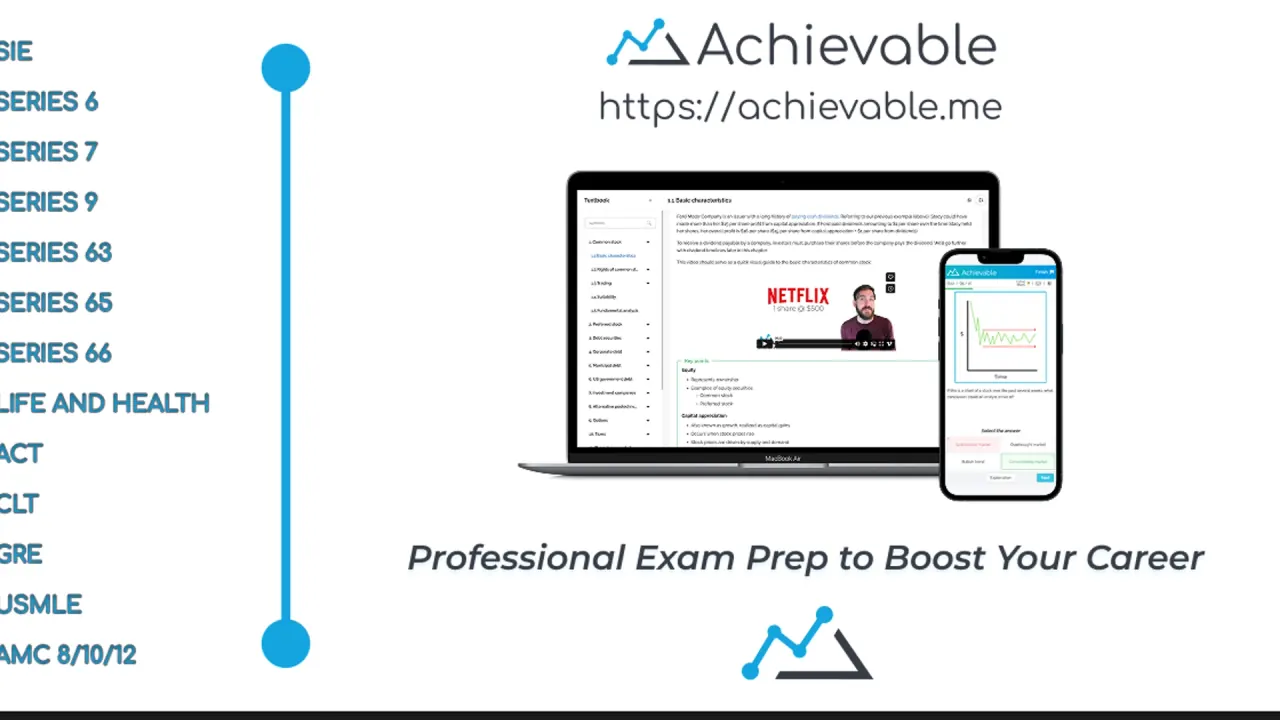
Each course opens with an online textbook in plain English rather than exam-legalese, meant to be read from start to finish. The Series 7 course adds 44+ video lessons and audio narration of nearly every section, so the same chapter can be read, watched or listened to.
The writing follows the official outline and is produced by subject-matter experts. The vendor is explicit about a 99% approach: it may leave out the small slice of material that is rarely tested but expensive to learn, which is a deliberate trade rather than an oversight.
Practice exams mirror the phrasing, difficulty and topic weighting of the real exam, and questions are drawn at random from a bank large enough to sit a dozen exams without duplicates. Many quantitative items randomise their numbers, so the skill being tested is the method rather than a memorised answer.
The Series 7 course shows the scale: 35 full-length practice exams, 4,700+ practice questions with explanations and 4,400+ exam questions, enough for 35 exams of 125 scored multiple-choice items.
Achievable does not hand out a calendar. It uses learning-science methods to model what the learner knows, estimates how they would score today, and sends review time to the topics where memory is weakest. Review sessions can be filtered by topic, so a candidate who already knows options strategies can spend the session on margin rules instead.
The model is also what makes the guarantee work, because a predicted score is what the vendor compares with the practice-exam threshold.
AI appears as an in-product tutor: explanations for missed questions, and a guide that adjusts the plan and responds when a learner is stuck. It is not a separate chatbot product and does not replace the written lessons.
Courses are not the same size. The SIE course carries 40 full-length practice exams, 3,800+ practice questions and 36+ video lessons, while Series 7 carries 35 exams, 4,700+ questions and 44+ lessons. The interface is identical, so moving from SIE to Series 7 changes the syllabus rather than the tool.
A free account holds every course a learner buys, and the vendor recommends keeping one account across exams because it offers substantial discounts to returning customers. Accounts last forever at no cost; a purchased course unlocks premium access for one year.
Pass/fail exams carry a pass guarantee: pass a full-length practice exam within the standard time before the real exam, and a failed official exam is refunded in full once the score report is verified. Scored exams carry a score-improvement guarantee instead, with the gain set per exam and starting score. AP courses guarantee a 4 or higher, and USMLE Step 1 has a seven-day satisfaction guarantee.
A first week on Achievable follows the order the product is built around.
For a licensing exam with a fixed date, a practical rhythm is one chapter plus its questions per session, one full-length exam per week, and a final week of topic-filtered review.
Two details matter on a first run. Practice exams run at the real test's pace, so at least a few should be sat under exam conditions: Series 7 allows 3 hours 45 minutes for 125 scored multiple-choice questions plus 5 unscored items, and requires 72%, or 90 correct answers. And because the guarantee is anchored to a passed practice exam, the exam that is passed becomes a milestone to record rather than another score.
The catalogue is organised by licence rather than by one exam, and each category behaves differently.
The finance catalogue covers SIE, Series 4, 6, 7, 9, 10, 63, 65 and 66, plus ACCA FA, CIMA Certificate BA, CMA Part 1, CFP and both IRS Enrolled Agent parts. Candidates often need two exams in sequence, which is why bundles exist.
State insurance licences follow the same pattern: read the state-specific material, drill the question bank, then sit practice exams built on the state outline. Life, health, life and health, property and casualty, and personal lines are sold as separate courses.
Nursing and allied-health exams, including NCLEX and CCMA, use content written to the relevant blueprint. For a working nurse or medical assistant, mobile delivery matters as much as the content because study time is fragmented between shifts.
SAT, ACT, CLT, GRE, GMAT, MCAT, AMC and a set of AP subjects sit in the same account. These are scored exams, so they carry the score-improvement guarantee, with guaranteed gains that shrink as the starting score rises.
Praxis Core, including its reading, math and writing sections, and TExES PPR follow the same structure for candidates who need a certification exam before or during a teaching placement.
Achievable fits a candidate with a fixed exam date, a syllabus published by a regulator or test provider, and limited hours per week. A readable textbook, a large question bank and a model that decides what to review are built for that situation.
It fits less well in three cases. A learner who wants live instruction will not find it, because the vendor does not provide tutoring. A learner who wants practice exams alone cannot buy them, since courses are sold whole. And a learner who wants a permanent library should note that premium access lasts a year, even though the account never expires.
Sharing is also a poor fit. Because the algorithm is built on one person's memory profile, the vendor warns that a shared login weakens the model for everyone using it.
Within a firm, the fit depends on how training is bought. A compliance department that already pays for a classroom programme may use Achievable as a supplement for candidates who need repetition; a team that leaves study to the individual gets the package, including the guarantee, in one purchase.
Candidates already familiar with part of the material use the review queue and the practice exams to find gaps quickly. Those starting from zero treat the textbook as the spine and use videos and audio narration as a second pass.
Achievable runs in all major browsers on a computer, tablet or phone with nothing to download or install. The mobile experience is a web app at app.achievable.me rather than a native iOS or Android app, with progress syncing between devices.
That keeps updates instant and removes app-store friction, but it also means studying depends on a browser and a connection rather than offline storage.
The account collects standard personal data, including cookies, usage data, email address and device information, and the privacy policy carries separate sections for users in the European Union and the United States.
Material is multi-format where the course supports it. The Series 7 course pairs its 44+ videos with audio narration, so a chapter can be listened to while walking and read again at a desk. The textbook, videos and question bank live in the same account, and progress follows the learner across devices.
Courses are sold one at a time as a one-time payment that unlocks a full year of access. Two public price points anchor the catalogue: SIE at $99 and Series 7 at $199.
| Purchase | Price | Covers |
|---|---|---|
| SIE | $99 | One SIE course, one year of access |
| Series 7 | $199 | 35 practice exams, 4,700+ questions, 44+ videos |
| SIE + Series 7 | $249 (list $298) | Both courses |
| Six FINRA and NASAA courses | $389 (list $904) | Six-course bundle |
Every course is all-in-one: textbook, question bank, practice exams and review system come in the same purchase, and the vendor does not sell question banks separately. Opening chapters are free without a card, so the decision can be made after reading real material.
Every course for a scored exam can be refunded in full within seven days of purchase for any reason, and USMLE Step 1 has the same seven-day window. Other refunds are handled case by case.
The model differs from the subscription pattern common in test prep. A one-time payment for a year means the cost does not grow if the exam date slips, but the material stops being available when the year ends. The bundles are the only discounts with published prices: the two-licence bundle sells below its $298 list price, and the six-course bundle cuts the list price by more than half.
The alternatives question depends on what a candidate is buying: content, questions, or a plan that decides what to do next.
Against traditional prep providers, the difference is delivery rather than syllabus: a one-year, one-time purchase with a browser-based platform, set against whatever term the other provider sells and a self-paced plan instead of scheduled classes. An independent review of Series 7 prep ranks Achievable as its budget pick at $199 for a full year with a modern adaptive platform.
Against free official material, the difference is the question bank and the feedback loop. Regulators publish outlines and some sample questions, but not thousands of explained items with a model that tracks weak topics. A candidate who only needs the outline can pass with free material; the paid product buys practice volume and prioritisation.
Against buying practice exams on their own, the difference is packaging. Achievable does not split the course, and the guarantee is tied to the course as a whole: a passed full-length practice exam comes first, and the score guarantee expects an earlier official score plus a retake inside the access year.
Against a classroom programme, the difference is accountability. No instructor checks attendance and there is no fixed weekly session, so the platform substitutes a readiness estimate and a guarantee that pays out if the result misses. That works for a disciplined candidate and fails for one who needs external deadlines.
The honest way to compare is to start from the exam. For a licensing exam with a published outline and a large official question pool, the deciding question is how many explained questions a provider gives and how it chooses what to review. For a scored exam such as the SAT, the deciding question is whether a provider can move a score by the promised number of points.
Those conditions decide who actually collects. A candidate who fails the official exam without first passing a full-length practice exam inside the standard time has no pass-guarantee claim, and a candidate with a recent official score must submit it within seven days of purchase to qualify for the score guarantee. Neither path requires a minimum number of study hours, but both require a verified score report and a valid state ID.
One constraint is invisible in the feature list. Because progress is tied to one account and one memory model, a firm buying a bundle for several candidates should keep each person on a separate login rather than sharing a corporate account.
Yes. Signing up requires no credit card, and the trial gives access to the platform and the first chapters of the course for each test.
The SIE course is $99 and Series 7 is $199, each a one-time payment for a year of access. Bundles cut the total: SIE plus Series 7 is $249 instead of $298, and six FINRA and NASAA courses are $389 instead of $904.
Pass one of the course's full-length practice exams within the standard time before the real exam. If the official exam is then failed, send a picture of the score report with a valid state ID, and the course is refunded in full once verified. There is no minimum study time and no chapter to finish.
Scored exams use a score-improvement guarantee: send an official score from the previous five years within seven days of buying, retake the test while access is active, and file a claim within 31 days. Guaranteed gains fall as the starting score rises.
No. Achievable runs in all major browsers on a computer, tablet or phone, and the mobile experience is a web app at app.achievable.me with progress synced across devices.
No. Each course is one package covering the textbook, question bank, practice exams and review system.
Yes, and the vendor recommends it: one account holds several courses and returning customers get substantial discounts.