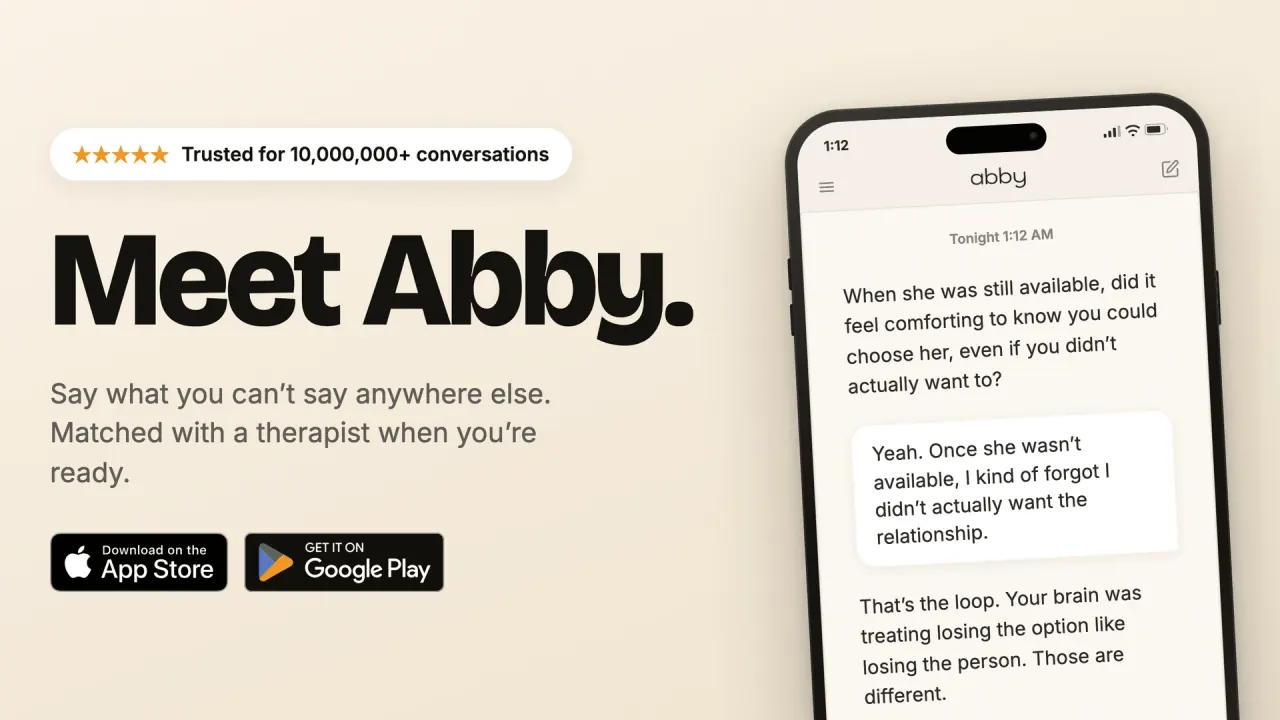

Abby is an AI chat companion for everyday emotional support that remembers past conversations, offers customisable personas in 88 languages and matches users with licensed therapists for free.
Used this tool? Rate it
Used this tool? Rate it


AI assistant for writing, analysis and tasks


Build random generators, share them free


DeepSeek AI models for chat and API


Real-time answers, images, and code in one chat


One workspace for every AI model


AI chat for dark fiction and research


AI assistant for structured work


Ad-free Chinese AI search with cited answers
Abby is an AI chat companion for mental health and everyday emotional support, made by Abby Intelligence, Inc., which is based in West Hollywood, California. It is an AI-powered conversational platform that is not a medical or therapy service, and the terms are unusually direct about the boundary: Abby is not a healthcare provider, does not provide licensed therapy, counseling, diagnosis, or treatment, and no medical or clinical relationship is created.
The product's promise is continuity rather than treatment. The site says Abby remembers your story, asks the questions you didn’t know you needed, and checks in before you even open the app. Users can shape her persona and tone, talk in 88 languages, switch languages mid-sentence, and use free therapist matching when they want clinical care.
That combination explains most of the design decisions. Abby is designed to offer general support, information, and self-reflection tools around everyday stress, relationships and decisions, and it is explicit that "Therapists diagnose and treat, and I don’t do either." It is not aimed at diagnosis, medication or emergency response, and the site tells anyone in crisis to call or text 988 (Suicide & Crisis Lifeline) or dial 911.
The company says the service has handled more than ten million conversations. Whether that number matters depends on what you want: a place to think out loud at 2am, or clinical care. Abby is built for the first and points to the second.
Abby’s central claim is continuity: the site says Abby remembers what you share over time, not only the facts but the themes, the patterns and the things you return to. The homepage frames this as the difference between a companion and a generic chatbot: you should not have to restart your story every session.
There is a described process behind each reply. "Between your message and her reply there’s a process, designed with licensed therapists," the homepage says, and the page walks through mapping how much of the story Abby knows, connecting to earlier memories and looking for the pattern underneath the immediate complaint. That is a product claim, not a clinical validation, but it explains why the conversation is meant to feel cumulative.
"Abby becomes exactly who you need," the customisation section says, and the options are unusually granular for a consumer chat app. There are six personas, including Professional, Mindfulness Guru, Empathetic Friend, Problem-Solver, Tough Coach and Philosophical Guide. Modes add a lens such as Stoic, Mindfulness, Strategist, Gratitude, Faith or Astrology. Four response styles, a pushback setting that ranges from gentle to "call me out", and a choice between daily check-ins and check-ins only when something matters complete the setup.
The effect is that two users can have very different experiences. A person who wants warm validation can choose it; someone who wants to be challenged can ask for direct pushback.
Abby speaks 88 languages. The site's more interesting claim is that you can change language mid-sentence without losing context: "Switch mid-sentence and she follows." The same memory is meant to survive the switch, which matters for bilingual users who think in one language and describe feelings in another.
Chat works as text or voice. The App Store description puts it simply: "Chat freely by voice or text." Voice is a practical accessibility feature as much as a style choice, since typing at 2am is not the same effort as talking.
Therapist matching is the feature that separates Abby from a pure companion app. Abby already knows your story, and when a user asks for clinical help the service uses the conversation history to propose a licensed therapist from a vetted network. The site promises "No directories, no cold calls," and describes the step as free: "match you with a licensed therapist who fits you. For free."
The matching is a referral service, not therapy delivered inside the app. The therapist is a separate professional, and the clinical relationship begins with that person.
Abby describes two oversight layers. Research studies go through institutional review board processes, and an Ethics & Safety Board made up of licensed therapists advises on crisis handling, safety boundaries and responsible product development. The company also states its scope: "Abby is not a human and is not a licensed therapist, psychologist, or psychiatrist."
Oversight of this kind is a governance claim, not evidence that the product works. It is still a relevant signal in a category where many apps ship without any clinician involvement.
Starting takes less setup than a therapy referral, which is the point.
The published scenarios are everyday emotional moments rather than clinical ones. The approach page names them directly: "Late at night. In the middle of overthinking. After the argument, the spiral, the hard conversation, or the silence that follows."
Abby is built for adults who want a place to think out loud and who are not looking for diagnosis or crisis care. The terms set the floor: "You must be at least 18 years old to use Abby."
Organizations are a separate audience. "Companies, universities, and healthcare systems use Abby" to give people someone to talk to before small struggles become big ones, and the enterprise section promises that "Conversations are never shared with employers." That promise matters, because an employer-provided mental health benefit is only useful if employees believe it is private.
Abby is available on iOS, Android and the web, and the App Store listing requires iOS 15.1 or later. The iOS build carries a 17+ age rating, the Android app is listed on Google Play, and the homepage offers a Download for iOS link next to a Continue on Web button. The website is a full client, not just a marketing page: chat and therapist matching both run there.
| Platform | What is available |
|---|---|
| iOS | Native app, iOS 15.1 or later, 17+ rating |
| Android | Google Play app |
| Web | Chat and therapist matching at abby.gg |
| Languages | 88, with mid-sentence switching |
Two platform details are worth separating. The 17+ store rating is Apple's content classification, while the terms require users to be 18 or older; the stricter contractual rule is the one that governs use.
The first conversation is free and needs no credit card, and every plan starts with a 7-day free trial. After that, Abby does not publish a price list. "Current pricing is in the app, because it varies by plan and region," the company explains, and Abby’s website publishes no pricing page.
Third-party sources fill the gap. Two third-party price trackers checked in November 2026 list $6.99 per week, $19.99 per month and yearly tiers from $99.99 to $179.99, all taken from the App Store in-app purchase table.
| Option | Reported price | What it covers |
|---|---|---|
| First conversation | Free | No credit card, no appointment |
| Weekly | $6.99 per week | In-app subscription, App Store listing |
| Monthly | $19.99 per month | In-app subscription, App Store listing |
| Yearly | $99.99 to $179.99 per year | Two yearly tiers listed on the App Store |
The App Store description adds a detail the website does not emphasise: "All features available with a paid subscription." Read together with the free first conversation, that suggests the free experience is a trial-sized slice rather than an ongoing free tier.
Refunds are narrow but clear. You can request a full refund within 24 hours of purchase, and the policy says: "Refunds are available for first-time subscription purchases only and do not apply to renewal charges." Cancelling stops the next charge, but your subscription will remain active through the end of your current billing period.
The honest alternatives split into three groups: structured self-help apps, general chatbots and an actual clinician.
Wysa is the most direct substitute for someone who wants structure. An independent clinician-written review recommends that most people start with Wysa’s free tier because it combines clinical evidence, therapeutic depth and free features, and Wysa is described as one of the most clinically researched AI mental-health apps, with a free tier and a paid human-coach add-on. The trade-off is a more guided, exercise-led conversation than Abby's open-ended chat.
General chatbots are the cheapest option and the weakest fit. A comparison published by a competing app notes that tools such as ChatGPT have no memory of your history, no therapeutic structure, no companion continuity, and no crisis escalation designed for this use. They can be useful for reflection; they are not a mental health product.
The third alternative is care from a person. Only a licensed clinician can evaluate your symptoms and decide whether a prescription treatment is appropriate, and Abby's own matching step is a route to that clinician rather than a replacement for one.
The most important limitation is the one Abby repeats most often: it is not a healthcare provider and does not provide licensed therapy, counseling, diagnosis or treatment. Everything else follows from that.
No. Abby is an AI companion, and its terms say it does not provide licensed therapy, counseling, diagnosis or treatment. The people who diagnose and treat are licensed professionals, and Abby's role is the conversation before that.
The first conversation is free with no credit card, and each paid plan begins with a seven-day trial. Ongoing use is a subscription, and the site keeps current prices in the app rather than on a public pricing page.
Use a crisis line or emergency services, not Abby. In the US, the site says to call or text 988 or dial 911, and its crisis page lists equivalent numbers for other countries.
No. Abby is positioned as support alongside therapy or before someone feels ready for it, and it can match users with a licensed therapist for free. It does not diagnose or treat.
Abby says it never sells personal information, never shares conversations with third parties for advertising and never shows an individual conversation to an employer or school. Data is encrypted at rest with AES encryption and encrypted in transit with TLS 1.2 or higher. After account deletion Abby will delete your personal information within 30 days. Backups that contain your information are cycled out within 90 days. If non-anonymised data were ever used for training, the policy says "we will require explicit user opt-in". HIPAA does not cover Abby, so conversations should not be treated as protected clinical records.