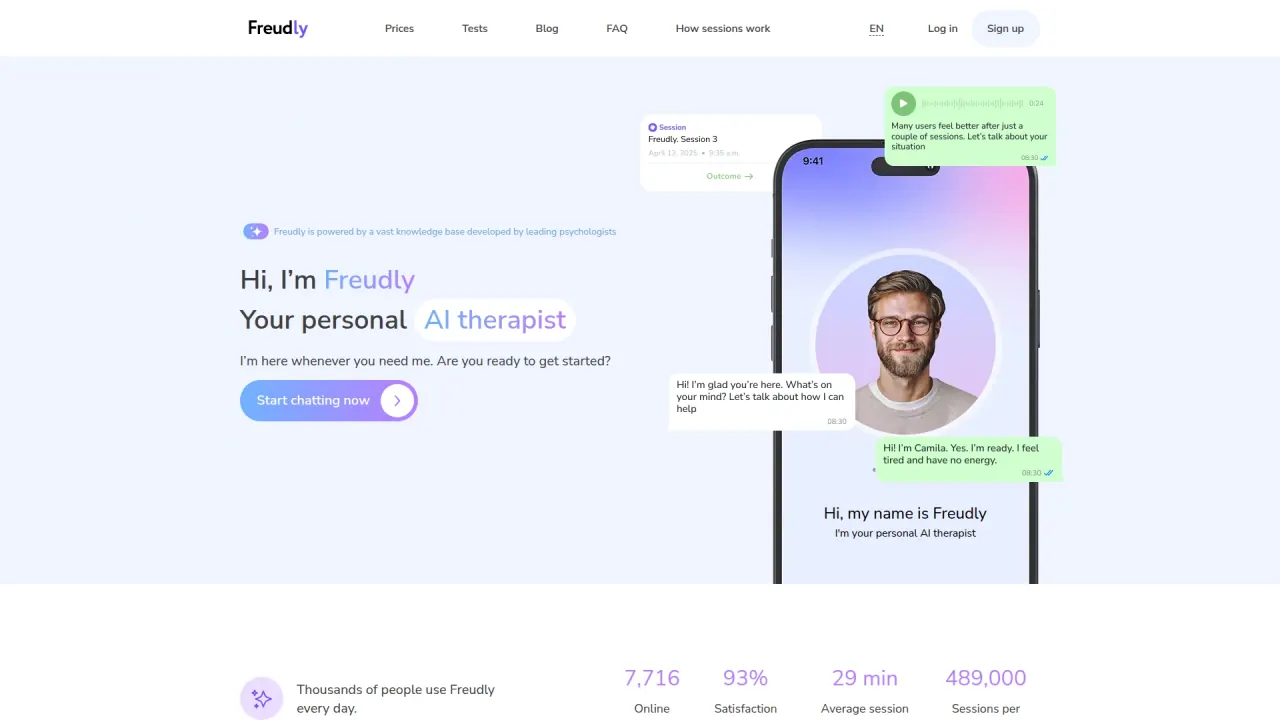

Explore psychological tests, connect results into a personal profile, and discuss them with an AI mental coach by text or voice.
Used this tool? Rate it
Used this tool? Rate it
Freudly combines psychological tests, a mood journal and an AI mental coach for self-reflection. It connects test results with a personal profile, a conversation and a small plan, building a continuing record of traits, feelings and goals.
Freudly’s terms say it is not a healthcare provider and does not provide licensed psychotherapy, counseling, diagnosis or treatment; using it creates no medical or clinical relationship. “Therapist” language elsewhere on the site describes an AI interaction, rather than access to a licensed human clinician.
The privacy policy’s company details identify TECOLUTION FZCO in the UAE. Freudly belongs to the category of AI self-reflection and mental-health support, with tests, conversation and journaling subject to explicit nonclinical boundaries.
The homepage describes more than 6,700 tests and quizzes across personality, emotions, relationships, intelligence and career, as captured on October 29, 2026. This is the company’s catalogue count, not a count of independently validated clinical instruments.
Freudly says its self-map covers 16 areas and 446 personality facets, with tests, chats and journal entries contributing to it. These numbers describe the profile’s organization, rather than a measured level of psychological certainty.
The psychological portrait connects test results into a profile of traits, emotional patterns, relationships and strengths. It gathers results across topics, extending the product beyond an isolated quiz score.
The mood journal offers icons for recording feelings, written descriptions of relevant events, review of past entries and visual mood statistics. It combines quick entries with context and a chart of recorded changes.
Freudly says its AI links mood entries with test results and looks for patterns over time. The journal and test profile give a conversation shared context.
Freudly presents text chat, voice messages and calls with its AI as conversation modes, and labels the first session free of charge. A call is an interaction with the automated coach, rather than a scheduled human session.
The AI mental coach is positioned as grounded in cognitive behavioral therapy, or CBT, and able to discuss test results and practical next steps by text or voice. This is a description of the vendor’s approach, rather than independent evidence of therapeutic effectiveness.
A homepage example pairs a PSQI sleep result with a two-week plan containing a sleep diary, a wind-down ritual, a coach chat and a PSQI retake. This illustrates the product’s organization; it does not promise improved sleep within two weeks.
The library lists a career test based on Holland RIASEC and a love-styles test using Lee’s six love styles. These provide work-interest and relationship-pattern entry points within the same catalogue.
These examples concern exploring preferences and interpreting questionnaires. They do not establish that a test selects a job, diagnoses a relationship or settles a consequential personal decision.
Freudly describes a sequence of scores and explanation, map updates, a coach-suggested goal, small steps and retesting. Its examples combine tests, diary days, exercises and the user’s own steps, organizing ongoing reflection around a topic.
A retake gives another questionnaire result, while the coach’s interpretation remains generated content subject to the service’s accuracy limits.
Freudly’s terms require users to be at least 18 and legally capable of entering a contract. Test topics concerning children, school or family do not remove this app-and-platform eligibility rule.
The app’s publisher positions it for people who want to explore themselves, their habits and their inner world through AI self-reflection. The intended use is personal insight, rather than a professional assessment of a particular individual.
Diagnosis, treatment, a doctor–patient relationship and licensed human sessions fall outside Freudly’s stated scope. Its mental-health positioning does not override that boundary or make it a crisis service.
The terms cover both a mobile application and a web platform. The website links to account creation and login in its web app; these routes do not establish complete feature or language parity across distributions.
The homepage language selector lists English, German, Spanish, Russian, French, Italian, Polish, Portuguese for Portugal, Portuguese for Brazil, Simplified Chinese, Hindi, Japanese and Arabic. This is the website inventory captured on October 29, 2026.
The iOS app metadata lists English and Spanish language codes. It separately specifies a minimum operating-system version of iOS 13.0. Those distribution details are narrower than the website language menu.
| Access surface | What the checked material establishes |
|---|---|
| Web platform | Website account-creation and login links, with web use covered by the terms |
| Mobile application | Mobile-app use is covered by the same terms |
| iOS listing | English and Spanish app-language codes; minimum iOS version 13.0 |
| Website language menu | The thirteen language choices listed above, without a promise of complete app parity |
Tests are free to start without signing up, while membership unlocks full results, the psychological portrait and AI sessions. Free starting access is distinct from continuing access to the reports and coach.
The membership section includes full test results, the self-map, an anytime text-or-voice coach, goals with step-by-step plans, skills and levels, and mood-journal insights.
| Access item | Public wording and boundary |
|---|---|
| Starting a test | Free to start; no sign-up needed |
| Full results and portrait | Unlocked by membership |
| First AI session | Labeled free of charge in the conversation section |
| Membership trial | Saved homepage HTML contains free and $1.25 variants for three days |
| Renewal | Both saved trial variants say $18.99 every month unless canceled before the trial ends |
The saved homepage HTML contains two trial variants: one says the trial is free and lasts three days; the other says $1.25 today for three days. Both say the trial begins only if chosen and renews at $18.99 monthly unless canceled before it ends. The pricing block shows a dollar symbol without an ISO currency code.
These are alternative strings in the saved structure, rather than proof both offers were displayed to every visitor. The evidence does not establish variant assignment, an annual plan, a session allowance or unlimited use.
The same trial text allows cancellation through the account or by email to hello@freudly.ai. The homepage names Stripe for payment processing. The cancellation wording does not establish refund availability.
The privacy page captured on October 29, 2026 offered a full refund within 48 hours of purchase, limited to a first-time purchase rather than renewals, with intensive use subject to case-by-case evaluation. Its “no questions asked” wording appeared alongside those conditions.
That version directed refund requests to support@freudly.ai with the subject “Refund Request” and the email used for the account; it said purchases were final after 48 hours. These were published conditions, rather than a verified refund outcome.
The privacy page captured on November 2, 2026 (UTC) did not contain that refund section. The earlier terms are historical wording, rather than confirmation of current refund availability.
Renée Space presents an AI mental-health app with therapist backing, 24/7 support and unlimited memory. It emphasizes ongoing conversation and understanding feelings; the backing description does not make each response a human therapist’s response.
Dzeny presents 24/7 text sessions, a goal-based personal growth plan, CBT and meditations, and a mood tracker. Its described approach places guided practices and daily check-ins alongside chat.
Freudly emphasizes the route from a broad test catalogue into a connected self-map and AI discussion. Renée Space emphasizes conversation continuity; Dzeny bundles conversations, plans, practices and mood tracking. This comparison concerns product approaches, rather than therapeutic effectiveness.
These are vendor-described functions, not evidence that either alternative delivers better outcomes or is clinically interchangeable with Freudly.
Freudly warns that AI responses may be inaccurate, incomplete or inappropriate, and says not to rely on them for important decisions, emergencies or issues of health, safety or well-being. It does not substitute for professional advice, therapy or medical care, even where marketing uses “therapist” language.
The library includes validated scales such as the Beck Depression Inventory and RAADS-R alongside self-discovery quizzes, with test pages describing their methods and result meanings. A named scale does not validate the whole catalogue or turn AI interpretation into diagnosis.
A public Freudly quiz also offers a kink-level result and BDSM-role labels including dominant, submissive, switch, brat, caregiver and primal. This is adult sexual-interest self-testing; it does not establish that the AI chat generates erotic content.
The acceptable-use policy prohibits discussing, seeking advice about or disclosing escalating obsession with another person; isolation, stalking or threats framed as concern or love; emotional dysregulation or loss of connection with reality; suicidal thoughts, plans or actions; psychosis or extremely pronounced paranoia; self-neglect risking bodily harm; and cumulative or escalating behavior indicating danger.
The list also covers locally prohibited topics within counseling or AI counseling, and discussion of medical procedures or interventions, including surgery, medication and abortion. The terms allow functional restrictions and encouragement to contact licensed professionals or emergency services. They do not promise a monitored clinical handoff.
Freudly says the service is not intended to store or process Protected Health Information and that users should not submit medical records, regulated health data or other highly sensitive medical information. This limits the material the service is designed to receive.
The acceptable-use policy restricts service use to personal, non-commercial purposes. That affects business or professional uses as well as work involving someone else’s sensitive records.
Users retain rights to their inputs while granting processing and analysis permission for providing, maintaining and improving the service, including analytics and product development. The terms permit anonymized, aggregated input/output data for research, analytics and AI improvement. Ownership and processing permission are distinct.
The output terms allow viewing, copying or downloading outputs and refer to in-app export/deletion tools or support. They contain both personal, non-commercial wording and a statement that commercial use must comply with law and the terms. These provisions do not amount to an unqualified commercial-use license.
The privacy policy says text may be processed by third-party AI providers, and voice input or transcripts transmitted for speech synthesis. It says providers process data to deliver the requested function, user conversations are not used to train Freudly’s own models, and providers are configured not to retain submitted data or use it for model training.
A later privacy section permits training or developing AI models with anonymized, aggregated inputs and outputs. It also permits creating and using synthetic data derived from anonymized interactions. The terms separately permit input/output storage and analysis for service improvement including AI training and analytics. Both sets of wording are published; they do not support a blanket no-training claim.
The collected-data list includes messages, AI outputs and conversation content; name, email and optional phone; payment data when subscribing; usage such as session duration and feature use; and device information including browser, operating system, IP and identifiers. Anonymous-conversation wording does not mean no account or device data is collected.
The policy says personal data is not sold, while allowing disclosures to hosting, payment, analytics and support providers, in business transfers, for legal requirements, or for rights protection, fraud handling and safety. These exceptions are part of the published confidentiality terms.
Processing is predominantly automated without routine review of individual conversations, but rare human review of anonymized or aggregated datasets is allowed. This differs from a promise that no human ever reviews interaction-derived material.
The homepage FAQ says data will not be transferred to a third party and nobody, including staff, can access sessions. The privacy policy describes third-party processing and limited human-review exceptions. Those statements differ in scope, so the broad homepage wording cannot replace the detailed policy.
The policy retains account data while an account is active and says personal data is deleted within 30 days of termination or cancellation. Some organizational customer data can remain under the organization’s agreement.
Conversation history is retained for active-user personalization and deleted within 30 days after account deletion, subject to legal or legitimate-interest exceptions including defense and compliance. Individual-conversation deletion is available through the app where provided.
Anonymized and aggregated data may be retained indefinitely, basic usage statistics for up to 24 months before anonymization or deletion, and anonymized usage patterns indefinitely. Identifiable account data and derivatives therefore have different retention rules.
For deletion, the policy says personal data is removed from active systems, backups cycle out within 90 days, and anonymized derivatives, including those from inputs and outputs, may remain. Requests can use in-app tools, privacy@freudly.ai or account deletion.
Privacy rights vary by jurisdiction; the policy generally lists access, correction, account and personal-data deletion, marketing opt-out, and input/output download or deletion where available. These are published rights and tool qualifications, rather than a guarantee about a particular request or a legal compliance determination.
