
Vondy is an AI creation hub that puts tens of thousands of task-specific generators and a beta prompt-to-app builder in one account, with images, video, audio, writing and code billed to a single credit balance.
Used this tool? Rate it
Used this tool? Rate it


Anime art, powered by a million community models


Plan, build, and refine work with an AI agent


From prompt to production with Gemini


AI translation for multilingual workflows


Generate new shots and rework existing footage


AI image editing from a reference photo


Multi-model image studio, free to start


Natural AI photo editing for portraits and projects
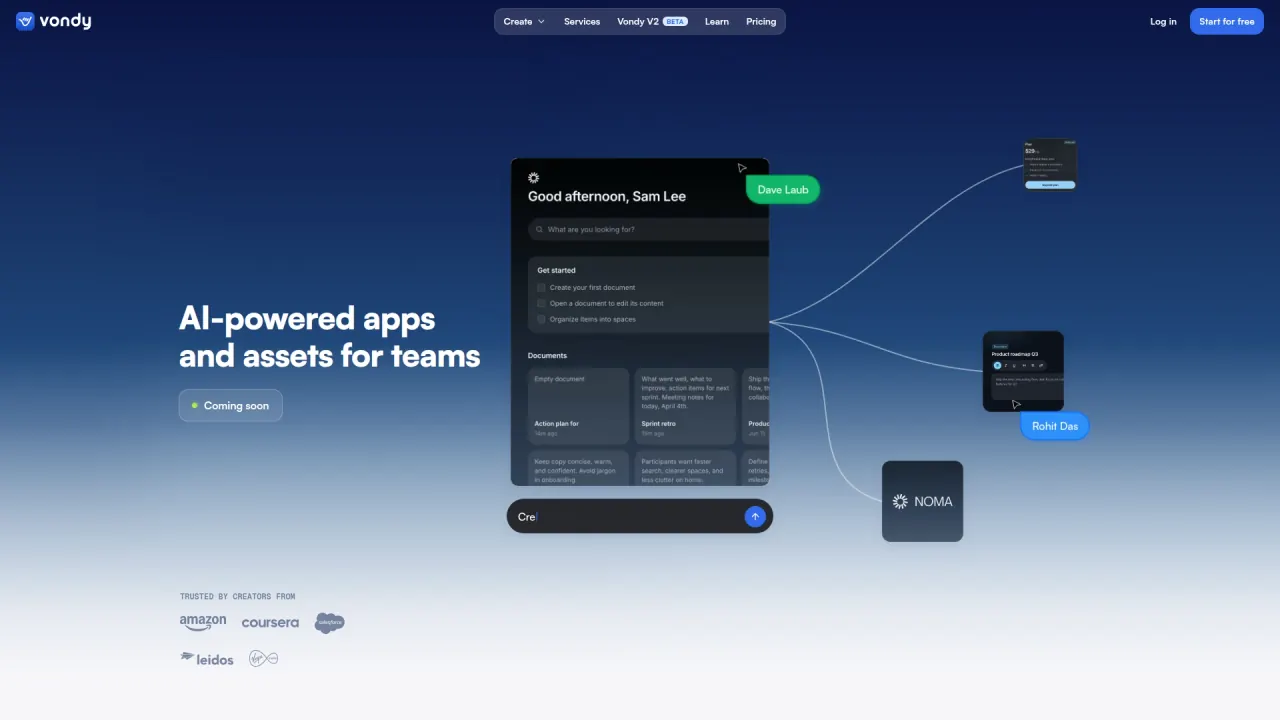
Vondy is a web platform that combines a catalog of task-specific AI generators with an AI app builder. A visitor can start from a form for a logo, book cover, voiceover or résumé, or describe a website, app, dashboard or internal tool and work from a generated first draft.
The catalog is the established half: 40,000+ AI generators and 48+ models available, with 1,000,000+ creators and 10,000,000+ assets created. Those are the operator's figures and are not independently audited here.
The builder is newer. The navigation marks Vondy V2 with a beta badge, and a "Coming soon" badge sits beside the "AI-powered apps and assets for teams" headline, so the team framing is forthcoming rather than shipped.
Both halves share one credit balance. Vondy pricing is sized by a monthly credit allowance rather than a fixed number of images or videos, and credits are described as spendable on any model.
Vondy's features divide into the generator catalog, the shared model balance, the V2 builder and the launch tooling attached to it. Each part works alone, so the platform reads as an AI generator platform with a builder attached rather than as one application.
The catalog is organised into six categories: Graphics & Design, Programming, Writing & Translation, Audio & Voiceover, Digital Marketing and Lifestyle. Each opens into narrower families — logo design, game art and book covers under Graphics & Design; ad copy and social media marketing under Digital Marketing; scriptwriting, résumés and translation under Writing & Translation.
Individual generator pages are forms rather than blank chat boxes. A logo generator asks for a brand or business name, a style, a size ratio and optional reference images, then returns previews that can be remixed. The same pattern — a few inputs, sample prompts and an examples gallery — repeats across the catalog, which is what makes tens of thousands of entries usable without prompt engineering.
A catalog this size has a cost. The entries are not a curated shortlist, two generators in different categories may sit on the same underlying model, and the generator page reviewed did not name its model. Breadth is the point; a category label is not a quality guarantee.
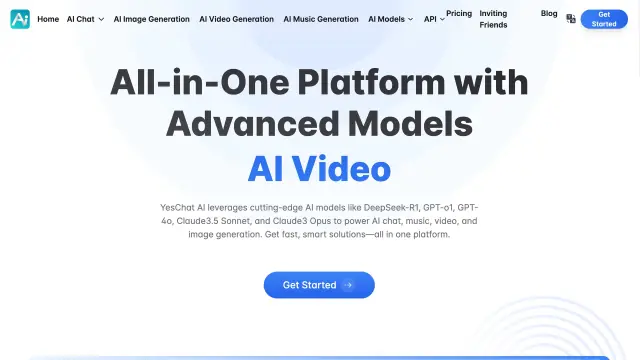
The homepage lists 48+ models available. Paid plans describe access to all AI models across image, video, audio, write and code, and generations spend credits from a single balance that the pricing page frames as usable on any model.
For budgeting, the unit that matters is the credit, not the asset: a team that mostly makes images and copy will stretch a plan further than one rendering long video, and the plan ladder grows the allowance rather than unlocking a different product. The shared balance is also why one account can replace several single-purpose subscriptions.
The builder starts from a description. After the first prompt it offers four directions to choose from, each with a different feel, and the work continues on a canvas where sections can be rewritten or shortened.
The canvas is not only a page editor. It also exposes actions for adding payments, authentication, a database, AI models and a pull request, and it can turn the canvas into a polished presentation or document. That places Vondy closer to a prompt-to-app tool than to a website template: a page builder stops at layout, while this one treats checkout, accounts and a repository as blocks on the same canvas.
Launch features are presented as one-click additions rather than code:
The combination matters more than any single item. A first draft with checkout, accounts and a repository is closer to a shippable project than a static mock-up, and analytics and SEO cover the chores that usually follow a build.
Projects can generate their own supporting assets: images, video, 3D elements, icons, product shots and other visuals, without leaving the builder. The account that supplies a hero image also supplies the page that displays it, and both spend from the same balance.
Two entry points cover most first sessions: a single generator for one asset, or the builder for a multi-page project. The Learn section publishes guides, tutorials and comparisons for readers who want background first.
Generator pages describe the flow as three steps — describe your brand, customise the result, download — and the download step promises high-resolution files for the uses above. The logo page also states that logos created with the generator come with full commercial usage rights, and its FAQ says logos can be created and downloaded at no cost. The "Get Started — Its Free" button and the site-wide "Start for free" call to action show a free entry point exists; the pricing table lists only paid tiers.
Payments, login and GitHub are the three launch features the homepage leads with; analytics and SEO are presented as part of the same set. The Vondy app builder is still labelled beta, so the sensible reading is a fast route to a working first draft, not a guarantee of production readiness.
Vondy's own segmentation suggests three recurring patterns rather than a single job, each using a different mix of catalog and builder.
Marketing teams are listed as shipping campaign surfaces that convert. The documented pieces fit that pattern: a landing page from the builder, campaign images and product shots from the catalog, and ad or email copy from the writing generators, all billed to one credit pool. A campaign needing a page, five social images and three email variants would otherwise involve three subscriptions and three export steps.
Ops teams are listed for the internal tools they keep putting off, and dashboards are one of the four output types named on the homepage. The builder's blocks — database, authentication, payments, AI models — cover the parts of an internal tool that usually require a separate backend project. The appeal is a working interface rather than a prototype image; the trade is that the build is only as reliable as the generated logic.
Founders are listed first among the audiences, with launching the first version faster as the promise. The same workflow suits agencies and freelancers who need a client-ready draft before a longer engineering project starts. For work beyond self-serve building, Vondy also sells Vondy Forge, a custom software service that says it delivers in weeks rather than months, following a six-step process from discovery to hosted launch.
The homepage describes the builder as built for anyone turning ideas into software, then names six groups:
The catalog widens that audience. A solo creator who only needs a book cover or a voiceover never has to touch the builder, and a small team can use both halves on one bill. That is the main reason to pick Vondy over a single-purpose generator.
The fit is weaker in three cases. Teams that need one best-in-class model for a single medium will usually get more depth from a specialist tool. Buyers who need a fixed project budget will struggle, because the credit cost per generation is not published in a readable table on the page reviewed. And teams that need a mature deployment platform should weigh the beta label on V2.
Vondy runs as a web application. A third-party review describes it as a browser-based hub that puts the generators and the prompt-to-app builder in one account, which matches the site's own calls to log in or start for free.
Everything else is delivered inside that account: the catalog, the canvas, the workspace, the credit balance and the launch integrations. No desktop client or mobile app link appeared in the pages reviewed, and the integration surface described on the site is Stripe, Auth and GitHub rather than a public API. The browser is therefore the whole product surface — nothing to install, but no offline mode either.
Vondy prices access by monthly credits rather than by seats. The plans below are the ones listed on the pricing page reviewed on 27 November 2026. Pro is $20 per month for 10,000 credits, Pro+ is $60 for 35,000 and Ultra is $200 for 100,000.
| Plan | Price | Monthly credits | Notable extras |
|---|---|---|---|
| Pro | $20 per month | 10,000 | Unlimited downloads, AI Assistant, workspace, support |
| Pro+ | $60 per month | 35,000 | Everything in Pro, priority support |
| Ultra | $200 per month | 100,000 | Priority support, white-label editing, team training |
| Enterprise | Custom | Custom credit volume | Unlimited seats, SSO, account manager, custom integrations, SLA |
All three self-serve tiers list unlimited downloads, and each includes the Vondy AI Assistant and a project workspace; the difference is the credit allowance and the level of support and white-label work. Ultra adds custom white-label editing plus onboarding and team training, while Enterprise moves to a negotiated contract with custom credit volume, unlimited seats and security features the lower tiers do not list.
Two gaps matter for budgeting. The pricing page invites visitors to start for free but does not list a free tier, so the allowance behind free is not stated there. The "Credits per generation" section, which should translate a plan into a number of images or videos, showed a loading placeholder instead of per-model prices in the version reviewed; a third-party review reports that per-model prices vary widely and that video consumes credits quickly.
Each step of the ladder multiplies the monthly credit allowance and adds support or white-label work rather than changing the product, so a buyer choosing between Pro and Pro+ is estimating volume, not features.
Buyers comparing Vondy usually compare it with specialist prompt-to-app builders. An alternatives directory ranks Lovable as the closest free match, describing it as an AI builder for turning an idea into working software, with Bolt and Base44 next; it describes Bolt as a chat-driven builder for web apps, websites and prototypes.
The difference is scope. Lovable, Bolt and Base44 compete on the build itself, while Vondy's pitch is the build plus a 40,000-generator catalog and one credit pool, with the builder still carrying a beta label. A buyer who wants the most mature builder should compare those specialists directly; a buyer who wants one account for assets and a first draft is the audience Vondy is addressing.
The opposite trade is a single-purpose generator. A dedicated logo or voiceover tool will usually go deeper on its one task, but it will not produce the page that uses the logo. Vondy's case rests on consolidation, not on beating every specialist at its own task.
The age boundary is the one item worth isolating. The terms require users to be over 18 and bar anyone under 18, while the privacy policy says the service does not address anyone under 13. The two documents do not set the same threshold, so a household or school evaluating Vondy should treat the stricter terms as the operative rule.
Vondy is an AI creation platform with two halves: a catalog of task-specific generators and Vondy V2, a prompt-to-app builder for websites, apps, dashboards and internal tools. The catalog is live at scale, while the builder is labelled beta.
The site invites visitors to start for free, and generator pages say logos can be created and downloaded at no cost. The pricing table lists only paid tiers, and the FAQ question about free-plan downloads has no readable answer on the page reviewed, so the free allowance is not documented there.
Credits are the unit of consumption. Each paid plan includes a monthly allowance — 10,000 on Pro, 35,000 on Pro+ and 100,000 on Ultra — and credits can be spent on any model. The per-generation price list did not load in the page reviewed, so the number of images or videos a plan covers depends on the model chosen.
The builder is marked beta, and the team framing carries a "Coming soon" badge. It can add checkout, authentication, a database, AI models, analytics and SEO, and it can push to GitHub, which makes it useful for a first draft; production readiness is a project-by-project judgement.
Yes. The terms say a paid subscription can be cancelled at any time, and that payments are non-refundable except where required by law. Mandatory local cancellation rules are not overridden by the terms.
The logo generator's FAQ says logos created with the generator come with full commercial usage rights, and that users own their logo. For other content types, the general terms describe a licence the user grants to Vondy for displaying and distributing submitted content, so the generator-level statement is the more specific source.