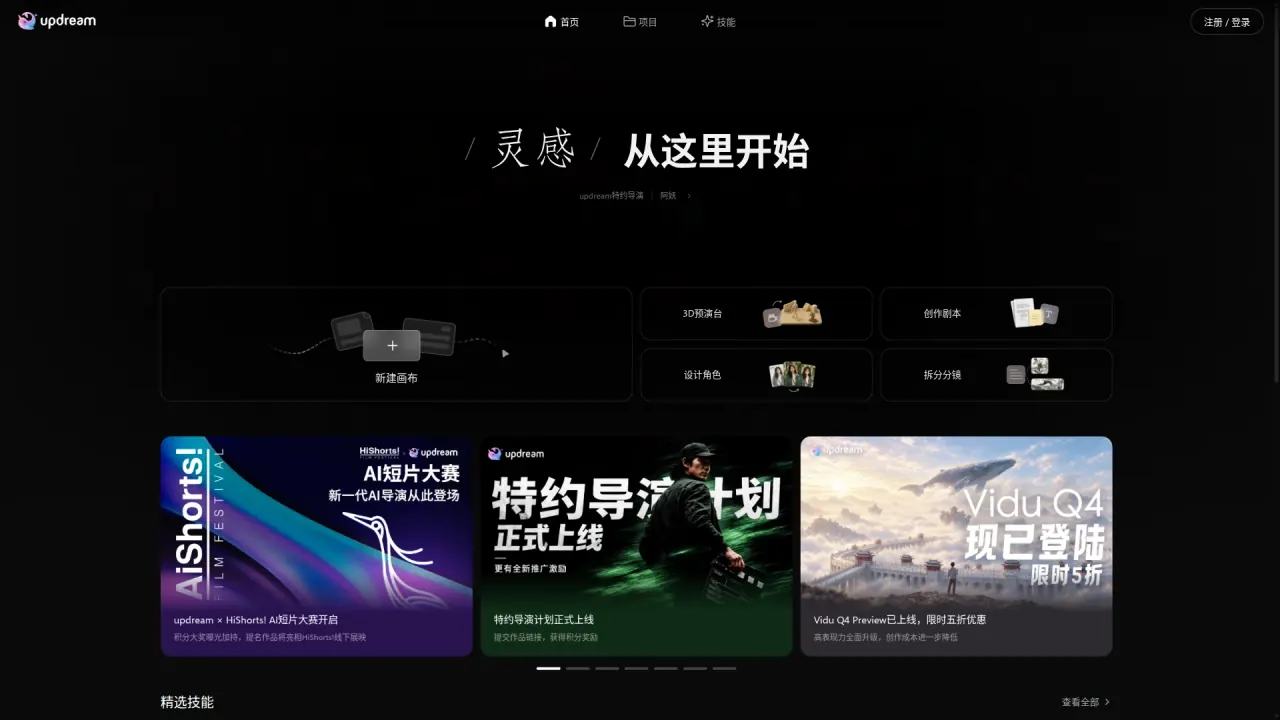

A browser-based workspace from Bilibili that turns a written idea into scripts, characters, storyboards and model-ready prompts through reusable skills, then generates video on a credit balance.
Used this tool? Rate it
Used this tool? Rate it


Multi-model image studio, free to start


Anime art, powered by a million community models


Community-Trained Models for Art, Video and Characters


One gateway for text and media models

Multi-model AI video and image generation in one browser workspace

Prompt-Based Images, Edits and Video


Chat Your Way to a Finished Video


Edit, caption, and generate video in one place
updream is a browser-based AI video creation workspace built in-house by Bilibili for professional video creators. Bilibili disclosed the product on 31 March 2026, saying at the close of its first AI creation contest that updream, described as a new AI video product developed in-house for professional creators, had entered internal testing.
The workspace is organised around five top-level entries: New canvas, 3D preview stage, Create script, Design characters and Split storyboard. Each opens a different part of the same project, and a skill library sits alongside them — named, reusable workflows that a creator activates and then talks to instead of writing every prompt by hand.
The 3D preview stage is the entry the company promotes most actively. A banner captured on November 21, 2026 describes an upgrade that hands 3D modelling, character blocking and camera movement to the AI once the creator has described the idea in words, and says the AI director feature is open free for a limited period.
Billing runs on credits: a balance is split into general and exclusive credits, with purchased and frozen credits tracked separately and daily and monthly spend shown alongside.
The skill plaza filters its entries by scenario: Bilibili-specific, social-media hits, script writing, art style, character design, props and scenes, storyboard scripts, video generation and full-pipeline assistants. Every entry carries an author label and a running use count, so the plaza separates official skills from those published by individual creators such as 京迁. The official skills lean on production discipline — timecodes, asset tables, review checklists — while creator skills bring a particular look or fandom.
Three skills are written for one model each and state that model's boundaries.
Some entries carry a credit line above the author label. The emotional-performance skill and the Deakins lighting skill name MOKE as the original author and state that authorisation was obtained before the skill went live on updream; the dirty-image diagnosis skill names 邪恶红猴子 on the same terms.
A run through updream keeps the same shape whichever skill is used.
The intermediate artefacts are what separate this from a prompt box: a timecode table, an asset list or a lighting change table can be checked and reused across a series.
Reviewing a narrative video before it goes out. The review skill covers the full stack of inputs a Bilibili narrative project accumulates — novel, synopsis, script, storyboard, settings, live-action short, AI animation theatre — and reports on publishing compliance and competitiveness alongside craft, which makes it a pre-publication check rather than a generator.
Commerce and brand video. The Wan3 skill lists the shot types a product video usually needs, from stills and macro material shots to unboxing, try-on and before-and-after, and adds physical-interaction constraints, a sound layer and a risk note to the prompt set. For teams producing on a schedule, the reusable part is the constraint list rather than any single shot.
Fan work and series content. A creator skill built around 原神 ships character references, voice, persona and world settings, so a one-line idea or a novel can become plot structure and then images and video with character voice, and a homepage campaign collects 崩坏:因缘精灵 derivative entries with credit reimbursement and a cash first prize.
updream sells generation through a credit balance rather than a per-project licence, and the public pages show the accounting around that balance more fully than the prices.
What is missing from the public pages is a plan table. No membership tier, credit pack or monthly fee appears on the homepage, the skill plaza or the login page as captured; published third-party write-ups disagree on both tier names and amounts.
updream is one of several AI video tools built by a Chinese content platform for its own creators, so the choice is largely a choice of which platform's pipeline and audience you already work inside.
The practical difference is where the tool stops. A creator who already has a script and only needs clips is buying a generation node; updream's argument is the layer before it, where skills produce the plan, the asset tables and the prompts that the node consumes.
Yes. The site, sign-in and skill plaza are served from updream.cn in a desktop browser.
The skills name MiniMax H3, Seedance 2.5 and Wan3, each through a dedicated prompt skill that states the model's inputs, resolution and clip length.
The H3 skill caps one generated segment at 15 seconds and splits long videos into segments. Other skills do not state a cap in their public descriptions.
The login page offers a phone number with a +86 country code or a password, and says an unregistered phone number is registered automatically. No Bilibili sign-in button appears on that page.
The credit panel includes a free-credit entry, but no amount is published on the homepage, the skill plaza or the login page. The only zero-cost terms on those pages are promotional: zero-credit use of MiniMax H3 on an annual plan and a free period for the AI director entry.
Yes. The Bilibili review skill returns evidence-based revision notes on a script, storyboard or setting without generating media, and the script-to-video skill returns a timecode mapping table first when long text is submitted.
Both the official team and individual creators. Skill cards carry an author label and a use count, and some add a credit line naming the original author and stating that authorisation was obtained.