
Create visuals from text, revise an image with reference material or turn a still into a short clip. Published content rules limit adult use.
Used this tool? Rate it
Used this tool? Rate it


AI image editing from a reference photo

Multi-model image studio, free to start


Natural AI photo editing for portraits and projects


Build random generators, share them free


Anime art, powered by a million community models


Real-time answers, images, and code in one chat


Community-Trained Models for Art, Video and Characters


Browser-Based AI Photo Editing and Image Generation
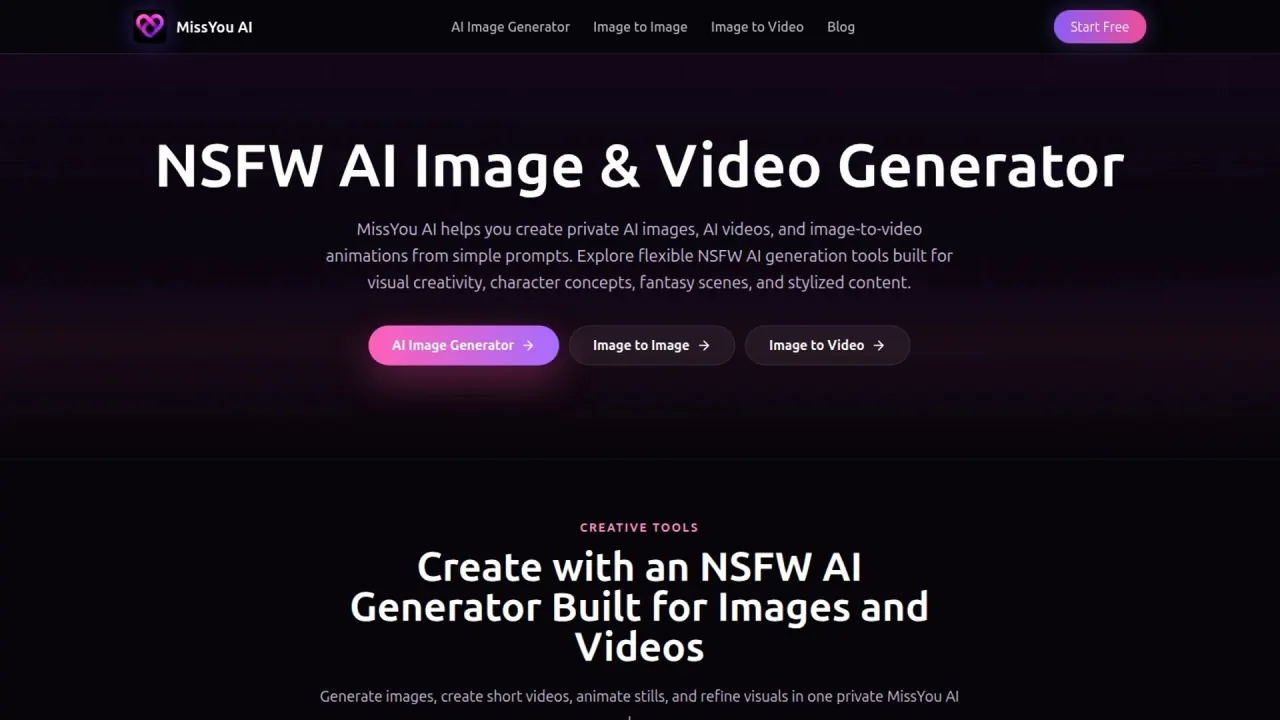
MissYou AI is a web workspace for generating images and short videos and revising images from written prompts. Its text-to-image tool starts from a description, its image-to-image tool takes reference material, and its image-to-video tool adds motion to a still. The video interface also shows a text-to-video tab for a clip that begins with a written scene.
The site markets the workspace as an NSFW image and video generator, but its terms list NSFW, adult, nude and sexually explicit content under prohibited use. The homepage also displays a “No Content Filter” heading while telling users to follow the site's content policy. The policy describes automated tools and human review. These statements conflict on what the service permits.
The image-to-video pages do not agree on the length shown by the prompt counter. The NSFW-labeled version displays a limit of 1,000 characters, while the free image-to-video page displays 5,000.
The image-to-image page describes using a reference as the base for a change in style, lighting or composition. Take an original illustration where the character's pose and the overall layout are already established. For a lighting study, those features are the input context and the lighting is the variable. A different job, such as moving the character to a new composition, gives the reference a looser role.
The service's free image-to-video page describes a product-visual use case in which an original product image supplies the starting frame and a prompt describes the motion. A studio still, for instance, can be the basis for a draft showing a change in camera distance. A clip with that single motion serves a different purpose from a finished product demonstration that must show the details of the actual item faithfully.
The animation page describes generating a still in the image tool or uploading an existing one before adding motion. That creates a two-stage path when a team still needs to settle on a visual. The first pass explores the composition as a still. The second uses a selected frame to express movement.
MissYou AI fits exploratory work where a creator owns the input or has permission to use it and can treat the result as a draft. The content policy permits animation of original fictional characters, concept art and illustrations when the user holds the necessary rights. It separately allows product videos from owned or authorized product images and restricts misleading advertising, false endorsements and unauthorized brand materials.
A reference-based revision is a plausible fit when some variation in the result is acceptable. The editor notes that instructions involving several changes at once can make a result less predictable. Tight requirements for consistent layout or repeatable output make that caveat more consequential.
For customer-facing use, the terms say commercial use may be available on eligible paid plans and remains subject to the terms, the content policy and plan-specific restrictions. That entitlement is a distinct question from whether the source material is cleared and whether the generated result is suitable for the project.
The free image-to-video generator is available through an online form with an upload box, a prompt, model selection and video settings. The video form has a separate history panel for generated results. It shows where output belongs in the interface without demonstrating how long a signed-in account keeps its results.
The site offers public pages for the image generator, reference-based image generation, its prompt-based editor and animation. The editor sends the user into the image-to-image workflow, so its separate page describes a way to use the same workspace.
The terms state that some features require an account. The free video FAQ says that a free account may be required for receiving trial credits, saving generations, managing credit use and accessing generated videos. The cancellation policy also describes using the account dashboard for subscription management if the option is available. The public dashboard page labels the screen as a dashboard and shows an account-loading state. The signed-in billing screen and export controls are outside what the public form shows. The published contact page handles billing separately from technical support, including when a billing issue involves invoices or credit purchases.
The editor advertises 40 trial credits for trying the current image-to-image workflow without signing up. Its FAQ says the model and settings affect how many credits each generation uses. The public image-to-image form shows 14 credits beside its current generation button. That display is useful evidence for the shown configuration, not a product-wide charge. The trial balance is measured in credits rather than a guaranteed number of images, since a different selection may change what a request costs.
The free video page describes trial credits for new users and says a free account may be needed for trial and history functions. The terms describe a trial that may depend on new-user or account eligibility and may be limited by factors such as model access, export resolution, watermarks or expiration. In practice, the public promise of a no-sign-up editor trial and the account caveat on the video page concern different entry points. The editor's announced credit amount cannot be carried over as a fixed allowance for video.
| Image-to-video access | Trial description | Paid description |
|---|---|---|
| Model options | Limited testing options | More models and advanced options |
| Resolution | Standard test exports | HD or higher-resolution options |
| Watermarks | Trial output may be watermarked | Watermark-free generation is advertised |
| Commercial use | Primarily for testing | May be available on eligible plans |
The free video page supplies these comparisons at the trial-versus-paid level. Its plans are not identified by price on that comparison. The terms point to checkout or pricing for the actual price, billing cycle and included features. The public pricing address checked for this profile redirected to the homepage. No named paid tiers or current checkout prices were confirmed on the public pages reviewed.
The terms say credits may be consumed when a generation starts, when a model is used, when a video is exported or when a premium feature is requested. The cost may vary by model, duration, resolution, number of outputs and other selected features.
The refund policy says credits consumed by a started generation are generally nonrefundable even if an output falls short of expectations. A confirmed service error that consumes credits may qualify for restoration or replacement credits. Those provisions distinguish a completed but creatively unsuitable output from a failed generation the vendor attributes to its own system. The policy also lists duplicate charges and missing paid access due to a system issue among cases where a refund or replacement credits may be available. Send refund requests to billing with the account email, transaction ID or invoice number, purchase date, plan or credit pack purchased, and reason for the request. Include relevant screenshots if applicable. The policy aims to review requests within 5–10 business days, with an approved refund returning to the original payment method when possible.
The cancellation policy says ending a subscription stops future renewal and does not automatically refund the current billing period. Paid benefits usually continue until the current period ends, subject to policy exceptions. Subscription credits, rollover and access to benefits such as watermark-free exports can depend on the plan. Canceling a renewal, retaining unused credits and retaining access to a paid export are therefore separate outcomes.
The policy treats separately purchased credit packs differently from renewal, if those packs are available. A subscription cancellation does not automatically cancel or refund such a pack. It also warns that deleting an account may leave billing active if the processor subscription remains active. The relevant billing event is the subscription cancellation, even when an account also needs to be deleted. The cancellation policy recommends acting at least 24 hours before renewal to avoid processing delays. That is the vendor’s timing recommendation within a policy that says the subscription must be canceled before the next billing date.
The content policy prohibits pornography, sexually explicit content, nudity and sexualized images or videos. The same policy prohibits sexualized content involving minors and non-consensual intimate imagery involving real people. The refund policy lists attempts to generate NSFW or adult content among the cases generally excluded from refunds. The content policy also restricts deceptive impersonation and requires rights and consent for use of a real person's likeness. These are vendor-published restrictions, regardless of the adult-oriented labels on parts of the site. A term such as NSFW in a page title is marketing language and does not grant permission for an otherwise prohibited request.
The policy says moderation may involve automated systems, third-party tools and manual review. Possible actions include rejecting an upload, stopping generation, restricting downloads or suspending an account. It also says credits may not be refunded when the service blocks a request for a policy violation. The policy provides a discretionary appeal process, without guaranteeing restoration of content, credits or access.
The privacy policy says uploads, prompts and generated videos are not intended to be public by default, except when users choose to share, publish or submit them to public features. That is a visibility statement. The same policy says the company may store uploads, prompts and generated videos for account history, access, moderation, security and service improvement. Private visibility therefore leaves room for storage and review by the service. The policy also says files may be deleted periodically and specifies no fixed storage period for a generated video.
Third-party AI and infrastructure providers may receive uploads, prompts, settings and related metadata as needed to process a generation, according to the privacy policy. The terms give the vendor an operational license to use user content for purposes that include running the service, producing videos and keeping history. The policies describe service improvement and processing, but do not make a specific model-training opt-out commitment in the provisions reviewed.
The privacy policy permits requests to delete an account or certain data and says that some records may be retained for legal, billing, security or related reasons. This makes a deletion request a documented option, not a promise of immediate removal of every record. The vendor lists separate contacts for support, billing and privacy or rights questions. Commercial checkout introduces a different data flow. The privacy policy says payment providers process payment information and that MissYou AI does not store full credit card numbers. The service may retain limited billing information such as subscription and refund status.
The terms say users retain rights in content they already own and are responsible for obtaining the rights and consents needed for uploads. They also say generated videos can be inaccurate or inconsistent, and give no guarantee that output is unique, legally protectable or free of third-party rights. A commercial-use entitlement for an eligible plan does not provide ownership of third-party artwork, brands or likenesses.
Yes. The image editor uses the reference-image workflow. An uploaded image supplies context and a prompt describes the revision. Exact identity or layout may vary between generations.
The public form examined shows 540p and 720p for the displayed video configuration. The free video comparison mentions higher-resolution paid exports, but does not give one maximum that applies across all models or plans.
No. The label appears in the site's marketing, while the terms and content policy list explicit prohibitions and the free video FAQ says the service does not support adult or sexually explicit content.
The cancellation policy warns that billing can continue if the payment processor still has an active subscription. It treats cancellation of the subscription and deletion of the account as separate actions.