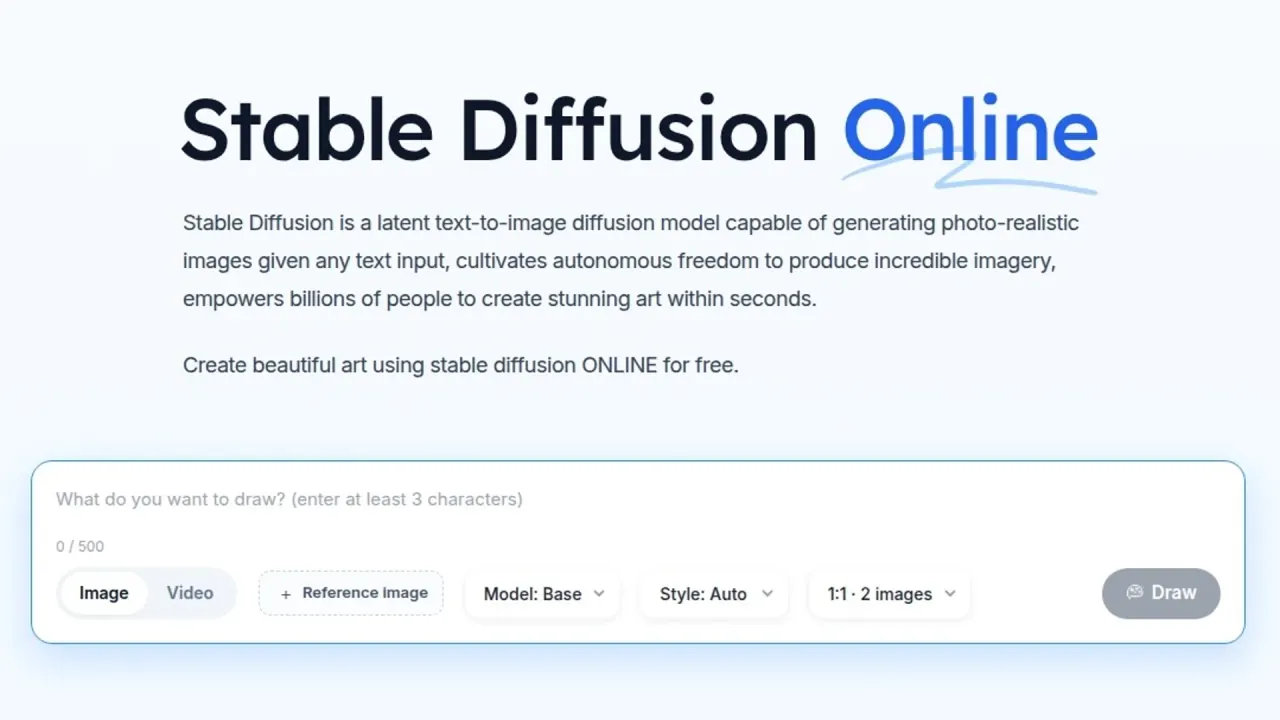

Stable Diffusion Online is a browser-based generator that runs nine image models and five video models on a shared credit balance, with a prompt database and batch editing tools alongside.
Stable Diffusion Online is a browser-based workspace that turns written prompts into images and short videos, with batch editing tools alongside. Its terms define it as a web-based AI image creation and editing service operated by Black Technology LTD.
Who runs it matters more here than for most tools, because the name points somewhere else. Stable Diffusion is an openly released text-to-image model family associated with other organisations, and the homepage opens by describing that model rather than the service. Across the five pages checked in this round, nothing states whether the site is affiliated with, licensed by, or independent of the model's developers. It neither claims such a relationship nor disclaims it, so no position is asserted here.
What the site says about its own engines never mentions Stable Diffusion: the acceptable use policy discloses that image generation may use models in the nano-banana and seed-dream series, while the homepage FAQ still answers the model question with Stable Diffusion XL. Two published pages, two different answers, neither treated as correct here. Read the name as branding and the policy pages as the product description: a credit-metered front end onto third-party model families, wrapped in a prompt library and an editing toolbar.
The creation menu covers text to image, image to image, text to video and image to video, plus photo effects and video templates built on the same engines.
Nine image models are listed — GPT Image 2, GPT Image 1.5, GPT Image 1, Seedream 5.0, Seedream 4.5, Seedream 4.0, Nano Banana 2, Nano Banana Pro and Nano Banana — alongside five video models: Seedance 2.0, Seedance 1.5 Pro, Seedance 1.0 Pro, Kling 3.0 and Kling O3.
That shelf changes what quality means here. The service does not train or own these engines; it resells access and lets you switch between them in one composer, so result quality is mostly the chosen model's, while the service layer decides which models are exposed and what each run costs.
Concrete limits live on the model pages. The flagship image page states that GPT Image 2 supports flexible output sizes and can be used for 1K, 2K, and up to 4K results, and describes a reference-image workflow: upload a picture, then say what should stay or change.
Seedance 2.0 publishes its video envelope in one line: text-to-video or image-to-video, standard or fast, duration from 4 to 15 seconds, 480p, 720p or 1080p, a chosen aspect ratio, and generate_audio when sound is needed.
The composer is identical on the homepage and every model page, so one workflow covers the site.
Step four is where the money is. The GPT Image 2 composer opens at 1:1, 1K, fast, one image and shows 3; the Seedance 2.0 composer opens at 16:9, 480P, 5s, one clip and shows 249 — a short clip at the lowest video resolution costs roughly eighty times a default image.
The service fits work where a usable draft matters more than a controlled pipeline.
Two worked examples show the cost shape. An operator producing twenty packshot variants stays cheap, because each run is a default-priced image at 3 credits. A social team producing five short clips is in another budget entirely at 249 credits for a five-second 480p default.
The service's own commercial guidance applies throughout: output suits concept exploration, ad drafts and product visuals, and text, trademarks, people and licensed source material should be reviewed manually before publishing.
A good fit:
A poor fit:
One group deserves naming separately: buyers who arrived while searching for Stable Diffusion itself. On a third-party consumer review platform, one reviewer says they went there thinking they were on Stable Diffusion, and only noticed after paying for a year that this was not the supplier they had in mind — one account rather than a pattern, but a structural mismatch.
Operator details are unusually checkable. The terms name Black Technology LTD, and the UK company register lists a company of that name: number 14313040, private limited, incorporated on 23 August 2022, registered office in London. The register entry does not mention this website and the site publishes no company number, so the two match by name and jurisdiction rather than through an explicit link.
Three things are known, and one important thing is not.
The billing model is known. Generation is metered in credits, paid plans, credits and subscriptions are billed under the pricing presented at checkout, and the composer shows the credit figure for the settings chosen before you submit. Two observed defaults give the spread: 3 for a 1:1, 1K, fast, single image, and 249 for a 16:9, 480p, five-second clip.
The refund position is known and blunt: unless required by law, purchases are non-refundable, with a note to review plan details carefully before buying. The carve-out is jurisdiction-dependent, but the default is no refund.
A free path is known to exist, because the homepage advertises creating art with the free AI image generator — without saying how large the allowance is or how it resets.
The plan table is not known. In this round the footer's Pricing link and its locale-prefixed equivalent both returned the site's own 404 page, so no tier names, prices or credit allowances were visible to a signed-out visitor, and no monthly figure is stated here. Treat the checkout screen after sign-in as the only authoritative source, and read it before committing to an annual term.
Three directions are worth weighing, and the first comes from the site's own disclosure.
Go to the model families directly. The acceptable use policy discloses that video generation may use models in the veo3, seed-dance and sora series. Those families are sold by their originating providers and other resellers, so if you need only one, buying it there removes a middle layer — at the cost of the model switching and single balance that are this site's convenience.
Run Stable Diffusion yourself. This is what many people are looking for when they land here, and it is a different product: local weights, no per-generation charge and full control of samplers and checkpoints, in exchange for hardware and setup time.
Compare hosted generators. A third-party software directory places this service in the same set as Midjourney, Qwen Image and DALL-E 3, and counts 142 listed alternatives. That record is stale — last updated in December 2023, its description copied from the model card — so verify capabilities at each vendor rather than trusting the listing.
One warning belongs here: the same display name is in use by more than one service, and a consumer review platform carries a separate profile under that identical name on a different domain. Check the address bar before entering payment details.
Content rules are strict and actively enforced. The terms prohibit generating, editing, uploading, requesting or distributing sexual, pornographic, nude, fetish, erotic, adult, sexually explicit or other NSFW content, and the acceptable use policy adds that prompts, uploads and outputs may be reviewed by automated systems and manual review. Access can be suspended or terminated at any time where risk is seen.
Published pages disagree about the models. The acceptable use policy names nano-banana and seed-dream for images, and veo3, seed-dance and sora for video. The navigation lists GPT Image and Kling models the policy does not mention, and the homepage FAQ answers with Stable Diffusion XL. Any may be current; this page records only that they are inconsistent.
Parts of the site are visibly out of date. The homepage FAQ is written around SDXL and SDXL Turbo, and the licence page hosts the CreativeML Open RAIL-M text dated 22 August 2022 under its original copyright line, while the terms and acceptable use policy carry April 2026 dates.
Two pages also disagree about data handling. The homepage states that no personal information is collected or used and that neither text nor images are stored. The privacy policy describes collecting personal information with consent, retaining it as long as the service requires, and prefilling an account from a Google profile. These cannot both describe the same system.
Legal exposure sits with the user. You are responsible for holding the rights to everything you submit, and aggregate liability is limited to the amount paid for the relevant service in the 12 months before a claim arose. The terms are governed by the laws of the United Kingdom, and the service is provided as is and as available.
Output rights come with an unresolved edge. The homepage FAQ states that images created through Stable Diffusion Online are fully open source and explicitly fall under the CC0 1.0 Universal Public Domain Dedication, while conceding that AI-generated image copyright varies by jurisdiction. That answer is written about Stable Diffusion rather than the current model shelf, so it is not established that the CC0 line still covers output from the nano-banana, seed-dream, Kling or GPT Image engines.
Independent verification is thin. One third-party consumer review platform holds the only usable body of first-hand accounts: 12 reviews, an overall 2.0, and 76% at one star, on an unclaimed profile that has never solicited reviews. Twelve is below the sample size at which a score carries weight, so no quality conclusion is drawn here. The countable part is the theme: six of those twelve reviewers describe cancellation, refund or unanswered-support problems.
Nothing is published about training on your content. The privacy policy commits to not sharing personally identifying information publicly or with third parties except when required to by law, and positions the operator as both data controller and data processor under the GDPR. It says nothing about whether prompts, uploads or outputs train models — a gap, not a commitment either way.
The terms describe it as a web-based AI image creation and editing service operated by Black Technology LTD. None of the pages checked in this round state whether that operator is affiliated with or independent of the model's developers, so there is no published answer.
It depends which page you read. The acceptable use policy names nano-banana and seed-dream for images and veo3, seed-dance and sora for video; the navigation lists GPT Image, Seedream, Nano Banana, Seedance and Kling; the homepage FAQ answers Stable Diffusion XL.
Purchases are non-refundable unless required by law. Statutory rights still apply where they exist, but the terms contain no discretionary refund promise, and several reviewers on a third-party platform describe difficulty cancelling.
The homepage FAQ releases images created through the service under CC0 1.0, while noting that AI image copyright varies by jurisdiction; the image model FAQ asks you to review text, trademarks, people and licensed source material manually before publishing.
The published privacy policy does not address this. It covers collection, retention, GDPR roles and a law-enforcement sharing exception, but makes no statement about training — so the honest answer is that the site has not said.
