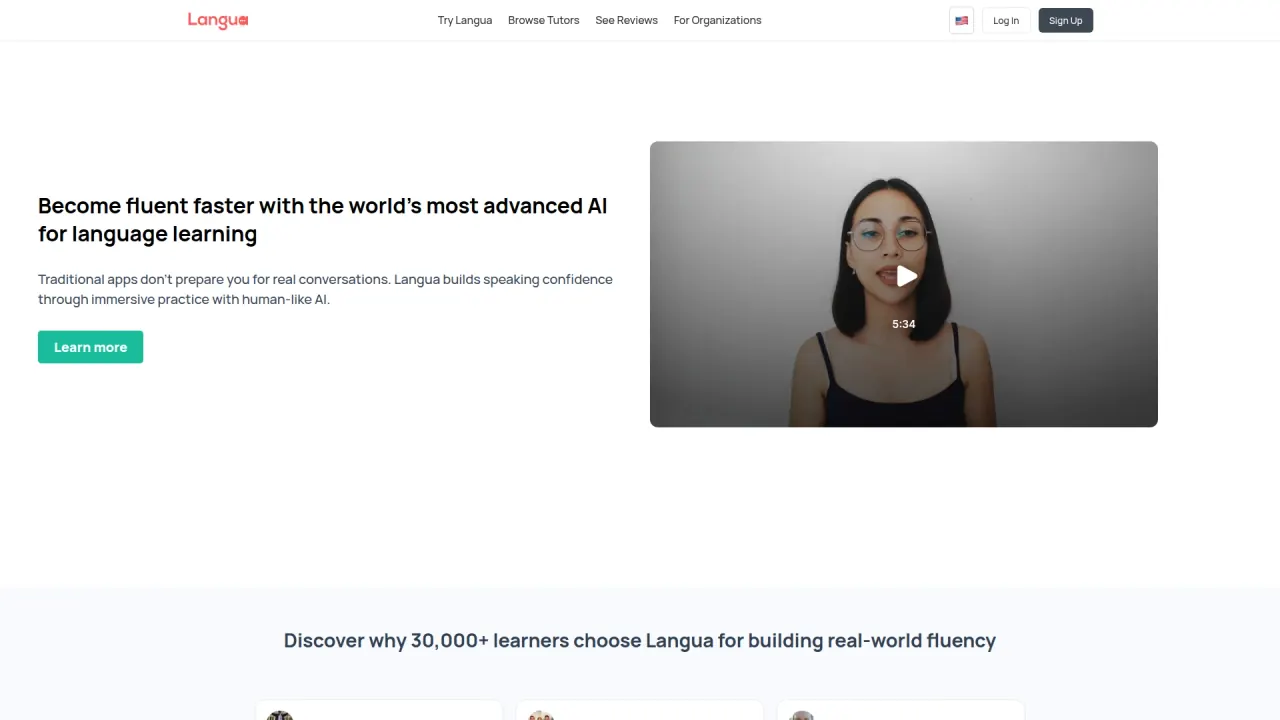

Langua pairs human-sounding AI conversation partners with corrections, feedback reports and spaced-repetition vocabulary across 23 languages on web, iOS and Android.
Used this tool? Rate it
Used this tool? Rate it


AI assistant for writing, analysis and tasks


Build random generators, share them free


Real-time answers, images, and code in one chat


One workspace for every AI model


AI chat for dark fiction and research


AI assistant for structured work


Astrology readings from real astrologers


Ad-free Chinese AI search with cited answers
Langua is the AI language-learning app from LanguaTalk, a company that has run a human tutoring marketplace since 2021. The app puts a voice-based conversation partner in front of the learner: you choose a character, choose a situation, and talk. Speech is answered with human-sounding audio, mistakes are corrected with explanations, and each session ends with a feedback report. The same account works on the web, on iOS and on Android, and progress syncs between devices.
The product covers 23 launched languages, with several available in more than one regional dialect. Practice material runs from roleplays and debates to interest-based chats, grammar drills and vocabulary review, and a guided conversation course covers the A1 and A2 levels. LanguaTalk positions the app as an AI language tutor for people who freeze in real conversations rather than for people who want multiple-choice drills.
Langua is a subscription product with a deliberately small free tier. Two paid plans exist — Standard and Unlimited — and both unlock every language and every feature; the difference is how much conversation practice is allowed each day. Human tutoring is sold separately through the same company and is not part of the AI subscription.
Langua is organised around spoken conversation rather than around a lesson tree, and most of the product is AI conversation practice with a topic attached. A learner opens a chat or a call, and the product supplies the characters, the topics, the corrections and the review material that follow from that conversation.
Every AI tutor voice is cloned from a real native speaker, and most languages offer more than one dialect to choose from. Conversation starters include hundreds of scenarios: roleplays, debates, small talk built around your interests, grammar-focused chats and vocabulary practice. The app also lets you describe your own scenario, so a session can be shaped around a specific trip, meeting or exam.
Call Mode turns the chat into a hands-free voice call. Speaking is handled live instead of waiting for a transcription step, which means the AI can be interrupted mid-sentence and can respond to background noise. The mode is available in the mobile apps and on the web, and it is the part of the product aimed at commuting, walking or household chores.
Corrections can be written or spoken, subtle or explicit, and a detailed report follows each conversation. The report covers the errors that came up, alternative phrasing that would sound more natural, and vocabulary worth keeping. Audio summaries let a learner review the key points without reading.
Grammar practice is generated from the learner's own mistakes. If articles or past-tense forms keep slipping, the app builds drills around those patterns instead of serving a generic grammar syllabus.
Saved words return as spaced-repetition flashcards, inside later conversations and in short AI-generated stories. A word is saved with a context-aware translation, an example of its use and near-synonyms, so review starts from the sentence where the learner met it rather than from a bare list.
Podcasts and videos play with interactive transcripts that stay in sync with the audio, and personal audio or text files can be imported. Any word in a transcript can be translated on the spot and saved to the vocabulary deck, which turns passive listening into practice material.
A guided conversational course covers A1 and A2 material, with suggested replies and slower audio for learners who are just starting. The course teaches phrases and patterns through short exchanges rather than through isolated grammar explanations, and it is being extended to more language pairs over time.
Smart memory stores interests and personal details so conversations stay on topic, and the feature can be switched off. When it is on, the AI remembers earlier subjects and reuses them, which reduces the repetition of introductions at the start of every session.
A first session takes a few minutes and does not require preparation. Speaking in your native language mid-conversation is allowed, and the app answers in the target language without breaking the session. The sequence below follows the product's own flow.
Langua fits situations where the bottleneck is speaking rather than understanding. The scenarios below are drawn from the conversation library and from the situations LanguaTalk describes.
LanguaTalk describes the app as most popular with A2 to B2 learners, and the design explains why: the core activity is producing speech, which is hard before a learner has a few hundred words and enough grammar to form a sentence.
Langua runs on three surfaces and keeps a single account across them.
| Platform | Access | Notes |
|---|---|---|
| Web | Browser at languatalk.com | Chrome is recommended because it handles the voice technology most effectively |
| iOS | Native iPhone app | Same account and progress as web |
| Android | Google Play app | Same account and progress as web and iOS |
The mobile apps add daily practice reminders, which the web version does not provide. Progress, saved vocabulary and subscription status sync across devices, so a conversation started on a phone can be reviewed on a laptop later.
Langua sells two paid plans on monthly and annual terms, plus a free tier and a separate organization offer. Prices are shown in the local currency on the pricing page and in the app stores, so the figures differ by region and by billing channel.
| Plan | Chat and call allowance | Other details |
|---|---|---|
| Free | About 3 minutes of Call Mode a day; roughly 20 messages a week in chat | Enough to test the product, not for regular practice |
| Standard | Up to 75 messages a day and up to 30 minutes of Call Mode a day | All languages and features; allowances reset daily |
| Unlimited | Fair-use allowance of 350 user messages a day | No daily cap on call time in the plan description |
Standard allows up to 75 messages a day in the regular chat modes and up to 30 minutes of Call Mode a day, and both allowances reset the next day. Feedback, summaries, flashcards, stories and podcasts are not counted against those limits, so a learner who hits the cap can still review material.
The Unlimited plan is described as unlimited practice, but the terms apply a fair-use allowance of 350 user messages per day that resets daily. Call time is not capped in the plan description, while chat is.
The free version allows about 3 minutes of Call Mode a day and roughly 20 messages a week in standard chat modes. LanguaTalk explains the cap by the cost of running the underlying models, and the same explanation is used for requiring a card before a trial.
Trials run for 5 days on a monthly plan and 7 days on an annual plan, and a card is required even though nothing is charged during the trial. A 30-day money-back guarantee applies to web and Android purchases but not to subscriptions bought through the App Store, because Apple controls refunds. After a refund, the terms impose a three-month waiting period before the same person can subscribe again.
Organization plans for schools, universities and companies start at $500 per month and are quoted individually. Human tutoring is a separate marketplace with its own rates; it is not included in any AI plan.
Langua competes as a speaking practice app with gamified language apps, with structured course apps and with general chatbots used as conversation partners. The products below appear repeatedly in independent comparisons and in LanguaTalk's own category review.
A general assistant is the other common substitute. LanguaTalk's own category review calls ChatGPT the best free option and says it suits advanced learners who want conversation practice, while a general chatbot does not supply graded scenarios, a correction report, a vocabulary deck or a guided beginner course.
The constraints that matter most are commercial and practical rather than technical.
Service providers may process personal data to run the service, but the terms forbid using it for advertising or for training shared models. Smart memory keeps interests and personal details across sessions until the learner disables it, which changes how much context the tutor carries into the next conversation.
A free account exists and allows about 3 minutes of Call Mode a day and roughly 20 messages a week in chat. Regular practice requires Standard or Unlimited, and a free trial needs a card even though nothing is charged during the trial.
Twenty-three languages have been officially launched, including Spanish, French, English, German, Italian, Portuguese, Japanese and Chinese. Several languages offer more than one regional dialect.
Yes. The same subscription works on the web, on iOS and on Android, and progress syncs automatically between them. The mobile apps add daily practice reminders.
Chat and Call Mode stop for the day and reset the next day. Feedback, summaries, flashcards, stories and podcasts remain available, and upgrading to Unlimited removes the chat and call caps.
LanguaTalk says the app is most popular with A2 to B2 learners, but beginners can use the guided course, suggested replies, slower audio and native-language switching to hold a first conversation.
Cancellation is done from Settings and My Subscription and takes a few clicks. A 30-day money-back guarantee applies to web and Android purchases, not to App Store subscriptions.