
Giststack reads the newsletters, sites and YouTube channels you follow, surfaces insights, and drafts posts, scripts and newsletters in your voice. Lifetime plans start at $85 with your own OpenRouter key.
Used this tool? Rate it
Used this tool? Rate it


Ad-free Chinese AI search with cited answers


AI search for cited research


AI image editing from a reference photo


Multi-model image studio, free to start


Natural AI photo editing for portraits and projects


AI assistant for writing, analysis and tasks


From a prompt to a deck, site or doc


Build random generators, share them free
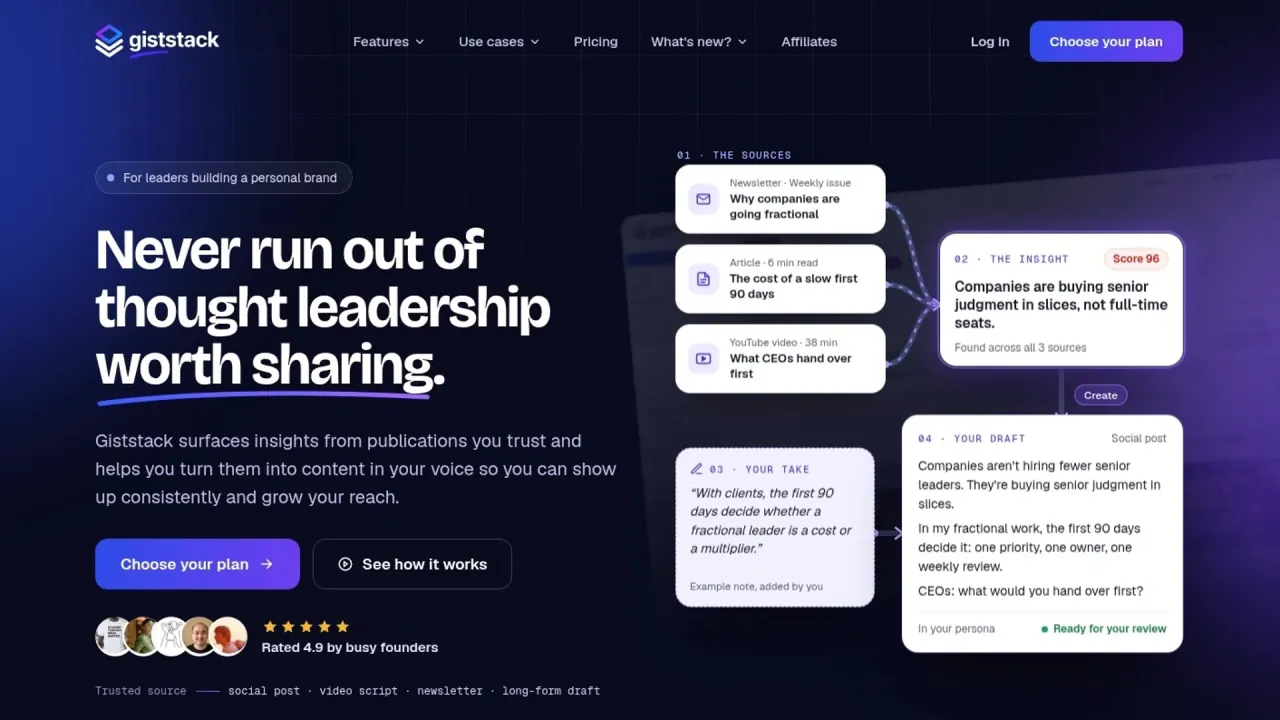
Giststack is a research-to-content workspace for people who want to publish consistently around what they already read. Its homepage calls the product a way to never run out of thought leadership worth sharing, and the pitch is specific: it brings the newsletters, websites and YouTube channels you follow into one reader, surfaces insights and stories from them, and then drafts content in your voice. The site describes itself as helping with the research and first draft, while your experience and judgment make the result worth sharing.
The problem it targets is familiar. You follow the right people, save useful articles, and still end up with a folder of links rather than a point of view. Giststack's argument is that a repeatable path from keeping up to publishing is missing, and the product is built as that path: follow sources, surface insights, create a draft, review it, share it. The homepage frames the three stages as follow, surface and create.
The output is not one format. Giststack drafts social posts and threads, video scripts, newsletter drafts and custom long-form pieces, and the content can be published through an add-on or copied out. In practice that is content repurposing with a review step: one source, several formats, your judgment in between. Behind the drafts sit a Brand Profile, a saved writing persona and a Brand Lens that applies your positioning to the text. The product also accepts your own documents as a source, so a framework or report you wrote can become the starting point rather than something you read elsewhere.
Pricing is unusual for this category: lifetime deals rather than subscriptions, from $85 to $197 one-time, with your own OpenRouter key required on every plan.
The reader is the first layer. Giststack pulls newsletters, websites and YouTube channels into a single place, summarises new posts and lets you organise sources. The point is not to replace a full RSS reader but to make the material you already trust available to the writing workflow, so that an idea does not have to be reconstructed from memory when you sit down to post.
The second layer is insight extraction. Giststack can show takeaways from a single article, newsletter or video, or assemble a story that spans several publications you follow. On the homepage, a story called "Buyers are paying for outcomes, not hours" is shown as found across four sources, with individual insights scored in the high 80s and low 90s and a StoryScore of 94. Those numbers are the product's own ranking signals, not a measure of truth, but they do show how the tool helps you choose one takeaway instead of summarising everything.
Creation is the third layer. From a source or an insight, Giststack drafts a social post, a thread, a video script, a newsletter or a longer custom piece. You choose the format that fits the idea, then review and edit. The draft is meant to be a starting point: the homepage repeats that your real opinions come from you, in review, and that you decide what is worth publishing.
Brand context is what keeps the drafts from sounding generic. The editable Brand Profile records who you serve, what you offer and the themes you want to be known for. A saved writing persona guides the voice, and Brand Lens applies the brand context to a draft, so the same insight can be angled for a founder audience or a finance audience while the brand voice stays recognisable across formats.
Two smaller pieces complete the workflow. A knowledge base holds your own documents, so private material can seed a draft the way a public article can. Publishing runs through the LarkPulse add-on, which posts, schedules or queues to LinkedIn, X, Facebook, Instagram and Threads; otherwise you copy the draft or, from Pro, send it through webhooks. Business adds 500 MCP calls a month.
Getting value from Giststack is mostly a matter of feeding it the right sources and being honest about your own angle. The homepage describes the loop in four moves.
Two setup choices matter more than the rest. Write the Brand Profile properly, because it decides which stories get prioritised and how drafts are framed. Prune the source list, because fifty half-relevant feeds make the insight layer noisier rather than smarter. The publication caps are also a prompt to be selective.
One prerequisite is easy to miss. Every plan requires your own OpenRouter key: create the account, generate a key and paste it in. The site says the key is how you choose models, and the terms put responsibility for it and its spending limits on the user.
Consultants and fractional operators are the clearest fit. Their credibility comes from client work, and their problem is turning that work into a steady public presence. Giststack's homepage example is exactly this: a fractional CFO reads a story about outcome-based pricing, adds a note from their own engagements, and gets a social post that opens with a position rather than a summary. The product supplies the research and the structure; the operator supplies the authority. The site's own list names four roles: founders explaining changes in their market, consultants showing clients how they think, fractional leaders sharing practical judgment, and creators and educators turning research into something their audience can use.
Newsletter writers and niche creators are the second group. Someone who already publishes in a field can use the reader to track more sources than they could skim manually, then turn a theme across several issues into a post or a video script. The custom long-form format is there for the piece that needs more room than a thread, and the newsletter format is for the audience that still reads email.
Small marketing teams use it as a way to keep a founder or a subject expert visible without adding headcount. The Brand Profile can encode the house position, the persona can hold the voice, and the drafts can be reviewed by the person whose name goes on them. That review step is not optional in practice: the terms make the user responsible for checking generated content against platform rules and for its accuracy.
Internal knowledge is a quieter use case. A knowledge base accepts your own documents, so a report or framework can be the source instead of a public article.
Giststack is built for individuals who sell expertise: consultants, fractional executives, coaches, and founders who are the public face of a small firm. The homepage's role examples lean that way, and a third-party review names the same groups: solopreneurs and consultants, niche content creators, and small marketing teams on a tight budget. It also says a large enterprise with a twenty-person social team is probably not the buyer.
The plan structure reinforces that design. Even the top tier offers ten workspaces rather than enterprise administration, and the units being sold are publications followed and posts processed, not seats. A team can share it, but the product is organised around one person's sources, brand profile and voice.
The fit is weaker for two kinds of buyer. Anyone who wants a fully managed content service will find a drafting tool with a review step, not an agency. And anyone who does not want to manage an API key will find the BYOK requirement in the way on every plan, including the $85 entry tier. The third-party review makes the same point, calling BYOK the most significant caveat and saying it is a small hurdle for technical users and a real one for everyone else.
If your job is to have opinions in public and your bottleneck is the research-to-draft loop, the product is aimed at you. If your bottleneck is distribution, design or strategy, Giststack helps with only one part of that chain.
Giststack runs in a browser; the site describes no desktop or mobile app. Its sources are web-based: newsletters delivered by email, websites and blogs, YouTube channels, and documents you upload, so the input side depends on connecting what you already receive.
The output side is wider. Drafts can be copied out, sent through webhooks on Pro and above, or published directly through the LarkPulse add-on, which covers LinkedIn, X, Facebook, Instagram and Threads and supports scheduling and queuing. Direct publishing is an add-on rather than part of the base plan, so the effective cost of a hands-off workflow is higher than the plan price alone. Business plans also expose 500 MCP calls a month, which lets external tools and assistants use your Giststack context.
AI processing runs through OpenRouter with your own key, which is a platform decision with practical consequences. You choose which models to route to, you pay OpenRouter directly for usage, and you set the spending limits on the key. Giststack provides the workflow and the integration but, according to its terms, is not responsible for the availability, performance or cost of OpenRouter. In exchange, the plan price stays a one-time payment because the per-token cost sits outside it.
The published terms also set the operating context. The service is operated by Christopher Closset trading as jednoosobowa działalność gospodarcza in Poland, the terms are effective from 23 April 2025, and the governing law is Polish. Users must be at least 18.
Giststack sells three lifetime plans rather than a subscription. At the time of writing the prices are $85 for Launch, $120 for Pro and $197 for Business, each a one-time payment, with a 30-day refund policy and a Black Friday promotion advertising 20% off. "Lifetime" here means the lifetime of the service, not your lifetime, which is the standard reading of a lifetime deal and an important one.
| Plan | Price | Publications | Posts per month |
|---|---|---|---|
| Launch | $85 one-time | 20 | 800 |
| Pro | $120 one-time | 50 | 2,000 |
| Business | $197 one-time | 100 | 4,500 |
The differences go beyond volume. Launch includes one workspace and keeps posts for six months. Pro adds three workspaces, twelve-month retention and webhooks. Business adds ten workspaces, twelve-month retention, webhooks and 500 MCP calls a month. Every tier includes unlimited AI content creation, and every tier requires your own OpenRouter key.
That makes the real cost less obvious than the sticker price. A one-time payment looks cheap next to a subscription, but AI usage is billed by OpenRouter at your chosen model's rate, and the plan caps publications and posts. For a heavy user the OpenRouter bill may matter more than the licence; for a light user the caps may bind first.
Publishing is priced separately. LarkPulse, the add-on that publishes, schedules and queues to LinkedIn, X, Facebook, Instagram and Threads, is available on any plan but is not included in the listed prices. Webhooks, which let you send drafts to other tools, start at Pro. So the $85 tier is the cheapest way into the workflow, while the $120 tier is the cheapest way to automate the handoff.
The refund policy is stated as 30 days on new purchases, both on the pricing page and in the terms. The terms add that no refund is issued on termination unless the law requires it, that price changes do not affect existing subscriptions, and that lifetime access is tied to the life of the service. On a one-time purchase those clauses carry more weight, because there is no later month in which to walk away.
The first limitation is structural: every plan requires your own OpenRouter API key. You have to create the account, generate the key, paste it in, choose models and manage spending. Giststack provides guides, and a third-party review notes that OpenRouter is often cheaper than using OpenAI directly, but the step remains. On a $85 lifetime plan, the setup burden and the separate AI bill are part of the real cost.
The second is the cap structure. Launch follows 20 publications and processes 800 posts a month with six-month retention. Pro doubles the publications and raises retention to a year. Business reaches 100 publications and 4,500 posts. A reader who subscribes to dozens of newsletters, or who wants to keep a year of drafts on the entry plan, will hit these limits in normal use rather than at the margin.
Publishing is not included. Direct posting to LinkedIn, X, Facebook, Instagram and Threads requires the LarkPulse add-on, and webhooks require Pro or above. Without either, the workflow ends with a copied draft. That is a legitimate design, but it means the product is a drafting and research tool by default, not a scheduling tool.
The terms put responsibility on the user. Generated content is generally owned by the user, but Giststack does not guarantee its accuracy, originality or suitability, and the user must check that output complies with platform rules. Liability is capped at the fees paid in the six months before a claim, and lifetime access means the life of the service. The privacy policy adds that data may be stored or processed in the USA, that users can request access, correction, deletion, restriction, portability or objection, that requests are answered within a month, and that personal information is not sold. It is a general GDPR template that does not describe AI-provider processing in product-specific detail.
There is also a quality limit that no tool removes. The product supplies research and a first draft; the point of view has to come from you. The homepage says so directly, and the output is weakest when the source is summarised without a genuine angle. For thought leadership content, that is the part that decides whether anyone reads it.
A research-to-content workspace. It brings the newsletters, websites and YouTube channels you follow into one reader, surfaces insights and stories from them, and drafts social posts, video scripts, newsletters or long-form pieces in your voice.
Yes, on every plan. Giststack uses OpenRouter for AI processing and requires your own key, so you choose the models and pay OpenRouter directly for usage. The terms put responsibility for the key and its spending limits on the user.
No. The plans are one-time lifetime deals: $85 for Launch, $120 for Pro and $197 for Business at the time of writing, with a 30-day refund policy. Lifetime means the life of the service.
Yes, through the LarkPulse add-on, which publishes, schedules or queues to LinkedIn, X, Facebook, Instagram and Threads. Direct publishing is an add-on on any plan; webhooks are included from Pro.
Social posts and threads, video scripts, newsletter drafts and custom long-form drafts. The custom format is the one to use for a blog article or a longer piece you will edit elsewhere.
The Brand Profile, saved writing persona and Brand Lens are designed to shape the voice and the angle. The site still describes the output as a draft you review and revise, and says your experience and judgment are what make it worth sharing.