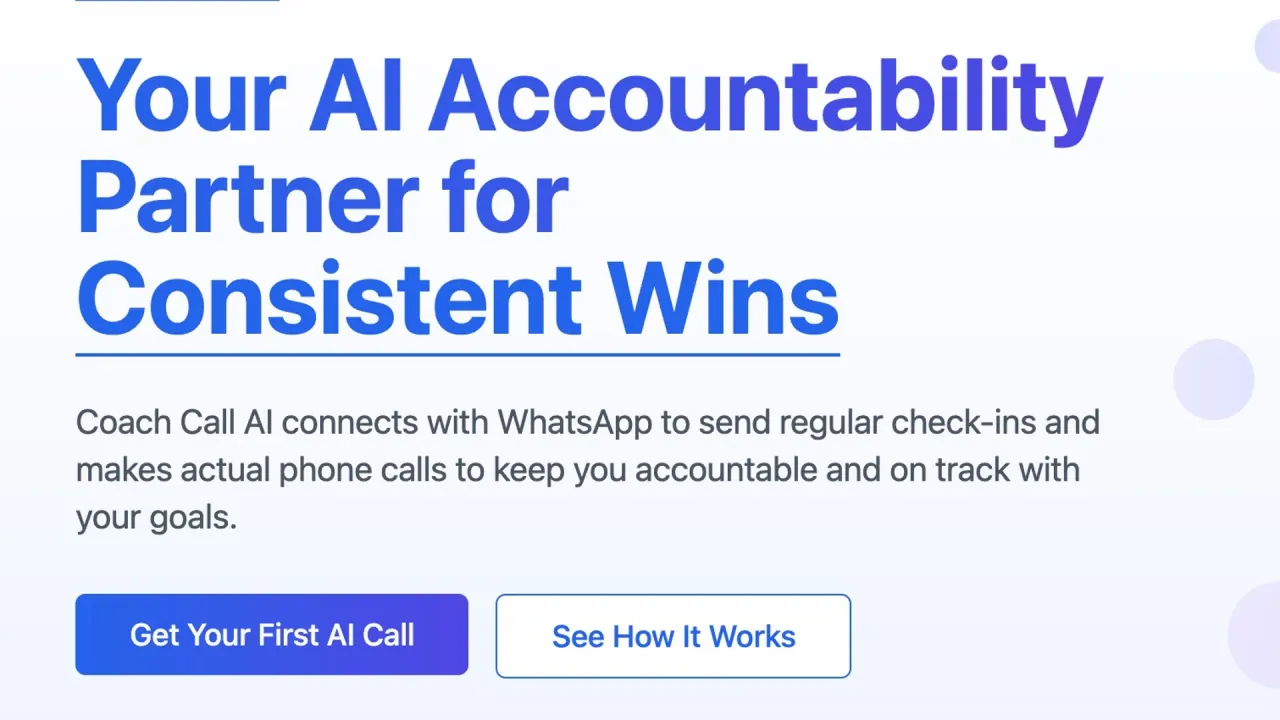

Coach Call AI pairs daily WhatsApp check-ins with scheduled phone calls from an AI coach, so a goal gets a follow-up instead of another reminder you can swipe away.
Used this tool? Rate it
Used this tool? Rate it


AI assistant for writing, analysis and tasks


From a prompt to a deck, site or doc


Real-time answers, images, and code in one chat


One workspace for every AI model


One workspace where your team and its AI agents think together


Public Codex reset tracker


AI assistant for structured work


Plan, build, and refine work with an AI agent
Coach Call AI is an AI accountability partner that reaches you through WhatsApp and ordinary phone calls instead of an app you have to remember to open. The company's own description is that it "connects with WhatsApp to send regular check-ins and makes actual phone calls to keep you accountable and on track with your goals." Nothing in the experience depends on new hardware: the messages land in a chat you already use, and the calls ring the number you already own.
The label the company puts on the product is deliberate. Coach Call AI is presented as "a true accountability coach, purpose-built and trained to deliver maximum accountability, not just reminders," which places it closer to a coach who follows up than to a habit tracker with streaks. What that framing describes in practice is narrow: two channels, a schedule you set, and a running record of commitments you have made.
The feature set is narrow by design. There are two ways for the service to reach you, one scheduling layer that decides when it does, and one place where the results collect.
Calls are what separate Coach Call AI from WhatsApp-only accountability apps. The company positions them as "real phone calls to your device when you need motivation the most," scheduled at the times you prefer, with call frequency matched to your goal. The calls are made with voice AI and are described as sounding "natural and conversational," though a call is still a call: it rings, it can be declined, and it ends when the plan's minute allowance runs out.
You choose a voice and a manner instead of accepting a single default. The homepage plays voice samples for each persona; the sample coach Elara is described as "Supportive & Empathetic," focusing on emotional well-being and positive reinforcement. Separate from the voice, the coaching style can be set to gentle, balanced, or tough-love, and the company says the style can be changed later as needs shift.
The coach is meant to carry context forward rather than restart each morning. The company says it "remembers everything from previous conversations," and the check-ins are built to ask specific follow-ups about what you reported earlier rather than generic questions about your goals.
Every conversation is supposed to leave a trace. The system records milestones automatically from chats and calls and plots them on a visual progress timeline, so the record builds itself instead of waiting for you to log a win. The company describes the dashboard as capturing achievements "from your conversations and phone calls, building a visual record of your progress over time."
Onboarding follows five steps, and only the first asks anything of you beyond talking.
The web app is a control panel rather than the product itself. The company describes it as being used "to set goals and review your progress," with the coaching happening in WhatsApp and on the phone. That division matters for anyone expecting a dashboard-first experience: there is nothing to keep open and nothing to tick off.
Timing is set once and respected afterwards. The company says you can choose your preferred times for calls and check-ins and that the coach will "respect your schedule" and reach out during your specified hours, which is the setting to revisit first if calls arrive at a bad moment.
Coach Call AI is marketed around six recurring situations, each with an audience the company names on its homepage.
The ADHD framing is the most specific claim the company makes about outcomes. Its FAQ states that the service is "particularly effective for individuals with ADHD or chronic procrastination" and that many users report improvement "within days," a vendor assertion without a cited study or published sample. Readers weighing that sentence should treat it as positioning rather than a measured result.
Two of the six situations depend on timing more than on coaching. A wake-up call and a pre-workout call are useful only if they arrive at the minute you named, which makes the scheduling settings and the plan's calls-per-week allowance the practical constraint on how many of these situations one subscription can cover.
The audience is people who already know what to do and stall anyway. The company's pitch starts from the failure of human partners, who "miss scheduled calls, cancel last minute, or simply disappear when life gets busy, leaving you without support when you need it most," and it offers the service as the substitute for that unreliability rather than as a replacement for expertise.
That framing sets the fit. It suits someone who wants external pressure applied on a schedule and who is comfortable being contacted on a personal number, including people who have tried planners, journals, or a friend's good intentions and stopped. It suits less well anyone who wants a clinician, a therapist, or an experienced human coach; the company's own FAQ draws that boundary and is quoted under Limitations.
The regional split is the one that changes adoption decisions. WhatsApp works almost everywhere, but the calling half of the product does not, so a reader outside North America, Europe, Australia, or the named Asian markets is buying a WhatsApp coach with calls unavailable. The vendor also describes availability as 24/7 across time zones, which is a statement about the service running continuously rather than about calls reaching every country.
| Plan | Monthly price | Calls per week | Call length | Support | |
|---|---|---|---|---|---|
| Basic | $9.99/month | 5 | 3 minutes | Daily check-ins, unlimited messages | Standard |
| Medium | $19.99/month | 8 | 4 minutes | Daily check-ins, unlimited messages | Priority |
| Pro | $39.99/month | 12 | 5 minutes | Daily check-ins, unlimited messages | Priority |
Every plan lists daily WhatsApp check-ins, unlimited WhatsApp messages, and advanced progress tracking. The differences are the number of calls, the length of each call, and priority support on the two higher tiers.
The page carries a monthly/yearly toggle that advertises "Save 17%" on annual billing. The yearly amounts are not shown in the default monthly view, so the table records list prices as displayed on the captured date.
The trial is stated inconsistently across the site. The homepage FAQ offers "a 14-day free trial," while a separate landing page says you can "try Coach Call AI free for a week" with "three coaching calls and unlimited WhatsApp check-ins included — no credit card needed to start." The two statements differ in both length and scope, and this page reports both rather than choosing one.
Cancellation is described as simple: the company says you can cancel "at any time with no questions asked." The terms add the mechanical detail behind that promise, since subscriptions renew automatically unless cancelled before the renewal date. That detail decides whether a cancellation lands before or after the next charge.
The substitutes fall into three groups: another AI that calls you, a human who checks in, and a scheduled session with a stranger.
A software directory that tracks alternatives names Coach.me, Beeminder, and GoalsWon as Coach Call AI's top competitors. Two other approaches make the trade-offs concrete: a human who checks in, and a session with a stranger.
Boss as a Service sells the thing Coach Call AI automates: "Meet your Boss — a real person who keeps you honest, calls out your excuses, and won't let you flake on your goals," for a monthly fee. You get judgement and improvisation that a scripted coach does not have, and you also get a person's availability, which is exactly the failure mode the AI product is positioned against.
Focusmate takes the opposite approach to presence through virtual coworking: you book a session, "greet your partner, share your session goals and get to work," and check in at the end. Joining is free, and the Plus tier is $8 a month billed yearly or $12 month to month. It supplies a witness for a working block rather than a caller who asks about your week.
The choice between them is mostly about which moment you fail at. If you stall at the start of a task, a booked session with another person addresses that; if you drift for days without anyone noticing, a scheduled call addresses that; if you need someone to weigh an excuse, only the human option does.
The limits that matter are contractual, regional, and privacy-related.
Two of these interact in a way that is easy to miss. Because the company can adjust call frequency at its discretion and each plan already caps calls per week, the advertised allowance is a ceiling rather than a guarantee, and the only commitment about timing is that calls follow the windows you set.
The privacy terms also shape what the product can be used for. Calls are placed to a number you supply and their recordings and transcripts may be retained for service improvement, so the service assumes a phone line you are willing to attach to coaching conversations rather than a shared or work-issued line.
No. The service runs through WhatsApp and ordinary phone calls; the web dashboard is used to set goals and review progress.
In North America, Europe, Australia, and select Asian countries, with more regions being added. WhatsApp itself works wherever the app is available.
Five, eight, or twelve calls a week depending on the plan, each capped at three, four, or five minutes.
The homepage FAQ says 14 days. A separate landing page describes a free week with three coaching calls and no credit card. The site states both.
It is an AI coach. The company says it does not replace a human coach's expertise, and the terms state it is not a substitute for medical advice.
Call recordings and transcripts may be stored and processed to improve the service, and WhatsApp message content and history are stored to deliver and personalise coaching.
Yes. The company says you can cancel at any time with no questions asked, and subscriptions renew automatically unless cancelled before the renewal date.