
Cantina is a social AI platform where adults build characters with a face, a voice and a backstory, then put them into short videos and real-time chats and share the results across TikTok, Instagram and the app.
Used this tool? Rate it
Used this tool? Rate it


Multi-model image studio, free to start


Community-Trained Models for Art, Video and Characters


One gateway for text and media models


Prompt-Based Images, Edits and Video

Multi-model AI video and image generation in one browser workspace

Design original characters and animate them


Chat Your Way to a Finished Video


Edit, caption, and generate video in one place
Cantina is a social AI platform where people create fictional characters with a face, a voice and a personality, then use them in short videos and live conversations. The same characters appear in group chats, voice calls, rooms and video alongside real users, so the product sits between a character chatbot, a video generator and a social feed rather than inside any one of those categories.
It runs as a website and as mobile apps, and the iOS listing is rated 17+ for content while the terms require users to be at least 18. That gap matters: the store label is a content rating, while the contractual age gate is stricter and is checked at sign-up and afterwards.
Access is free to start. Paid features are sold as credits that are spent on eligible actions and as subscriptions that renew automatically, but the public pages reviewed here do not publish a price list; the terms state that prices, billing periods, taxes and included credits are disclosed before purchase.
The product works as an AI character chat service and as a short-video studio at the same time, which is why the same asset has to survive both a conversation and a clip.
A character is built in three layers. Appearance covers the visual design, identity covers personality, traits and backstory, and voice gives the character an actual voice rather than text alone. The platform describes the result as a character with personality, voice and identity that can be brought to life in videos and interacted with in real time.
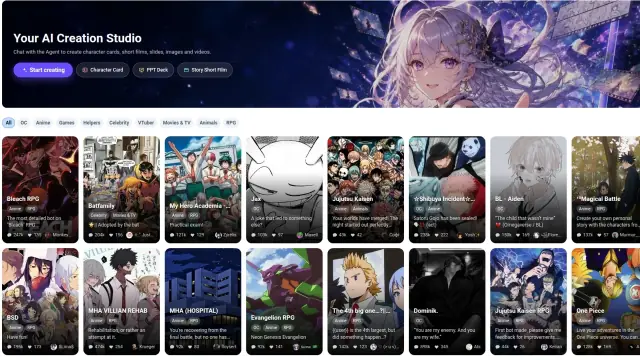
Creation is fast by design. The site presents it as designing expressive characters in seconds, and the character catalogue on the home page is organised by genre, including animal, assistant, celebrity, comedy, companion, expert, food and game, which shows the range of personas other users have already published.
For people who arrive looking for an AI video generator, the difference is that the subject already exists as a character with a voice and a history, so a clip does not begin from a blank prompt.
Characters can be placed into dynamic videos that are ready to share, and the app listing describes transforming them into high-quality shareable AI videos, putting several characters together in stories and evolving narratives, and producing solo moments, duos or a full cast. The framing is short-form entertainment rather than a general-purpose video editor: the character is the asset, and the video is how it performs.
Distribution is part of the loop. The app listing says videos export to TikTok, Instagram and group chats, and the site describes publishing across Cantina, TikTok and beyond, with creators building a following around a recurring character.
Characters respond and interact in real time. Users can chat with them, create alongside them, and comment on and share their own characters and their friends' characters, and the discovery surfaces on the home page rank bots by recent interactions and by most shared.
Rooms add a group layer. Characters appear with real people in group chats, voice calls and video, and room owners and admins set a room's privacy, assign roles and write their own rules. Hosts and above can revoke a member's microphone and camera, remove them, or ban them for an hour, a day or permanently, and whoever adds a character to a room is responsible for what it says there.
The home page is a live catalogue: trending bots, most-shared rankings, top creators with interaction counts and bot counts, genre filters and rotating themes. Each creator has a profile that lists their bots, which turns a single character into a small portfolio and gives successful personas a way to become recurring series.
Generated media carries C2PA Content Credentials, and anything shared off Cantina carries a visible watermark as well, so the output stays identifiable as AI-generated even when metadata is stripped. Guardrails sit in the generation pipeline rather than being added feature by feature, and the safety page states that none of those controls can be turned off by a user.
The product is organised around a create, perform and share loop.
The clearest pattern is episodic short-form entertainment. A character with a fixed voice and backstory can carry repeated scenes, and the app listing frames this as turning creations into recurring series or breakout personalities. Because the same character can speak, appear and react, a creator does not rebuild the asset for each format.
A second pattern is remixing other people's characters. The catalogue includes thousands of bots made by other users, and the product explicitly supports making content with them as well as commenting on and sharing friends' characters. That is a social workflow rather than a solo generation workflow, and it depends on the room and profile features as much as on the generator.
A third pattern is running a themed room. Room owners set privacy, roles and their own rules, which supports a host who wants a recurring live space around a genre or a story, with characters and real participants in the same conversation. The home page genre list, from animal and comedy to companion and game, gives an idea of the themes users already organise around.
Cantina fits adults who want to build a character once and then use it across chat, video and live rooms, who are comfortable publishing to a social feed, and who treat AI characters as performance rather than as a private assistant. It also suits creators who already post short video and want a repeatable persona instead of a new prompt for every clip.
It is a poor fit for several groups. Anyone under 18 cannot use it: the terms require 18 and accounts confirmed as under 18 are permanently suspended. Anyone who needs confidential work should look elsewhere, because the terms say the service does not offer end-to-end encrypted messaging and that private means access-restricted, not unmonitored. Anyone who needs a controlled production pipeline with published per-render pricing will also find the commercial side opaque, since prices are disclosed only at purchase.
Cantina runs in the browser at cantina.com and as mobile apps distributed through the Apple App Store and Google Play, both of which the terms address directly. A third-party review notes that the store listing carries a 17+ content rating while the contract requires 18, and explains that the two numbers serve different purposes.
The mobile app is where most of the social surface lives: the listing describes chatting, creating, commenting and sharing, and exporting video to TikTok, Instagram and group chats. The website carries the same catalogue and creator profiles in a browser layout.
Account creation can run through Apple, Google or another third-party service; the terms say Cantina receives information that provider makes available according to the user's settings, and that it never asks for that provider's password. The service is licensed for personal, non-commercial use unless business use is expressly permitted.
There is no published price list on the pages reviewed. What is documented is the structure. Some features require payment, and prices, billing periods, taxes, included credits and other material terms are disclosed before purchase.
Credits are the metered unit. They can be used only for the eligible features identified in the service, they are a limited revocable permission rather than money or stored value, they have no cash value, and they cannot be transferred, sold or redeemed for cash except where the law requires it. Free or promotional credits are used first, starting with those that expire soonest, then credits included with a subscription. Purchased credits do not expire, while promotional credits may expire as disclosed when issued.
Subscriptions renew automatically for successive periods of the same length at the then-current price until cancelled, and cancellation must go through the same channel used to subscribe, either account settings for direct purchases or the app store for store purchases. A cancellation before renewal prevents the next charge, access continues to the end of the paid period, and cancellation does not retroactively refund the current period. An annual subscription can be changed to a monthly one only at the end of its annual term.
Refunds are narrow. Except as stated in the purchase terms or required by law, fees are nonrefundable, and if Cantina ends a paid subscription for a violation the user receives no refund unless the law requires one. If Cantina itself ends a paid subscription without a violation, it provides a prorated refund or comparable credit for the unused prepaid period.
The nearest alternatives split along the same axis the product straddles. A third-party review of the platform positions Character.AI as text-led character chat and discovery with less video-social emphasis, Chai as a lighter mobile route into character chat and discovery, Replika as an ongoing relationship with a single AI companion, and HeyGen as authorised commercial AI video production rather than a social UGC network. Read together, they describe four different jobs: chat, quick mobile chat, companionship, and production.
That framing is useful because it shows what Cantina is optimising for: a character that performs in public and travels as video. Anyone who mainly wants long private conversations is closer to the chat-led tools, and anyone who mainly wants a polished corporate clip is closer to the production tools.
The contractual age is 18, and the check does not stop at sign-up. When a date of birth, an automated flag or a moderator review raises a question, the account is locked until age is verified by a video selfie that estimates age from facial features, or by a government ID if that is inconclusive, and accounts confirmed as under 18 are permanently suspended. The 17+ app store label describes content, not eligibility.
Private in Cantina means access-restricted, not unmonitored. The terms reserve the right, without undertaking an obligation, to access, monitor and review content, communications and activity across rooms, direct messages, bot configurations and bot interactions, and to have service providers, including AI model providers, do the same. There is no end-to-end encrypted messaging, and the terms advise against storing anything that must stay private from the company.
Users keep rights in the original creative elements they contribute to a character, such as persona, backstory, appearance and instructions, but they do not acquire rights in the platform's content, third-party materials, models or software. Where Cantina has rights in generated content it assigns them to the user, yet it does not promise that the output is copyrightable, unique, accurate or free of third-party rights, and other users may receive the same or similar output.
Users grant a broad service licence covering hosting, reproduction, modification, translation, display, distribution and transmission as needed to run and moderate the service, plus an improvement licence to analyse content and interactions to develop and train the service, bots, models and safety systems, subject to law and privacy controls. The conduct rules forbid, among other things, impersonating a real person without the required rights and consents, non-consensual intimate imagery, and any sexualisation of minors, and violations can end an account without a refund.
At least 18. The terms require users to be 18 or older and legally able to enter a binding agreement, the safety page says Cantina is 18+ at sign-up and keeps checking afterwards, and accounts confirmed as under 18 are permanently suspended. The 17+ label in the app store is a content rating, not the eligibility rule.
Not in the sense of unmonitored. Private describes who can access a room or message, which is access-restricted, and the service does not offer end-to-end encrypted messaging. The terms allow Cantina and its service providers, including AI model providers, to access, monitor, record and analyse content in rooms, direct messages, calls and bot interactions.
You retain rights in the original creative elements you contribute, such as persona, backstory, appearance and instructions, and Cantina assigns you any rights it holds in generated output. It does not promise that generated content is copyrightable, unique or free of third-party rights, and other users may produce similar results.
The public pages do not publish a price list. Some features require payment, and the terms say prices, billing periods, taxes and included credits are disclosed before purchase. Credits are spent on eligible actions, purchased credits do not expire, and promotional credits may expire as disclosed.
Yes, through the same channel used to subscribe, either account settings for direct purchases or the app store for store purchases. Cancelling before renewal prevents the next charge and access continues to the end of the paid period, but the current period is not refunded.
Generated media carries C2PA Content Credentials, and anything shared off Cantina also carries a visible watermark, so the output remains identifiable as AI-generated even if metadata is removed.
Cantina runs in the browser and as mobile apps distributed through the Apple App Store and Google Play, both named in the terms. The store listing carries a 17+ content rating, which describes the content rather than who may sign up.