
Morph sells an OpenAI-compatible inference API plus task-specific endpoints for code search, edit merging, context compaction and typed decisions, so teams can run coding agents on one stack.
Used this tool? Rate it
Used this tool? Rate it


DeepSeek AI models for chat and API


One Gateway, Every Model, Compensated Failures


Public Codex reset tracker


One gateway for text and media models


AI assistant for structured work


From prompt to production with Gemini


Track public AI usage-limit reset signals


AI image editing from a reference photo
Morph is an inference provider and model toolkit for teams building coding agents, operated by AutoInfra, Inc. It is not an editor or a chat assistant: the product is a hosted API with an open-weight model catalogue, plus specialised endpoints that take over the parts of an agent loop that general models handle badly — searching a repository, merging a generated edit into a file, compacting context and returning typed decisions.
The integration surface is deliberately ordinary. One OpenAI-compatible API covers the chat models and the specialised models, so an existing SDK can be pointed at a different base URL. The same models are available through MCP and the AI SDK, and enterprises can self-host. The vendor says the service handles more than 1 trillion tokens a day and is used by 400+ production agents; those are company figures rather than audited measurements.
Morph should be read as infrastructure rather than an end product. A third-party review with 15 user ratings scores it 4.5 and makes the same point: it is a component for teams building agents, and a developer expecting an out-of-the-box coding assistant will be disappointed. The vendor's own customer quotes come from companies embedding the apply step — Binance, Zo Computer, Anything and HeroUI — which is the shape of the actual buyer.
The model catalogue is open-weight-first. Kimi K3.1 Pro, GLM-5.3 744B, GLM-5.3-Flash and DeepSeek V4.1 Flash are served on custom kernels, with Qwen and MiniMax in the wider lineup. Morph also serves abliterated variants with refusal behaviour removed, offered to approved teams and priced above the standard models.
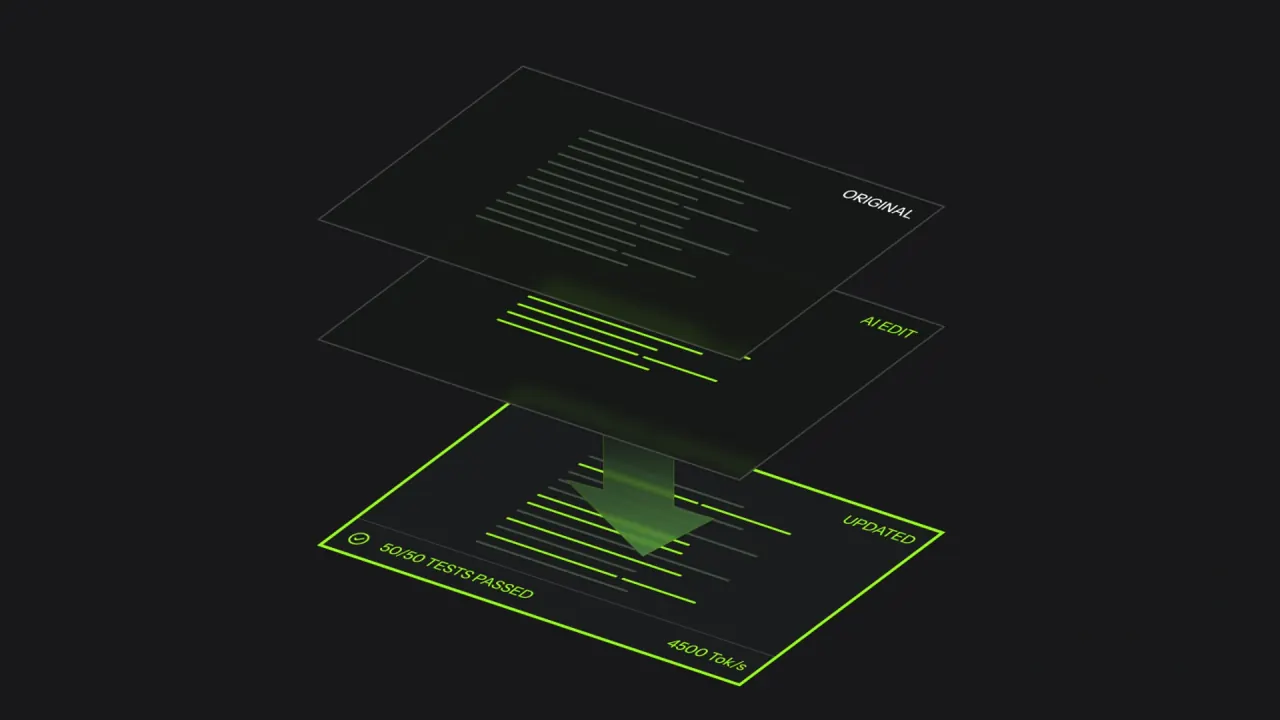
Fast Apply is the product's signature endpoint: a 7B model that merges an AI-generated edit snippet into an existing file and returns the complete merged file. The vendor quotes 10,500 tokens per second and 98% merge accuracy, with a 500-line file completing in about 0.8 seconds and a 262K context window. Two variants exist — morph-v3-fast for latency and morph-v3-large for complex multi-scope changes — plus an auto route that picks between them by edit complexity.
The design assumes the planning model has already decided what to change. The agent sends the instruction, the original code and a lazy edit snippet with markers for unchanged sections; Fast Apply returns the merged file. That division is the argument for a small specialist model: merging is a bounded task that does not need world knowledge, so it can run faster and cheaper than asking a frontier model to rewrite the whole file.
WarpGrep is agentic repository search, positioned as a way to find the right files without loading a whole codebase into the planning model's context. The vendor claims first place on SWE-Bench Pro for code search and prices it at $0.80 per 100K tokens, with a 100K context window that rises to 1M on the Pro tier. The practical value is context isolation: the search subagent reads broadly and returns a narrow result, so the main agent's window stays clean.
Compact compresses context verbatim rather than summarising it, and the vendor says it shrinks context by 50–70% at 33,000 tokens per second. It is priced at $0.20 per million input tokens and $0.50 per million output tokens with a 1M context. Verbatim compaction is aimed at long agent sessions where the original wording matters — logs, stack traces, file contents — and a paraphrase would lose the detail the next step depends on.
Reflex returns typed decisions instead of generated text: a state goes in, and a probability distribution per question comes out, with zero output tokens. It is priced at $0.042 per million input tokens with a 64K context. The use case is classification inside an agent loop — whether to retry, escalate, stop or choose a branch — where paying for a paragraph of reasoning is waste.
The router picks a model by task difficulty for $0.005 per request. It is the smallest piece of the stack and the one that turns a catalogue into a policy: cheap models for routine turns, stronger models when the request warrants it, without the application hard-coding the mapping.
The chat catalogue is sold per token with separate input, cached-input and output prices. DeepSeek V4.1 Flash is the cheapest at $0.12 input, $0.008 cached and $0.80 output per million, with a 1M context. GLM-5.3-Flash sits at $0.20/$0.04/$0.70, GLM-5.3 744B at $1.19/$0.20/$6.00, and Kimi K3.1 Pro at $2.50/$0.29/$14.00. The abliterated variants cost more: $0.30/$0.03/$1.20 for DeepSeek and $5.00/$0.58/$28.00 for Kimi.
Integration follows the shape of an OpenAI client, which is the point of the design.
The guide is short because Morph does not ask the buyer to adopt a workflow. It asks for one HTTP call in a place where the agent already makes one, which is also why the product is hard to evaluate without a working agent to plug it into.
The core case is an agent that generates many edits per session. A general model rewriting a 500-line file takes seconds and thousands of tokens; Fast Apply returns a merged file in under a second for 700–1,400 tokens. At thousands of edits a day the difference is latency and cost at the same time.
WarpGrep targets agents working in codebases too large for a single context window. A subagent searches, the main agent receives a narrow answer, and the planning context stays small enough to remain coherent across a long session.
Compact fits agents that accumulate logs, traces and file contents over a long run. Verbatim compression keeps the exact strings the next step may need while cutting 50–70% of the tokens, which is the difference between a session that fits and one that has to restart.
Enterprises with data-residency or retention requirements can self-host Morph or sign a zero-data-retention addendum. One customer quote describes deploying a fully on-premises coding agent where broken diffs at a 2% error rate would mean hundreds of failed edits a day; the quote is vendor-hosted and describes that customer's deployment, not an independent benchmark.
The product is a poor fit for an individual developer who wants a coding assistant to open and use. A third-party review makes the distinction directly: Morph is a component, and developers expecting an out-of-the-box assistant will be disappointed. The same review notes that agent frameworks such as Sweep AI and Codex CLI offer a more direct agent experience, while lacking Morph's native performance. It is also a poor fit for a team that needs one general model for open-ended reasoning; the specialised endpoints solve narrow problems and assume the agent already has a planner.
Morph is a cloud API first. The endpoints are OpenAI-compatible, available through MCP and the AI SDK, and documented for direct HTTP calls. Beyond the hosted service, the vendor offers self-hosting on the customer's infrastructure, regional data centres for paid and enterprise customers, custom rate limits, a 99.9% uptime SLA, SOC 2 certification and ready-to-sign enterprise agreements.
Data handling is tiered. Free and paid traffic runs under minimal retention: inputs and outputs are kept for no longer than 30 days and are not used for training. Enterprise customers can sign a zero-data-retention addendum under which content is processed in volatile memory and discarded when the request completes. One exception survives ZDR: prompts that safety classifiers flag as an attempt to compromise systems the customer does not own are retained for safety review and legal process.
Morph prices on usage rather than seats. The pricing page captured on November 26, 2026 lists a free allowance, pay-as-you-go credit, a flat subscription and enterprise capacity.
| Plan | Price | What it covers | Limits |
|---|---|---|---|
| Free | Free | 200 requests every month | Request cap; minimal retention |
| Pay as you go | From $10 first top-up, plus $5 free | Any model, billed per token or per request | Practically no rate limits |
| Ultra | $200/month | Unlimited Kimi K3.1 and DeepSeek V4.1 Flash for coding; 1,000 places | Subscription capacity |
| Enterprise | Quoted | Dedicated capacity, SSO, custom rate limits, priority support | Contract terms |
Chat models are billed per million tokens with separate input, cache-read and output rates: $0.12/$0.008/$0.80 for DeepSeek V4.1 Flash, $0.20/$0.04/$0.70 for GLM-5.3-Flash, $1.19/$0.20/$6.00 for GLM-5.3 744B and $2.50/$0.29/$14.00 for Kimi K3.1 Pro. The gated abliterated variants cost $0.30/$0.03/$1.20 and $5.00/$0.58/$28.00 respectively.
The specialised endpoints have their own meters: Fast Apply at $0.80 input and $1.20 output per million tokens (morph-v3-large at $0.90/$1.90), WarpGrep at $0.80 per 100K tokens, Compact at $0.20/$0.50 per million and Reflex at $0.042 input with $0.002 cached per million. The router charges $0.005 per request.
The structure rewards commitment. Pay-as-you-go starts with a small top-up and a $5 credit, Ultra converts heavy Kimi and DeepSeek use into a flat $200, and enterprise moves to dedicated capacity with discounts over public pricing. The vendor says dedicated endpoints are private deployments rather than a premium tier of the shared pool.
Alternatives. The realistic alternative is a general model provider: send the edit back to Claude, GPT or Gemini and ask for the full file. A third-party review frames Morph against GitHub Copilot and Cursor as general coding tools and against agent frameworks such as Sweep AI and Codex CLI, concluding that Morph is the component rather than the complete experience. The trade is control and speed against the convenience of one vendor for planning and applying.
Usage pricing is hard to forecast. Every endpoint has its own unit — per million tokens, per 100K tokens, per request — and an agent that retries edits or searches repeatedly multiplies the bill in ways a seat price does not. The free tier is a testing allowance, not a production one.
The specialised models do one thing. Fast Apply merges edits, WarpGrep searches, Compact compresses and Reflex classifies. None of them plans or reasons about a feature request; an agent still needs a general model and a harness around these calls.
Benchmark numbers are vendor-published. The 10,500 tokens per second and 98% merge accuracy come from Morph's own pages, and third-party descriptions disagree — one model directory quotes 96% accuracy and gives two different context figures, 262,144 and 81,920, for the same model, while the pricing page lists 262K. The vendor's SWE-Bench Pro first place for WarpGrep is likewise a company claim.
The only independent rating is thin. The third-party review that scores the product 4.5 draws on 15 ratings, below the threshold for a stable average, and its statement that pricing is not public no longer matches the vendor's pricing page. It is useful as a description of fit, not as a price check.
Retention depends on the contract, not a setting. Zero data retention requires an enterprise addendum; free and paid traffic keeps inputs and outputs for up to 30 days. Flagged prompts are retained on every tier, including ZDR.
Abliterated models are gated and contentious. They are sold to approved teams only and priced above the standard models, and the vendor markets them for penetration testing. The privacy policy separately retains prompts flagged as attacks on third-party systems, so the retention posture for that workload is not the same as for ordinary coding traffic.
No. It is an API and model toolkit that a coding agent calls. The planning and the user interface belong to the product that integrates Morph.
Yes. The chat models and the specialised endpoints use the chat-completions shape, so an existing OpenAI SDK can point at the Morph base URL without a new client library.
It merges an edit snippet into a file and returns the complete merged file. The agent supplies the instruction, the original code and the snippet; the model handles the merge.
Free traffic is capped at 200 requests a month. Pay-as-you-go starts at a $10 top-up with $5 free credit, Ultra is $200 a month for unlimited Kimi K3.1 and DeepSeek V4.1 Flash, and token prices range from $0.12 to $5.00 per million input depending on the model.
The privacy policy states that inputs and outputs are not used to train, fine-tune or evaluate models on any tier. Free and paid traffic is retained for up to 30 days; enterprise customers can sign a zero-data-retention addendum.
Yes, self-hosting is offered for on-premises or cloud deployment on the customer's infrastructure, alongside regional data centres for paid and enterprise customers.
No. They are gated to approved teams, priced above the standard models and marketed for penetration testing; the standard catalogue is the default offering.