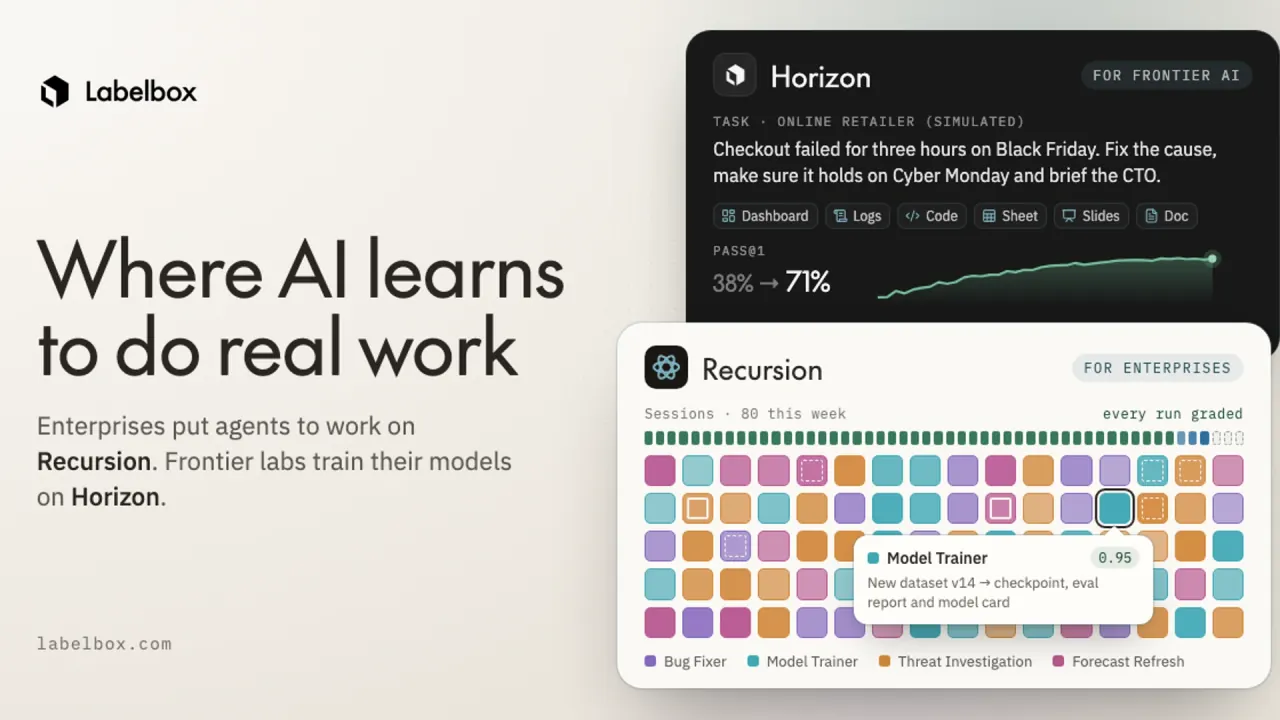

Labelbox builds the reinforcement-learning environments frontier labs train models in and the managed AI agents enterprises hand recurring work to, alongside expert data, robotics data and model evaluation services.
Used this tool? Rate it
Used this tool? Rate it


One workspace for every AI model


Chat Your Way to a Finished Video


Plan, build, and refine work with an AI agent


AI image editing from a reference photo


Multi-model image studio, free to start


Natural AI photo editing for portraits and projects


AI assistant for writing, analysis and tasks


From a prompt to a deck, site or doc
Labelbox builds the environments frontier labs train AI on, and the managed AI agents engineering and research teams hand their backlog to. It began in 2018 as a platform for AI training data, turning expert judgment into datasets machine-learning teams could train on; the site now splits the offering by audience, "For enterprises" pointing to Recursion and "For frontier AI" to Horizon.
The company describes itself as a technology company, founded in 2018 and profitable, headquartered in San Francisco, with $189M raised to date. In its Series E announcement it said it raised more than $100 million in equity and a credit facility at a $1.25 billion pre-money valuation, led by Infinitum Partners with Wipro Ventures, a16z, B Capital, Tau Ventures and Snowpoint Ventures. The same announcement reports 250+ customers building with Labelbox.
Labelbox presents its history as three chapters: data, environments and agents — the software teams used for data annotation, Horizon's RL environments and evals, and Recursion Managed Agents, which start on their own and are graded on every run. That is the company's narrative, not an outside classification.
Recursion Managed Agents puts AI agents to work inside the apps a business already uses: Salesforce, Zendesk, NetSuite, Slack, Jira and 100+ more. Agents start on schedules, events and API calls and work all 168 hours of the week, many sessions at once. A coordinator plans the job and spawns specialists in parallel, and bigger jobs get more agents rather than longer prompts. Work arrives where the team already works: a pull request, a results table or a Slack thread with the evidence attached.
Horizon supplies RL training gyms and evals for reasoning, tool use and computer use. WorldSim recreates the enterprise environments agents work in, from GitLab and Jira to CRM, email and chat, filled with realistic business data, so a model can work a task end to end while verifiers score each trajectory. Two signals are separated: deterministic checks that score every trajectory the same way, and expert preference that teaches taste when two answers are both correct.
Terra is the data engine for robotics: egocentric and teleoperated demonstrations captured on purpose-built rigs, annotated and validated by an AI diversity engine, and delivered from pre-training through evals. Every rig writes the same episode format, so pre-training data, post-training demonstrations and evaluation episodes share one shape.
Alignerr captures expert human judgment across 200+ knowledge domains, 40+ countries and 4M+ contributors, including 50K+ PhDs and 85K+ licensed professionals, and delivers it as structured signal. Tasks route to contributors whose credentials match the domain; outputs are graded and validated before entering a customer pipeline as preference pairs, ranked trajectories or rubric-graded assessments.
Labelbox turns rubrics into real-time, automated reward signals, positioned for finance, law, science and other domains where correctness is multidimensional rather than binary. Experts define quality while a review team scales it, dashboards show where models fail, and weights, prompts and data are revised between runs.
The Recursion page summarises credential handling as "Real access to your systems. Never the keys." Credentials stay in a vault, Recursion attaches each one to an approved call so the model never sees it, and every tool call is recorded in the session transcript. Merges and deploys can require an approval, and permissions are set per tool.
The published use cases centre on frontier model evaluation, RL environments, robotics data and recurring engineering or research work.
The company states that over 90% of leading US AI labs post-train and evaluate on Labelbox. A published customer story covers work with Meta: Labelbox produced the data foundation for a benchmark called GIM, with 820 expert-authored problems across seven cognitive categories, including 229 multimodal items and 528 rubric-graded prompts, supporting a 2PL IRT model calibrated over more than 200,000 prompt-response pairs. GIM-615, the resulting benchmark, evaluated 22 models across 47 reporting configurations. These are the participants' and company's accounts of a customer programme.
The Recursion job catalogue spans software engineering, reliability and infrastructure, security engineering, ML research, evals, R&D, product, finance, sales, strategy and procurement. Named examples include a Feature Builder, a Bug Fixer that reproduces a bug and writes the fix with a regression test, a Dependency Upgrader, a Flaky Test Fixer, an Eval Regression Watch, a Benchmark Runner and a Data Quality Audit.
The pages checked present no self-serve plan, published price or individual tier; entry points are "Get started", "Contact us", "Bring us a job" and a meeting-scheduling form. Someone labelling a first small dataset, or needing a consumer app, will not find a matching path: the agent jobs described assume codebases, CI, incidents, data pipelines or eval suites.
Labelbox is a hosted platform reached through connected apps, an API, a web app and an iPhone or iPad app.
| Surface | What the site states |
|---|---|
| Business apps | Salesforce, Zendesk, NetSuite, Slack, Jira and 100+ more, per the Recursion page |
| Developer and data tools | GitHub, Datadog, Databricks, Snowflake, BigQuery, Google Cloud, Sentry, PagerDuty, Okta, DocuSign and Notion appear across the job catalogue |
| MCP servers | An agent can be pointed at any MCP server, internal or third party, with the same per-tool permissions |
| Browser tasks | An agent that needs a browser gets its own to sign in, search, fill in forms and download files |
| Mobile | An iPhone or iPad app shows every session on one board, with Home Screen and Lock Screen widgets |
Sessions run in isolated sandboxes rather than on customer machines, and Recursion reports each run through a session transcript. For data, the security page states that Labelbox uses Google Cloud for cloud storage and that assets can instead be hosted by the customer on its own cloud platform, through signed URLs or delegated access.
A dedicated pricing URL returned HTTP 404, and every page checked routes buyers to a sales conversation instead of a checkout. The sales page leads to a contact form, and its confirmation text tells visitors a team member will reach out by email to discuss how Labelbox can help.
| Cost question | What the official pages state |
|---|---|
| Is a price list or tier table published? | No price list, tier table or rate appears on the pages checked this round. |
| How is a plan bought? | Through a sales conversation; the sales page asks visitors to fill in details to schedule a meeting. |
| Is billing per seat, per task or per agent session? | Not stated on the pages checked. |
| What does a free tier or trial include? | Not stated on the pages checked. |
| Are compute and model costs included? | Not stated on the pages checked. |
| Is there a self-serve checkout? | Not on the pages checked; the calls to action are "Get started", "Contact us" and "Bring us a job". |
Because nothing is published, the questions that decide budget — what a free tier includes, how overages are treated, whether pricing follows seats, tasks or agent sessions — cannot be answered from official pages in this round. Third-party directories describe a free tier and usage-based units, but those figures are not confirmed by the vendor and are not treated as product facts here. This states what the checked pages disclose, not that no price exists.
Buyers comparing Labelbox arrive from three directions: an annotation or data-curation platform, an RL-environment and evaluation vendor, or an open-source tool a team runs itself.
The divide is scope rather than feature count: Labelbox sells environments, expert data and agents together; the alternatives specialise in one layer or in software a team runs itself.
The limits grounded in official pages concern access, hosting and how far agent autonomy reaches.
The pages checked do not state a data retention period, a model-training use policy for customer data, a refund or cancellation window, or a free-tier quota. All labeled data, metadata and private user information hosted by Labelbox are encrypted at rest using AES-256. Data is encrypted with TLSv1.2+ in transit, and Labelbox does not sell customer or end-user personal data. Where a policy is not stated, this round does not infer one.
Three things, presented as chapters: data (software and expert networks that capture judgment as AI training data), environments (Horizon RL environments and evals, with WorldSim simulated apps) and agents (Recursion Managed Agents, graded on every run). The site foregrounds Recursion for enterprises and Horizon for frontier AI labs.
No price list, tier table or rate is shown on the pages checked this round. A dedicated pricing URL returned HTTP 404, and the sales page asks visitors to fill in details to schedule a meeting; any specific number would have to come from a quote.
The Recursion page states "Real access to your systems. Never the keys." Each session runs in an isolated sandbox with only the tools and credentials granted to it, credentials stay in a vault with a short-lived token attached to an approved call, the model never sees them, and every tool call is recorded in the session transcript. Merges and deploys can require an approval.
The homepage lists SOC 2 Type II, GDPR, CCPA, NIST 800-171 and PCI DSS. The security page says the programme is rooted in Privacy by Design and informed by SOC 2, ISO 27001 and GDPR. These are vendor statements on the checked pages.
The Recursion page describes checking on agents from an iPhone or iPad, with widgets on the Home Screen and Lock Screen. No desktop client is described on the pages checked; the platform is otherwise reached through a web app, an API and connected apps.
Not from the pages checked. Entry points are "Get started", "Contact us", "Bring us a job" and a meeting-scheduling form, and no self-serve plan or published price appears. The agent jobs described assume existing repositories, CI and data systems.