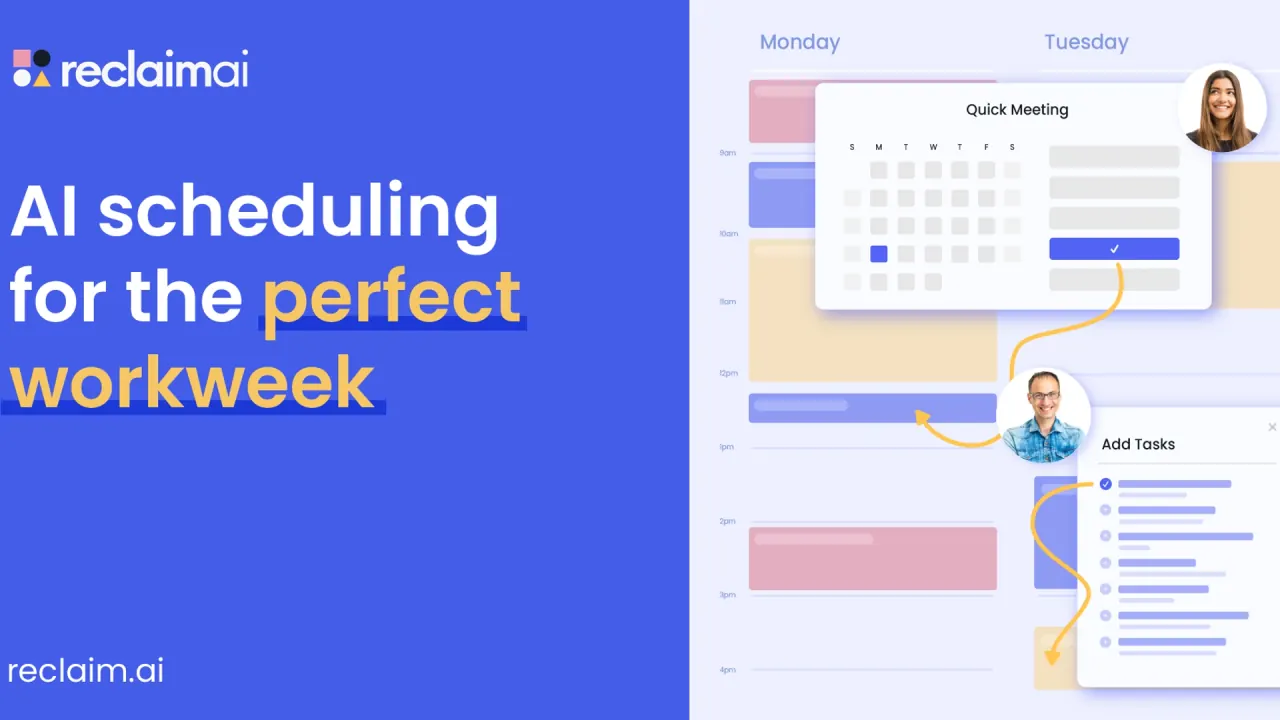

Reclaim is an AI calendar assistant for Google Calendar and Outlook that auto-schedules focus time, habits, tasks, breaks and recurring meetings, with team plans for scheduling links, analytics and shared out-of-office calendars.
Used this tool? Rate it
Used this tool? Rate it
Reclaim (also written Reclaim.ai) is an AI calendar assistant that works alongside your existing calendar provider instead of replacing it. Reclaim runs on your Google Calendar or Outlook Calendar account and automatically schedules meetings, focus time, tasks and habits around the events already there. Blocks for deep work, routines, breaks and tasks are treated as flexible time that moves as meetings arrive.
The company describes its product as AI agents that schedule work, meetings and life, and says it is trusted by more than 600,000 users across 70,000 companies; that figure is the vendor's own claim, not an audited count. Reclaim.ai is now part of Dropbox. Independent technology press reported the acquisition in August 2024 and noted that Reclaim.ai was founded in 2019 by Henry Shapiro and Patrick Lightbody and planned to keep developing the product under its new owner.
The current generation, Reclaim 2.0, adds an in-app AI Assistant, a Planner with a Preview Mode sandbox and configurable agents.
The AI Assistant is a chat panel that highlights what needs attention, such as conflicts, overloaded days or missing focus time, and suggests what to do next. Preview Mode is a staging area for the calendar: changes are made and reviewed there before anything is applied to your live Google or Outlook calendar, and attendees are not notified until you apply them. This split shapes how much control you keep. Agents can automatically manage flexible time like Habits, Focus blocks and Buffers based on your rules, while changes made through the AI Assistant or MCP integrations are first staged in Preview Mode for review.
Scheduling Links work like booking pages with priority settings: a high-priority link can show lower-priority smart events as available. You can add up to 3 meeting length options to a Scheduling Link, and team plans add round-robin links that schedule meetings on a rotating basis across a team. Calendar Sync copies events between Google and Outlook calendars so one schedule blocks the others; each sync policy controls how much detail appears, down to a "Busy for All" setting that shows only "Busy" with no details.
Business and Enterprise add a Team OOO Calendar that automatically syncs employees' PTO and out-of-office events to a team calendar, plus Delegated Access. Enterprise adds SSO and SCIM user provisioning. Time analytics range from personal stats to workforce analytics dashboards that track meeting load, focus time and fragmented time across departments.
An agent can fail to place time when there is no free slot within its allowed hours, the scheduling window is too restrictive, the minimum duration cannot fit, higher-priority events fill the calendar, or the agent is disabled. Expanding Hours, widening move windows, or lowering minimum durations can help.
Reclaim describes itself as especially useful when a calendar is dynamic or overloaded, so manual time blocking keeps breaking.
It fits poorly for people who plan mainly on a phone or use a calendar other than Google or Outlook.
Reclaim prices paid plans per seat per month. As captured on October 6, 2026, the pricing page showed:
| Plan | Yearly billing | Monthly billing | Team size | Scheduling range | Connected calendars | Scheduling Links |
|---|---|---|---|---|---|---|
| Lite | Free | Free | 1 user | 1 week | 2 | 1 |
| Starter | $10 per seat/month | $12 per seat/month | Up to 10 seats | 8 weeks | Unlimited | 3 |
| Business | $15 per seat/month | $18 per seat/month | Up to 100 seats | 12 weeks | Unlimited | Unlimited |
| Enterprise | $22 per seat/month | Unavailable on monthly plans | Over 100 seats | 12 weeks | Unlimited | Unlimited |
The scheduling range is how far ahead agents optimize and excludes Scheduling Links. Lite includes Google Tasks, Slack, Zoom, and Google Meet support, while Todoist, Asana, ClickUp, Jira and Linear require a paid plan. Business adds webhooks, the Team OOO Calendar and Delegated Access.
Every new account gets a free 14-day trial of the Business plan and then rolls into Lite unless it upgrades. If your setup exceeds Lite limits at that point, the account moves into a free overage period for 28 days before you must disable extra events or upgrade. On October 6, 2026 a site banner advertised "Save 30% today-only on Starter & Business plans (special new user offer)".
Standing discounts are 50% for 12 months for students, educators, and faculty, 20% for 3 years for qualified nonprofits and startups, and a switching discount of 20% off any plan for 6 months, or 12 months for a team of 10 or more, for people moving from tools like Calendly, Clockwise or Motion.
Paid fees are non-refundable, with one exception: if you cancel an annual subscription within 30 days of its start, you can request a pro-rata refund equal to eleven months of the fee, less transaction fees or taxes.
The most common comparisons are other auto-scheduling and daily-planning tools. One former rival is gone: Reclaim's help center says Clockwise officially shut down and ended services on March 27, 2026, and Reclaim offers Clockwise users a data import and a one-year price match on individual and team subscriptions.
Against this group, Reclaim's free Lite plan contrasts with the trial-based access the three pricing pages describe, while Reclaim lacks the native phone apps all three list.
Yes. The Lite plan is free forever for a single user, with a one-week scheduling range, two connected calendars and one Scheduling Link. Paid plans start at $10 per seat/month on yearly billing.
No native iOS or Android app is offered; the web app can be added to a phone's home screen.
Its privacy policy says calendar data is not used to train large language or other generative AI models unless you separately consent or opt in.
Agents automatically move flexible time such as Focus blocks, Habits and Buffers within the rules you set. Changes proposed through the AI Assistant, Claude or ChatGPT are staged in Preview Mode until you apply them.
