
Promptchan is an adults-only AI generator from Ireland's VisionAI Labs that makes uncensored images, video and companion chat across eleven styles, metered in Gems, with an 18+ rule the site enforces by self-declaration alone.
Used this tool? Rate it
Used this tool? Rate it
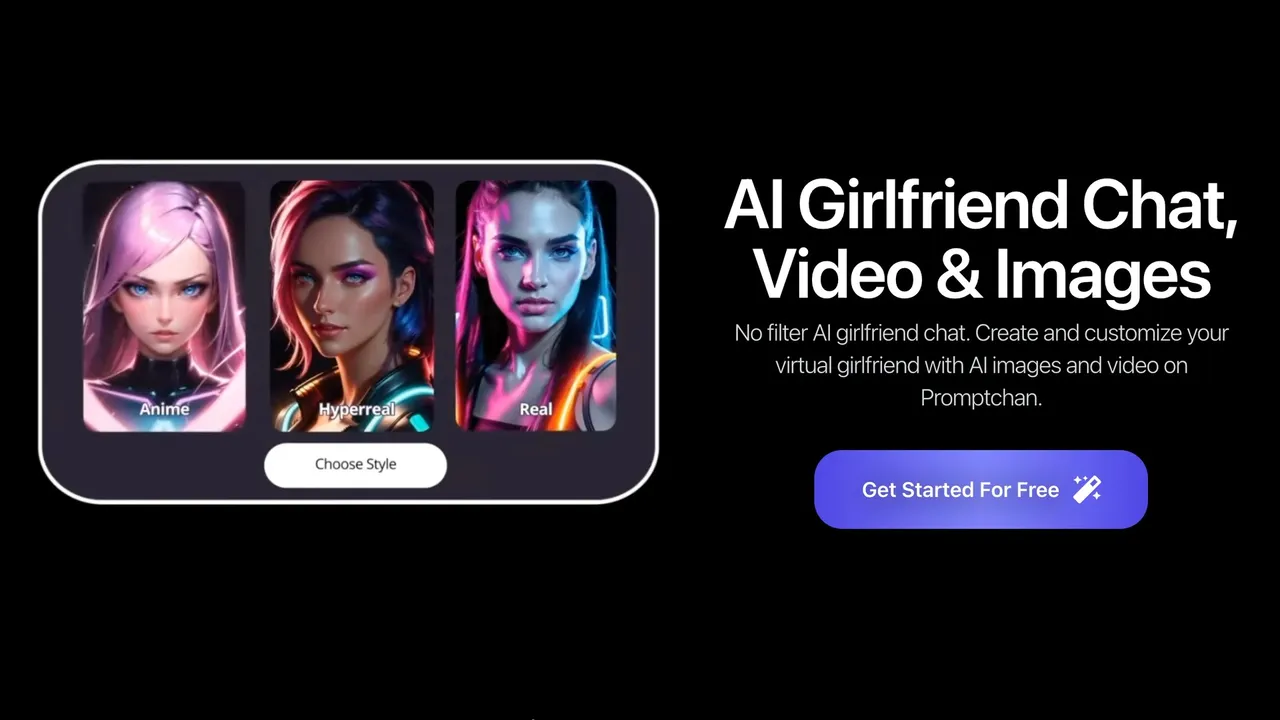
Promptchan is a browser-based generative AI service built around adult content. It produces still images and video from text prompts, runs character-based companion chat, and lets users clone and remix anything published in its community gallery. The homepage headline is AI Girlfriend Chat, Video and Images, and the subheading describes it as no filter AI girlfriend chat.
This page documents what the service actually is, what it costs, what its own legal texts commit it to, and where verifiable facts diverge from the marketing. Because this is an adults-only product, the section on age assurance and content policy carries more weight than usual, and it is reported from first-hand observation rather than from the review blogs that dominate search results for this category.
The terms of service name the operator as VisionAI Labs Limited, with a registered address at The Black Church, St. Mary's Place, Dublin, Ireland. Disputes are governed by the law of the Republic of Ireland. That much is clear. Two related data points are less clear and are reported here without being reconciled. The App Store listing is published under a different name entirely, AI Research Group Limited, and the site offers no explanation of how the two entities relate. Separately, Trustpilot's business record lists the company's country as the United States, which does not match the Irish registered address in the terms. None of these are necessarily contradictory in a corporate-structure sense, but a prospective subscriber cannot resolve them from public information.
One further signal about self-positioning is worth recording plainly. The company's own affiliate guide sits at a URL that reads ai-porn-affiliate-program, which is the clearest statement of category the operator makes anywhere. The customer-facing copy uses gentler language than the company's own internal URL structure does.
Image generation is the product's centre. The style selector offers eleven options including Real, Hyperreal, Anime, Cinematic XL, K-Pop, Fur and Furtoon, plus one named simply Hardcore XL. That last name is not an interpretation; it is a literal menu entry, and it is a fair indication of the range the service is built to cover.
Output is organised across three quality tiers labelled Standard, High and Max, and across model versions the gallery labels as XL 2 and XL+ (for example Realism XL 2, Anime XL+, Hyperreal XL+). Community cards display which tier and model produced each image, which is unusually transparent and useful if you are trying to work out what settings produce the results you want before spending anything.
The terms state the service is built on open-source text-to-image diffusion models that the company has refined and optimised, referencing the CreativeML Open RAIL-M license. So this is a tuned deployment of open-weight diffusion models rather than a proprietary model trained from scratch, which is worth knowing when comparing output quality claims against competitors making the same kind of statement.
The service generates video as well as stills. Full-length AI videos, including an extend function, are restricted to the top Pro plan; lower tiers do not get them. If video is your reason for subscribing, that single fact determines which plan you need.
Alongside text-to-image there is AI video generation, character chat, one-click cloning of any public community creation into your own variation, and a private generating mode. The chat side lets you build a character with a defined appearance, personality and interests, or pick from characters published by other users. Voice calling inside chat is a Pro-tier feature and, like everything else, is metered.
The site claims more than 20 million images and videos generated by its community, a vendor-reported figure with no independent audit behind it. Cloning is the practical feature built on top of that volume: you can take any public creation and generate variations from it, which in practice means you can start from a prompt that already works rather than writing one from scratch.
This convenience has a licensing cost attached, covered in the limitations section below, and it is the single most important thing on this page for anyone planning to publish work made here.
Generation can be run in a private mode. This matters legally rather than merely cosmetically: the licence you grant over your content differs sharply between public and private mode, and the distinction is worth understanding before your first generation, not after.
The company also offers developer access, with an API guide and API documentation linked in the footer alongside a business contact address.
Adult image generation for personal use is the primary case and the one the product is unambiguously built for. The eleven styles cover photorealistic through to several animation and anthropomorphic treatments.
Companion and roleplay chat serves users who want an ongoing character interaction rather than one-off image output. Persistent characters with defined personalities, and voice calling at the top tier, are aimed at this.
Character design iteration is a legitimate use of the cloning feature: starting from a community image whose look is close to your target and iterating variations is faster than prompt engineering from zero.
Anime and stylised illustration is well served by the multiple anime-family engines, and this subset of output is not necessarily explicit.
Where it does not fit: anything involving real people. The terms prohibit depicting or impersonating celebrities, public figures or private individuals without consent, and separately prohibit non-consensual deepfake pornography outright. Commercial work is also a poor fit, both because the rights position is vague and because of the public-mode licence discussed below. Any workplace or shared-device context is obviously unsuitable, since the site serves explicit material on its landing page.
Suited to: adults who specifically want uncensored generative output and accept a credit-metered model; users who value style variety and the ability to clone and iterate on community work; and people who want companion chat and image generation in one place rather than across two subscriptions.
Not suited to: anyone under 18; anyone needing clear commercial rights, since the terms are vague on this point; anyone unwilling to grant a perpetual public-mode licence and unaware that private mode is the alternative; users in jurisdictions tightening age-assurance rules on adult services, where access may become inconsistent; and anyone wanting a mobile app experience, for reasons covered under platforms.
Promptchan runs as a web application, and the footer carries only Discord, Instagram and X links with no app download entries. There is an iOS app: Promptchan AI: Create, Chat, first released in November 2023, currently at version 10.0.0 as of July 2026, free to download, holding 4.17 stars from 822 ratings.
The pricing page advertises Web, iOS and Android, yet four plausible package names all return 404 on Google Play and the site footer carries no app download link at all. Treat the Android claim as unverified. Practically, the web application is the reference implementation and the one the marketing describes.
Prices here were verified directly from the pricing page and are stated in US dollars.
Paid plans run at USD 14.99 a month for Plus with 100 Gems, USD 23.99 for Premium with 400 Gems, and USD 33.99 for Pro with 800 Gems, above a free tier that grants a daily Gem allowance. The free tier includes image creation, AI chat, and browsing and cloning the community gallery.
Plus adds priority access, High quality and basic styles. Premium adds more styles and features. Pro adds full-length AI video with extend, custom characters, voice calling in chat, Max quality and the complete style library. All paid tiers get 50 percent off additional Gem purchases.
On the word "unlimited". The word doing the work in Pro's unlimited casual generations is casual: it covers the lowest quality tier only, while High and Max output still spends Gems, and even a voice message costs one Gem with a voice call costing two. Read Pro as a large allowance plus uncapped low-quality generation, not as unmetered access.
On the word "uncensored". The pricing page describes the product as uncensored AI image generation in plain words, while the homepage softens the same capability to no filter. Both phrasings are current and on the same site; this page reports both rather than choosing one.
Refunds. Refunds are available within 30 days of purchase, but only for subscribers who have not made significant use of the AI services in that window, and you must cancel the subscription first to qualify. Annual plans get the same 30-day window measured from each charge including the automatic renewal, annual Gems are credited monthly and remaining credits stop when a refund issues, and cryptocurrency payments are final and non-refundable. Requests are reviewed individually and processed within seven business days.
Note also that crypto and G2A payments run as fixed-period subscriptions rather than recurring ones, and the checkout page labels which methods auto-renew. Promotional pricing appears from time to time and is shown at checkout, so the list prices above are ceilings rather than guarantees.
Comparable services in this category include Candy.ai and Nastia on the companion-chat side, SeaArt and Civitai for open-model image generation with more community model choice, and self-hosted Stable Diffusion deployments through interfaces such as AUTOMATIC1111 or ComfyUI for users who want full control and no third-party licence over their outputs. The self-hosted route eliminates both the metering and the content-licensing questions entirely, at the cost of requiring your own GPU and setup effort.
Promptchan's advantages against this field are breadth of built-in styles, the combination of image, video and chat in one subscription, and the clone-from-community workflow. Its disadvantages are the licensing terms in public mode, the vagueness on commercial rights, and the absence of any independent verification of its claims.
The public-mode content licence is the most important term in the product. Anything you make in public mode carries a perpetual, irrevocable, transferable licence to the company and, separately, a worldwide licence for every other user to reproduce it and build derivative works from it. You retain copyright, but you have licensed it broadly and permanently. Private and offline mode is the carve-out: there the company states it asserts no rights and you remain sole owner. Anyone who cares about exclusivity must use private mode from the start, because the licence attaches at generation time.
Commercial rights are not clearly stated. The site's own FAQ answers the commercial-use question with "in many cases, yes" and refers users to the terms, which do not resolve it cleanly either. For any revenue-generating use, treat the position as unsettled.
Third-party ratings are positive but need caveats. On Trustpilot the service holds 4.3 out of 5 across 207 reviews, with 68 percent at five stars and 8 percent at one star, on an unclaimed profile that Trustpilot flags as having no history of asking for reviews. That last point normally removes a bias concern, but here it needs qualifying: 205 of those 207 reviews landed in the last twelve months, most are one-line praise from accounts with a single review to their name, and one reviewer wrote plainly that they were asked to write it. Trustpilot's no-solicitation flag covers only its own channel. The score is real but the sample is not the independent cross-section it first appears to be.
The one substantive critical review carries a conflict. The only detailed negative review describes crashes and bugs, unresponsive support, deleted complaints and a subscription that cannot be used as sold — but it also promotes a named competitor, which is a recognised pattern for planted reviews. It is recorded here with that conflict disclosed rather than being treated as clean evidence either way.
No independent press coverage exists. No first-tier technology publication has independently reviewed or investigated Promptchan. English-language coverage of this product consists almost entirely of affiliate-monetised review blogs, which are excluded here as evidence. The absence of independent scrutiny is itself a fact worth weighing.
Platform claims are partly unverified, as covered above regarding Android.
Vendor statistics are self-reported. The 20 million community generations figure has no external verification.
This section is the reason this page exists in its current form, and it is reported strictly from what was observed and what the documents say.
The stated rule. The stated minimum age is 18, and the terms frame it purely as something you represent and warrant rather than something the service checks. The privacy policy repeats that the services are not intended for anyone under 18 and that the company does not knowingly collect their data.
What actually happens. Visiting the homepage without an account returned explicit thumbnails and explicit prompt text immediately, with no age gate, no interstitial and no confirmation step, and a raw HTML search of both the homepage and the explore page found no age-verification markers at all. Two independent methods, rendered browsing and raw source inspection, agreed. So the 18+ rule is a contractual assertion, not an access control.
Why that matters right now. In November 2025 Ofcom fined Itai Tech Ltd, operator of Undress.cc, a total of GBP 55,000 for failing to put highly effective age assurance in place under the Online Safety Act, and the regulator explicitly rejected self-declaration and payment card checks as acceptable methods. Accepted methods named by the regulator include photo ID matching, facial age estimation, mobile network checks and open banking. Promptchan was not the subject of that action and no regulatory proceeding naming Promptchan was found. The comparison is offered as regulatory context and as the standard now being applied to this category, not as a legal conclusion about this service. Users in the UK and in other jurisdictions tightening these rules should expect access conditions in this category to change.
What the content rules prohibit. The terms prohibit AI-generated child sexual abuse material and non-consensual deepfake pornography outright, state that strict safety measures block attempts to produce it, and declare that all characters depicted are intended to be over the age of 18. The prohibited list also covers content involving minors or high-school settings, incest whether real or fictional, bestiality, scat, extreme or graphic violence, and any depiction or impersonation of celebrities, public figures or private individuals without consent.
How moderation is described. The policy states that AI systems scan prompts, outputs and uploads at the point of creation or submission, that trained moderators review flagged and site-wide content, that generation may be blocked preventively before delivery, and that every posted item carries a report option. The company aims to respond to valid requests within 48 hours and refers matters to law enforcement where appropriate.
A documented gap. The moderation policy contains no statement about verifying the age of users, nor about verifying the age of persons depicted. The claim that characters are "intended to be over the age of 18" is a statement of intent in the disclaimer, not a described verification process. This page notes the gap rather than filling it.
Privacy documentation is stale and incomplete. The privacy policy was last updated in June 2024, roughly two years before the current terms, and it says nothing at all about whether prompts or images train the models, nor about international data transfers. Prompt collection is described as applying to public mode. Users are told they can request access, correction, erasure and objection. On the training question specifically, the company has not made a statement either way, and this page does not supply one on its behalf.
On the App Store rating. Apple rates it 17+, but the advisories behind that rating list only mild categories such as infrequent mature or suggestive themes, with no sexual content advisory at all, and the store description drops the words the website leads with. In other words, the version of this product that passed platform review is presented very differently from the website. An app store age rating is normally useful independent evidence of content level; in this case it describes something milder than what the web service openly advertises, so it should not be read as a platform endorsement of the website's content.
There is a free tier that costs nothing and includes a daily allowance of Gems, image creation, AI chat, and browsing and cloning the community gallery. It is a genuine free tier rather than a time-limited trial, but it is capped daily and excludes the higher quality tiers, the full style library, video and custom characters. Most output that users describe as the product's strength sits behind a paid plan.
Plus is USD 14.99 per month with 100 Gems, Premium is USD 23.99 with 400 Gems, and Pro is USD 33.99 with 800 Gems. All paid tiers receive 50 percent off additional Gem purchases. The company notes that promotional pricing appears from time to time and is shown at checkout, so verify the amount on the payment screen before confirming.
No. Pro provides "unlimited casual generations", where casual denotes the lowest quality tier. High and Max quality output still consumes Gems from the 800-Gem monthly allowance, and some actions have separate costs, with a voice message at one Gem and a voice call at two. Pro is best understood as a large allowance plus uncapped low-quality generation.
Not through any mechanism observable from the public site. The terms require you to be at least 18 and to represent and warrant that you are, but visiting the homepage without an account produced explicit content immediately with no age gate, no interstitial and no confirmation step, and an inspection of the raw page source found no age-verification markers. The 18+ requirement is enforced as a contractual statement rather than as a technical control.
You retain copyright either way, but the licence differs by mode. In public mode you grant the company a perpetual, irrevocable, transferable, royalty-free worldwide licence, and you separately grant every other user a licence to reproduce your content and create derivative works from it. In private or offline mode the company states it asserts no rights and you remain sole owner. Choose the mode before generating, because the licence attaches at that point.
The position is unclear and you should treat it as unsettled. The site's FAQ says "in many cases, yes" and directs users to the terms, which do not give a clean answer. Combined with the public-mode licence granting other users derivative rights, anyone planning commercial use should generate in private mode at minimum and seek written confirmation from the company.
Within 30 days of purchase, but only if you have not made significant use of the AI services during that period, and only after cancelling the subscription first. Annual plans use the same 30-day window measured from each charge including automatic renewals. Cryptocurrency payments are final and non-refundable. Requests are reviewed case by case and processed within seven business days to the original payment method.
There is an iOS app, Promptchan AI: Create, Chat, free to download, rated 4.17 from 822 ratings and rated 17+ by Apple. The pricing page also claims Android availability, but no Google Play listing was found under four plausible package names and the site footer carries no app download links. Note also that the App Store listing is published by AI Research Group Limited rather than by VisionAI Labs Limited, the entity named in the terms.
The terms prohibit AI-generated child sexual abuse material and non-consensual deepfake pornography, content involving minors or high-school settings, incest whether real or fictional, bestiality, scat and bodily waste, extreme or graphic violence, and any depiction or impersonation of celebrities, public figures or private individuals without consent. The company states it applies automated scanning at generation time plus human moderator review, and refers matters to law enforcement where appropriate.
Read them with context. The Trustpilot score is 4.3 out of 5 from 207 reviews on an unclaimed profile with no solicitation history recorded by the platform, which is a genuinely positive signal. However, 205 of the 207 arrived within twelve months, most are single-sentence praise from accounts with one review, and one reviewer stated they were asked to write it, so off-platform solicitation cannot be ruled out. The iOS rating of 4.17 from 822 ratings is a larger and more stable sample. No independent technology publication has reviewed the service, so no editorial assessment exists to weigh against these numbers.
