
Toolso.AI
Toolso.AI
All ToolsCategoriesTrendingLatest ToolsPricingBlog
Toolso.AI
Toolso.AI
Toolso.AI
Toolso.AI

Discover the best AI tools to boost your productivity

GitHubGitHubTwitterX (Twitter)YouTubeYouTubeTikTokEmail

Popular Categories

  • AI Writing
  • AI Image
  • AI Video
  • AI Coding
  • More Categories

Explore

  • Latest Tools
  • Popular Tools
  • More Tools
  • Submit Tool
  • Pricing

About

  • About Us
  • Contact
  • Blog
  • Changelog

Legal

  • Cookie Policy
  • Privacy Policy
  • Terms of Service
  • Refund Policy
© 2026 Toolso.AI All Rights Reserved
Limited timeLimited-time offerFeatured Listing24h priority review · No backlink · 30 days featured$29.90then $59.90Price rises to $59.90 after Oct 31Ends in--:--:--Submit now
  1. Home
  2. All Tools
  3. Data Analysis
  4. Julius AI
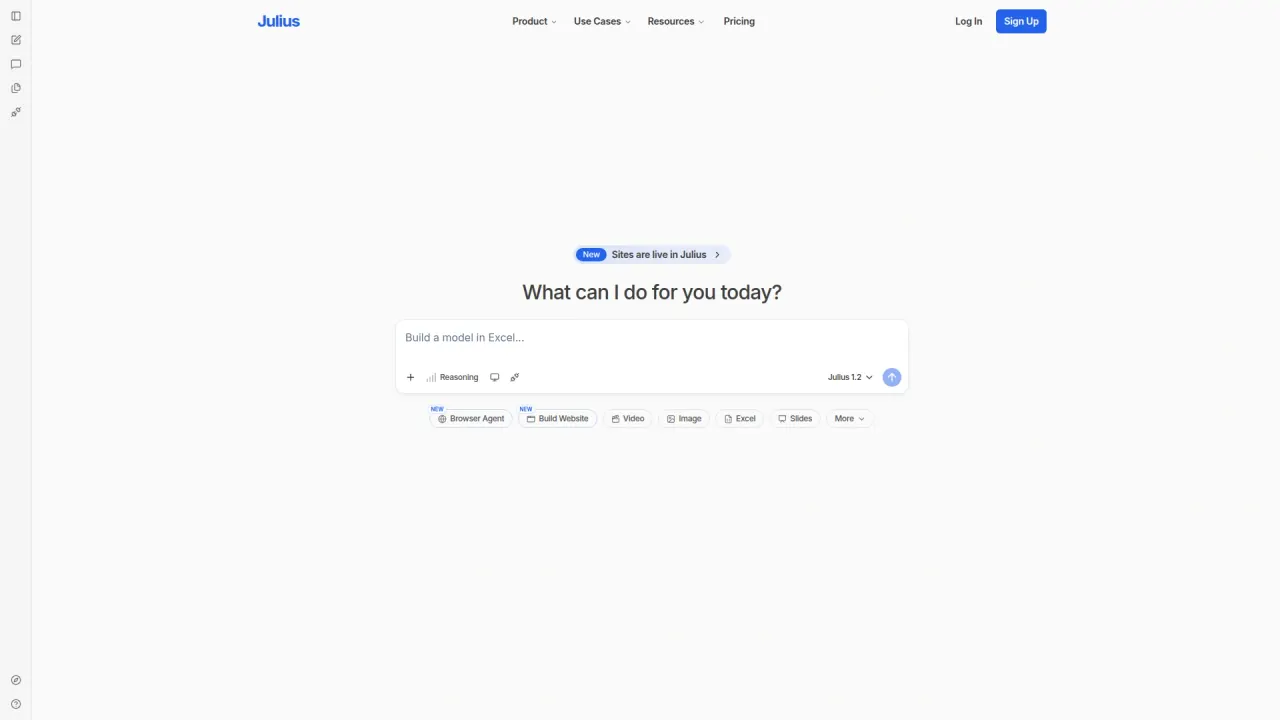
Julius AI interface preview
Julius AI logo

Julius AI

Julius AI analyzes spreadsheets, documents and connected databases through chat by writing and running code, then turns the results into charts, presentations, reports, websites, images or video on a credit-based plan.

Data AnalysisResearchPresentation#Research Assistant#Spreadsheet#Data Visualization
View Pricing
Saves
Visits
Views
Pricing
Paid
Published
Oct 6, 2026
Domain
julius.ai
Community rating

Used this tool? Rate it

Rate this tool

Julius AI Product Information

View Pricing
Tool Information
Saves
Visits
Views
Pricing
Paid
Published
Oct 6, 2026
Domain
julius.ai
Community rating

Used this tool? Rate it

Rate this tool

Featured Tools

Related Tools

View Pricing

What is Julius AI?

Julius AI is a browser-based AI workspace that analyzes uploaded files and connected databases through chat, then turns the results into charts, presentations, reports, dashboards, websites, images and video. The homepage now describes one workspace where you research complex topics, analyze data, and create presentations, dashboards, websites, images, and video.

That broad pitch sits on top of a narrower original identity that is still published. The help center FAQ defines Julius as an AI assistant designed for statistical analysis, data science, and computations that picks among several large language models and writes code to analyze your data based on your prompt. Independent tech press coverage from July 2025 also described a startup that calls itself an AI data analyst, reporting a $10 million seed round led by Bessemer Venture Partners. In the same report, the company said it had more than 2 million users and had generated more than 10 million visualizations; those figures are company-reported, not independently audited.

The Terms of Service name Caesar Labs Inc. as the contracting company behind Julius AI.

Core features

Julius answers data questions by generating and running code in a sandbox, so outputs can include tables, statistics and charts rather than prose alone. The same chat thread then carries those results into finished deliverables, and every action costs credits, whether it is a regression, a slide deck or a video clip.

Data analysis and file handling

  • Analysis in chat: every plan includes exploring files, running analyses, visualizing results and getting answers with citations.
  • Supported uploads: data files include CSV, Excel, JSON, Parquet, Feather, SQLite and SPSS, alongside PDFs, images, and code files such as Python, R, SQL and Jupyter notebooks.
  • Reasoning mode: a Reasoning toggle has Julius think through complex, multi-step tasks before answering, with a choice of how much reasoning effort to apply.

Databases and connectors

Julius natively supports Snowflake, BigQuery, MySQL, PostgreSQL and SQL Server, and also connects to Google Drive, OneDrive and SharePoint. For large warehouses, Julius builds a semantic layer of your schema as you query, so it only selects tables relevant to the question instead of scanning thousands at once.

Deliverables beyond analysis

  • AI presentation maker: decks can start from prompts, documents, research, or data, and can be refined, published, or exported to PowerPoint, PDF, HTML, or Google Slides.
  • Websites and web apps: a prompt produces a site that you refine in chat and publish to a shareable link without writing code.
  • Images and video: Julius creates original images for campaigns, products and presentations, and generates video from text or images that can be refined in the same workspace.
  • Live Browser: Julius can open and control a real web browser to interact with pages on your behalf.

Custom instructions and skills

Persona or workflow guidance now lives in Custom Instructions, or in a reusable Skill file (.md) that Julius builds on request and that can be applied across conversations. This replaces the older Custom Agents feature, whose status is covered under Limitations.

Guide

Starting an analysis from a file

  1. Open the Chat page and attach a file with the paperclip icon; supported formats include CSV, Excel, PDF, JSON and images.
  2. Ask in plain language, for example "Summarize this dataset," "Create a scatter plot," or "Run a one-way ANOVA." Julius returns insights, visualizations and the code it used.
  3. For a workbook with several sheets, mention tab names in your prompt and Julius analyzes those tabs specifically.
  4. Pick the model deliberately: faster models such as Julius 1.2 Lite consume credits far more slowly than frontier models, so lighter models stretch the allowance on simple tasks.

Linking a Google Sheet

  1. In Google Sheets, click Share and set "Anyone with the link" to Viewer.
  2. In Julius, click the paperclip and choose Google Sheet.
  3. Paste the sheet or Drive URL and click Submit.

This route depends on link-level sharing of the sheet, which differs from the warehouse connectors described above.

When a task stalls

If a task keeps failing, the documented fix is to create a new task, which resets the accumulated context and can resolve most performance or functionality issues. The FAQ also notes that the AI sometimes "hallucinates" by looping without producing output; rewording the prompt with more detail or starting a fresh thread is the suggested recovery.

Julius AI use cases and examples

Published examples range from a required business school course to campaign changes inside an ad account.

  • Teaching data science: a Harvard Business School professor asked the founder to adapt Julius specifically for the school's new required course, Data Science and AI for Leaders.
  • Cross-dataset business questions: a reported example prompt asks Julius to visualize how revenue and net income correlate for different industries in China versus the US.
  • Recurring reports and dashboards: Julius builds shareable reports and dashboards from data and research, and the Business plan includes unlimited scheduled report runs.
  • Advertising operations: a Google Ads connector with write access lets Julius create and modify items in a connected Google Ads account, which goes beyond read-only reporting.

Who is it for

  • Non-programmers who need statistics: the stated goal is an intuitive way to analyze and visualize data without having to code, making statistical analysis accessible to everyone.
  • Small teams testing fit: the Business tier is meant for younger companies, smaller teams, or larger teams that want to self-serve test whether Julius fits; Enterprise targets organizations bringing on multiple internal teams or needing SSO, audit logging and fine-grained RBAC.
  • Collaborating colleagues: Teams provides a shared workspace for sharing conversations.
  • Startups: Julius offers special pricing for qualifying startups on request.

Julius is a weaker fit for anyone under 18, because users must be 18 or older or at least the legally required age where they live. It is also a poor fit for decisions that rely on unverified output: the Terms disclaim the accuracy of Output and say not to rely on output that purports to give legal, medical or financial advice without independently confirming it.

Platforms

  • Web: the workspace runs in the browser, and the homepage opens directly into the task interface.
  • iPhone and iPad: the iOS app is listed as "Julius AI: Data & Math Helper" with Caesar Labs Inc. as seller.
  • iOS listing details: the app is free to download, rated 4+, and requires iOS 15.1 or later; the current version in the listing was released on May 30, 2025.
  • iOS ratings: the listing showed an average of 4.76 from 398 ratings as captured on October 6, 2026.
  • Android: this round's check did not find an active Google Play listing for the app.

The iOS listing still describes Julius as an AI-powered data analyst and math helper, and its description does not mention the newer website, video or presentation features.

Pricing

Julius AI pricing is credit-based: instead of counting messages, Julius now measures usage in credits, and every action costs credits depending on the task, the AI model and its complexity. The pricing page shows these monthly plans as captured on October 6, 2026.

PlanMonthly priceCreditsNotable inclusions
Free$0Free daily creditsJulius Lite models; Google Drive data connector
Plus$202,000 per month; 24,000 per yearGPT-5.6 and Claude Sonnet 5; 1 seat
Pro$455,000 per month; 60,000 per yearAll models, including Claude Fable 5; expanded context window; priority email support
Max$20025,000 per month; 300,000 per yearLarger context window; early access to unreleased features; permanent file storage
Business$45060,000 per month; 720,000 per yearUp to 50 team members; Postgres, BigQuery, Snowflake and more connectors
EnterpriseContact usUnlimitedListed in the comparison table, not as a plan card

A Yearly toggle labeled "SAVE -20%" sits above the cards, and each paid card also shows a lower per-month figure: $16 for Plus, $37 for Pro, $166 for Max and $375 for Business. Annual plans are billed once per year at a discounted rate, with all credits granted upfront. Prices are in U.S. dollars and exclude applicable sales and other taxes.

Every plan, including Free, can create presentations, websites and videos, but the Free plan runs on a daily credit allowance. The credits help page lists more tiers than the pricing cards, including Ultra at $500 with 70,000 credits and Growth tiers from $750 for 100,000 credits up to $5,000 for 850,000 credits.

Several numbers do not line up across official pages. The same credits page gives the Free plan 25 welcome bonus credits plus 25 daily credits in its table, but elsewhere says Free users receive a one-time grant of 100 credits at sign-up. It also says a Pro annual subscriber gets 50,000 credits on day one, which differs from the Pro yearly figure in the table above.

Buying extra credits or topping up a balance is not supported at the moment; the documented route to more usage is a plan upgrade. The company says fewer than 5% of users will exceed their monthly credit limits under normal usage.

Julius AI alternatives

Press coverage has noted that Julius offers functionality similar to ChatGPT, Anthropic's Claude and Google's Gemini, and Julius's own paid plans include GPT and Claude models. The practical comparison is therefore between Julius's data plumbing and the general assistants' built-in analysis tools.

  • ChatGPT data analysis: ChatGPT can analyze uploaded files, answer questions about the data, and create tables or charts. Its Python environment cannot make external web requests or API calls, so external data must be uploaded or connected first.
  • Claude file creation and analysis: code execution and file creation are available to all Claude users, including the Free plan, on the web, desktop and mobile apps, with a maximum of 30MB per file for uploads and downloads.

Julius's distinguishing pieces are the native warehouse connectors, the learned schema layer and scheduled report runs. For analysis of individual uploaded files, both general assistants offer code-based analysis of their own.

Limitations

Usage, storage and billing limits

  • Memory ceiling: there is no row or size limit enforced by Julius, but a practical limit comes from what fits into 32G of RAM on the sandbox; connecting a warehouse such as BigQuery is the stated route for large datasets.
  • File retention versus "permanent" storage: the Files help page says Free-tier files are deleted after up to 1 hour of inactivity and paid users' files remain available for up to 7 days of inactivity. The pricing page, however, lists "Permanent file storage" among Max additions and in its comparison table, and the two pages do not reconcile these terms.
  • Credits expire: unused credits expire at the end of each billing cycle and do not roll over; credits are non-refundable except where law requires and cannot be transferred between accounts.
  • Refunds: refunds are not automatic and are reviewed case by case after an email request.
  • Custom Agents: a help page states that Custom Agents are being sunset because the feature was not built in a way the team could keep maintaining, yet the Business card still advertises Unlimited Custom Agents.
  • Account closure: after an account is terminated or cancelled, its data cannot be recovered.
  • Disputes: the Terms contain a binding arbitration provision and a class action waiver.

Review signals

A third-party review platform's company-level profile for Julius showed a score of 1.8 from 20 reviews, with 80% of reviews at one star, as captured on October 6, 2026; the profile is unclaimed and the company has not invited reviews, so it may not be representative. That score measures the company across a small sample, while the 4.76 iOS figure measures the app among App Store raters; the two are not comparable or averageable.

Privacy, training and data rights

  • Model training: the privacy and security help page answers "Never" to whether Julius trains models on your data, adding that AI providers are contractually bound by this.
  • Policy wording: the Privacy Policy says it uses data to improve the Services and AI Function, provided it does not use your Personal Information to train its artificial intelligence models.
  • Terms wording: the Terms allow Julius to collect and use your Input and Output to maintain, improve, modify and develop the AI Features, while contractually restricting AI providers from training on user content. The Terms do not repeat the help page's blanket "never" wording.
  • Where data lives: all data is stored and processed in the United States, and staff access is limited to exceptional cases such as troubleshooting.
  • Isolation: each user can only access their own data in notebook storage, and Python execution environments are isolated per user.
  • Deletion: after you cancel and request deletion, information accessible to Julius is deleted within seven business days.
  • Sub-processors: listed service providers include Anthropic, PBC, Google LLC and OpenAI, L.L.C.
  • Ownership: you exclusively own the AI Content, meaning your inputs and the outputs returned to you.
  • Compliance: Julius states it is SOC 2 Type II compliant.
  • Operator name: the Privacy Policy names Julius AI Inc., while the Terms name Caesar Labs Inc.; the pages use different company names.

FAQ

Q1. Is Julius AI free to use?

Yes, there is a $0 Free plan with daily credits, Julius Lite models and limited presentations, websites, images and video. Heavier use requires a paid plan starting at $20 per month, because extra credits cannot be bought separately.

Q2. Does Julius AI train models on my uploaded data?

The privacy and security help page says your data is never used to train any models. The Privacy Policy says Personal Information is not used to train its models, while the Terms allow Input and Output to be used to improve and develop the AI Features. Those are the published statements; their wording is not identical.

Q3. Can Julius analyze a database without uploading files?

Yes. Julius connects natively to Snowflake, BigQuery, MySQL, PostgreSQL and SQL Server, and builds a semantic layer of large schemas so queries only touch relevant tables.

Q4. How long does Julius keep my files?

The Files help page says Free-tier files are deleted after up to 1 hour of inactivity and paid users' files remain for up to 7 days of inactivity, while the pricing page advertises permanent file storage on some plans.

Q5. Can I get a refund for unused credits?

Credits are non-refundable and expire at the end of each billing cycle. Subscription refunds are not automatic and are reviewed case by case on request.

Know a Similar Tool?
If you know other great AI tools, feel free to submit them to us