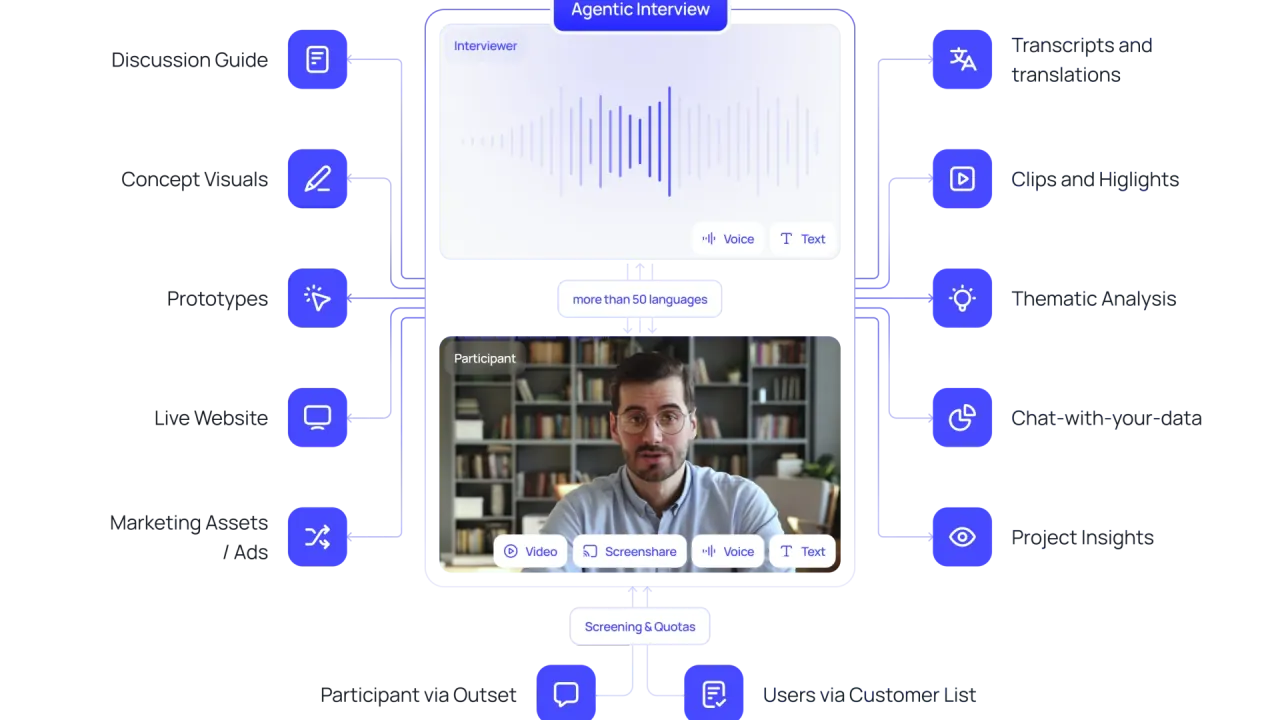

Run AI-moderated interviews, recruit participants, and analyze conversations in one research platform. Explore customer perspectives through human interviews and Digital Twins.
Used this tool? Rate it
Used this tool? Rate it
Outset is a customer research platform that combines context-aware AI-moderated interviews with simulated human data. It brings study design, participant recruitment, interviewing, and research synthesis into a connected research process.
The current product includes both interviews with people and Digital Twins grounded in individual humans. These are distinct sources of answers: a participant responds directly during an interview, whereas a twin generates a response from the information available about that person. Outset describes twin outputs as directional.
Outset conducts concurrent AI-moderated interviews through video, voice, or text, with a customizable moderator and dynamic follow-up questions. Researchers can shape the moderator around their research style.
Recruitment connects to 25+ panel integrations, including Prolific and User Interviews. Researchers can invite their own participant lists by sharing an interview link. These routes serve different sources of respondents: panel recruitment finds people through connected providers, while self-recruitment distributes the study to an audience the team already has.
Custom screeners support advanced logic for selecting the audience for a study. Outset says its fraud-detection agent observes sessions to detect fraudulent and low-quality answers. That is a vendor description of the screening mechanism, rather than an independently established guarantee that every completed interview is valid.
AI synthesis organizes interview data into themes, quotes, and patterns across multiple sessions. Analysis can be directed by the research goals supplied to Outset. This connects the synthesis to the question a study was designed to answer, while retaining interview material as part of the findings rather than reducing everything to a single generated summary.
Chat-With-Your-Data supports natural-language follow-up questions on synthesized themes, summaries, and quotes. A researcher can ask about onboarding comments or request quotations related to pricing concerns. These queries explore collected research; they are separate from asking a Digital Twin to generate a new response as a simulated participant.
Highlight reels combine video and transcript snippets associated with key themes into shareable narratives. Outset also generates top-line reports and PowerPoint decks for stakeholder sharing.
Researchers can upload MP3 or MP4 recordings for transcription, thematic analysis, executive summaries, and highlight reels.
A guide can be built from scratch or uploaded from an existing file. AI can also draft an interview guide from research goals, with qualitative and quantitative questions, probing guidelines, and skipping logic.
The documented setup exposes several separate decisions:
The guide settings also expose context for the AI interviewer. These are study-level controls, distinct from a subscription’s commercial allowance. The configurable interview limit is not a published number of included interviews. Voice-to-voice is marked beta in the documented modality options.
Outset supports monadic, comparative, and protomonadic concept tests; the last combines individual evaluation with a final head-to-head choice. A monadic test presents one concept in isolation. A comparative test puts concepts side by side to explore relative preference and tradeoffs. The combined format preserves an individual reaction before collecting the final comparison.
Concepts can be rated across multiple attributes, with AI probing the scores that need explanation. Feature bundles, tiers, and offer structures can be evaluated for perceived value and the reasons behind it.
Value proposition testing explores believability, differentiation, and the language used to express value. It focuses on the message itself, alongside the wider concept-testing options.
Live product task tests observe completion on live sites or apps, including hesitation, detours, failures, and explanations. Usability recordings synchronize participant reactions with their screens.
The supported stimuli include static images, video, Figma uploads, clickable prototypes, and live sites.
In an Outset-published customer case, Away conducted 75 interviews overnight with a one-person research team. The project examined changes in shopping behavior related to AI, and the case describes using the platform's synthesis to move from interview footage to takeaways. This is a named customer example of the workflow under time pressure. The result is a vendor-published case outcome, rather than a general completion-time promise for every audience or project. It does not establish a standard sample size or recruitment speed for other studies.
Outset positions its platform for consumer insights teams balancing strategic work with high research demand.
Custom branding adds a logo to the participant experience; interviewer white labeling is also offered. Those features support a branded research experience, including agency or enterprise presentation needs.
Outset's documented participant entry points include a shared interview link, desktop website or prototype tasks, and mobile-app testing.
MCP requires Outset authentication and authorization of accessible workspace data, with the same access permissions as the platform. The connection flow includes selecting which workspace data is available where applicable. The external AI tool is an authorized route into the organization’s research, with the login method following the organization’s Outset setup, including SSO where configured.
Official marketplace connectors currently work only with the US deployment; EU-hosted organizations use a Custom Connector and the EU endpoint.
Outset customizes a plan around the research team, research needs, and support needs. The public pricing route is a custom quote rather than a published per-seat or per-interview rate. No reproducible numeric subscription price, fixed included interview allowance, or standard team-seat count was found in the pricing material checked for this description.
Feature access varies by custom plan and add-ons. The pricing matrix names interviewing, synthesis, recruitment, security, sharing, and support capabilities, but a listed feature is not a universal entitlement. The access statement limits how the wider feature catalog can be read.
A standard subscription serves teams running studies independently; additional support models cover project setup, recruitment, and other research needs. This separates software access from the level of hands-on research assistance a team receives. The vendor frames the choice around the resources a team has to run studies end to end.
The public terms say subscriptions renew automatically unless cancelled through account management or customer support. They also say paid subscription fees are non-refundable except when required by law. These are the published subscription terms; they do not disclose the complete contents of a negotiated enterprise agreement. The public terms restrict access and use to individuals at least 18 years old.
The MCP connector does not expose every dashboard operation:
A Digital Twin represents one real person, is built from an AI-moderated interview, and can be enriched through follow-up interviews with that person. Twin answers carry high, medium, or low confidence scores, expose the human quotes that informed them, and are graded by the real person.
Outset describes Digital Twin answers as directional and validated against the real person behind them. They are not presented here as a population-level statistical guarantee, nor is a simulated response counted as a new interview with a recruited human participant.
Emotional Intelligence is off by default, must be enabled by the study organization, can be disabled per project, and does not analyze past recordings.
Emotional Intelligence captures about one webcam image frame every two seconds and analyzes the full video after the interview; it currently analyzes facial expressions rather than voice tone or speech patterns. The facial-expression feature does not identify or match faces, infer age/race/gender, or attempt to infer intentions, beliefs, or mental states beyond observable facial expressions. These are the product's stated processing boundaries, not a claim that an expression establishes what a participant privately thinks.
Google Gemini processes video and image frames for facial-expression analysis; structured emotion text summaries, without video or images, pass to OpenAI models for the interviewer and insights dashboard.
Files temporarily uploaded to Gemini are deleted after analysis, with Google auto-expiring uploads within 48 hours as backup; Outset retains full recordings until customer-requested deletion or the customer relationship ends. Temporary analysis-file deletion therefore has a different scope from retention of the complete interview recording in Outset.
Personal information processed for the research platform is governed by customer agreements in Outset’s processor role rather than the general website Privacy Policy, including enabled facial-expression analysis. That distinction limits what the general website policy alone establishes about a study's participant data.
Outset publicly promises never to train on customer data. It also says customer datastores are encrypted at rest, sensitive collections use row-level encryption, and data transmission uses TLS 1.3 or higher. These are vendor-published security commitments, rather than independently tested conclusions about the deployment used for a particular study.
The general Privacy Policy retains personal information as long as necessary for collection purposes and other explained business purposes. It describes requests for access, deletion, correction, objection, and restriction of processing. That general retention wording does not specify a fixed number of days for all personal information, and it is separate from the specific recording-retention disclosure for Emotional Intelligence.
The general Privacy Policy allows transfers from the EEA, UK, or Switzerland to non-adequate countries including the US using safeguards such as standard contractual clauses. This is a disclosed international-transfer mechanism, not a universal promise that all participant data remains in one geographic region.
