Use Toolso.AI's experience to choose launch languages, review translated product claims, verify localized URLs, and decide when to expand.
A multilingual AI tool launch can fail after the translation is finished. A landing page promises a free export, but the local interface only lets people preview the result. Or a language switch opens the right-looking page while its canonical points back to English. Both are discoverable before launch if someone tests the full journey from search result to product outcome.
We run Toolso.AI, a multilingual AI tools directory. Our own pages provide a concrete example of how URL signals can agree with the content people see. This guide applies that lesson to a founder's launch: choose the first language, review the promises it makes, test the URLs, and decide what would justify adding another locale.
| Decision | What to have before moving on |
|---|---|
| Pick a locale | A real audience signal, a usable workflow, and a person who can review and support it |
| Adapt the page | A local search task, a clear product promise, and evidence that the promise is true |
| Open the URL | A finished page with a stable address, accurate metadata, and working language links |
| Expand the rollout | A record of discovery, product behavior, and unresolved problems by locale |
Start with a workflow people already ask about. Useful signals include repeated support questions in a language, visits to a relevant existing page, or prospects who can explain what stops them from trying the product. Country-level traffic may suggest where to look, but it does not tell you which language people prefer. A smaller audience with a reviewer who can test the product and handle replies may be a better pilot than a larger audience without that coverage.
Follow the path beyond the landing page. A visitor may need to sign in, upload a file, understand an allowance, and export the result. Write down which screens, help pages, and support replies you can handle in the target language. If the interface is still in English, say so before the visitor starts. If that limitation makes the core task unusable, hold the launch. Translating more marketing pages will not remove it.
Build a small query set in each launch language. Look for a task, an eligibility question, and a comparison. Review the result types: product pages, tutorials, directories, or help articles. Then ask a fluent reviewer how they would search for the same outcome. Keep the search date and context with your notes, especially when you cannot verify the searcher's location.
In our planning sample, English results for a multilingual launch checklist included procedural guides from translation providers. A Simplified Chinese search about launching an AI product across languages surfaced more material about overseas expansion, localization services, and app distribution. We used that difference to shape the brief: the English guide can start with release checks; a Chinese edition could clarify the target market and distribution choices sooner. These were different queries in one search sample. They say nothing about market size or how all English or Chinese readers search.
For a hypothetical AI video tool, compare a search for a subtitle editor with a question about downloading a finished video without a watermark. A demo of generating subtitles helps with the first. The second needs an answer about export format, the watermark, and which plan includes the download. If only the preview is free, put that fact beside the export example and the call to action. Localize the evidence along with the headline.
Google's guidance for multilingual sites recommends a separate URL for each language version. Subdirectories are one option: decide which language uses the default path, what the other prefixes mean, and where an old or redundant address should go. Give visitors a visible language switch. Where possible, link to the equivalent page rather than sending people to a translated homepage and making them find the product again.
On Toolso.AI, the English directory walkthrough has no language prefix. The Simplified Chinese edition uses /zh/, while its language annotation is zh-CN. In our live check, each page declared itself as canonical, both declared the same language alternatives, and each pointed to the other. The x-default entry pointed to English. This was a check of those pages, not an audit of every Toolso.AI listing.
Canonical and hreflang solve different problems. A canonical signals your preferred URL among duplicates; Google may select another URL. An alternate identifies a language or regional version of the same content. For distinct translations like the pair above, check that each canonical points to the corresponding language page. Google's canonical guidance explains how it interprets that preference. Its localized-page guidance calls for each version to list itself and for alternates to link back. Use absolute, final URLs. A French URL that redirects to English is not a ready French alternate.
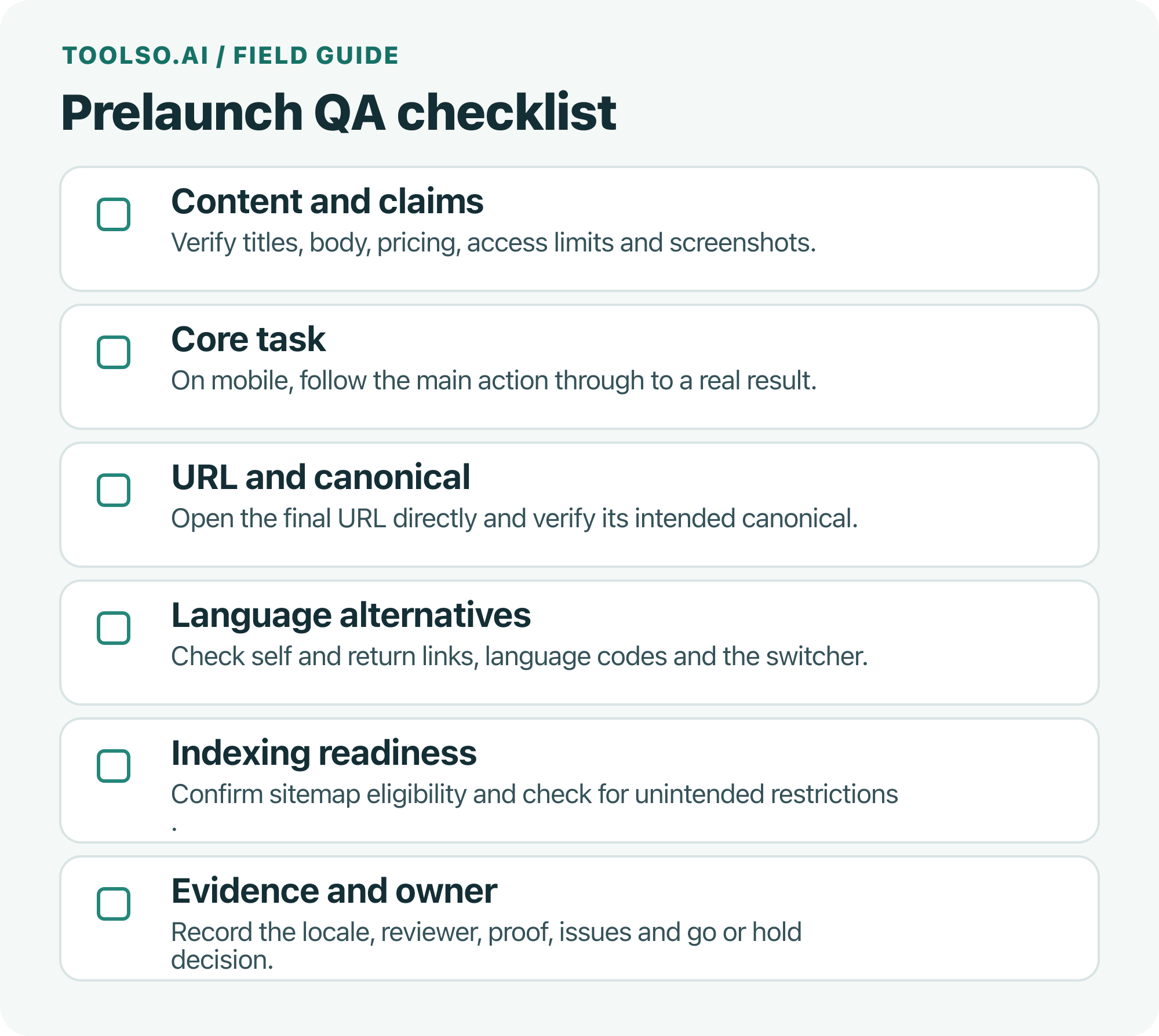
Before translating, collect the claims that can go wrong: what the tool accepts, what it produces, whether an account is required, what the free option covers, and where support is available. Link each claim to a product screen or a current source. Give the language reviewer permission to rework headings and examples, and ask the product owner to confirm anything that changes what a visitor can expect. A fluent sentence can still promise the wrong thing.
Have a reviewer open the candidate page on a phone and follow its main action with a safe example. Match the wording to the button the visitor actually sees. Check for clipped text, untranslated errors, screenshots in the wrong language, and examples that imply unsupported output. If a critical step requires a separate environment or permission, record it as untested and decide whether it blocks the locale.
Toolso's blog code checks for a nonblank title and body when building its list of available translations. That prevents an empty record from being counted as a finished page. It cannot judge whether a translation is useful or accurate. Keep the editorial decision with the reviewer, and exclude unfinished versions from the advertised language set. Where an existing route serves fallback content, check that the site handles that state intentionally instead of describing the fallback as a finished translation.
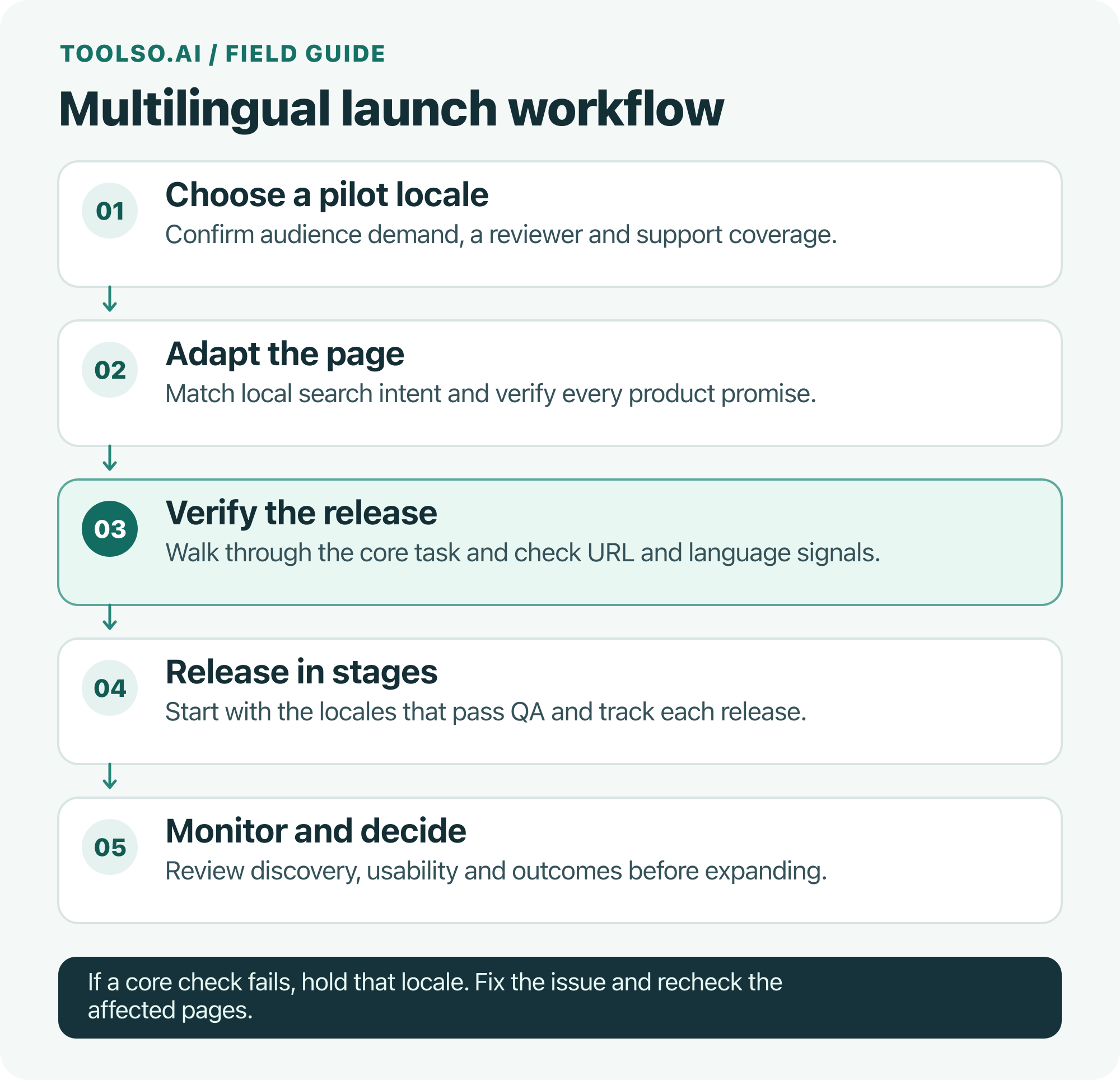
Create a release row for each locale: owner, final URL, reviewer, product task, intended indexing state, evidence, and open issues. Start with the smallest set that can complete the user journey. Before inviting traffic, open each final URL directly and through the language switch. Check the response status, page language, canonical, and alternate links. Confirm that the sitemap lists the intended versions, and inspect the final response for an unintended indexing restriction.
Copy this row for the team: Locale | Owner | Reviewer | Final URL | Task to complete | Intended index status | Evidence | Open issue | Go or hold. In the video tool example, “preview works, download untested” belongs in the evidence and issue columns. A preview screenshot cannot sign off on the download.
Use a concrete stop rule. If the main action leads to the wrong language or the page misstates what is free, hold that locale. If the content is correct but language links disagree, fix and recheck the affected pages together. A shared URL builder helps: Toolso uses the same path logic for canonicals, alternates, and sitemap URLs, with language availability supplied by the content. When one locale joins a group, test the older pages as well as the new one so their links point back.
Keep the first distribution small enough to respond to feedback. Use one relevant landing page per channel and verify that a tagged referral link still reaches the intended language. Our AI tool launch checklist covers the wider launch calendar; this release row adds the checks specific to each language.
Record the launch date and distinguish three questions. Can Google discover and index the page? Use URL Inspection to look at that URL and its selected canonical where available. Is the page attracting the intended searchers? Use Search Console's Performance report to compare landing pages, queries, and comparable date ranges. Can visitors finish the task? Use your own event records and feedback to look for repeated errors, abandoned steps, or completed actions.
When Toolso published its AI pricing report, we recorded which pages were live, which crawl requests were acknowledged, and what the index check showed in separate fields. An acknowledgement did not replace the observed index status. Google's recrawl guidance says a request does not guarantee inclusion. Keep traffic in a separate field too. Where the data is sparse, keep the result open rather than calling the rollout a success or failure. Review recurring issues before committing to another language.
The Toolso.AI page pair shows that a URL policy can be checked on real pages. It does not measure the effect of localization on rankings, sign-ups, or revenue. A search sample also cannot tell you how much demand you will find. Localization creates ongoing work: when pricing changes or a feature moves, someone has to update the promise and repeat the checks in each supported locale. Choose a narrower rollout if you cannot keep those pages accurate.
For the next release, pick one user task and give it a named reviewer, a stable URL, and a clear stop rule. If you are preparing a directory listing, bring the same evidence to the Toolso.AI tool submission page: the official product URL, a concrete use case, and any language or access limits a visitor should know.
No. Start with the locales whose key workflows you can review and support. Add others once you have a reliable process for fixing issues and keeping the published versions current.
No, when they are distinct, intended-to-be-indexed language versions. Verify each page's preferred URL and the reciprocal alternate links. Handle untranslated fallbacks and near-duplicate regional variants according to the content they actually serve.
No. Those actions can help Google discover or revisit a URL. Check the actual indexing status separately and keep the observed result dated.
Sources:
Last updated: November 4, 2026.

A practical six-stage launch guide for AI tool founders, with 30 copyable actions and clear records for owners, dependencies, evidence, and results.


A practical guide to evidence, ten checks, editorial scoring, commercial disclosure, and the limits of an AI tool assessment.
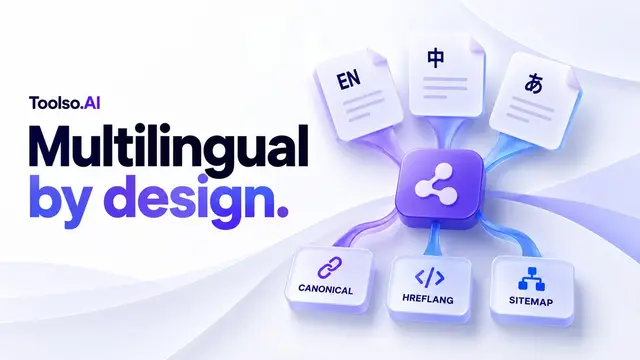
How Toolso structures multilingual URLs, canonical tags, hreflang, sitemaps, and translation fallbacks, with checks for directory builders.
How to produce AI video in 2026: picking a model per shot, prompting for motion, keyframe workflows, real cost math, artifact fixes and Sora migration.

The 2026 automation guide: how Zapier, Make and n8n differ on pricing model, AI agents and self-hosting — plus when a workspace agent beats all three.

Prompt engineering for 2026: why leaner prompts score 10–15% higher, what reasoning modes made obsolete, the five patterns that survived, and agent specs.

The 2026 playbook for coding with Claude: lean CLAUDE.md, plan-first workflows, subagents, parallel worktrees, hooks, and verification loops that work.

A working guide to Copilot in 2026: Agent Mode setup, auto-approve policy, agentic review, cost discipline, and the habits that make agents net-positive.
