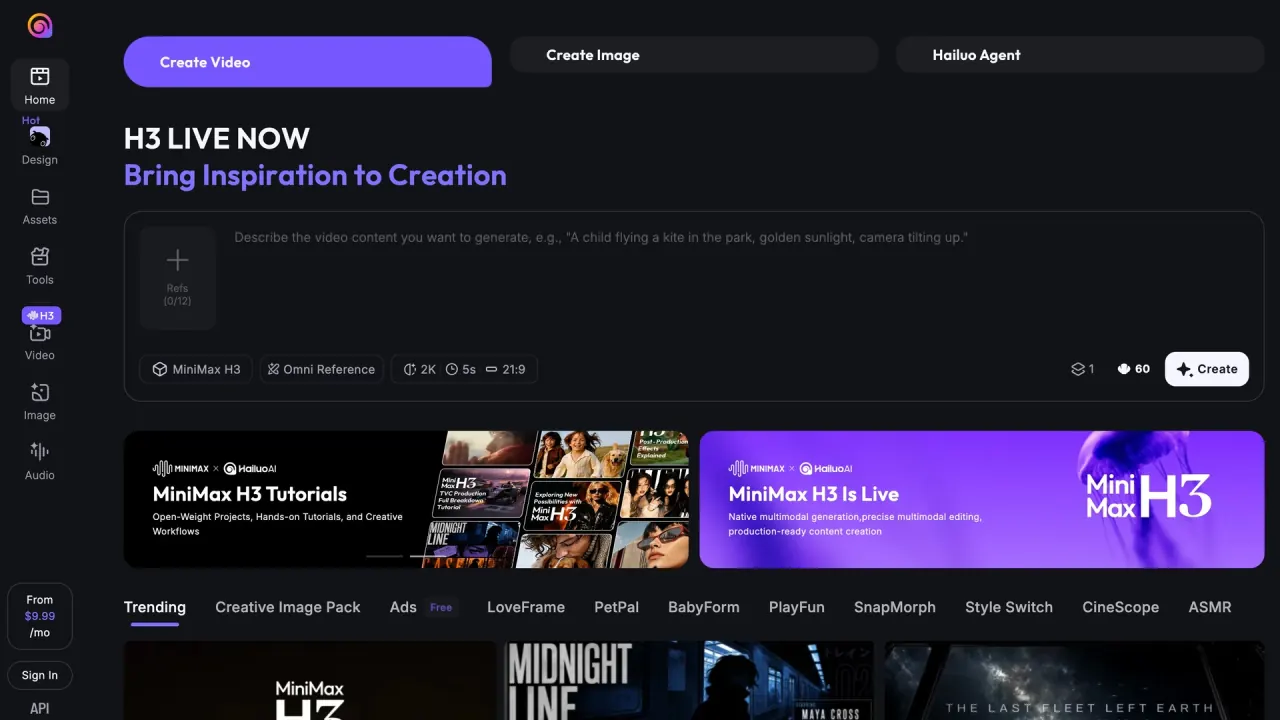

Hailuo AI is MiniMax's web editor for generating 5–15 second videos with native sound on the H3 model, animating photos with Hailuo 2.3 and creating images, paid for with credits.
Used this tool? Rate it
Used this tool? Rate it
Hailuo AI is MiniMax's browser-based AI video generator: it turns written prompts, still photos and mixed reference files into short video clips, and the same workspace also generates images and runs template effects aimed at social content.
The flagship model in the editor is MiniMax H3, a multimodal video model from MiniMax that is available directly in Hailuo AI; Hailuo 3 and H3 are other names for the same model. Earlier Hailuo 2.3 models remain available for text-to-video and image-to-video work, and the site also hosts a speed-tuned H3 variant.
The Terms of Service are a contract with Nanonoble Pte. Ltd., and they state that the Services are owned and operated by a Singapore company. On Android, the app is published under the developer name MiniMax AI, with Nanonoble Pte. Ltd. listed as the developer entity.
Access runs on credits: each model and output setting has its own cost, new accounts start with free credits, and paid plans add more.
Hailuo AI is a multi-model editor: render time, resolution and audio support depend on the model you pick in the editor.
The reference system is what separates H3 from prompt-only tools: images can set a character's appearance, a video clip a motion or camera move, and an audio clip a voice, all in one request. Because audio is generated with the picture, a finished clip already carries dialogue, ambience or music.
MiniMax H3 Max is described as a post-trained variant of the open-weight H3 model, tuned by fal for prompt adherence, aesthetics and audio-visual quality. fal reports that its stack can render a five-second 768p clip in under three seconds, though actual time varies with the request, queue and service conditions. Its output options are 480p or 768p, so the speed comes with lower resolution than standard H3.
A typical MiniMax H3 job in the Hailuo AI editor takes four steps:
Hailuo 2.3 works differently. You switch the creation mode to Start/End Frame and then choose Hailuo 2.3 or Hailuo 2.3-Fast; the entry 768p 6-second spec costs 25 credits and is pitched for fast, affordable iteration.
Text-to-video uses no reference files at all, so anything missing from the prompt is left to the model. The site's prompt guide splits a clip into six parts: subject, action, camera, setting, light and mood, and sound; on audio-capable models, naming the ambience generates it with the frames.
MiniMax positions H3 for filmmakers, advertisers, brand and e-commerce teams, game studios and social creators. The Android listing adds marketers who need quick video content and storytellers.
Hailuo AI is a reasonable fit for:
It is a weaker fit for:
Hailuo AI pricing is built on credits, and the cost of a clip depends on the model, resolution and duration you choose.
| Model and setting | Published cost | Conditions |
|---|---|---|
| Hailuo 2.3, 768p, 6 seconds | 25 credits | Exact availability and pricing can vary by plan |
| Hailuo 2.3, 768p, 10 seconds | 50 credits | Same plan caveat |
| Hailuo 2.3, 1080p, 6 seconds | 50 credits | Same plan caveat |
| MiniMax H3, 2K | About $0.073–$0.120 per second, or $0.37–$0.60 per 5-second clip | Vendor estimate; actual plan credits vary by mode |
The H3 figure is a vendor estimate in dollars, not a credit price; the vendor puts it 46%–67% below Seedance 2.5 at 720p.
Paid plans add credits. The site header advertises a starting monthly price, but plan names, per-plan prices, monthly credit allotments and billing terms were not displayed to signed-out visitors on the pages reviewed as of October 6, 2026.
Free entry points vary over time:
On mobile, the Android listing shows in-app purchases and says some advanced features need an optional subscription. In a public reply on that listing, the developer said memberships renew automatically with fees charged 2 days before expiry, and that cancelling means switching to the free plan, with benefits kept until the period ends.
Against both, Hailuo AI stands out for H3's single-request mix of image, video and audio references with native stereo sound; developers who want H3 itself can use the MiniMax API platform.
The commercial-use position is split across documents. The Terms say they permit use of the Services for personal, non-commercial use only. The text-to-video page says output is used commercially depending on your plan and usage rights. The H3 page defers to the Terms of Use. The Terms add that any business or commercial use of generated content is at your own risk, whether or not it is permitted.
Yes. Hailuo AI is MiniMax's video and image platform and runs MiniMax's H3 model. The website is operated by Nanonoble Pte. Ltd., the Singapore company named in the Terms, and the Android app is published as MiniMax AI.
You can start free with new-user credits and occasional promotions; apart from a starting-price label in the site header, paid plan details were not shown to signed-out visitors on the pages reviewed.
The documents differ: product pages tie commercial use to your plan, while the Terms speak of personal, non-commercial use and put any commercial use of outputs at your own risk.
MiniMax H3 produces 5 to 15 second clips; Hailuo 2.3 produces 6 or 10 second clips.
Android, yes, via Google Play. iOS availability is unconfirmed because the linked App Store listing returned no US record on October 6, 2026.
No refund terms appear in the Terms of Service or the other public pages reviewed. Memberships renew automatically, and cancelling means switching to the free plan at the end of the current period.
