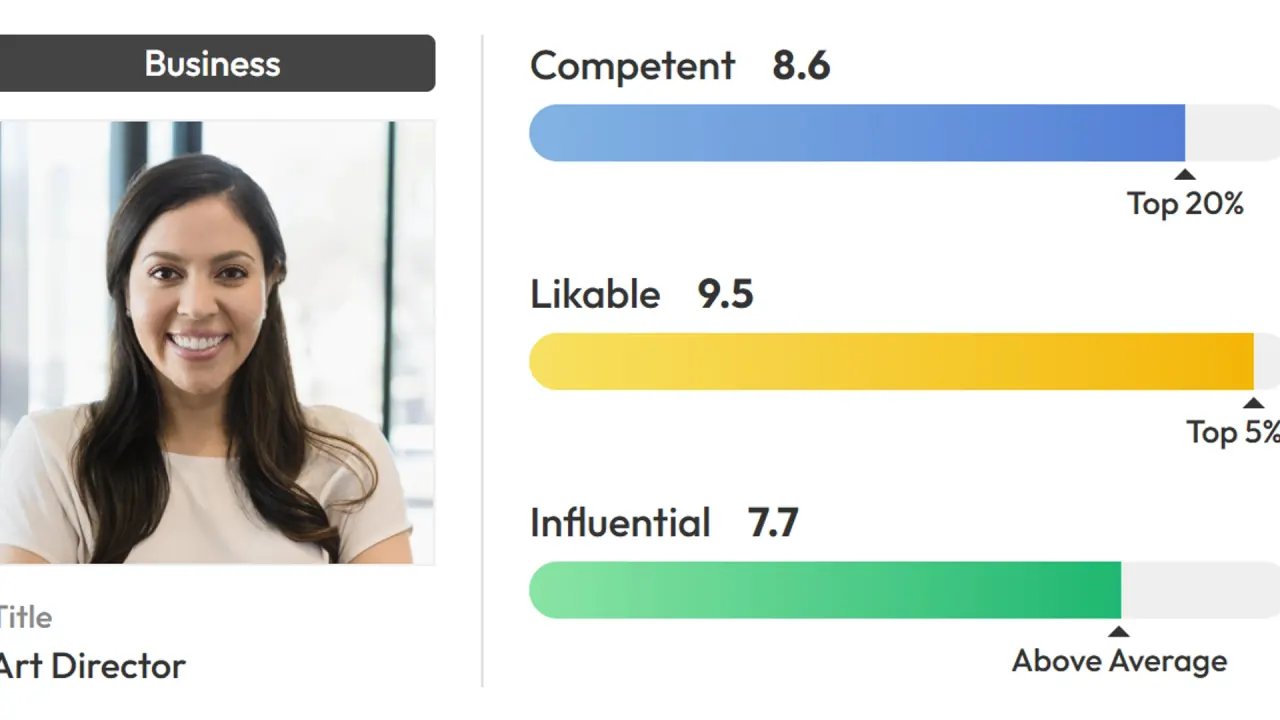

Photofeeler has other users score your dating, social, and business photos on three first-impression traits each, free when you vote on other people's photos or faster with paid credits.
Used this tool? Rate it
Used this tool? Rate it
Photofeeler is an online photo feedback tool for business, social, and dating profile pictures: you upload a photo, other people score it on key traits, and you get feedback to improve your online image.
The company describes the service as a personal team of friendly humans who give unbiased but respectful feedback from a safe, controlled environment. Photofeeler was founded in 2013, is based in Boulder, Colorado, and was co-founded by Ben Peterson and Ann Pierce.
Two points shape most decisions about it. The numbers are standardized first impressions from strangers, not a measurement of how attractive or competent you are. And testing is free if you vote on other people's photos, while paid credits buy speed and a guaranteed vote count. Scoring stays human-voted; the company's AI model was released as a separate product.
Each category is scored on the three traits Photofeeler says research ties most closely to first impressions, so a business headshot and a dating picture are judged on different criteria.
Besides scores, voters can attach Quick Notes, pre-written comments chosen on the voting page; Photofeeler says this option leads voters to leave 10x as many notes, and a repeated note means several different voters picked the same one. The company says every note is either prewritten or a moderated custom note so that users never receive hurtful comments, and it bans users for negative or demeaning behavior.
Photofeeler says it detects and filters bad votes in real time and that no one can vote on the same test twice, even if the test is paused and restarted a year later. Free tests are fuelled by your own voting: Karma comes in low, medium, or high levels, more Karma brings more votes on your Karma test, and Karma is used up as that test collects votes.
Photofeeler does not run "pick A or B" comparisons. It tests each photo on its own so it can flag cases where neither option is good, and because showing several photos together gives voters more information than a real first impression would. This is the main structural difference from ranking-style services.
The company developed an AI model, Photofeeler-D3, for the service but says it decided Photofeeler should stay human-based "forever and always" and released the model independently as PicScore. The company also says it will roll accuracy-boosting AI into human votes rather than replace them, and rates D3 as equivalent to 4-7 Photofeeler votes; the pages checked do not detail how AI is used in current vote processing.
A "Quality Rough" label means the test has too few votes to be statistically significant yet. Speed is not fixed: it depends on what is in the queue, which demographics are voting, how many tests have priority through credits, and the time of day or week, so votes can arrive faster or slower from hour to hour.
Photofeeler's case for asking strangers is that friends and family can be too biased to give objective opinions and are usually not your target audience. That makes it most relevant when the question is how an unfamiliar viewer reads a photo.
Likely fit
Poor fit
Testing is free at any time through the Karma Test, which works by voting on other people's photos to receive votes on yours. Credits are sold in four packs, from 40 credits for $9 up to 650 credits for $79.
| Option | Price | Votes on your photos |
|---|---|---|
| Karma Test | Free | Earned by voting on others |
| 40 credits | $9 | 40 |
| 100 credits | $19 | 100 |
| 250 credits | $39 | 250 |
| 650 credits | $79 | 650 |
One credit buys one vote, and credits can be split between tests, spent on new tests, or added to tests already running. Credits can only be purchased, not earned by voting; in return, credit tests get votes faster, receive a guaranteed number of votes, and can run several at once. Karma users, by contrast, can test only one photo at a time. The company says its revenue comes from credits bought on the platform and that it does not show ads. Purchases go through payment processors such as Stripe and PayPal, and Photofeeler says it stores no sensitive or credit information. The pages checked show no subscription plan.
Users who want feedback before posting a profile picture also compare Photofeeler with services built on different models:
The trade-off is in how a verdict is produced. Photofeeler judges each photo alone with trait scores against a standardized baseline and charges per vote; RankPic compares a small set head to head and lets you target voters; PicScore, which the company describes as the home of its D3 model, answers without waiting for voters but at a recurring monthly price.
Credits may expire on or beyond one year from the purchase date, though the company says it has never expired a credit and does not plan to. In the pricing, FAQ, help-center, and terms pages checked, no refund policy is stated.
On a third-party review platform, Photofeeler's unclaimed profile showed an average of 3.1 from 39 reviews as captured on October 5, 2026, with 26% five-star and 44% one-star ratings and only 2 reviews posted in the previous 12 months. Individual reviews in that sample point both ways: a June 2024 review says scores dropped 2-3 points across the board, reviews from February 2024 and August 2022 blame random or troll voting, and an October 2022 review says ratings matched the reviewer's own judgment. These are single accounts rather than a measured pattern, and most date from 2022 to 2024.
Yes, through the Karma Test: you vote on other people's photos and earn votes on your own, one photo at a time. Credit packs, starting at $9 for 40 votes, add speed, a guaranteed vote count, and parallel tests.
Other users see a photo while its test is running, and the FAQ says it becomes private once the test ends. The terms separately state that uploaded content can be viewed by the public, so the two pages are not fully consistent.
Scores come from human votes. The company says it kept Photofeeler human-based and released its Photofeeler-D3 model as PicScore, while also describing AI used to boost the accuracy of human votes.
They are standardized impressions with confidence intervals that narrow as votes accumulate, and tests with few votes are labeled rough. The company says scores describe the impression a photo makes, not facts about the person, and the terms give no accuracy warranty.
Yes. Tests can be stopped and deleted, photos removed from the + New Test screen, and the account closed through the account deletion page; profile info may be kept for up to 30 days after a deletion request.
The terms say credits may expire on or beyond one year from purchase, while the company says it has never expired one.
