
Toolso.AI
Toolso.AI
All ToolsCategoriesTrendingLatest ToolsPricingBlog
Toolso.AI
Toolso.AI
Toolso.AI
Toolso.AI

Discover the best AI tools to boost your productivity

GitHubGitHubTwitterX (Twitter)YouTubeYouTubeTikTokEmail

Popular Categories

  • AI Writing
  • AI Image
  • AI Video
  • AI Coding
  • More Categories

Explore

  • Latest Tools
  • Popular Tools
  • More Tools
  • Submit Tool
  • Pricing

About

  • About Us
  • Contact
  • Blog
  • Changelog

Legal

  • Cookie Policy
  • Privacy Policy
  • Terms of Service
  • Refund Policy
© 2026 Toolso.AI All Rights Reserved
Limited timeLimited-time offerFeatured Listing24h priority review · No backlink · 30 days featured$29.90then $59.90Price rises to $59.90 after Oct 31Ends in--:--:--Submit now
  1. Home
  2. All Tools
  3. Research
  4. Scite
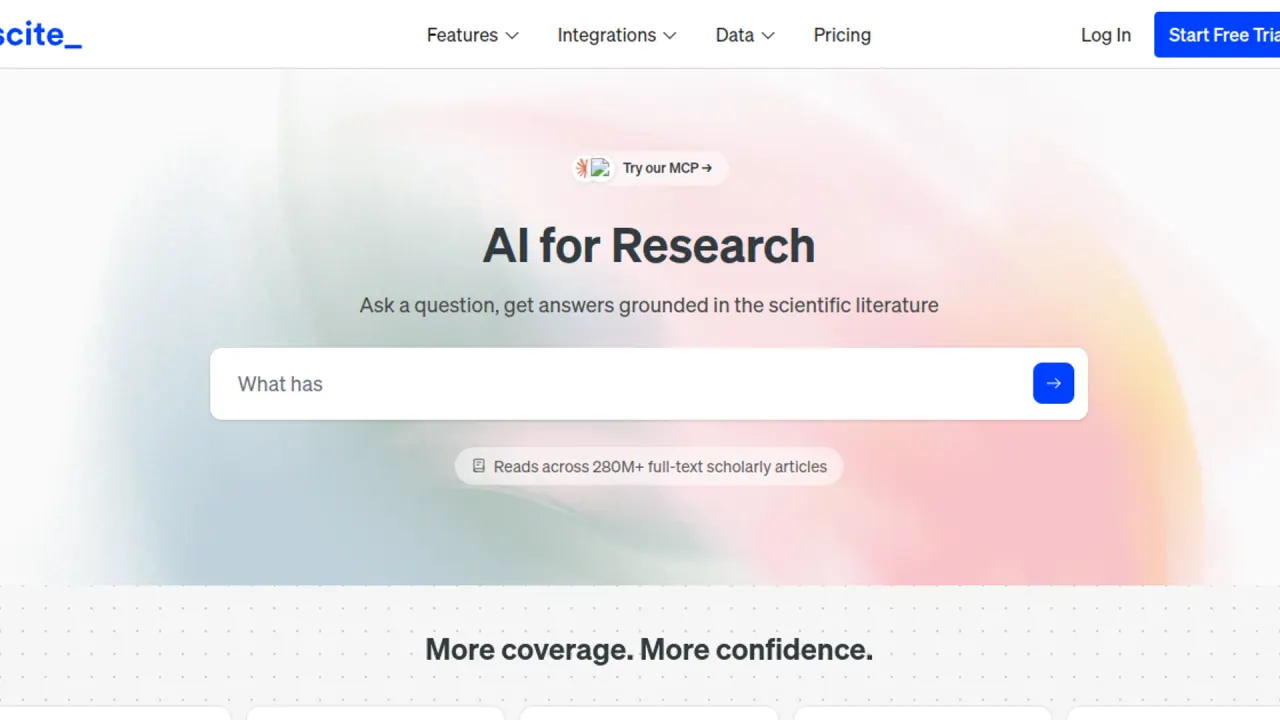
Scite interface preview
Scite logo

Scite

Scite pairs an AI research assistant with Smart Citations that label how later papers cite a study, helping students, researchers, editors and organizations judge evidence before citing it.

ResearchAI Assistant#Research Assistant#Api Available#Browser Extension
Start Free Trial
Saves
Visits
Views
Pricing
Free Trial
Published
Oct 6, 2026
Domain
scite.ai
Community rating

Used this tool? Rate it

Rate this tool

Scite Product Information

Start Free Trial
Tool Information
Saves
Visits
Views
Pricing
Free Trial
Published
Oct 6, 2026
Domain
scite.ai
Community rating

Used this tool? Rate it

Rate this tool

Featured Tools

Related Tools

Start Free Trial

What is Scite?

Scite is an AI-powered platform that helps researchers discover and evaluate scientific literature through Smart Citations, which show whether later studies support or contradict a claim. Instead of counting citations, it extracts the sentence where one paper cites another and labels that statement, then builds an assistant, a full-text search engine, citation reports, monitored collections and a manuscript checker on top of that layer.

Scite is now part of the Research Solutions family. Research Solutions, listed on Nasdaq as RSSS, announced the acquisition on November 27, 2023, and subscription questions now go to a Research Solutions support address.

Scale figures are vendor statements, and Scite's own pages do not agree with each other as captured on October 6, 2026. The features page lists 1.6B+ Smart Citations, 317M+ articles indexed, 49M+ full-text sources and 44+ publisher partners. The machine-readable site summary describes more than 315 million scholarly articles from more than 41 million full-text sources and more than 30 publisher partners, and a help-center coverage sheet cites over 1.9 billion unique citations.

Core features

Smart Citations

Scite's deep learning model classifies each citation statement as supporting, contrasting or mentioning, so a paper shows how it has been cited rather than only how often. Labels follow the rhetorical function of the citing sentence, not positive or negative sentiment: a supporting citation can read negatively and a contrasting one can read positively.

Wrong labels can be flagged by signed-in users. Flagged classifications are reviewed by at least two subject matter experts, and Scite says it aims to correct mis-classifications in less than 24 hours.

Scite Assistant

  • Grounded answers: Scite Assistant is an AI research assistant that answers questions from Scite's index; the company says every answer is drawn from peer-reviewed literature and linked to its source, unlike general-purpose AI tools.
  • Sentence-level links: Scite describes each claim the Assistant makes as linking back to the specific sentence in the specific paper it came from.
  • Table Mode: instead of the default plain-text survey, Table Mode lists citations relevant to the query with a summary from each article, and custom columns can drill into each result.
  • Document questions: a June 2026 university library evaluation reports that, from May 2026, users can upload a PDF or document directly to Assistant and ask questions against it.

Search and Reports

Scite Search matches citation statements extracted from the full text, not only titles, abstracts and keywords, so findings and methods that never appear in an abstract can surface. A Scite Report shows the exact text from each citing paper and can be filtered by classification, section, year or source type.

Collections and alerts

Collections can be created from Zotero, Mendeley, a CSV of DOIs or search results; they alert you to new supporting or contrasting citations and flag retractions. Saved searches can send an email whenever new publications or new citations to the results are detected.

Reference Check

Reference Check takes a manuscript PDF and shows how every reference has been cited by others, including whether any have been retracted, received editorial notices or accumulated contrasting findings.

Data beyond journal articles

The database extends to patents, clinical trials, grants, preprints and datasets, which lets a search follow an idea from a funded proposal to a published finding to a commercial application. Subject coverage spans biomedical and natural sciences, engineering, social sciences and arts & humanities from the 1600s to the present; metadata and references update daily, while full texts are processed daily to monthly depending on the source.

These tools share one evidence layer. Smart Citation signals label how a paper has been received, the Assistant uses those same signals to ground its answers in the wider literature, and Reference Check applies them to an entire bibliography at once.

Guide

Running a Reference Check

  1. Log into Scite AI.
  2. Open the Product tab and click Reference Check.
  3. Upload a PDF of your manuscript and wait for the report to finish generating.
  4. Review each reference for editorial notices, retractions and its supporting or contrasting tallies.
  5. Reopen past checks later from your Profile, under Reference Checks.

Using Scite inside ChatGPT through MCP

  1. Open Scite in ChatGPT and start the app.
  2. Sign in with your Scite account when ChatGPT prompts you to authenticate.
  3. Type @Scite in a prompt to activate the connector, for example "@Scite find papers on CRISPR gene editing".
  4. If Scite stops responding, open the ··· menu next to Scite and select "Reconnect", because ChatGPT may silently disconnect tools between sessions.

Scite use cases and examples

  • Term papers and coursework: a student can search titles, abstracts and other metadata, search inside papers through citation statements, or ask the Assistant simple questions to synthesize findings, then use Reports to judge which papers to cite.
  • Systematic reviews and meta-analyses: a vendor case study describes a company research lead using Scite for systematic literature reviews and network meta-analyses in fast-changing disease areas, including checking whether manuscript references carry editorial notices.
  • Finding experts: search results include an Authors tab that reveals the top authors in a result set, which helps when mapping an unfamiliar field or looking for advisors and reviewers.
  • Pre-submission checks: as a literature review tool Scite also works at the end of writing, since Reference Check is pitched at authors, editors and peer reviewers who want to evaluate citation quality before publishing.

Who is it for

  • Students: students use Scite to write papers, find references and analyze the quality of research; a discount is available when they recommend Scite to their institution.
  • Researchers and research teams: individual plans cover Assistant, Search, Reports and alerts, while Team adds shared Collections and usage analytics for a lab.
  • Universities, libraries and companies: Enterprise is aimed at universities, libraries, pharmaceutical companies, publishers and other organizations that need broad access, administration, data or integration support.
  • Publishers: the MCP architecture surfaces Smart Citations from a publisher's articles without giving AI tools full access to the content.
  • Developers: the API returns citation tallies, search results, Reference Check flags and Assistant answers as structured JSON.

Scite is a weaker fit for anyone who needs a complete map of a field from a single index, or who wants a citation label to stand in for reading the citing paper; both limits are covered below.

Platforms

  • Web app: Assistant, Search, Reports, Collections and Reference Check run in the browser at scite.ai.
  • AI assistants via MCP: Scite runs inside Claude, ChatGPT and any MCP-compatible assistant, and the setup page also covers Copilot.
  • API: endpoints include POST /assistant, GET /search, GET /tallies/{doi} for Smart Citation tallies and POST /reference-check.
  • Browser extension: a free extension adds citation badges on Google Scholar, PubMed and other sites and lets you right-click to ask the Assistant. The Chrome version showed 4.1 out of 5 from 40 ratings and 100,000 users as captured on October 6, 2026; a Firefox version is also published under the MIT License.
  • Zotero plugin: syncs a Zotero library with Scite to show Smart Citations without leaving the reference manager.
  • Institutional holdings: organizations can connect their holdings for full-text access through an enterprise integration.

Users covered by an organization license must sign up or log in at least once through the authentication method their organization provides, usually an institutional proxy or SSO; logging in with an institutional email is usually not enough.

Pricing

Prices below come from Scite's plan summary, last updated August 25, 2026, and are in US dollars.

PlanMonthly billingAnnual billingMCP allowanceAPI access
FreeFreeFree25 credits/monthNot included
Basic$20/month$144/year ($12/month)250 credits/monthNot included
Pro$50/month$480/year ($40/month)2,500 credits/monthIncluded
Team$50/seat/month$480/seat/year ($40/seat/month)2,500 credits/month/userIncluded for each user
EnterpriseCustomCustomFlexible pooled usageIncluded

Basic includes unlimited Assistant queries, Smart Citation Reports, citation alerts and the Claude and ChatGPT connectors. Collection size is the main step between individual plans: Basic holds up to 1,000 papers per collection and Pro up to 10,000, while Enterprise raises the cap to 50,000. Pro also adds patent, clinical trial and grant datasets, and the interactive pricing page currently advertises a $60 API credit with Pro for a limited time. Enterprise adds regulatory and safety datasets such as FAERS, MAUDE and FDA 510(k). Scite also offers bulk data, higher-volume API access and custom licensing, with availability and usage limits that depend on the plan and agreement.

Team pricing is presented two ways. The interactive pricing page shows $250/month including 8 seats, with $50 per month for each additional seat, while the plan summary says Team subscriptions can include up to 15 seats through self-service checkout.

Access without a subscription is also described inconsistently. An AI agent can make up to 10 requests through the Scite MCP without an account, after which a free account receives 25 MCP credits per month, but the MCP setup page states that Scite MCP requires a paid plan or free trial.

  • Trial: new users get a 7-day free trial and are automatically enrolled in the plan selected at the start; cancelling before the trial ends avoids charges. One help article still mentions a one-month free trial for new accounts.
  • Discounts: students and academics can request a discount code by recommending Scite to their institution and copying the support and sales addresses.
  • Institutions: universities and libraries buy organization-wide access through an Enterprise agreement priced on faculty, student and staff numbers, which may include volume-based discounts.
  • Cancelling: subscribers cancel from the Subscription section of their account using the Cancel Plan button.

Scite alternatives

A June 2026 university library evaluation compared Scite's 41.2 million full texts and 2.8 billion citations with Undermind, which covers 200 million articles, and Consensus, with over 220 million research papers. Those figures measure corpus size rather than citation context, which is where Scite's supporting, contrasting and mentioning labels differ.

The same evaluation frames a choice inside Scite itself. Connecting the MCP to an existing AI tool brings literature search and classified citation contexts into that tool, while the scite.ai platform adds systematic literature search, customizable dashboards, full citation reports and broader discovery tools.

Limitations

  • Independent accuracy evidence is mixed: an independent 2023 journal study tested citations from systematic reviews that cited retracted publications. Only 98 of 324 sampled citations were classified in Scite; Scite labeled 96 of them mentioning and 2 supporting, whereas the researchers judged 42 supporting, 39 mentioning and 17 contrasting, giving F-measures between 0.0 and 0.58. The result describes that 2023 sample, not a current benchmark.
  • Answers still need checking: Scite states that every answer is grounded in real papers, never generated or hallucinated, yet the June 2026 library evaluation found that the Assistant's fact-check list does not guarantee that retrieved papers are relevant to the question, and recorded an off-topic source cited as a synthesis.
  • Preprints are included by default: although Scite describes Assistant answers as drawn from peer-reviewed literature, the same evaluation found that Assistant includes preprints in its search by default; settings can filter publication types.
  • A label is not a replication: supporting and contrasting citations do not necessarily mean the same experiments were performed, and citations that merely reuse a method, reagent or software are not counted as supporting.
  • Coverage has gaps: a citation may be missing because the citing article has not been processed, because PDF extraction missed it, or because Scite has no indexing agreement with that publisher for closed content. Journals must be registered with Crossref or Datacite with functional DOIs and active ISSNs to be indexed.
  • Retractions may look clean: a retracted paper can show no contrasting citations, for example when the retraction notice does not cite the retracted article or no contrasting study exists.
  • Not exhaustive: the library evaluation cautions that the database does not provide exhaustive coverage of the scholarly literature.

Privacy and permissions

  • Model training: the privacy policy, effective March 26, 2026, states that Scite does not use Customer Data to train, fine-tune, retrain or otherwise improve large language models or other AI systems.
  • Advertising cookies: Scite does not sell personal information for money, but cookies shared with advertising networks can count as a sale under California law, so the site offers a "Do Not Sell or Share" opt-out and recognizes Global Privacy Control.
  • Retention: account-related personal information is kept for as long as the account exists and for 10 years after that.
  • Student records: when a US institution licenses Scite and designates its users as FERPA-covered, Scite acts as a "school official" under its written agreement with that institution.
  • Browser extension data: on the Chrome listing, the developer has disclosed that it will not collect or use your data.
  • Extension permissions: the Firefox version requires permission to access your data for all websites, with optional access to the Scite API domain.
  • Enterprise controls: Enterprise lists enhanced security and data confidentiality, SAML single sign-on and access by domain, IP address or email.

FAQ

Q1. Is there a free version of Scite?

A free account includes 25 MCP credits per month for use inside AI assistants. The full Assistant and Search start with Basic at $20/month, and individual plans can begin with a 7-day free trial.

Q2. Who owns Scite?

Scite is part of Research Solutions, a Nasdaq-listed company (RSSS) that announced the acquisition on November 27, 2023.

Q3. Does a supporting citation mean a study was replicated?

No. Supporting and contrasting labels describe what the citing sentence does, and they do not require that the same experiments were repeated.

Q4. Can I use Scite in ChatGPT or Claude?

Yes. The Scite MCP connects ChatGPT, Claude, Copilot and other MCP-compatible tools to Smart Citations and full-text literature; in ChatGPT you type @Scite to activate it.

Q5. Do students get a discount?

Yes. Students and academics can request a discount code by recommending Scite to their institution.

Know a Similar Tool?
If you know other great AI tools, feel free to submit them to us