
Toolso.AI
Toolso.AI
All ToolsCategoriesTrendingLatest ToolsPricingBlog
Toolso.AI
Toolso.AI
Toolso.AI
Toolso.AI

Discover the best AI tools to boost your productivity

GitHubGitHubTwitterX (Twitter)YouTubeYouTubeTikTokEmail

Popular Categories

  • AI Writing
  • AI Image
  • AI Video
  • AI Coding
  • More Categories

Explore

  • Latest Tools
  • Popular Tools
  • More Tools
  • Submit Tool
  • Pricing

About

  • About Us
  • Contact
  • Blog
  • Changelog

Legal

  • Cookie Policy
  • Privacy Policy
  • Terms of Service
  • Refund Policy
© 2026 Toolso.AI All Rights Reserved
Limited timeLimited-time offerFeatured Listing24h priority review · No backlink · 30 days featured$29.90then $59.90Price rises to $59.90 after Oct 31Ends in--:--:--Submit now
  1. Home
  2. All Tools
  3. Research
  4. Connected Papers
Connected Papers interface preview
Connected Papers logo

Connected Papers

Connected Papers turns one origin paper into a similarity graph of related research drawn from the Semantic Scholar corpus, helping researchers and students survey a field, trace prior and derivative works, and fill gaps in a thesis bibliography.

ResearchEducation#Visualization#research paper tool#academic research
Try for Free
Saves
Visits
Views
Pricing
Freemium
Published
Oct 6, 2026
Domain
connectedpapers.com
Community rating

Used this tool? Rate it

Rate this tool

Connected Papers Product Information

Try for Free
Tool Information
Saves
Visits
Views
Pricing
Freemium
Published
Oct 6, 2026
Domain
connectedpapers.com
Community rating

Used this tool? Rate it

Rate this tool

Featured Tools

Related Tools

Try for Free

What is Connected Papers?

Connected Papers is a web-based literature mapping tool: you give it one academic paper, and it draws a graph of related papers so a research area can be scanned at a glance. The company describes it as a visual tool that helps researchers and applied scientists find and explore papers relevant to their field of work.

The paper data comes from outside the company. Connected Papers says its database is connected to the Semantic Scholar Paper Corpus, which is licensed under ODC-BY. What a graph can show is therefore bounded by what that corpus contains.

The product started small. According to the company, four friends built it as a weekend side project to solve their own literature-search problems, and it grew to hundreds of thousands of users. An independent 2021 science-press feature dates the founding to 2019, when Eddie Smolyansky co-founded what it called one of a new generation of visual literature-mapping and recommendation tools.

Graph building is metered rather than paywalled by feature: every plan, including the free one, has the same features, and paid plans mainly lift the monthly graph limit.

Core features

Similarity graphs, not citation trees

  • Candidate pool: For each graph, Connected Papers analyzes on the order of 50,000 papers and keeps the few dozen with the strongest connections to the origin paper.
  • Similarity metric: The graph is explicitly not a citation tree; similarity is based on co-citation and bibliographic coupling, so papers that never cite each other can still be strongly connected and placed close together.
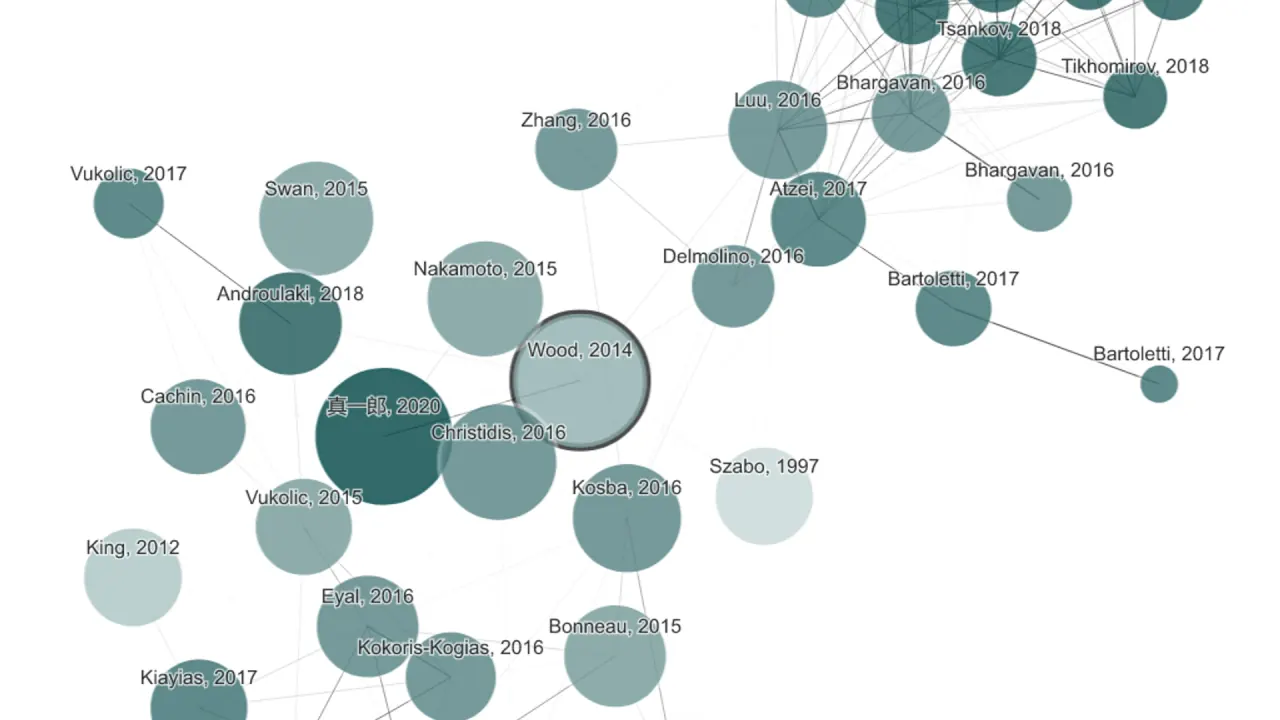
  • Layout: A force-directed layout clusters similar papers and pushes less similar ones apart, and selecting a node highlights its shortest path to the origin paper in similarity space.

The metric judges two papers as related when their citations and references overlap heavily, which the company presents as a sign that they likely treat related subject matter. The result is a neighborhood of similar work around one paper, not a map of who cited whom.

Prior and derivative works

The Prior Works view surfaces important ancestor works in the area of interest, while the Derivative Works view points to literature reviews of the field and recently published state-of-the-art papers that followed the input paper. Together they turn one graph into a short reading list in both directions of time.

Multi-origin graphs

Any paper in a graph can be added as a second origin from the right-side panel. Connected Papers then builds a new graph whose papers are selected by similarity to both origins, and a third or fourth origin can be added the same way. The company's July 2022 launch post said multi-origin graphs would be available on both Free and Premium plans.

List view and filters

Besides the graph itself, a graph page offers Prior works, Derivative works and List view tabs, plus filters for PDF availability, open access, code availability and publication year.

Saved papers and graph history

All plans include the similarity graphs, prior and derivative works, multi-origin graphs, saved papers and graph history. Saving needs an account: a logged-out visitor sees a "Log in to save" prompt in the paper panel.

Guide

To find related papers, the whole workflow hangs on one choice: the origin paper.

  1. Search for a starting paper. Search by keywords or a paper title, then pick the result that best represents your topic. A 2023 peer-reviewed librarianship article notes that Connected Papers suggests relevant papers from the search keywords, but the graph itself rests on the researcher's judgement in choosing the origin paper.
  2. Build the graph. Enter a typical paper and Connected Papers builds a graph of similar papers in that field; interesting papers found along the way can seed further graphs.
  3. Read the map. Each node is a paper related to the origin paper: node size shows its number of citations, node color shows its publishing year, and similar papers have strong connecting lines and cluster together.
  4. Change direction. Switch to Prior works for older foundations or Derivative works for later reviews and follow-up papers.
  5. Narrow the set. Add a second origin to tighten the focus, or open List view and apply the filters.
  6. Go to the paper. From the side panel, open a paper in Semantic Scholar, on its publisher page or in Google Scholar, and read the Semantic Scholar TL;DR summary shown there.

Use cases for Connected Papers

Each of the company's suggested uses depends on having a representative paper to start from.

  • Getting oriented in a new field: The pitch is a visual overview of an unfamiliar academic field; as more graphs are built from interesting papers, the user should gain a real, visual understanding of the trends, popular works and dynamics of the field.
  • Catching papers you might have missed: In fields such as machine learning, so many new papers are published that keeping track is hard; the company says users can simply search and visually discover important recent papers, with no need to keep lists.
  • Building a thesis bibliography: Start with the references that definitely belong in the bibliography and use Connected Papers to fill in the gaps and find the rest.

The thesis case is where the prior and derivative views help most directly, since a student can check both the foundations and the newer work around each key reference.

Who is it for

  • Researchers in many disciplines: The company addresses everyone from a machine learning researcher to a biology student or a philosopher, because the Semantic Scholar database it uses contains hundreds of millions of papers from all fields of science. That breadth is the vendor's description of the corpus, not a measure of depth in any single discipline.
  • Occasional users: An independent university library guide notes that because the free service only allows five graphs, it works more as a tool for a quick look at the scholarship around a specific research question. Students who want a literature review tool for a few targeted searches a month fit that pattern.
  • Academic and non-profit users versus commercial users: The Academic plan is meant for people at academic institutions or non-profit organizations and for personal use, while the Business plan covers individuals using Connected Papers in a commercial context or in relation to for-profit work.

It is less of a fit for people who mainly want new papers pushed to them automatically, since graphs are built by hand from chosen papers, and for staff of for-profit companies hoping to use the cheaper Academic plan, which the terms rule out.

Platforms

  • Web browser: Connected Papers runs on the web at connectedpapers.com. Its July 2022 update recalled that support for mobile browsers had been announced that April. The official pages checked describe no native desktop or mobile app.
  • arXiv: Connected Papers appears on the arXivLabs showcase as a collaboration, with the Connected Papers founders listed as collaborators.
  • Institutional access: The Academic Library plan is open to all students and staff and lists email, IP and SSO access options, with pricing by quote.

Pricing

Prices below are those displayed in USD with annual billing, as captured on October 6, 2026.

PlanPrice with annual billingGraphsIntended for
Free$05 per monthNot specified; all features included
Academic$6/month, billed $72 annuallyUnlimitedAcademics, non-profits and personal use
Business$20/month, billed $240 annuallyUnlimitedBusiness and industry
Academic Group$6 per seat per monthUnlimitedAcademics and non-profits
Business Group$20 per seat per monthUnlimitedBusiness and industry
Academic LibraryQuote on requestUnlimitedAll students and staff of an institution

The free tier includes all of the features, and the company says its five monthly graphs are enough for most users; researchers who need more than five graphs a month can upgrade.

Billing periods and renewal. Quarterly billing is also offered, but the quarterly prices were not displayed in the annual view captured. Under the terms, the initial subscription period is one year for annual plans and three months for quarterly plans, premium subscriptions renew automatically, and automatic renewal can be cancelled at any time from the account or subscription settings page.

Refunds. The terms allow no returns and no refunds, with the sole exception of double coverage: a user who bought an individual premium plan and then received premium access through a group or institution can be refunded for the overlapping period, minus processing fees of 10% of the initial order.

Payment. Payments are processed by PayPro Global, which hosts the checkout page; card statements show PayPro Global rather than Connected Papers, and Connected Papers does not store or manage credit card information. Supported methods include credit and debit cards, PayPal, Alipay and wire transfers, among others. Group buyers can also choose a Purchase Order at the PayPro Global checkout, which carries an additional manual processing fee.

Group seats. Group plans are run by administrator accounts that assign premium access to members according to purchased seats; administrators do not occupy a seat by default. Adding seats mid-cycle costs a prorated sum covering only the days left in the cycle. After a group subscription is cancelled, automatic charging stops at the end of the cycle, the paid seats stay active until then, and all group members then revert to the free plan.

Scholarships. For researchers who truly cannot afford a subscription, Connected Papers runs a scholarship program: a request sent to its scholarships address may lead to a discounted or free Premium plan, which the company says it will do its best to arrange.

Connected Papers alternatives

Literature-mapping tools overlap, but they differ in what they map and how new papers reach you.

  • Research Rabbit: An independent library guide places the two side by side: like Research Rabbit, Connected Papers presents information in a graphical format that shows connections between the citations in papers.
  • Litmaps: Litmaps describes itself as a research discovery tool that combines interactive citation maps, modern search tools and targeted updates.
  • arXiv Bibliographic Explorer: This arXivLabs project displays works that cite and are cited by arXiv papers and is built around navigating an article's citation tree, the opposite design choice to Connected Papers' similarity graph.
  • Trying them on arXiv: On arXiv abstract pages, a Connected Papers toggle sits among the bibliographic and citation tools next to Bibliographic Explorer, Litmaps and scite Smart Citations, so several mappers can be compared on the same paper.
  • E-mail alert services: A doctoral student quoted in the 2021 science-press feature found Connected Papers less automated than Google Scholar, which sends fresh papers by e-mail, although she could manually work out which articles were the newest.

The practical split is between similarity maps built from chosen origin papers, citation-tree navigation, and services that push new papers to you.

Limitations

Coverage and accuracy

  • Corpus bounds: Graphs only draw on the Semantic Scholar corpus. In 2021, independent science press reported that corpus at around 200 million articles including preprints, and co-founder Smolyansky acknowledged that Google Scholar will "very rarely" find "some niche 1970s paper" that Semantic Scholar does not.
  • No accuracy warranty: The terms state that Connected Papers does not warrant or make any representations concerning the accuracy, likely results, or reliability of the use of the materials on its website.

Account and licence rules

  • Academic means non-commercial: Under individual and group Academic subscriptions, the site may only be used for generally recognized academic and educational purposes and may not be exploited for profit or used by a for-profit company.
  • Audits: Connected Papers reserves the right to audit accounts for sharing between multiple users, underpaid fees or Academic accounts used commercially, and may temporarily or permanently remove premium status after a one-week notice.
  • One person per account: Individual premium accounts are personal, non-transferable and non-sublicensable.
  • No backup duty: Connected Papers is not obligated to back up user information; users are responsible for keeping their own copies of their content.
  • Changing terms: The terms may be revised at any time without notice, including the fees and charges for the premium subscription.
  • Jurisdiction: The terms are governed by the laws of the State of Israel, with exclusive jurisdiction in its courts.

Privacy and data

  • What is collected: Account creation collects a username, email address and password; papers added to the Saved Papers list are stored, and clicks and page views are gathered with third-party analytics tools.
  • Who processes it: Third-party vendors handle authentication, email communications, business analytics, data storage and data processing, which the policy says requires letting them analyze user data.
  • Where it is stored: The privacy policy says data is stored securely in Microsoft Azure.
  • Marketing: Connected Papers says it sends no marketing messages and does not share user details with third parties for marketing purposes.
  • Rights: The policy grants full rights under GDPR, listing access, rectification, erasure, restriction of processing, objection to processing and data portability.

FAQ

Q1. Is Connected Papers free to use?

Yes, with a cap. The free tier includes every feature but allows five graphs a month; the Academic and Business plans remove the limit.

Q2. Where does Connected Papers get its papers?

From the Semantic Scholar Paper Corpus, licensed under ODC-BY. Papers missing from that corpus cannot appear in a graph.

Q3. Is a Connected Papers graph a citation network?

No. Papers are arranged by similarity based on co-citation and bibliographic coupling, so two papers can sit close together without citing each other.

Q4. Can I get a refund on a Connected Papers subscription?

Generally not. The terms exclude refunds except for double coverage, where a 10% processing fee is deducted, and cancelling only stops future renewals.

Q5. Can I use an Academic plan at a company?

No. Academic subscriptions are limited to academic and educational purposes and may not be used by a for-profit company; commercial users need the Business plan.

Know a Similar Tool?
If you know other great AI tools, feel free to submit them to us