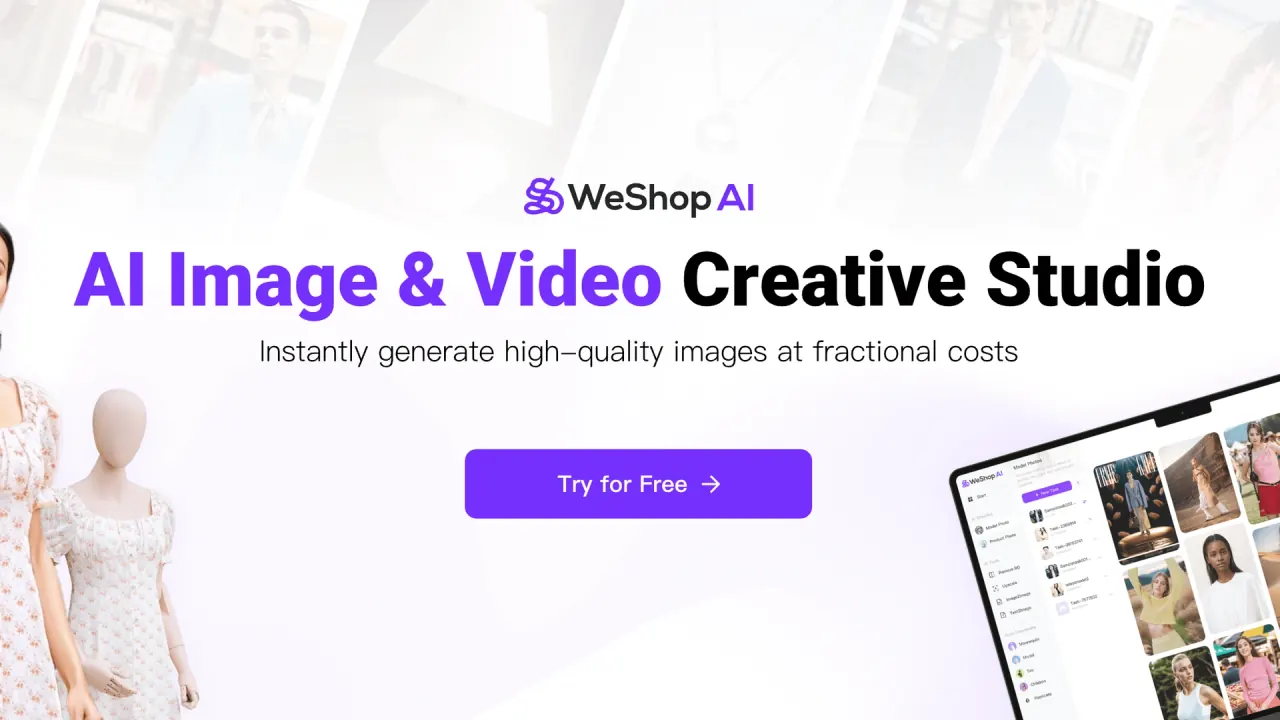

WeShop AI turns flatlay, mannequin and product photographs into on-model images, mannequin shots and short videos, metered per generation with a published per-tool point price for e-commerce catalogue work.
WeShop AI is a browser studio that turns apparel and product photographs into on-model images, mannequin shots, styled scenes and short videos, billed by the generation rather than the seat. What you buy is not one model's house style but a metered front end over engines several labs build, wrapped in apparel tooling those engines do not ship on their own.
The catalogue is organised as task-named agents in three groups. AI Image holds the commerce work — Virtual Try-On, AI Fashion Model, AI Product, Model To Mannequin, AI Pose Generator, an ecommerce outfit generator, a background remover, a hands and feet fixer, a magic eraser and a photo enhancer. Effects holds consumer-leaning novelties. AI Video holds a Video Agent, an image-to-video generator, a watermark remover and a video enhancer. You do not open a blank canvas; you pick the job and the interface narrows to its inputs.
Generation runs on named third-party engines rather than one in-house system: GPT Image 2.5, Nano Banana, Seedream 5.0 Pro, Qwen Image Edit, Midjourney, Z-Image, FireRed and Grok Imagine for images; Seedance, MiniMax, Kling, Sora 2, Wan, Hailuo, Vidu and Veo for video. Capability therefore moves when those labs ship, and cost per task moves with the engine you select, not with a flat plan fee.
The operator is WESHOP.COM LIMITED, registered in Hong Kong under certificate number 52642529-000-07-21-4, with terms in force since 20 June 2023. An independent technology-media profile places the business in the TechCrunch Disrupt 2025 Startup Battlefield cohort, based in China, with Lynn Lin as founder — self-submitted data rather than reported testing, and this round found no hands-on review in the technology press.
As an ai fashion model generator it diverges from general image generators, because each apparel tool assumes a specific starting photograph and commerce output.
AI Fashion Model starts from flatlay clothing images, mannequin shots and product-only apparel photographs, and lets you direct model style, background, lighting, pose and body type. That input list matters: it is built for sellers who own a garment and no photoshoot, not for users who own a portrait and want to redress it. Virtual Try-On covers the adjacent job of placing a garment onto a chosen model, and is the one apparel tool with two engine grades in its pricing.
Model To Mannequin runs the conversion in the direction most competitors do not: photographs of real models become mannequin-style product images, keeping garment texture, drape and fit while removing the person. That answers a problem sellers rarely see addressed — the shoot is paid for, likeness rights complicate reuse, and the garment needs showing without the model. It accepts up to nine uploads per session, with the API named as the route for larger catalogues.
AI Product, the platform's ai product photography surface, exposes a trade-off most such tools make silently, through three composition modes: Recommended, high accuracy and realistic, for product listings; Similar, balancing realism against variation; and Creative Adaptation, highly stylised, for advertising and campaign assets. A Fixed Location option repeats one scene across products, which is how a catalogue stays coherent.
Video Agent outputs 1:1, 9:16 and 16:9, accepts your own images, logos and audio, and does not expose transitions for editing — control over what happens in a shot, none over how shots join.
The rules reward a specific working order, because what you spend is consumed at click time, not satisfaction time.
The jobs that fit share a shape: you own the product, you lack the photography, and the ai model photos must survive sitting beside a real photograph on a page of e-commerce product images. A small apparel seller with flatlays and no shoot budget is the central case. A seller who commissioned a model shoot but cannot reuse the images freely has the reverse problem, and Model To Mannequin is the unusual answer — garment preserved, person removed. That alone grants no reuse right over the original photograph. A merchandising team refreshing a season uses Fixed Location to hold one scene while products change. A listing needing motion turns to the video side: Video Agent assembles short videos from supplied images and prompts through a storyboard step where scenes, shots and actions are set before generation.
Swimwear, bikini and lingerie categories are supported as commercial imagery, with safety filters applied and the platform stating that overly explicit prompts or results may be restricted or fail.
Who should look elsewhere is equally concrete. Anyone needing video at volume should price it first, because video sits in a different band from images. Anyone needing guaranteed turnaround should weigh that all users draw on a shared computing pool, and the platform states generation can take longer at peak. And anyone whose buying depends on undoing a purchase should read the cancellation terms first.
The service is browser-first: the platform recommends Chrome, Edge or Safari, and its login flow tells newly registered users to continue on a PC web browser.
| Surface | What it is | What to know |
|---|---|---|
| Web app | The full agent catalogue | Recommended on Chrome, Edge or Safari; positioned as the PC workspace |
| Shopify App Store listing | Merchant-facing distribution | Live since 29 November 2023 under the operator's own corporate name, filed under image editor, published in English |
| iOS app | Consumer-leaning companion | Listed as a face and background swap app under Photo & Video, 4+ age rating, advertising over 200 human models |
| Developer API | Programmatic access to the same agents | Addressed by agent name and version, authenticated by an API key in the request header, capped at five valid keys per package holder |
The surfaces are not one product in different shells, and buying one does not give you the other. The web catalogue is built around seller workflows; the mobile listing sells face and background swapping to consumers, at a different price, under an age rating that does not match the terms' own 18-plus requirement.
Everything is metered in computing power points against a published standard of roughly ten points per generated image, framed as buying compute rather than maintaining GPUs. Unusually, the per-agent price list is published rather than hidden behind a calculator.
| Plan | Monthly | Annual billing | Model access | Concurrency |
|---|---|---|---|---|
| Free | $0 | — | Selected models only, frequency limit | 1 concurrent job |
| Pro | $9.99 | 20% off | All models | 16 concurrent jobs |
| Ultra | $45 | 20% off | All models, high-priority queue | 48 concurrent jobs |
| Enterprise | $457 | 20% off | All models, full API access | 48 concurrent jobs |
Read the ladder by what changes across it: the paid tiers buy throughput and reach, not a different feature set. The free tier's ceiling is the clearest illustration of that design.
The per-task table is where budgeting happens, and its spread is enormous. Most apparel and effect tools sit at 10 points per image — AI Fashion Model, AI Product, background removal, mannequin conversion, the eraser, the hand and feet fixer — while Virtual Try-On is 10 or 20 depending on the Flash or Pro engine. Video is a different economy: Video Agent starts above 500 points and Kling 3.0 ranges from 120 to 900 per task. A plan that looks generous in images can be consumed in a handful of video jobs.
Three rules decide whether the budget behaves as expected. Points do not roll over: monthly plans issue them each cycle and they expire at its end, yearly plans grant them once for the subscription period, and cancelling leaves the plan live to the cycle's end, after which remaining points expire. Pay-as-you-go compute packs are restricted to Ultra and Enterprise, so Pro cannot top up mid-cycle and must upgrade. And the terms make all purchases non-refundable once bought, with used points neither refundable nor cancellable.
An independent software directory files the product under virtual try-on and lists it beside consumer try-on apps such as Doppl, Outfit Anyone and Kolors, plus seller-facing tools such as ProductToModel. The framing is informative: the market indexes it through one apparel feature while its paid tiers are built around catalogue throughput. If try-on is all you need, that list holds the narrower and often free options, and the concurrency you would pay for here goes unused. Where you subscribe also matters: the iOS listing sells a different bundle, a monthly in-app subscription of 3,000 points for $12.99.
What does not resolve from public sources is the comparison against dedicated AI fashion photography vendors: most ranking pages sit on the marketing domains of rivals appearing in their own rankings. Those are self-interested rankings, not independent tests, and this round found no neutral head-to-head comparison.
The most consequential rule before subscribing is that a disappointing result costs exactly as much as a perfect one. Points are charged for every task because compute is consumed whether or not output is usable, and returned automatically only on a system or server error. One of 43 merchant reviews averaging 4.5 stars reports a credit charged to redo a generation the reviewer attributes to a platform-side error; more frequent quality remarks there concern finger rendering and fit. Conversational agents extend this, deducting points for the exchange before any image is produced.
Entitlements also differ by channel. After a buyer reported that advertised Shopify integration was unavailable on a lifetime deal, the vendor publicly confirmed that Shopify binding is offered only through direct subscriptions — a difference invisible from the feature list.
Two documents govern this service and they do not describe the same world, which is why the rights question deserves more care than the marketing surface suggests.
The terms state that users retain full ownership of their contributions, and in the same clause grant the company an unrestricted, irrevocable, perpetual, worldwide, sublicensable licence to use, reproduce, sell, publish and make derivative works of them — expressly including image and voice — for any purpose, commercial and advertising included, with moral rights waived. Both are in force at once; ownership and licence are different things, and the second determines what can be done with what you upload. Users must also warrant written consent from every identifiable person appearing in an upload, which places likeness clearance squarely on you.
The privacy policy is written entirely around account and marketing data and never once addresses uploaded images, generated outputs or model training — the document binding the service says nothing about the material the service exists to process. It does cap retention of personal information at seventy-two months past account termination, and requires users to be at least 18 or have a parent or guardian consenting. Separately, the platform states that generated images are reachable only through the account that made them and that it does not share user creations with third parties — a help-centre statement rather than a policy commitment, which is a weaker instrument.
The operator is registered in Hong Kong, yet the terms are governed by Florida law, route disputes to binding arbitration in Collier, Florida, waive class actions, and bar any dispute begun more than one year after the cause of action arose — the practical shape of recourse for a buyer outside the United States.
Roughly ten computing power points, the published reference standard. Most apparel tools — AI Fashion Model, AI Product, mannequin conversion, background removal — are listed at 10; Virtual Try-On is 10 or 20 depending on the Flash or Pro engine.
Video is metered in a different band. Video Agent starts above 500 points and Kling 3.0 ranges from 120 to 900 per task, so a balance covering hundreds of listing images covers only a handful of video jobs.
Yes. Points are charged for each generation because compute is consumed regardless of whether output matches expectations, and are refunded automatically only on a system or server error.
The terms state that all purchases and subscriptions are non-refundable once bought, and used points are neither refundable nor cancellable. The free tier's 200 registration points are the intended evaluation path.
The terms say you retain full ownership of your contributions while also granting the company a perpetual, irrevocable, worldwide, sublicensable licence covering commercial and advertising use, expressly including your image and voice. You also warrant written consent from every identifiable person in an upload. That clause covers submitted contributions; the terms do not state who owns the AI output, so it is a licence over uploads, not an ownership guarantee.
A Shopify App Store listing has been live since 29 November 2023 under the operator's own corporate name, but entitlement depends on where you bought: the vendor has publicly confirmed that Shopify binding comes with direct subscriptions and was not included in its lifetime-deal offer.
